Thursday, April 12, 2012

Maserati GranCabrio Fendi, 2012

 
Maserati GranCabrio Fendi, 2012

The Maserati GranCabrio Fendi designed by Silvia Venturini Fendi was born from the union of two iconic brands of the made in Italy, which share common values such as craftsmanship and tradition.

A masterpiece of technology and craftsmanship, the Maserati GranCabrio Fendi will be introduced at the 2011 Frankfurt MotorShow.

The Maserati GranCabrio Fendi is crafted at the historical Maserati headquarters in Modena, with exclusive materials bespokely created in various colours for this project.

The three-layered body colour named Grigio Fiamma Fendi is a special dark grey with an iridescent golden finish on the surface. The wood trim Pergamena Fendi runs across the width of the dashboard, on the doors and on the top of the gear lever, all in the iconic FENDI yellow, like the brake callipers and the embroidered yellow trident on the headrests.

Adding a stronger yet elegant character to the GranCabrio is FENDI's unmistakable double F-logo, stitched on the seat, also appearing in the centre of the 19-inch Trident design alloy wheels, and the FENDI logo along the rocker panel.

Cuoio Romano, Fendi's most precious leather of its Selleria line, has been used for such details as the instrument cluster cover, for the gear lever and for the profiles of the floor mats. It also features in the Limited Edition Travel Set of luggage and accessories.

The Maserati GranCabrio Fendi represents a perfect marriage between the art of a handmade product with the ultimate technology and research of its 4.7-litre V8 engine coupled with automatic transmission, which brings out to life a unique roar, music to the ears of car connoisseurs.

Silvia Venturini Fendi's specially crafted logo seals this collaboration. A silver oval plaque with the engraving of the Maserati trident, Fendi logo and the 5-digit series number (five being an iconic number for Fendi) is located on the dashboard, in front of the passenger seat, and on both sides of the black cloth folding roof.

A special black car cover with a ton-sur-ton double F logo dresses the GranCabrio, hiding this marvellous secret from indiscreet eyes until the very last moment.
Read More

Maserati Quattroporte Sport GT S Awards Edition, 2011


Maserati Quattroporte Sport GT S Awards Edition, 2011

The Maserati Quattroporte Sport GT S Awards Edition, the latest jewel in the Maserati range, made its official debut at the 2010 Geneva Auto Show.

6 years after its birth, the car that created the luxury sport sedan segment continues to receive accolades from the general public, automobile enthusiasts and the press. Maserati has decided to celebrate its success with a superlative version, blending the elegance and sporty stylishness of the brand's flagship, thanks to the combination of highly refined details, handcrafted finishes and features with a decidedly sporty flair.

During its six years of life, the Maserati Quattroporte has received no less than fifty six awards from the most prestigious automotive and lifestyle publications in fourteen countries over in four continents: a global approval for a car that has known how to recreate itself over the years, never failing to maintain the appeal of the lines and purity of the forms created by the hand of Pininfarina, which defined it an instant classic.

The Maserati Quattroporte Sport GT S Awards Edition, based on the Quattroporte Sport GT S, aims to combine in one car all the features that have made the Trident flagship a benchmark for its segment:
  • the unique and elegant styling, mixed with a hint of sporting flair due to the eye-catching features adopted on both the exterior and interior fittings;
  • driving enjoyment, because the "Awards Edition" is based on the Quattroporte Sport GT S, which boasts dynamic and top-class performance;
  • the craftsmanship of the hand-finished details which make each car a unique product.

The new Quarzo fuso finishing - a pearlescent metallic grey with golden nuanced colour - exclusive to this model, makes the exterior immediately recognizable, and highlights the body's elegant lines. The burnished treatment used on the exterior chrome parts, as well as on the side air vents and radiator surround, also blends with the 20" Multi Trident dark grey rims with satin finish.

The brake system, which replicates the system fitted to the Quattroporte Sport GT S and uses dual-cast technology, is further enhanced by the hand-polished calipers both at the front and rear. With the Maserati Quattroporte Sport GT S Awards Edition, Maserati and Brembo are introducing on the market for the first time polished calipers, treated with precision mechanical processes and featuring a hand finish which gives them their special mirror-like appearance and enhances their sporty credentials at the same time.

The interior also bears witness to the combination of sporting flair and craftsmanship that has always characterized the Maserati flagship sedan. The Poltrona Frau leather of the seats is combined with perforated Alcantara with a new undulated pattern, and the headlining still in Alcantara. Completing the interior space are the special brushed aluminum door sills and Piano Black satin-finish wood moldings.

The boot with a full black trim has been embellished further with chrome details and a leather side pocket. The attention to details has even been extended to the mats, which are made of even richer and softer material.

A special exterior "Awards Edition" series plate completes the car's look and makes an already unique car even more unmistakable.
Read More

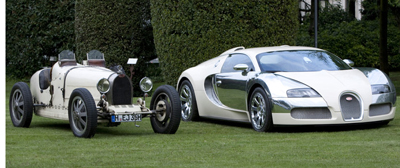
Bugatti Veyron Centenaire, 2009


Bugatti Veyron Centenaire, 2009

Bugatti Automobiles S.A.S. presented four Bugatti Veyron specials at Villa d'Este Concorso d'Eleganza. These one off models are reminders of Bugatti's glorious motor-racing history which played a central role in popularising and ultimately establishing the myth which the brand continues to enjoy to this day.

The Bugatti brand is almost inextricably linked to the Type 35. The Type 35 Grand Prix was by far the most successful racing model. The unmistakable radiator grille and eight-spoke aluminium wheels of the Type 35 have become defining features of the Bugatti automobile. In its day, the Grand Prix was also well ahead of its time in terms of engineering ingenuity. The front axle design of this vehicle, which, for reasons of weight minimisation, is hollow, is a true masterpiece of workmanship and was deemed nothing less than revolutionary. Its springs were passed through the axle to produce a high level of stability. The Grand Prix's brake drums were integrally fitted into its lightweight aluminium wheels. Unfastening the central wheel nut allowed the wheel to be easily removed within a matter of seconds and the brake to be exposed. This was a crucial advantage at the pit stop.

2000 wins in ten years
The blue racers made their first appearance on the race track at the Grand Prix held by Automobil Club de France in Lyon in 1924. In the decade that followed, they remained practically unchallenged thanks to sophisticated manufacturing efforts, their lightweight design and easy handling. During that ten-year era, they won almost 2000 races - more than any other model ever has. Grand Prix races were highly fashionable events in those days, and Bugatti was not the only brand with considerable interest in substantiating the reputation of its products by winning races. In fact, in the 1920s, Europe was regularly host to a number of different races in different countries on a single weekend. The teams set up by different automobile manufacturers competed at popular race circuits such as Targa Florio, Le Mans, Monza and Spa as well as in Rome, Nice, Antibes and even a village in Alsace.

The main reason Bugatti won such an enormous number of races - on the back of which successes the brand was also able to forge its image - was the fact that Bugatti sold not only its normal sports and touring cars to private buyers, but its racing cars too. Thus it was that its automobiles took part in such a large number of Grand Prix events.

The bestowed upon Ettore Bugatti a double success. He was able on the one hand to sell his racing cars expensively to wealthy private buyers with a keen sporting ambition and, on the other, to capitalise on their successes on international racing circuits - without actually having to make a single investment in these "marketing activities". This stroke of genius by "Le Patron" not only brought him immortal fame, but a substantial fortune as well. A total of 350 legendary Type 35-series automobiles were ultimately built - in a wide variety of versions. Those that survived their racing days, accidents, World War II and all other risks over the years, have become coveted and highly priced collectors' items.

4 Type 35 Grand Prix models - Four distinct personalities - Four Veyrons

Tradition being what it is, the Bugatti Veyron Specials built to mark the 100th anniversary of the brand feature the racing colours of the respective countries: blue for France, red for Italy, green for England and white for Germany. Each of the four new Veyrons has a specific "predecessor" in the form of an original Grand Prix Bugatti on which it was modelled. These four historic race cars represent the generation of legendary Bugatti Grand Prix racers which were piloted by world-famous race-car drivers and which scored countless racing victories in the 1920s and '30s. Each of the four Veyron Specials is named after a Bugatti race-car driver of the 1920s and 30s. Jean-Pierre Wimille has given the blue Veyron its name, Achille Varzi the red one, Malcolm Campbell the green one and Hermann zu Leiningen the white Veyron.

Jean-Pierre Wimille was one of the longest-serving drivers at Bugatti. He only joined the team in Molsheim in 1933, but subsequently remained loyal to the brand, ultimately driving home Bugatti's last-ever victory in 1947 at Bois de Boulogne in a 4.7-litre Monoposto Type 59/50 B. Wimille's many previous successes included winning the 24 Hours of Le Mans in 1937 and 1939. Achille Varzi was a member of the official Bugatti team from 1931 to 1933. He had already achieved many successes since 1928 driving a private Type 35 C, then later went on to win the Monaco Grand Prix, an event on Berlin's Avus circuit and other races. As the setter of numerous world records for speed, the name Malcolm Campbell is firmly established in racing history. He also competed in countless "normal" races from 1911 and 1936, often piloting a Bugatti Type 39 A or Type 35, and he owned one of the legendary Type 57 S street sports cars. Prinz Hermann zu Leiningen's career driving Bugattis began in 1927 when he purchased a Type 40 chassis, for which he had a racing body built. He went on to win a number or races in a privately owned Type 37 A before eventually standing in the spotlight of the international racing scene in a 35 C for several years from 1930 onward.
Read More

Mitsubishi ASX, 2011

 
 Mitsubishi ASX, 2011

The Mitsubishi Motors extends the concept one notch below (C-segment) with the introduction of a smaller and sportier sibling: the all-new Mitsubishi ASX compact crossover. Another "global car for the regions" from Mitsubishi Motors and therefore named and specified accordingly, Mitsubishi ASX was first launched in Japan in February 2010 (as "RVR"). After its European premiere at the 2010 Geneva Motor Show, it will be retailed in Europe end of spring 2010.

From Concept-cX to ASX reality
Sharing the same evocative "Kawasemi Blue" introduction color, the new Mitsubishi ASX represents a marketable interpretation of the Concept-cX show car, unveiled at the 2007 Frankfurt Motor Show, whose success convinced MMC's management to turn it into a full-fledged production car.

Longer by nearly 20 cm (4.295 m vs the concept's 4.11 m), slightly higher (+ 6.5cm) and wider (+ 2cm), and featuring a more upright tailgate all for the sake of optimum packaging, Mitsubishi ASX shares nonetheless Concept-cX's basic design theme as well as its passenger car-like sure-footed stance.

Suggested by the gaping "Jet Fighter" grille - a nod to Mitsubishi Heavy Industries, Ltd.'s F-2 jet fighter and now a trademark feature for nearly all Mitsubishi Motors on-road vehicles in Europe (Colt, Lancer and Outlander) - this car-like "attitude" was a key direction for Mitsubishi designers: unencumbered by any marketing pressure to simulate an SUV look through heavy detailing (no need to with Pajero/Montero/Shogun and L200 already in the range...), they further developed Concept-cX's own vocabulary towards a less polarizing yet sharp, expressive and finely executed "sports hatch" with proper presence & substance.

Retaining Concept-cX's "compact wedge" design concept with its thrusting side character line, they optimized the overall shape, making the best use of a 14.5 cm longer wheelbase (2.67 m vs. 2.525 m) to create a lower and more balanced silhouette with a better integration of the bulging wheel arches. Accordingly, the roof line now flows down toward the rear of the car to enhance aerodynamic performance (Cd: 0.32) and to further highlight its dynamic profile.

At the front, the Jet Fighter grille appears identical to Lancer's or Outlander's. However, it is now framed within a more substantial looking clip, itself merging with a sculptured bonnet featuring a double bulge: this serves the dual purpose of contributing to better pedestrian safety, short overhang notwithstanding, and also to make the body more visible to the driver, improving maneuverability around town.

At the rear, the purpose was both to lower and widen the silhouette, whilst avoiding any sort of chunkiness resulting from the short overhang, hence the sharp aerodynamic lip at the bottom of the backlight, the slim slanted combination lamps as well as the wide trapezoidal license plate recess running in between.

The dynamic quality
Inside, the concept of sharp, sporty elegance continues with a clear emphasis on form, trim and material rather than the usual endless pursuit of fantasized SUV-ness.

Consistent with the exterior, Mitsubishi ASX's cabin reflects a clear sense of "dynamic quality" as expressed through the hooded meter cluster shared with Outlander, the soft padding around the center instrument panel itself extending to the door trim or the carefully applied silver accents either side of the audio system or along the door panels.

At the same time, items such as the chromed round module circling the shift lever, the motorbike inspiration for both the silver accents either side of the console and for the meters.

Logically, the texturing and materials were chosen to achieve the same right touch and appearance. Although the interior color scheme is based on a black monotone, contrasting use of textures and materials was made to generate dynamism.

The same approach prevailed for the seat upholstery where Mitsubishi designers and their partners of the textile industry created a new embossed woven material to add to the overall sense of sporty dynamic quality, while adding visual 3D drama to the understated black interior.

Lancer + Outlander
The latest vehicle developed from MMC's "Project Global" mid-size platform, Mitsubishi ASX aims at blending Lancer's passenger car on-road attitude with Outlander's commanding driving position and convenience of its clever AWC electronically-controlled 4-Wheel Drive system.

Sharing Outlander's long wheelbase of 2.67 m, the 34.5cm shorter Mitsubishi ASX essentially carries over most of Outlander's lower structure as well as the basic architecture of its chassis (MacPherson front suspension, multi-link rear suspension) suitably tuned for this smaller and lighter vehicle.

A notable improvement is the introduction of an electric power steering mechanism to further lower emissions, also fitted with both tilt and telescopic adjustments, the latter being a first for Mitsubishi Motors' current range of vehicles.

Courtesy of the all-inclusive electronic architecture of its "Project Global" platform, Mitsubishi ASX offers the full palette of active & passive safety devices, including (availability according to model and market):
  •     * 160° Super-HiD "Wide Vision" xenon headlamps
  •     * Active Stability Control
  •     * Traction Control
  •     * Hill Start Assist system
  •     * ABS
  •     * Electronic Brake Distribution
  •     * Brake Assist
  •     * Emergency Stop signal System
  •     * 7 airbags (incl. driver knee airbag)
  •     * Low impact MIVEC Diesel

The latest contributor to MMC's green tech strategy, Mitsubishi ASX will also inaugurate an all-new family of all-aluminum DOHC 16v 4-cylinder Common rail Direct injection "low impact" Euro 5 Diesel engines, jointly developed by Mitsubishi Motors Corporation and Mitsubishi Heavy Industries, Ltd. (MHI), the latter providing - amongst others - engineering expertise gained through experience in industrial and marine Diesel engines, as well as in gas turbine technologies.

Initially offered in 1.8 liter form - first with Mitsubishi ASX and later on during the second half of 2010 in the related Lancer family - this "4N13" set of powerplants is a derivative of MMC's recent petrol engine and features innovative technologies, including a new variable geometry turbocharger as well as high-efficiency combustion characteristics that stem from the application of MMC's and MHI's own analytic technology.

Highlight of the technological showcase is Mitsubishi's proprietary MIVEC variable valve timing system: a world first for passenger car Diesel engines.

Of strategic importance in Europe against high profile competitors in a very competitive segment, the very smooth running 1,798 cc "4N13" Mitsubishi low impact Diesel MIVEC engine will be further supported in its environmental mission by the adoption - standard on all versions - of a full ClearTec low CO2 package:
  •     * "Automatic Stop & Go" system
  •     * Closed-flow Diesel particulate filter
  •     * Electric power steering
  •     * Generation Control System
  •     * LED rear lamps (for low consumption)
  •     * Low resistance tires

The Mitsubishi ASX will also be proposed with a new 1.6 liter DOHC 16v MIVEC engine: another in-house development, this time of Mitsubishi's own 1.5 liter engine as fitted to Colt. In this Mitsubishi ASX application, it will also be made available with the full ClearTec package and be offered with a 5-speed manual transmission.

Lounge style
Stylishly restrained, Mitsubishi ASX's interior is also a very pleasant place to lounge in, whether in its layout, its functionality or its features.

Making the best usage of its long 2.67 m wheelbase, the 5-seater Mitsubishi ASX brings a comprehensive set of utility features well suited to both its compact size and the likely loading needs of its potential customers in its 416 L at rear seat back angle at 17 degrees (forward position) (393L at rear seat back angle at 23 degrees) trunk:
    * Adjustable rear back rests
    * Rear armrest with:
          o ski slot
          o cup-holders
    * 60:40 split rear seat,
    * Easy-fold rear bench,
    * Under floor tray (approx. 30l),
    * Convenience hooks + lighting

The lounge feeling is first felt thanks to Mitsubishi ASX's panoramic glass roof: a first for Mitsubishi Motors, this wide UV-proof glass panel is equally enjoyable during day time (as a sun roof) as night time (as a moon roof), courtesy of the ambient "Moonlight" LED lighting that frames it. This panoramic glass roof comes standard with a power sunshade.

This is also tangible though a host of equipments, even from the entry model featuring standard items such as: radio CD w/MP3, AUX-in and 4 speakers, manual air conditioning, 7 airbags, Active Stability Control & Traction Control systems, etc

Further up the line, automatic air conditioning, rain & dusk sensors, cruise control, multi-function steering wheel, rear parking monitor, Bluetooth & USB connectivity, privacy glass, Super HiD "Wide Vision" xenon headlamps, keyless operation system, engine stop-start button, leather upholstery, Mitsubishi Multi-Communication System with HDD navigation system & music server, Rockford Fosgate Premium audio, etc are also available with Mitsubishi ASX.
Read More

Scion iQ Concept, 2009


Scion iQ Concept, 2009

The Scion iQ concept is a new urban vehicle with a revolutionary package that is just over 10 feet in length and accommodates three plus luggage. As more and more urban centers are revitalized with a new sense of purpose, energy, and creativity, young people are moving in from the suburbs to embrace new urbanism and are looking for a car that suits their needs and delivers high emotional value.

The Scion iQ concept is the intelligent answer to this need for highly emotional and efficient urban transportation. The convenience of having work, entertainment and culture nearby for young city-dwellers is a significant draw to urban centers. The vehicle must be able to navigate narrow, congested streets, park in tight places, have impressive fuel economy, and have compelling design and function.

The production Scion iQ is currently sold in Japan and Europe. Five Axis of Huntington Beach, Calif. took the Scion iQ to the next level with aggressive exterior and interior modifications that show the vehicle's potential for personalization.

With its 78.7-inch wheelbase, the three-door hatchback can deftly maneuver through city traffic. At the same time, its overall length of 126.9-inches, overall width of 71.4-inches, and short front and rear overhangs allow the Scion iQ to fit in virtually any city parking space. The front-mounted differential and repositioned steering rack decrease front end length. In addition, the Scion iQ is equipped with a flat gas tank housed beneath the floor that reduces rear overhang.

Pushing the wheels of the small, bold concept towards the four corners of the body gives the Scion iQ a confident stance. The custom 18-inch wheels with a nickel finish and wide tires fill the wheel well, adding to its surefootedness. The Scion iQ's custom front air dam, aero headlamps and high-intensity LED driving lamps signal urban road readiness.

The Scion iQ's profile is defined by a strong and high beltline. Smooth lines glide from the large, dark finish headlamps, up the A-pillar, across the roof and wrap around the rear emphasizing the concept's geometric beauty. Side mirrors with integrated turn signals accent the clean design.

The rear emphasizes the vehicle's modern style. Trapezoidal lines run toward the wheels, from the hatch to the thick rear diffuser, creating a substantial presence. A center-mounted trapezoid exhaust adds to the vehicle's distinctiveness, while large, matte-finished rear taillights help keep the vehicle visible.

The Scion iQ's interior fuses function, style and entertainment. Attention to detail and modern accents can be seen in the illuminated door handle; the swiveling spotlight that hovers over the dash; an illuminated Scion iQ logo on the passenger-side dash and nickel and raw aluminum toned interior panels. Iridescent green and gray honeycomb upholstery covering the door panels and seating areas, combined with the custom exterior paint, provides a balance of freshness and sophistication. Black matte scuba-like polyurethane covers the seat bolsters and is also used on the headliner with a bright green topstitch for a contemporary finish.

The Scion iQ features a 10-inch panel LCD screen on top of the center cluster that serves as the main entertainment console and navigation system interface. With the push of a button, the touch-screen articulates to reveal the entertainment hub. The touch screen can also play movies while the vehicle is parked. When not in use, the screen lays flat on the dash with a translucent cover that emits a colorful display of light patterns to make the interior even more unique.

A few quick strokes to the black panel below the entertainment hub, or steering wheel controls, command the audio system to shuffle through a music library. The center cluster also features three control knobs for dual front heating and air conditioning settings. The driver and front passenger each have a knob that displays their desired temperature and controls their temperature and fan settings. The center knob dictates zone control for both occupants.

The instrument panel has a speedometer, warning lamps, and a multi-information display. The multi-information display allows the driver to toggle through the odometer, average speed, temperature and eco lamp. The eco lamp illuminates during efficient driving to help the driver achieve maximum fuel economy.

Comfortable front passenger legroom was achieved with a newly-engineered, compact air conditioning unit located behind the center of the front console. The Scion iQ employs a glove bag, with the same textured, honeycomb fabric as the front and rear seats, that can be easily snapped on and off for storage or additional legroom.

Rear seating can accommodate one adult behind the front passenger and a child, small package, or pet behind the driver. Extra slim front seat backs provide rear passengers with legroom. The rear seats are 50/50 and fold flat for increased utility. In addition, the rear seat cushion lifts up to reveal a small flat storage space that can be used for pocket-sized portable music players, small books, digital cameras, or slim laptops.

The Scion iQ does not skimp on safety and is equipped with Vehicle Stability Control (VSC); an anti-lock brake system (ABS) with Electronic Brake force Distribution (EBD); Brake Assist (BA); and nine SRS airbags, which includes the world's first rear window curtain airbag. Other airbags include driver and front passenger front airbags; driver and front passenger seat-mounted side airbags; side curtain airbags; a driver knee airbag; and a front passenger seat cushion airbag.

POWERTRAIN
  •     * Engine: 1.3-liter, four-cylinder, VVT-i
  •     * Horsepower: 93 hp
  •     * Torque: 89 lb.-ft.
  •     * Drivetrain: Front wheel drive
DIMENSIONS (inches)
    * Overall Length: 126.9
    * Overall Width:
          o 71.4 without side mirrors
          o 79.3 including side mirrors
    * Overall Height:
          o 56.9 without antenna
          o 62.5 including antenna
    * Wheelbase: 78.7
    * Seating Capacity: 3+1

MODIFICATIONS
    * Exhaust: Five Axis custom stainless exhaust
    * Wheels: Five:AD S6:F custom wheels with nickel finish prototyped by MetalFX 18x8.5 ET03
    * Tires: Yokohama S.drive 2.5/40R18
    * Suspension: TEIN Super Street coilover suspension
    * Body:
          o Five Axis widebody conversion
          o Burnt nickel accents
          o Custom accented headlights and taillights
Read More

Wednesday, April 11, 2012

Kia Forte 5-door, 2011


 Kia Forte 5-door, 2011

The Kia Forte 5-door builds on the popular Forte compact sedan and bold Forte Koup by employing another practical yet modern iteration of the platform. Lower and firmly set on its haunches, Kia Forte 5-door carries with it all the amenities of the Forte line and introduces a new front grille, alloy wheels, lower valence design, center console, paddle shifters, push-button start and navigation in addition to the ostensible fifth door for a distinct appearance and intentional practicality. 

The Kia Forte 5-door is available with two efficient engines - 2.0-liter or 2.4-liter - and a new six-speed manual or automatic transmission.
Read More

Kia K2, 2012

 Kia K2, 2012

The Kia Motors and its Chinese joint venture partner, Dongfeng Yueda Kia, unveiled the Kia K2 B-segment sedan at the 2011 Shanghai Motor Show - heralding the all-new Kia Rio due to arrive in Europe in the late summer of 2011.

Based on the platform of the all-new Kia Rio, which made its world premiere at the 2011 Geneva Motor Show in March, the new Kia K2 was designed and engineered specifically for the Chinese market and will enter production at Dongfeng Yueda Kia's manufacturing facility in Jiangsu province starting this June. A 5-door hatchback of version of the Kia K2 will commence production in August of this year.

Kia K2  positioned as a premium small car with advanced styling and upgraded levels of quality and performance, and is expected to be a highly competitive offering in a segment that accounts for 16 per cent of all new car sales in China.

The Kia K2 represents the next phase in Kia's strategy to better satisfy customers in various regions of the world by developing and marketing products that reflect local tastes and needs. Following the introduction of the cee'd family of C-segment vehicles and Venga B-segment MPV, which were designed and engineered specifically for European customers, the new Kia K2 is a clear sign of Kia's commitment to become a leading automotive brand in China.

Speaking at the Kia press conference at the Shanghai Motor Show, Hyoung-Keun Lee, Vice Chairman of Kia Motors, said, "We are confident that this all-new model for China will provide the momentum needed for Kia not only to remain as one of China's fastest growing automotive brands but also to become a top 10 automaker in the local market in terms of quality and customer satisfaction."

While sharing the same technical underpinnings as the all-new Rio, the K2 has been completely redesigned for the Chinese market, drawing on styling cues from the popular K5 sedan (known as 'all-new Optima' in many markets), including sophisticated lines that create a dynamic, bold and sophisticated exterior appearance.

The front view features Kia's signature "tiger nose" radiator grille and exudes a high-tech and bold image thanks to the innovative fog lamp design, large air intake and dynamic swept back headlamps. A side character line, side air vent and trunk edge line add to the sporty image of the Kia K2 while the rear view features a two-tone bumper and modern combination lamps.

The driver-focused futuristic interior conveys a spacious and comfortable feeling and drivers will enjoy a 3-cylinder supervision instrument cluster, cloth lined door panels, leather steering wheel, engine start-stop button and smart key.

Measuring 4,370 mm (overall length) by 1,700 mm (overall width) by 1,460 mm (overall height), the Kia K2 is longer, wider and lower than the previous generation Rio and boasts the longest wheelbase (2,570 mm) in its class. The expanded dimensions allow Kia K2 to claim best-in-class interior space and ample luggage capacity of 500 litres (VDA). Space utilisation is further enhanced thanks to the 60:40 split rear seat.

Kia K2 will be available to Chinese customers in six trim levels with either a 1.4-litre or 1.6-litre Gamma petrol engine mated to a manual or automatic transmission.
Read More

Buick Verano, 2012


 Buick Verano, 2012

The all-new 2012 Buick Verano compact luxury sedan, the brand's third new model in the past two years and first in the compact luxury segment, makes its debut at the 2011 North American International Auto Show.

The Buick Verano goes on sale in the fourth quarter of 2011, the latest model in a product renaissance that began with the Enclave and continued with the LaCrosse and Regal. Like them, Buick Verano is distinguished by luxury and technology, including 10 standard air bags, an available heated steering wheel and a next-generation radio system with OnStar-powered connectivity that enables seamless communication between the Buick Verano and the driver's smart phone.

An Ecotec 2.4L and six-speed automatic powertrain combination is standard and delivers an estimated 177 horsepower (132 kW) and 170 lb.-ft. torque (230 Nm), 0-60 mph performance of 8.0 seconds and an estimated 31 mpg on the highway. A 2.0L turbo engine will be offered in the future.

5 elements infused in Buick Verano that define its character:
  •     Sculpted design - Refined styling with a sporty profile, blending Buick's signature cues - including a black chrome waterfall grille, blue translucent projector beam headlamps, portholes and chrome accents
  •     Luxurious interior - Premium seat comfort and support redefined for a compact sedan and matched with upscale, soft-touch materials and premium leather - all complemented by leading-edge infotainment and ambient lighting
  •     Quiet tuning - The quietest compact sedan on the road - quieter than many midsize and full-size cars - Buick Verano's quietness is supported by acoustical laminated glass, triple door seals, refined chassis dynamics and specially manufactured 17-inch standard forged alloy multi-spoke wheels, which minimize road noise
  •     Refined and responsive performance - Powerful and efficient Ecotec 2.4L/six-speed automatic powertrain matched with a refined, responsive suspension system, including a sophisticated Watts Z-link rear suspension and four-wheel disc brakes with standard anti-lock brakes, full-function traction control and StabiliTrak electronic stability control
  •     Purposeful technology - Convenience and safety features that enhance the driving experience and are rare for the segment, including 10 standard air bags, a next-generation radio, touch screen navigation and advanced connectivity technologies powered by OnStar.

Sculpted design
Buick Verano carries the modern Buick design cues introduced on the Enclave and interpreted for the LaCrosse and Regal. They include a bold, detailed black chrome waterfall grille, prominent blue translucent projector beam headlamps, portholes, chrome accents, premium wheels and a tailored body-to-wheel relationship. An arching roofline connects a steeply raked windshield and fast-sloping rear pillars to give the car a sporty profile that's complemented by large, 17-inch standard multi-spoke forged alloy sterling silver-finish wheels. Two premium 18-inch wheel designs are available.

Unique to Buick Verano are translucent blue projector-beam headlamps, which give the car a distinctive, upscale appearance. A palette of rich colors enhances the premium look, including Claret Red Tintcoat and White Diamond Tricoat. Other exterior color choices include Black, Olympic White, Switchblade Silver Metallic, Cyber Gray Metallic and Mocha Bronze Metallic.

Luxurious interior
Complementing Buick Verano's precisely crafted, premium-accented exterior is an interior marked by exceptional seat comfort and support, as well as premium soft-touch materials, including ambient lighting inspired by the LaCrosse. Metallic and wood trims and warm ambient lighting make the cabin an inviting environment.

Neutral and medium titanium colors are offered on interiors with leatherette/fabric seating surfaces, while ebony, cashmere and a unique Choccachino color are offered on the available leather-trimmed interiors. Buick Verano uses the same premium leather material for the seats that is used on the LaCrosse.

The instrument panel blends with an integrated center stack that houses the infotainment display, climate controls and radio controls. Flush-mounted components within the center stack have a gap tolerance of less than 1 mm, while the instrument panel-to-door panel gaps are less than 5 mm. Those tolerances are among the best in class.

Additional interior standard and available features:
  •     Push-button engine start
  •     Dual-zone climate control with standard air conditioning (automatic climate control available)
  •     Heated steering wheel
  •     Heated leather-appointed seating
  •     Electronic parking brake
  •     Console armrest that slides and locks
  •     Power windows with express up/down in the front and express down in the rear
  •     Steering wheel radio controls
  •     Uplevel front and rear reading lamps.

The Buick Verano's heated steering wheel and heated seats are linked with the remote start feature. In temperatures lower than 45 F (7 C), the steering wheel heater and seat heaters automatically activate.

The quiet tuning
Buick Verano delivers the library-quiet driving experience for which Buicks have become known. Quiet-tuning systems, processes and components are built into every facet of the vehicle's architecture. All are designed to block or absorb sound and dampen or eliminate vibrations.

Hydraulic ride bushings, for example, and an isolated engine cradle reduce or eliminate vibration pathways that could be transmitted to the passenger compartment. Similarly, a number of noise-reducing and noise-cancelling technologies are employed throughout the body structure:
  •     The steel front-of-dash panel is sandwiched between two damping mats
  •     Nylon baffles are used in various hollow portions of the body structure and filled with sound-absorbing foam that expands when the body enters the paint oven
  •     The headliner comprises five layers of thermal fiber acoustic material, including a premium woven fabric on the visible outer layer
  •     Patches of sound-damping material are applied strategically throughout the body structure and melt into place when the body passes through the paint oven, allowing the patches to follow the contours of the sheet metal below
  •     Sound insulation material between rear-body structural components that is made from recycled denim
  •     Triple-sealed doors that feature fiberglass "blankets" serve as water, airflow and noise barriers. The doors are also beta-braced, meaning they close with a solid, precise sound and no resonance
  •     Optimized windshield and side glass for quietness, with 5.4-mm-thick laminated windshield and 4.85-mm laminated side glass
  •     The engine's intake and exhaust systems are tuned for quiet performance
  •     Isolated brake and fuel lines prevent vibrations.

Even the wheels and tires contribute to Buick Verano's quietness. The standard 17-inch aluminum wheels are manufactured in a unique way to enhance quietness, while the tires minimize road noise.

Refined and responsive performance
A power-dense Ecotec 2.4L four-cylinder, with dual-overhead camshafts, variable valve timing and E85 capability, is the standard engine in the Buick Verano. It produces an estimated 177 horsepower (132 kW) and 170 lb.-ft. of torque (230 Nm). Direct injection technology helps it produce more power with less fuel and lower emissions - including up to 25-percent reduced hydrocarbon emissions when compared with a multi-point fuel injection engine. The engine is matched with a six-speed automatic transmission that helps the Buick Verano deliver an estimated 31 mpg on the highway. Electric power steering and a more efficient transmission design help optimize fuel economy.

The front suspension uses decoupled MacPherson struts for better isolation, providing greater separation of extreme road conditions - large potholes, for example - from everyday driving conditions. At the rear, a technically advanced Watts Z-link design helps center the rear axle during cornering, which helps keep the Buick Verano's handling responses symmetrical on both left-hand and right-hand turns. The linkage's capability to center the axle during cornering delivers a more-balanced driving experience because the rear suspension better follows the lead of the front suspension.

The Z-link design is also lighter and requires less space than a typical fully independent rear suspension. The lower weight contributes to Buick Verano's fuel economy, while the compact design enables more trunk space.

Steering inputs are executed by an electric power steering system, featuring a dual-pinion rack. Electric powering steering helps save fuel because it removes the conventional power steering pump from the engine's driven accessories. Engineers tuned the speed-sensitive system to provide quick, direct reaction to steering actions and a strong on-center feel. The system has a ratio of 15.5:1 and requires only slightly more than two turns, lock to lock.

Stopping power is handled by a four-wheel disc brake system with standard anti-lock and electronic brake force distribution, as well as StabiliTrak electronic stability control with traction control.

Purposeful technology
Comprehensive connectivity is enabled by OnStar's remote vehicle access, which makes keeping tabs on the vehicle a breeze from anywhere with a smart phone. Highlights:
  •     Passive entry
  •     Heated steering wheel
  •     Touch screen navigation system
  •     Bluetooth connectivity (both phone and audio)
  •     XM Satellite Radio
  •     Bose sound system
  •     Next-generation radio.

Downloading an OnStar app enables the use of remote vehicle features from anywhere in the world. With a few taps, customers can check the:
  •     Fuel tank level and range
  •     Fuel mileage
  •     Remaining oil life
  •     Tire pressure
  •     Odometer reading.

The other remote-access features include remote vehicle locking/unlocking, remote vehicle start and a vehicle locator.

The next-generation radio system includes a navigation system, along with USB and auxiliary input jacks, and includes full Bluetooth with streaming audio, structural speech recognition, SMS texts and more. Additional connectivity features include text-to-speech conversion of SMS texts, smart phone app integration (Pandora, Stitcher, etc.) and Gracenote music organization for external devices (USB drives, etc.), including Playlist Plus and Album Art features.

Safety is another component in Buick Verano's technology story. Primary features:
  •     Ten standard air bags, including frontal, head curtain side air bags, front and outboard rear-seat side-impact air bags and new knee air bags. The head-curtain side air bags deploy in a rollover crash
  •     StabiliTrak electronic stability control, traction control and anti-lock brakes
  •     Collapsible pedal system, which allows the pedals to detach during a crash to reduce the risk of leg or ankle injuries
  •     OnStar with Automatic Crash Response.

The Buick Verano has a strong, unitized body structure that incorporates 60-percent high-strength steel in key areas to enhance strength and crash protection. It is used to help prevent intrusion into the passenger compartment. Safety development included testing at GM's rollover test facility.
Read More

Tuesday, April 10, 2012

Volkswagen Buggy Up Concept, 2011


Volkswagen Buggy Up Concept, 2011

A buggy is more than just a car; it is an automotive lifestyle feeling. It was born in California in the 1960s and was based on the Beetle, which provided the engine and the chassis. The rest was created by buggy pioneers such as American Bruce Meyers: out of GRP, or glass-reinforced plastics. Buggies have had a cult following that continues to today. That is reason enough for Volkswagen to now present a 21st century buggy concept based on the new up!: the buggy up!. This buggy is not made of GRP, but instead of strong, high-tech, lightweight construction steels. Yet, the conceptual approach for developing the two-seater, as original as it is, still follows the lead of historic models from California.

Openness. The (reinforced) underbody, running gear and drive technology of the up! were kept, while the roof-less exterior skin of the body was completely redesigned, and the ride height was lowered by 20 mm. Nonetheless, the design of the buggy up! with its headlights, the position of the VW badge - and signature trait of the front bumper that appears to smile - all tie the car to the two-door up!. Yet, everything is different: the bonnet is built much flatter, the bumpers show an independent character, the roof is not just clipped off, rather it takes its idea from small convertible sports cars. The rear section was also completely redesigned. This is logical, because the buggy up! does not have a boot like the "normal" up!, nor does it have any C-pillars. However, it is immediately recognisable as an up! by its rear lights, which are like a reflection of the headlights. Practical: the bootlid is constructed of two pieces; the main part of the lid lifts upward like a classic bootlid, but the section above the bumper folds down, like the tailgate on a pick-up. And this makes it extremely easy to stow even heavy and bulky items. On top of the lid, there are also tie-down straps for a set of luggage.

Safe
The designers also made this up! a purebred buggy in its side profile. Of course, it has no doors, but in their place it has extensive body reinforcements and a sturdy roll bar behind the two seats. Especially cool: the open side sills. This makes the experience of open-air driving even more exciting than in a conventional convertible.

Snappy
At 3,584 mm, the buggy up! is somewhat longer than the production up! with a hard top (+44 mm), and its width of 1,672 mm is somewhat wider (+31 mm). As might be expected, the height of the buggy up! comes in significantly lower at 1,288 mm (-190 mm). The minimalistic overhangs, front and rear, show sharp styling. Filling the wheel housings are 18-inch alloy wheels - enormous for a vehicle of this size - which have 205/40 tyres.

Colourful
The area above the bumper and the open side sills are in the colour "hot orange", which was specially created for this vehicle; those who think back to the buggies of the 1960s when they hear this colour name are right on track. The bumpers and side sills are designed in a matt and rugged "metallic grey" colour. The same colour schemes dominate in the interior.

Waterproof
As is proper for a beach vehicle, the new interior styling is completely waterproof. Drains in the vehicle floor and the open side sills prevent flooding. Even the neoprene coated shell seats have water drains, so that no water accumulates in the vehicle after a swim in the ocean. If it should rain for a longer period of time, it is possible to stretch a sail between the window frames and the roll bar.

Sound
The controls for the infotainment system also sport a waterproof design. Among its features, the system has an iPod/iPhone dock. The entire module can be removed - including the integrated active loudspeakers - so that it can be used as a sound system for parties on the beach.

Go-kart
Compared to the two-door up! the buggy up! has a lower seat position - in keeping with the lower vehicle height. The specially designed seats were lowered by 58 mm compared to the production model. To ensure that everything makes ergonomic sense for the driver, engineers reduced the basic angle of the height-adjustable steering wheel by 4 degrees to an angle of 21 degrees. The result is a go-kart feeling. A sturdy handle is installed on the dash panel for the front passenger - just as it once was in the Beetle - because one never knows what lies over the next dune. In essence, the buggy up! is pure emotion, but it is easy to drive and very safe. A car that would not only be good to drive in California. One thing should be made up!solutely clear at this point: the New Small Family is just beginning to grow.
Read More