Showing posts with label Audi. Show all posts

Thursday, December 26, 2013

Audi RS Q3, 2014


  •  Audi RS Q3, 2014

Audi is presenting the RS Q3 at the 2013 Geneva International Motor Show, the first RS model for the successful Q line-up. It combines outstanding everyday practicality with dynamic driving performance: It takes just 5.5 seconds to complete the sprint from 0 to 100 km/h (62.14 mph), and its top speed is electronically governed to 250 km/h (155.34 mph). The 2.5-liter five-cylinder turbo produces 228 kW (310 hp) and has an average fuel consumption of just 8.8 liters of fuel per 100 km (26.73 US mpg).

An award-winning high-performance engine, the 2.5 TFSI, is at work under the hood of the Audi RS Q3. This five-cylinder engine has been named "International Engine of the Year" in its class for three consecutive years since 2010 by an international jury of automotive specialists. From 2,480 cc of engine displacement, the turbocharged direct-injection engine produces a maximum power of 228 kW (310 hp) at 5,200-6,700 rpm; its maximum torque of 420 Nm (309.78 lb-ft) is available between 1,500 and 5,200 rpm. These two values signify that the RS Q3 is unrivaled in its competitive field. This five-cylinder is a special engine, beginning with its fundamental concept. It is familiar from the TT RS and RS3 Sportback, and quattro GmbH modified it for use in the RS Q3.

The 1-2-4-5-3 ignition sequence, supported by the geometry of the air induction and exhaust systems, generates a sporty engine sound that first made Audi popular back in the 1980s.

Drivers can influence the flap control for the exhaust system and the accelerator characteristic by choosing one of the modes auto, comfort and dynamic using the standard Audi drive select system. In the dynamic mode, engine response is sharper and the engine sound more intensive.

The 2.5 TFSI accelerates the Audi RS Q3 from a standstill to 100 km/h (62.14 mph) in just 5.5 seconds - the best performance value in this segment. The vehicle's top speed is electronically limited to 250 km/h (155.34 mph). In the RS Q3, the Audi five-cylinder engine is working together with a standard start-stop-system for the first time. Other efficiency measures such as a regulated oil pump, which only pumps lubricant when needed, contribute to the car's low average fuel consumption of 8.8 liters of fuel per 100 km (26.73 US mpg) which equates to 206 grams CO2 per km (331.52 g/mile).

A standard seven-speed S tronic transfers power to the drivetrain. It was designed in a compact three-shaft configuration, and its seventh gear has a long gear ratio to save on fuel. Drivers can choose between the D and S modes for automatic shifting of the dual clutch transmission, or they can shift manually - using the shift paddles on the steering wheel or the selector lever that sports a unique RS design. The Launch Control function controls acceleration from a standstill to attain optimal traction.

The heart of the quattro permanent all-wheel drive system is the hydraulically operated and electronically controlled multi-plate clutch located at the rear axle. It ensures proper distribution of torque between the front and rear axles.

The Audi RS Q3 impresses with dynamic and stable handling without sacrificing comfort. The RS sports suspension lowers the body of the compact high-performance SUV by 25 mm (0.98 in). The battery is located in the luggage compartment to achieve better weight distribution. The independent rear wheel suspensions are controlled by four links.

The electro-mechanical rack and pinion steering system operates very efficiently, conveying a stiff, precise steering feeling. An electro-mechanical parking brake and hill hold assist are also standard.

In the Audi RS Q3, the internally ventilated and perforated brake discs at the front wheels have a wave design with wave-shaped outer contours, which saves approx. one kilogram (2.20 lb) of weight at the front wheels. The discs have a diameter of 365 mm (14.37 in), and they are gripped by eight-piston calipers painted black with RS logos. The electronic stabilization control (ESC) has a sport mode, and it can also be deactivated entirely.

The Audi RS Q3 comes on the German market with standard 19-inch alloy wheels. Three versions of 20-inch wheels are offered as well. One of these is the exclusive 5 dual-spoke V design, which is based on the Audi RS Q3 concept car that was shown at the 2012 Auto China motor show.

In addition to its engine, the Audi RS Q3 also demonstrates its special status within the Q3 line-up with a number of visual highlights. RS-specific design details emphasize the confident look of the compact, high-performance SUV. They consist of body accents and roof rails in matt aluminum, special door sill plates and door trim strips, a high-gloss black honeycomb front grille, RS front bumper and quattro emblem in the front air intake. A large roof spoiler, rear bumper with distinctive diffuser insert, large elliptical tailpipe and an RS Q3 logo accentuate the rear. At a length of 4,410 mm (14.47 ft), the dynamic top model is 25 mm (0.98 in) longer than the Audi Q3. It weighs in at 1,730 kg (3814.00 lb).

The Audi RS Q3 can also be customized by one of two optional styling packages - matt aluminum or black. Styling features include the flaps in the side air intakes, the trim on the diffuser and the fins on the roof spoiler. The Audi RS Q3 is available in eight exterior colors, including the exclusive Sepang Blue pearl effect.

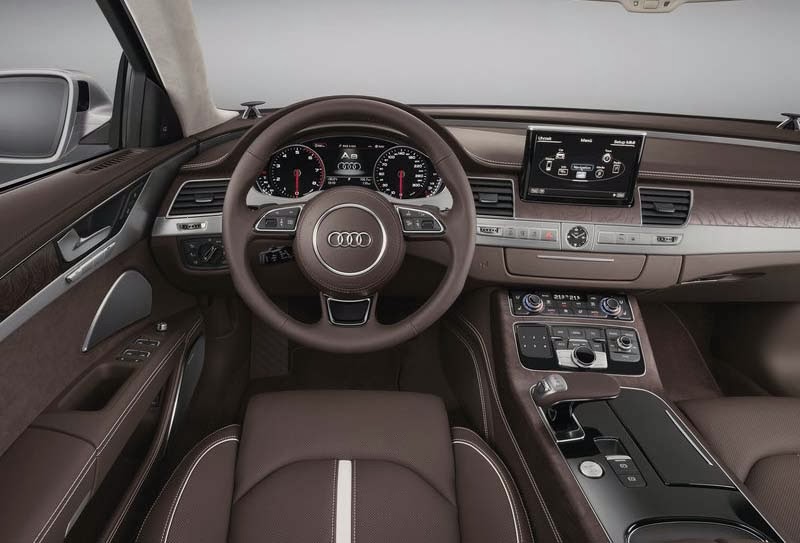
The sporty lines of the exterior are continued in the interior styling. The instrument cluster has gray gauges with white scales and red pointers. Contrasting stitching in rock gray trim the three-spoke multifunction steering wheel with its flat bottom as well as the gear selector lever. The MMI and driver information system displays welcome the driver with the RS logo. Drivers can call up the boost pressure, oil temperature and a lap timer via the RS menu in the driver information system.

Along with the pedals, a foot support also shines in aluminum look, and the standard inlays are in piano finish black. quattro GmbH offers aluminum race or carbon as alternatives here. Black headlining is standard, and lunar silver headlining is optional.

Sport seats with embossed RS Q3 logos are also standard and are upholstered in black Alcantara/leather. Customers can also choose the optional Fine Nappa leather in black or lunar silver with contrasting stitching in rock gray or the design package with diamond stitching.

The cargo area has a base capacity of 356 liters (12.57 cubic ft), which can be increased to 1,261 liters (44.53 cubic ft) by folding down the split rear seat backs. A practical reversible loadliner is standard. Those wishing to transport even more cargo can order the towing bracket that is offered for the RS Q3.

Other standard features of the Audi RS Q3 include - in addition to the RS-specific driver information system - park assist plus, Audi sound system with ten loudspeakers, xenon plus headlights and LED tail lights. When they are not lit, the tail lights display a dark red tint.

In the infotainment area, a modular component system offers a wide range of options; at the top there is the hard-drive based navigation system, MMI Navigation plus. The surround sound system from Bose drives 14 loudspeakers with up to 465 watts of output power, while the Bluetooth car phone online together with WLAN hotspot connects the compact high-performance SUV with the Internet and brings the online services of Audi connect into the vehicle. Highly advanced driver assistance systems round out the options program.
Read More

Monday, December 23, 2013

Audi A8L, 2014


  •  Audi A8L, 2014

The A8 makes Audi among the innovation leaders in the worldwide luxury segment, the most demanding automobile category. One great strength of the big sedan is its low weight. The Audi A8 3.0 TFSI with the normal wheelbase has a curb weight of just 1,830 kilograms (4,034.46 lb) - best-in-class for models with all-wheel drive.

The key factor in its lightweight construction is the body, which except for the B-pillars is made entirely of aluminum. An Audi Space Frame (ASF) design, it tips the scales at just 231 kilograms (509.27 lb), roughly 40 percent less than a comparable steel construction. The ASF body also makes it possible to reduce weight in many other areas, from the brakes to the fuel tank.

Length (5.14 meters [16.86 ft]), wheelbase (2.99 meters [9.81 ft]), width (1.95 meters [6.40 ft]) and height (1.46 meters [4.79 ft]) remain unchanged, giving the Audi A8 the sportiest look in the segment. The A8 L gains an additional 13 centimeters (5.12 in) in both length and wheelbase. Equipped with a TDI engine, both body variants have a drag coefficient of just 0.26. This same figure with a TFSI engine is 0.27.

In updating the A8, Audi paid great attention to the acoustics. Additional noise damping measures reduce the already low interior noise level even further. The trunk now has a maximum of 520 liters (18.36 cubic feet) and can be loaded substantially better thanks to the altered layout. The optional power trunk closing assist means that the entire car can be locked at the touch of a button.

Dynamic, yet harmoniously elegant - the big sedan's design has become even more expressive. The engine hood, the single-frame grille and the front bumper are even more sculptured and precise; the lower edge of the headlights is straight. In the German market, LED headlights are standard in all models with a V8 engine.

Audi also offers the headlights with optional Matrix LED technology, which sets new benchmarks with respect to design and technology. With these headlights, the high-beam unit is made up of 25 individual segments. The small light-emitting diodes, which work in conjunction with lenses and reflectors connected in series, are activated and deactivated or dimmed individually according to the situation. This enables the system to react precisely to other cars, which it recognizes using a camera, and always illuminate the road brightly. Additional features of the new headlights are the intelligent cornering light, new-look daytime running lights and dynamic turn signals.

The LED lights at the rear of the new Audi A8 have also become flatter and are joined together by a continuous chrome strip. In all models except the S8, the redesigned bumper houses two rhomboid tailpipes. Chrome strips in the lower section of the body, fine inserts in the door handles and high-gloss black window frames round out the distinctive features. There is a choice of 12 exterior colors, including five new ones. Wheels are available in sizes up to 21 inches with 275/35-series tires.

The engines: more power with greater efficiency
Besides the S8, A8 L W12 quattro and A8 hybrid models, the new Audi A8 will be offered in the German market with two TFSI gasoline engines and two TDI units. A package of measures to reduce friction reduce fuel consumption by as much as ten percent, and most engines have also seen an increase in power. All engines already satisfy the requirements of the Euro 6 standard.

Under the hood of the A8 3.0 TFSI quattro is a V6 engine whose mechanical compressor can be deactivated. Power output is now 228 kW (310 hp), an increase of 15 kW (20 hp). The V6 accelerates the standard wheelbase version of the sedan from 0 to 100 km/h (62.14 mph) in 5.7 seconds. Top speed is electronically restricted to 250 km/h (155.34 mph). It consumes on average 7.8 liters per 100 kilometers (30.16 US mpg), corresponding to 183 grams CO2 per kilometer (294.51 g/mile).

The twin-turbo V8 in the A8 4.0 TFSI quattro now produces 320 kW (435 hp), 11 kW (15 hp) more than before. Key performance data: from 0 to 100 km/h (62.14 mph) in 4.5 seconds; average fuel consumption 9.1 liters per 100 kilometers (25.85 US mpg), corresponding to 213 grams CO2 per kilometer (342.79 g/mile). The Audi cylinder on demand (COD) system plays a major role in this efficiency by deactivating four of the eight cylinders under part load.

With average fuel consumption of 5.9 liters per 100 kilometers (39.87 US mpg), corresponding to 155 grams CO2 per kilometer (249.45 g/mile), the 3.0 TDI clean diesel set a new record in the all-wheel-drive luxury segment. The V6 diesel engine's output has been bumped up 6 kW (8 hp) to 190 kW (258 hp). It now accelerates the sedan from 0 to 100 km/h (62.14 mph) in 5.9 seconds.

When it comes to torque, the 4.2 TDI clean diesel tops the A8 lineup, delivering 850 Nm (626.93 lb-ft) to the crankshaft. Audi has boosted its output by a whopping 25 kW (34 hp) to 283 kW (385 hp). Equipped with the powerful V8 diesel, the A8 completes the standard sprint in 4.7 seconds, and average fuel consumption is 7.4 liters per 100 kilometers (31.79 US mpg), which corresponds to 194 grams CO2 per kilometer (312.21 g/mile).

Powertrain: tiptronic and quattro
All variants of the model series are equipped with a fast and smooth-shifting, eight-speed tiptronic. The transmission, which can be controlled electronically using an elegant selector lever as well as paddles on the steering wheel, works in conjunction with the quattro permanent all-wheel drive system. The latter is standard in the A8 series (except for the A8 hybrid). If desired, Audi will combine quattro all-wheel drive with the optional sport differential on the rear axle. The power can then be distributed between the rear wheels as needed for even more agile handling. The sport differential is standard in the S8 and the A8 4.2 TDI clean diesel quattro.

The Audi A8 owes its sporty character in large part to the sophisticated chassis. Axle load distribution is balanced, and all wheel control arms are aluminum. The Audi drive select system, which enables the driver to influence the function of various technical modules such as the steering and the accelerator characteristic, is standard. It also controls the adaptive air suspension with adaptive damping, which adjusts the body's ride height to the speed driven. Audi also offers the air suspension with a sporty setup upon request.

The power steering now uses an efficient electromechanical drive that reduces fuel consumption and also enables the use of numerous assistance systems. The optional dynamic steering varies its ratio with the car's speed. All brake discs are internally vented. Carbon fiber ceramic brake discs are available for V8 models, the S8 and the A8 L W12.

One new component of Audi's lightweight construction technology are the 9J x 20 aluminum-technology wheels. These are based on forged support wheels that are joined via a special process to a ten-spoke design element of high-strength polymer. This technology gives designers the freedom to use large-area, yet three-dimensional designs.

Elegant and airy: the interior
The interior of the Audi flagship enchants with its elegant, airy lines. The instrument panel is lean and low, and below the windshield is a long arc - the wrap-around. Space is generous in every seat. The broad range of options for the front seats includes ventilation and massage functions with five programs and intensities each.

Audi offers electrically adjustable, individual rear seats as an option for the A8 and the A8 L. The A8 L is also available with a continuous, leather-covered center console. Equipped with every available luxury feature, the relaxation seat with electrically adjustable footrest is the first-class solution here.

Among the numerous individual options available for the A8 family are four-zone deluxe automatic air conditioning, the panorama glass roof, convenience key with power door closing assist, privacy windows, a cooler, folding tables and an ionizer to improve air quality.

Audi quality knows no compromise. All of the materials in the new A8 have been carefully chosen and precisely worked. Lovingly executed details document the hand-built character, from the barely visible gaps in the two-piece inlays to the ambient lighting with its adjustable LED light to the seat covers in premium grades of leather. The best of these is the new Unicum leather in nutmeg brown, which is particularly natural-looking, soft and breathable.

A new range of choices for seat coverings, inlays and interior colors is available in many areas. New additions include the woods Fine grain poplar brown-silver and Fine grain ash natural gold-brown, whose fine pores are filled with small amounts of silver and gold, respectively. Audi design selection offers customers an aesthetic pre-selection of exclusive materials and colors for the interior, including sycamore gray, marble gray and vermont brown for the S8. The Audi exclusive range offers an even greater degree of individualization for particularly discerning customers.

As is typical for Audi, the brand's flagship features exemplarily clear controls despite the abundance of functions. The driver information system with color seven-inch display and the eight-inch MMI monitor are standard. If the optional MMI navigation plus is installed, the control element on the center tunnel console includes a touchpad. The MMI touchpad enables the driver to control numerous functions; for example, the navigation destination can be entered by tracing the letters on the pad.

Audi connect including car phone is available as an ideal extension of MMI navigation plus. It connects the new A8 to the Internet via an integrated UMTS module. Thanks to the WLAN hotspot, passengers can surf and e-mail freely with their mobile devices. For the driver, the system delivers the tailored online services from Audi connect to the car, including online traffic information with real-time data and navigation with Google Earth and Google Street View.

In the area of multimedia, the Bang & Olufsen Advanced Sound System that sends over 1,400 watts of power to 19 speakers provides for good sound. The rear seat entertainment system for the passengers in the back includes two large displays, Bluetooth headphones and a DVD player, among other things.

The MMI navigation system is closely networked with additional systems on board the Audi A8, including the optional adaptive cruise control with stop&go function. The radar-based cruise control itself is linked with an expanded version of the standard Audi pre sense basic safety system, as is another optional system, Audi side assist. The camera-based speed limit display is also available.

New assistance systems
New assistance systems are making their debuts in the new A8, including Audi active lane assist, which makes slight steering adjustments when necessary, and the park assist system with 360° display, which handles steering when parking. Also new is the head-up display, which is elegantly integrated into the instrument panel and projects important information into the driver's field of vision on the windshield. The night vision assistant detects not only pedestrians, but also larger animals and warns the driver about them.

The new Audi A8 is scheduled to arrive at German dealerships in November 2013. Despite the more generous list of equipment and more powerful engines, prices are increasing only slightly. The new Audi model will be available in Germany starting at 74,500 euros.

Audi A8 L W12 quattro (preliminary data)
The Audi A8 L W12 quattro is equipped with a powerful gasoline engine that is particularly short and lightweight thanks to its W layout. The normally aspirated, 6.3-liter engine produces 368 kW (500 hp), yet is very smooth-running. The sprint from 0 to 100 km/h (62.14 mph) takes just 4.7 seconds. Average fuel consumption is a moderate 11.7 liters per 100 kilometers (20.10 US mpg), which corresponds to 270 grams CO2 per kilometer (434.52 g/mile) and is thus the benchmark for twelve-cylinder sedans. A newly developed COD system is active at low load. It temporarily deactivates the fuel injection and ignition for six of the twelve cylinders.

As the top model in the series, the Audi A8 L W12 quattro is available exclusively with the long wheelbase. Its luxurious features include MMI navigation plus with MMI touch, Audi connect including car phone, LED headlights, power door closing assist, convenience key, four-zone automatic air conditioning, individual rear seats and noise-insulating glazing. An innovative absorber foam in the tires reduces rolling noise.

For the first time Audi is also offering Active Noise Cancellation (ANC) in the W12 so that the top model retains its quiet composure even when the Audi cylinder on demand system is operating in efficient six-cylinder mode.

The A8 Audi exclusive concept is intended for customers looking for something very special. The limited-edition package (50 cars) is available for the A8 L W12 quattro. Leather from Italian furniture manufacturer Poltrona Frau in the color Agatha cognac dominates the interior. The inlays are made of fine grain olive ash natural silver brown. Its gray-brown shade harmonizes with the granite gray piping on the seats. Audi recommends the color Tierra Del Fuego for the exterior finish.

Audi S8
With 382 kW (520 hp) - the S8 is Audi's big sports sedan. Its 4.0 TFSI paired with quattro all-wheel drive accelerates the car from 0 to 100 km/h (62.14 mph) in 4.1 seconds, yet consumes on average just 9.6 liters of fuel per 100 kilometers (24.50 US mpg), corresponding to 225 grams CO2 per kilometer (362.10 g/mile). The COD technology that greatly improves the efficiency of the sonorous, twin-turbo V8 under part load is largely responsible for this top value. In four-cylinder mode, Active Noise Cancellation (ANC) uses precise antiphase noise to eliminate intrusive noise in the interior, while active engine mounts dampen vibrations. The A8 4.0 TFSI quattro, the A8 L W12 quattro and the A8 hybrid also have the ANC system on board.

The Audi S8 is the only member of the A8 family whose exhaust system ends in two elliptical dual tailpipes. Dynamic steering, the quattro powertrain with sport differential and the adaptive air suspension sport with an S-specific setup are standard. The wheels are 20 inches in diameter, and the brake calipers on the front axle bear S8 emblems.

The Audi A8 can be distinguished visually by means of several distinctive design modifications The Audi design selection black/vermont brown with Carbon twill copper inlays is available for the interior.

The Audi A8 hybrid (preliminary data)
The 2.0 TFSI engine in the Audi A8 hybrid produces 155 kW (211 hp), and the electric motor produces 40 kW and 210 Nm (154.89 lb-ft) of torque. Average fuel consumption is 6.3 liters of fuel per 100 kilometers (147 grams CO2 per kilometer) [37.34 US mpg/236.57 g/mile]. Coupled together, the two drive systems deliver their power to the front wheels via a highly modified eight-speed tiptronic. With the electric motor supporting the four-cylinder unit as an electric booster, system output is 180 kW (245 hp) and system torque 480 Nm (354.03 lb-ft).

Energy storage is provided in the form of a lithium-ion battery with a nominal capacity of 1.3 kWh mounted in the back of the vehicle. The hybrid sedan can drive at up to 100 km/h (62.14 mph) on electric power. The primary visual cue identifying the A8 hybrid, which Audi also offers as a long wheelbase version, are its turbine-design wheels. Specific displays inform the driver about the function of the hybrid drive. The A8 hybrid comes standard with a custom Audi luggage set for the trunk, which has a luggage capacity of 335 liters (12.54 cubic ft).
Read More

Friday, December 13, 2013

Audi A8, 2014


  •  Audi A8, 2014

Superior design, hand-built quality, systematic lightweight construction and an abundance of high-end technologies: Audi presents the comprehensively updated A8, its successful flagship, at the 2013 IAA in Frankfurt am Main. The engine lineup has once again become more powerful and efficient; new assistance systems and the innovative Matrix LED headlights make driving more composed than ever.

The A8 makes Audi among the innovation leaders in the worldwide luxury segment, the most demanding automobile category. One great strength of the big sedan is its low weight. The Audi A8 3.0 TFSI with the normal wheelbase has a curb weight of just 1,830 kilograms (4,034.46 lb) - best-in-class for models with all-wheel drive.

The key factor in its lightweight construction is the body, which except for the B-pillars is made entirely of aluminum. An Audi Space Frame (ASF) design, it tips the scales at just 231 kilograms (509.27 lb), roughly 40 percent less than a comparable steel construction. The ASF body also makes it possible to reduce weight in many other areas, from the brakes to the fuel tank.

Length (5.14 meters [16.86 ft]), wheelbase (2.99 meters [9.81 ft]), width (1.95 meters [6.40 ft]) and height (1.46 meters [4.79 ft]) remain unchanged, giving the Audi A8 the sportiest look in the segment. The A8 L gains an additional 13 centimeters (5.12 in) in both length and wheelbase. Equipped with a TDI engine, both body variants have a drag coefficient of just 0.26. This same figure with a TFSI engine is 0.27.

In updating the A8, Audi paid great attention to the acoustics. Additional noise damping measures reduce the already low interior noise level even further. The trunk now has a maximum of 520 liters (18.36 cubic feet) and can be loaded substantially better thanks to the altered layout. The optional power trunk closing assist means that the entire car can be locked at the touch of a button.

Dynamic, yet harmoniously elegant - the big sedan's design has become even more expressive. The engine hood, the single-frame grille and the front bumper are even more sculptured and precise; the lower edge of the headlights is straight. In the German market, LED headlights are standard in all models with a V8 engine.

Audi also offers the headlights with optional Matrix LED technology, which sets new benchmarks with respect to design and technology. With these headlights, the high-beam unit is made up of 25 individual segments. The small light-emitting diodes, which work in conjunction with lenses and reflectors connected in series, are activated and deactivated or dimmed individually according to the situation. This enables the system to react precisely to other cars, which it recognizes using a camera, and always illuminate the road brightly. Additional features of the new headlights are the intelligent cornering light, new-look daytime running lights and dynamic turn signals.

The LED lights at the rear of the new Audi A8 have also become flatter and are joined together by a continuous chrome strip. In all models except the S8, the redesigned bumper houses two rhomboid tailpipes. Chrome strips in the lower section of the body, fine inserts in the door handles and high-gloss black window frames round out the distinctive features. There is a choice of 12 exterior colors, including five new ones. Wheels are available in sizes up to 21 inches with 275/35-series tires.

The engines: more power with greater efficiency
Besides the S8, A8 L W12 quattro and A8 hybrid models, the new Audi A8 will be offered in the German market with two TFSI gasoline engines and two TDI units. A package of measures to reduce friction reduce fuel consumption by as much as ten percent, and most engines have also seen an increase in power. All engines already satisfy the requirements of the Euro 6 standard.

Under the hood of the A8 3.0 TFSI quattro is a V6 engine whose mechanical compressor can be deactivated. Power output is now 228 kW (310 hp), an increase of 15 kW (20 hp). The V6 accelerates the standard wheelbase version of the sedan from 0 to 100 km/h (62.14 mph) in 5.7 seconds. Top speed is electronically restricted to 250 km/h (155.34 mph). It consumes on average 7.8 liters per 100 kilometers (30.16 US mpg), corresponding to 183 grams CO2 per kilometer (294.51 g/mile).

The twin-turbo V8 in the A8 4.0 TFSI quattro now produces 320 kW (435 hp), 11 kW (15 hp) more than before. Key performance data: from 0 to 100 km/h (62.14 mph) in 4.5 seconds; average fuel consumption 9.1 liters per 100 kilometers (25.85 US mpg), corresponding to 213 grams CO2 per kilometer (342.79 g/mile). The Audi cylinder on demand (COD) system plays a major role in this efficiency by deactivating four of the eight cylinders under part load.

With average fuel consumption of 5.9 liters per 100 kilometers (39.87 US mpg), corresponding to 155 grams CO2 per kilometer (249.45 g/mile), the 3.0 TDI clean diesel set a new record in the all-wheel-drive luxury segment. The V6 diesel engine's output has been bumped up 6 kW (8 hp) to 190 kW (258 hp). It now accelerates the sedan from 0 to 100 km/h (62.14 mph) in 5.9 seconds.

When it comes to torque, the 4.2 TDI clean diesel tops the A8 lineup, delivering 850 Nm (626.93 lb-ft) to the crankshaft. Audi has boosted its output by a whopping 25 kW (34 hp) to 283 kW (385 hp). Equipped with the powerful V8 diesel, the A8 completes the standard sprint in 4.7 seconds, and average fuel consumption is 7.4 liters per 100 kilometers (31.79 US mpg), which corresponds to 194 grams CO2 per kilometer (312.21 g/mile).

Powertrain: tiptronic and quattro
All variants of the model series are equipped with a fast and smooth-shifting, eight-speed tiptronic. The transmission, which can be controlled electronically using an elegant selector lever as well as paddles on the steering wheel, works in conjunction with the quattro permanent all-wheel drive system. The latter is standard in the A8 series (except for the A8 hybrid). If desired, Audi will combine quattro all-wheel drive with the optional sport differential on the rear axle. The power can then be distributed between the rear wheels as needed for even more agile handling. The sport differential is standard in the S8 and the A8 4.2 TDI clean diesel quattro.

The Audi A8 owes its sporty character in large part to the sophisticated chassis. Axle load distribution is balanced, and all wheel control arms are aluminum. The Audi drive select system, which enables the driver to influence the function of various technical modules such as the steering and the accelerator characteristic, is standard. It also controls the adaptive air suspension with adaptive damping, which adjusts the body's ride height to the speed driven. Audi also offers the air suspension with a sporty setup upon request.

The power steering now uses an efficient electromechanical drive that reduces fuel consumption and also enables the use of numerous assistance systems. The optional dynamic steering varies its ratio with the car's speed. All brake discs are internally vented. Carbon fiber ceramic brake discs are available for V8 models, the S8 and the A8 L W12.

One new component of Audi's lightweight construction technology are the 9J x 20 aluminum-technology wheels. These are based on forged support wheels that are joined via a special process to a ten-spoke design element of high-strength polymer. This technology gives designers the freedom to use large-area, yet three-dimensional designs.

Elegant and airy: the interior
The interior of the Audi flagship enchants with its elegant, airy lines. The instrument panel is lean and low, and below the windshield is a long arc - the wrap-around. Space is generous in every seat. The broad range of options for the front seats includes ventilation and massage functions with five programs and intensities each.

Audi offers electrically adjustable, individual rear seats as an option for the A8 and the A8 L. The A8 L is also available with a continuous, leather-covered center console. Equipped with every available luxury feature, the relaxation seat with electrically adjustable footrest is the first-class solution here.

Among the numerous individual options available for the A8 family are four-zone deluxe automatic air conditioning, the panorama glass roof, convenience key with power door closing assist, privacy windows, a cooler, folding tables and an ionizer to improve air quality.

Audi quality knows no compromise. All of the materials in the new A8 have been carefully chosen and precisely worked. Lovingly executed details document the hand-built character, from the barely visible gaps in the two-piece inlays to the ambient lighting with its adjustable LED light to the seat covers in premium grades of leather. The best of these is the new Unicum leather in nutmeg brown, which is particularly natural-looking, soft and breathable.

A new range of choices for seat coverings, inlays and interior colors is available in many areas. New additions include the woods Fine grain poplar brown-silver and Fine grain ash natural gold-brown, whose fine pores are filled with small amounts of silver and gold, respectively. Audi design selection offers customers an aesthetic pre-selection of exclusive materials and colors for the interior, including sycamore gray, marble gray and vermont brown for the S8. The Audi exclusive range offers an even greater degree of individualization for particularly discerning customers.

As is typical for Audi, the brand's flagship features exemplarily clear controls despite the abundance of functions. The driver information system with color seven-inch display and the eight-inch MMI monitor are standard. If the optional MMI navigation plus is installed, the control element on the center tunnel console includes a touchpad. The MMI touchpad enables the driver to control numerous functions; for example, the navigation destination can be entered by tracing the letters on the pad.

Audi connect including car phone is available as an ideal extension of MMI navigation plus. It connects the new A8 to the Internet via an integrated UMTS module. Thanks to the WLAN hotspot, passengers can surf and e-mail freely with their mobile devices. For the driver, the system delivers the tailored online services from Audi connect to the car, including online traffic information with real-time data and navigation with Google Earth and Google Street View.

In the area of multimedia, the Bang & Olufsen Advanced Sound System that sends over 1,400 watts of power to 19 speakers provides for good sound. The rear seat entertainment system for the passengers in the back includes two large displays, Bluetooth headphones and a DVD player, among other things.

The MMI navigation system is closely networked with additional systems on board the Audi A8, including the optional adaptive cruise control with stop&go function. The radar-based cruise control itself is linked with an expanded version of the standard Audi pre sense basic safety system, as is another optional system, Audi side assist. The camera-based speed limit display is also available.

New assistance systems
New assistance systems are making their debuts in the new A8, including Audi active lane assist, which makes slight steering adjustments when necessary, and the park assist system with 360° display, which handles steering when parking. Also new is the head-up display, which is elegantly integrated into the instrument panel and projects important information into the driver's field of vision on the windshield. The night vision assistant detects not only pedestrians, but also larger animals and warns the driver about them.

The new Audi A8 is scheduled to arrive at German dealerships in November 2013. Despite the more generous list of equipment and more powerful engines, prices are increasing only slightly. The new Audi model will be available in Germany starting at 74,500 euros.

Audi A8 L W12 quattro (preliminary data)
The Audi A8 L W12 quattro is equipped with a powerful gasoline engine that is particularly short and lightweight thanks to its W layout. The normally aspirated, 6.3-liter engine produces 368 kW (500 hp), yet is very smooth-running. The sprint from 0 to 100 km/h (62.14 mph) takes just 4.7 seconds. Average fuel consumption is a moderate 11.7 liters per 100 kilometers (20.10 US mpg), which corresponds to 270 grams CO2 per kilometer (434.52 g/mile) and is thus the benchmark for twelve-cylinder sedans. A newly developed COD system is active at low load. It temporarily deactivates the fuel injection and ignition for six of the twelve cylinders.

As the top model in the series, the Audi A8 L W12 quattro is available exclusively with the long wheelbase. Its luxurious features include MMI navigation plus with MMI touch, Audi connect including car phone, LED headlights, power door closing assist, convenience key, four-zone automatic air conditioning, individual rear seats and noise-insulating glazing. An innovative absorber foam in the tires reduces rolling noise.

For the first time Audi is also offering Active Noise Cancellation (ANC) in the W12 so that the top model retains its quiet composure even when the Audi cylinder on demand system is operating in efficient six-cylinder mode.

The A8 Audi exclusive concept is intended for customers looking for something very special. The limited-edition package (50 cars) is available for the A8 L W12 quattro. Leather from Italian furniture manufacturer Poltrona Frau in the color Agatha cognac dominates the interior. The inlays are made of fine grain olive ash natural silver brown. Its gray-brown shade harmonizes with the granite gray piping on the seats. Audi recommends the color Tierra Del Fuego for the exterior finish.

Audi S8
With 382 kW (520 hp) - the S8 is Audi's big sports sedan. Its 4.0 TFSI paired with quattro all-wheel drive accelerates the car from 0 to 100 km/h (62.14 mph) in 4.1 seconds, yet consumes on average just 9.6 liters of fuel per 100 kilometers (24.50 US mpg), corresponding to 225 grams CO2 per kilometer (362.10 g/mile). The COD technology that greatly improves the efficiency of the sonorous, twin-turbo V8 under part load is largely responsible for this top value. In four-cylinder mode, Active Noise Cancellation (ANC) uses precise antiphase noise to eliminate intrusive noise in the interior, while active engine mounts dampen vibrations. The A8 4.0 TFSI quattro, the A8 L W12 quattro and the A8 hybrid also have the ANC system on board.

The Audi S8 is the only member of the A8 family whose exhaust system ends in two elliptical dual tailpipes. Dynamic steering, the quattro powertrain with sport differential and the adaptive air suspension sport with an S-specific setup are standard. The wheels are 20 inches in diameter, and the brake calipers on the front axle bear S8 emblems.

The Audi A8 can be distinguished visually by means of several distinctive design modifications The Audi design selection black/vermont brown with Carbon twill copper inlays is available for the interior.

The Audi A8 hybrid (preliminary data)
The 2.0 TFSI engine in the Audi A8 hybrid produces 155 kW (211 hp), and the electric motor produces 40 kW and 210 Nm (154.89 lb-ft) of torque. Average fuel consumption is 6.3 liters of fuel per 100 kilometers (147 grams CO2 per kilometer) [37.34 US mpg/236.57 g/mile]. Coupled together, the two drive systems deliver their power to the front wheels via a highly modified eight-speed tiptronic. With the electric motor supporting the four-cylinder unit as an electric booster, system output is 180 kW (245 hp) and system torque 480 Nm (354.03 lb-ft).

Energy storage is provided in the form of a lithium-ion battery with a nominal capacity of 1.3 kWh mounted in the back of the vehicle. The hybrid sedan can drive at up to 100 km/h (62.14 mph) on electric power. The primary visual cue identifying the A8 hybrid, which Audi also offers as a long wheelbase version, are its turbine-design wheels. Specific displays inform the driver about the function of the hybrid drive. The A8 hybrid comes standard with a custom Audi luggage set for the trunk, which has a luggage capacity of 335 liters (12.54 cubic ft).
Read More

Saturday, November 9, 2013

Audi A3 Sportback S-Line, 2014


  •  Audi A3 Sportback S-Line, 2014

Sporty, versatile and functional - Audi presented the new A3 Sportback. The compact five-door model with the spacious luggage compartment is groundbreakingly light thanks to ultra lightweight technology. The engines are powerful and highly efficient. The infotainment with the intuitive connect technology and the driver assistance systems available in the new Audi A3 Sportback set new standards in the premium compact segment. The overall design language concentrates on the essentials, with each individual design element making a confident aesthetic statement.

A lightweight car is a prerequisite for sportiness and efficiency. ultra lightweight technology from Audi reduces the weight of the new Audi A3 Sportback by as much as 90 kilograms (198.42 lb) compared with the previous version. Equipped with the 1.4 TFSI engine, the five-door model has a curb weight (without driver) of just 1,205 kilograms (2,656.57 lb). Hot-shaped steels are used in the occupant cell of the new A3 Sportback to reduce the weight. The complete occupant cell is 37 kilograms (81.57 lb) lighter overall than in the previous model. Significant weight reductions were also achieved in the interior and with the engines. Audi, worldwide pioneer in lightweight construction, has reversed the weight spiral and once again set a new record.

The body of the new Audi A3 Sportback is long and lean. While the length (4,310 millimeters [14.14 ft]), width (1,780 millimeters [5.84 ft]) and height (1,425 millimeters [4.68 ft]) of the new model are only slightly greater than on the previous model, the wheelbase is now significantly longer at 2,636 millimeters (8.65 ft), an increase of 58 millimeters (2.28 in).

The front end is low; the roof arch spans a dome that extends beyond the subtle roof spoiler to the muscular tail end. The design with the three side windows is taut, with every detail precise and expressive. The large wheel wells underscore the sporty aspirations of the new Audi A3 Sportback.

The distinctive, Stone Gray single-frame grille with the angled upper corners is the distinguishing element at the front of the vehicle. Its horizontal slats and the Audi rings are highlighted three-dimensionally. The flat headlights are works of art and give the new Audi A3 Sportback a determined gaze. Full LED headlights will be offered at a later time.

The interior of the new A3 Sportback is elegant, airy and cleanly designed. It carries over the dynamics of the exterior. The instrument panel with its curving front is slim and low. Together with the center console oriented toward the driver, it appears to float slightly.

Large, round air nozzles in jet design, the elegant user interface panel for the climate control system and sculpturally styled trim set the tone - with their polish they bring the quality of the full-size class into the new Audi A3 Sportback. The seats and steering wheels are new developments, and the car's user controls are clear and intuitive - as they are in every Audi. The compact five-door model offers a generous luggage capacity of between 380 and 1,220 liters (13.42 and 43.08 cu ft).

Audi ultra lightweight technology
ultra lightweight construction has long been a main pillar of the brand. Audi recorded a pioneering achievement in the use of aluminum as a body material back in 1994: The first A8 had a full-aluminum body in ASF (Audi Space Frame) technology.

ultra lightweight technology reduces the weight of the new Audi A3 Sportback by as much as 90 kilograms (199.42 lb) compared with the previous version. Equipped with the 1.4 TFSI engine, the compact five-door model has a curb weight (without driver) of just 1,205 kilograms (2,656.57 lb). Audi, worldwide pioneer in lightweight construction, has reversed the weight spiral and once again set a new record.

ultra lightweight construction in the body
The broad-based expertise of the Audi body development engineers is by no means restricted to a certain material, but rather encompasses all relevant materials. The multimaterial construction of the new Audi A3 Sportback is entirely in keeping with the motto "The right material at the right place for optimal function."

High-end components of hot-shaped steel in the occupant cell form a strong, yet lightweight structure. Before deformation, they are heated in a continuous flow furnace to nearly 1,000 degrees Celsius and are then cooled to about 200 degrees in a water-cooled stamping press.

This extreme temperature jump creates an iron-carbon structure with extreme tensile strength. Hot shaped steels are able to perform with relatively thin walls, and this makes them lightweight.

Hot-shaped steels represent a roughly 25 percent share of body materials. They are used in the transition from the front of the vehicle to the occupant cell, in the A-pillars, roof arch, center tunnel, side sills and floor panels. What is known as a tailored rolled blank forms the transition from the floor to the rear body section - its eleven individual segments are rolled into five different thicknesses.

The B-pillars also consist of this high-end steel; their lower sections are more flexible than above, since the energy of a side-impact collision must be absorbed here. All together, the hot-shaped steels in the new Audi A3 Sportback reduce the weight of the vehicle by 37 kilograms (81.57 lb) compared with the previous model.

High-strength and ultra-high-strength steel grades are used in many other body areas such as in the side members and in the floor of the passenger cell. The engine hood, fenders, the subframe of the front axle and the sections mounted behind the front bumper as crash absorbers are made of aluminum. Together the aluminum components save around twelve kilograms (26.46 lb), thus improving axle load distribution.

Processing aluminum components in body construction and joining these components with steel components are challenging tasks. The same is true of welding hot-shaped components, which are coated with a corrosion-inhibiting aluminum-silicon alloy. Audi benefits here from its extensive know-how in ultra lightweight construction - the joining technologies have been practice-proven for years now in models such as the TT. A number of very different joining technologies are used to assemble the new A3 Sportback, including bonding, clinching and punch riveting.

Between the side wall and the roof, which are both made of steel, a Plasmatron brazed seam produces the joint, where the allowable tolerance is just a few tenths of a millimeter. The finished seam is smoothed with brushes - the practically invisible zero-joint that is produced is an expression of the stringent precision thinking at Audi.

Unlike the previous model, the doors and window frames are stamped in one piece, and this also saves weight. The door hinges integrate a convenient new type of clamping mechanism.

Safety and aerodynamics
The new Audi A3 Sportback is tops when it comes to passive safety. In a frontal collision, the front cross-member distributes the forces to the two side members, which undergo defined deformation to dissipate these forces. The structural members for the engine and front suspension, as well as the sections in the upper area of the fenders, act as additional load paths. If necessary, the pedals are decoupled from the firewall; the steering column absorbs energy and is not displaced into the occupant cell.

In a side impact, the occupant cell offers excellent protection with its hot-shaped steel components such as the sills and B-pillars. In a rear-end collision, the bumper's cross members redirect loads to the large side members made of high-strength steel.

The new Audi A3 Sportback meets all legal requirements for the protection of pedestrians in the event of a collision. Starting at a specific collision speed, a new system is activated. Pyrotechnic elements at the back of the engine hood raise it upward. This increases the distance between the engine hood and the engine components, thus cushioning the impact with the pedestrian.

Minor collisions, such as the standardized low-speed collision, do not result in any major financial impact, which is also reflected in the car's favorable type classification - the new Audi A3 Sportback is rated the best-in-class for its market segment. It also performs well in the RCAR bumper test, focused on the compatibility with the other party in the collision.

The new Audi A3 Sportback is planted firmly on the road - a strength attributable in large part to Audi's aerodynamics specialists. The underbody back to the B-pillar is completely lined. The covering is made of glass fiber-reinforced polymer. It protects the sheet metal and engines from salt, water and stone impact and absorbs undesirable vibrations. Small spoilers in front of the wheels help to guide the air flow with low drag losses. The aerodynamic underbody of the new Audi A3 Sportback reduces aerodynamic drag by about ten percent. To take full advantage of the aerodynamic potential, a great deal of effort was also focused on the flow of air through the engine compartment.

ultra lightweight construction in the interior
The Audi ultra lightweight principle is not limited to the body or to specific subassemblies and parts - developers always consider the vehicle as a whole, and in their work every gram counts. This is the only way the car's curb weight could be reduced by up to 90 kg (198.42 lb) compared with the previous model.

The engineers have internalized the Audi ultra lightweight principle, and in the interior of the new Audi A3 Sportback they also succeeded in eliminating every superfluous gram. The redesigned seats contribute a one kilogram (2.20 lb) weight savings; lightweight plastic inserts replace the steel wire used previously in the frame of the rear bench seat.

A new control unit arrangement requires fewer wires, thus reducing the weight by 1.5 kilograms (3.31 lb). The blower motor requires fewer coils, and the air conditioning system shed four kilograms (8.82 lb) of weight. The housing of the passenger airbag is made of polymer; the mounting for the MMI monitor is made of magnesium. Together these two solutions save 640 grams (1.41 lb). In the previous model, many linings in the interior were fastened with steel screws. In the new Audi A3 Sportback, polymer expanding rivets were used here for a weight savings of four grams (0.01 lb) per fastening point. When it comes to the Audi ultra lightweight construction principle, every gram counts.

ultra lightweight construction in engines and chassis
The engines of the new Audi A3 Sportback have shed a significant amount of weight as well. The engines of the new A3 have shed a lot of weight as well. The 1.8 TFSI, for example, weighs just a little over 130 kilograms (286.60 lb), while the 1.4 TFSI weighs in at just 107 kilograms (235.89 lb) - 21 kilograms (46.30 lb) less than the previous engine. With a weight difference of 15 kilograms (33.07 lb), the aluminum crankcase accounts for the largest share of reductions, but progress has also been made in many small engine details - e.g. in the new aluminum pistons and the hollow-bored connecting rod pins.

In the 1.8 TFSI, the thin-wall technology of the crankcase reduces weight by 2.4 kilograms (5.29 lb). In the 2.0 TDI, the balance shafts are mounted in the engine block, which accounts for three kilograms (6.61 lb) of savings, while modified sound dampers in the exhaust system save an additional two kilograms (4.41 lb). Weight was trimmed from the exhaust system in all engine versions.

In the chassis, the new one-piece aluminum subframe and aluminum pivot bearings (depending on the engine) reduced the weight of the front suspension system by about six kilograms (13.23 lb). The optional 18-inch alloy wheels are no heavier than the 17-inch wheels; they are produced by a complex flow-forming technology. In this process, the rim well is rolled out over a cylinder under high pressure and at high temperature. The system shapes the wheel blank in a single work step, during which the material also becomes stronger. This permits thinner wall thicknesses so that the wheel is both lighter and stronger.

Environmental footprint
In developing the new A3, Audi conducted an environmental assessment of two of the engine versions. The 1.4 TFSI and the 2.0 TDI - both with a manual transmission - were subjected to a detailed analysis. Both versions offer clear benefits compared with their respective previous models. Greenhouse gas emissions, for example, are reduced by roughly two metric tons per model. This corresponds to roughly seven to nine percent of the greenhouse gas emissions over the entire life cycle. This is due in large part to the substantially lower fuel consumption and low weight of the new models. At the end of its life, about 95 percent of the new Audi A3 Sportback can be recycled.

Exterior design
The new Audi A3 Sportback is long and lean. While the length (4,310 millimeters [14.14 ft]), width (1,780 millimeters [5.84 ft]) and height (1,425 millimeters [4.68 ft]) are only slightly greater than on the previous model, the wheelbase is now significantly longer at 2,636 millimeters (8.65 ft), an increase of 58 millimeters (2.28 in). The overall design language of the new Audi A3 Sportback concentrates on the essentials, with each individual design element making a clear and confident aesthetic statement. The front end is low; the roof arch spans a dome that extends beyond the subtle roof spoiler to the muscular tail end. The ratio of metal surface area to windows is two-thirds to one-third - a typical proportion for Audi.

The design with the three side windows is taut, with every detail precise and expressive. The tautly curved surfaces, the sharp shoulder of the body and the relatively narrow, sharply inclined C-pillar give the new Audi A3 Sportback its typical character. The sharply defined tornado line articulates the flank below the windows and evokes a powerful shoulder. The dynamic line above the side sills runs upward toward the rear. The large, precisely defined wheel wells and the subtle roof spoiler underscore the sporty aspirations of the new Audi A3 Sportback. The same applies to the exterior mirrors with integrated LED turn signals, which like with a sports car are mounted on the doors.

The distinguishing element of the front end is the distinctive, Stone Gray single-frame grille with the angled upper corners. Its horizontal slats and the Audi rings are highlighted three-dimensionally. A slender, chrome-plated frame surrounds the grille. Large air intakes up front hint at the supreme power of the engines.

The flat headlights are works of art of the highest technical precision and give the new Audi A3 Sportback a determined gaze. They are styled in a wedge shape, and their lower edges are contoured in a slight wave. In the optional xenon plus modules, the LED daytime running lights form clear, visually uniform contours of lights at the upper and lower edges, which suggest the shape of an eyebrow. The turn signal lights are at the pointed corner of the headlight behind the "wing" - a narrow, chrome-plated fin that is a typical Audi feature.

As an option, Audi can supply the new A3 Sportback with the high-beam assistant, and - in conjunction with xenon plus headlights - with adaptive light. It integrates a special curve, cornering and intersection light function and can be supplemented by variable headlight range control. It works together with the front-facing camera to adjust the light-dark boundary of the headlights automatically in response to approaching vehicles or the vehicles ahead. Full LED headlights will be offered somewhat later.

The rear is sculptured, and the split rear lights underscore its width. Audi offers LED rear lights in combination with the xenon plus headlights; LED light conductors appear to form a continuous arch. The adaptive brake light, which pulses at high frequency during hard braking, is standard. A sharp crease sets off the diffuser. Depending on the engine, the exhaust system terminates in one or two tailpipes on the left side of the car. On the Ambition and Ambiente they are chrome-plated.

The S line exterior package further sharpens the look of the premium compact car. The single-frame grille is painted in a high-gloss black, honeycomb-look screens with fog lights fill the large air inlets, which are bordered by powerful edges. Suggested air inlets that extend towards the wheels create distinctive visual accents. The sills have distinctive add-on strips. The roof spoiler has been lengthened, the bumper has an additional edge, the platinum gray diffuser includes a honeycomb-pattern insert, and the tailpipes of the exhaust system are chrome-plated.

There are twelve paint colors from which to choose. The solid finishes are called Amalfi White, Brilliant Red and Brilliant Black. The metallic finishes are Beluga Brown, Dakota Gray, Ice Silver, Glacier White, Monsoon Gray, Scuba Blue and Shiraz Red. The pearl-effect finishes Phantom Black and Misano Red round out the selection. The optional high-gloss package offers small highlights in the area of the side windows (standard with the Ambiente line).

Interior
The interior of the new Audi A3 Sportback is marked by an elegant, clean and light design. The dynamics of the exterior are also fully carried over here; the lines and surfaces are dynamic and taut. In the style of the larger Audi model series, a long arch called the wrap-around runs below the windshield. The instrument panel with its curving front is slim and low. Together with the center console oriented slightly toward the driver, it appears to float slightly.

The clean ergonomics are a classic Audi strength. The MMI operating system with the power-retractable monitor is available with the MMI radio and above. The center tunnel console, framed on both sides by knee pads in the style of the TT sports car, presents a clean, well-organized look. Thanks to the new electromechanical parking brake, there is no longer any brake lever; this has created space for the terminal of the optional MMI user interface. The armrest is adjustable in length and height.

The driver seats at an elegant steering wheel. Depending on the version, it has three or four spokes, a flat-bottomed rim, multifunction buttons and shift paddles. The large dial instruments can be easily read at a glance. The driver information system, which is available with an optional color monitor, displays useful data on a 3.5-inch display. These include such things as the current radio station or song title, speed, outside temperature and the time, as well as information from the navigation and driver assistance systems if present. The on-board computer provides information on fuel consumption, average speed and the time and distance driven. Furthermore, the integrated efficiency program supports an economical driving style.

The newly developed front seats offer countless adjustment possibilities for optimal support. Audi also offers optional sport seats (standard with Ambition), which can also be adjusted to the driver's body size. Another comfort and safety feature is the high-adjustable seat belt. S sport seats with integrated head restraints will be offered somewhat later as part of the S line sport package.

The new Audi A3 Sportback also offers several millimeters more head and leg room than the previous model. Thanks to the 58-millimeter (2.28 in) increase in wheelbase, it also offers enough head, elbow, knee and foot room in the rear. The L-shaped rear head restraints provide for good rear visibility.

The interior of the new A3 Sportback conveys the luxurious look and feel of the full-size class. The sculpted inlays are just one of the highlights. Audi offers a choice of Aluminum Mistral or 3D glass-look inlays (standard with Ambiente) as options. The top-of-the-line version is manufactured using a complex process. The transparent film that is drawn over the base part is imprinted with a pattern of tiny triangles five times. A layer of transparent polycarbonate amplifies the 3D visual effect and at the same time gives the trim an extraordinary glass-like look.

The four large, round air nozzles in classic jet design are a typical Audi feature that simultaneously reflects technological aesthetics. Each of the air nozzles consists of over 30 individual parts, and tolerances of just a few hundredths of a millimeter are allowable. Their air flow is adjusted by pulling on the central axis - this varies the air flow from broadly dispersed or draft-free to a focused stream. When the rings are turned, they make the sound of technical precision - a fine, precisely-defined click.

The Audi A3 Sportback comes standard with a manual air conditioning system. The control unit for the optional deluxe automatic air conditioning is mounted on a panel in Piano-finish black. The instrument cluster fascia is also black. Upon request, many of the controls feature an aluminum-look finish. The optional interior lighting package (standard with Ambiente) accents the interior with additional highlights: Small LED lights are placed in the headlining, front and rear, in the make-up mirrors, doors, and foot areas, at the cup holder, in the glove box and on the exterior mirrors.

Interior colors are adapted to the respective trim line. Attraction is the modern, Ambition the sporty and Ambiente the luxurious, comfort-oriented line. In the A3 Sportback Attraction, the interior is bathed in black or titanium gray; the interior of the sporty Ambition line is either all black or black with additional silver, blue or yellow contrasting elements.

The two-tone Audi design selection capri orange is available as an exclusive option for Ambition. This exclusive design from the Audi designers features a youthful color combination. The colors pashmina beige and chestnut brown are available with the luxurious Ambiente trim line.

Additional distinctions are made in the materials that are used. Cloth seats are standard with the Attraction and Ambition lines; Ambiente comes standard with a mix of cloth and synthetic leather. Milano leather in black, pashmina beige, gray, brown and capri orange (Ambition only) or a combination of Pearl Nappa leather and Alcantara in black or gray are available as options. When Milano leather is selected in conjunction with sport seats, the shoulder area is upholstered in Velvet leather. Special processing gives it a rugged, slightly rough surface similar to that of suede.

The S line sport package, which is available for the Audi A3 Sportback Ambition, completely immerses the interior in black - even the headlining. Seat upholstery options are available in various materials - ranging from a cloth/leather combination to Fine Nappa leather; S line logos are embossed on the front seatbacks. Silver seams accentuate the styling, while the same color is used in contrasting seams for the borders of the floor mats; the decorative trim strips are made of matt brushed aluminum. Besides the S line sport suspension, a gear knob in perforated leather and a three-spoke leather-covered sport steering wheel - optionally with a flattened ring - emphasize the dynamic atmosphere.

The luggage compartment of the new Audi A3 Sportback has a capacity of 380 liters (13.42 cu ft) in its standard configuration and 1,220 liters (43.08 cu ft) with the rear seats folded down. The cargo floor is flat, and the opening between the wheel wells measures 1,000 millimeters (39.37 in). The cargo floor can be inserted on two levels, and the supports on which it rests are marked with small LED lights. The rear seat can be folded down in a 60:40 split or as a whole. Practical bag hooks and lashing eyes in the cargo compartment are standard.

As options for the new A3 Sportback, Audi offers a load-through hatch, a ski and snowboard sack, a reversible floor mat and a storage and luggage compartment package. For the interior, this package offers nets on the backs of the front seats and in the front passenger area, a 12-volt outlet and a storage bin for safety vests under the middle rear seat.

For the luggage compartment, it offers a 12-volt outlet, a multi-fixing point for shopping bags, a luggage net and a compartment with net on the left side.

Multimedia systems
Audi's leadership in automotive electrical and electronic systems can also be fully experienced in the new A3 Sportback - the premium compact offers a comprehensive system of infotainment components. The heart of the mobile communications electronics is a groundbreaking innovation: the modular infotainment platform (MIB). This concept enables very fast innovation cycles in development.

The new Audi A3 Sportback comes standard with the Audi radio with a 2.5-inch monochrome display and a CD drive that also plays MP3 and WMA files. Its head unit can be lowered into the instrument panel, and an Aux-in port makes it possible to connect auxiliary devices. The Audi radio drives four loudspeakers with 80 watts of output power.

The next step up - the MMI radio - adds a control terminal on the center tunnel console and the power-retractable 5.8-inch monitor. This can be supplemented with the optional connectivity package, which includes the Audi music interface for the integration of a mobile player, a Bluetooth interface, navigation system preparation and an additional SDXC card reader. If the customer later buys an SD card with navigation data or chooses the navigation package from the very beginning, the MMI radio becomes a navigation system.

The new central computer of the MIB is located in the glove compartment of the Audi A3 Sportback. It comprises two units - the radio car control unit and the MMX board (MMX = Multi-Media eXtension). One of the plug-in module's key components is the fast T-20 graphics process from market leader Nvidia's Tegra 2 series. The chip, which generates complex 3D images, is used in all online, voice control, media, navigation and telephone functions. The screen with the high-resolution monitor (5.8 or 7.0-inch diagonal) extends from the instrument panel when the system is started.

The MMI terminal is used to control the numerous functions. Audi is also presenting important innovations for the control terminal on the center tunnel console. The hard keys for navigation, telephone, radio and media have been rearranged and are now implemented as toggle switches. The volume control includes a skip function.
Read More

Tuesday, October 29, 2013

Audi A3 Sportback g-tron, 2014


  •  Audi A3 Sportback g-tron, 2014

The A3 Sportback g-tron can fundamentally run on natural gas, the biomethane on sale at certain filling stations, or e-gas. Customers wanting to buy e-gas can sign up for a particular contingent of e-gas for the A3 g-tron at their Audi dealer. This enables them to take part in an accounting process that ensures that the amount of gas that they put in their vehicle at the natural gas filling station has been supplied to the grid by the Audi e-gas plant.

Audi is taking a large step towards sustainable future mobility with the A3 Sportback g-tron. The five-door premium compact model, which will appear on the market at the end of the year, runs on both the fossil fuel natural gas and on climate-friendly Audi e-gas, which Audi itself produces at a recently completed power-to-gas plant. It innovatively combines ecological balance, economy and high-tech solutions.

The Audi A3 Sportback g-tron, the brand's first natural gas car to go into production, reveals the sheer depth of the technological expertise of Audi - from ultra lightweight technology through the highly advanced infotainment to the driver assistance systems. It showcases state-of-the-art CNG technology (CNG = compressed natural gas), complete with the fuel storage technology. Its two pressurized tanks beneath the trunk floor each hold around seven kilograms (15.43 lb) of gas; they essentially use the recess for the spare wheel, thus impinging only minimally on the load capacity.

These tanks, which store the gas at a pressure of 200 bar, use the ultra lightweight construction principle of Audi: They weigh 70 percent less than conventional steel bottles, each of them weighing 27 kilograms (59.52 lb) less than an equivalent steel version. Their composition reveals an innovative layout: The inner layer consists of a gas-impermeable polyamide matrix, while a second layer of carbon fiber reinforced polymer (CFRP) gives the tank its extremely high strength; a third layer of glass fiber reinforced polymer (GFRP) provides protection against damage from the outside. Epoxy resin is used to bind the fiber reinforced materials.

A second highlight of the Audi A3 Sportback g-tron is its electronic gas pressure regulator. This compact and lightweight component reduces the high pressure of the gas flowing from the cylinders down to around five to nine bar in two stages. It ensures that the right pressure is always present in the gas rail and at the injector valves - low pressure for efficient driving in the lower speed range, and higher when the driver wants more power and torque.

When the pressure in the tank falls below 10 bar when there remains about 0.6 kilogram (1.32 lb) of gas, the engine management automatically switches to gasoline operation. The Audi A3 Sportback g-tron is designed as a bi-fuel concept. In the NEDC cycle it drives over 400 kilometers (248.55 miles) on gas and a further 900 kilometers (559.23 miles) on gasoline, so its overall range is comparable to a TDI. The driver information system always shows current consumption; two displays in the instrument cluster indicate the tanks' fuel level. The filler pipes for both are located behind the same flap.

After refueling, and whenever it is very cold, the Audi A3 Sportback g-tron is started with gasoline initially, then it is switched over to natural gas as quickly as possible. Its engine is a modified 1.4 TFSI; the cylinder head, turbocharger, injection system and catalytic converter are specifically designed to run on gas. With an output of 81 kW (110 hp) and 200 Nm (147.51 lb-ft) of torque, the compact five-door model accelerates from 0 to 100 km/h (62.14 mph) in less than 11 seconds; it achieves a top speed of more than 190 km/h (118.06 mph).

The Audi A3 Sportback g-tron is the benchmark in its segment for efficiency and economy. Its CO2 emissions in the exhaust gas remain below 95 grams per km (152.89 g/mile) in the NEDC cycle, and the fuel costs for the customer are around four euros per 100 km (62.14 miles). Over 100 km (62.14 miles), the compact car uses on average less than 3.5 kilograms (7.72 lb) of natural gas or Audi e-gas - the fuel that is produced in the Audi e-gas project from CO2 and water using renewable power. This fuel is a major step into the future of mobility for the brand with the four rings - Audi is the first carmaker to be establishing production facilities for a whole chain of sustainable energy sources.

The e-gas plant that Audi has set up in Werlte (Emsland) involes two major process stages - electrolysis and methanation. In the first step, the plant uses renewable power to break water down into oxygen and hydrogen in three electrolyzers. The hydrogen obtained from this process can be stored separately if required, for powering future fuel-cell vehicles.

However for the time being, in the absence of an area-wide hydrogen infrastructure a second process step is carried out: The hydrogen is then reacted with CO2 to produce synthetic methane, or Audi e-gas. In chemical terms it is almost identical to the fossil fuel natural gas and can therefore be distributed throughout Germany using the natural gas grid to CNG filling stations, for refueling vehicles.

The carbon dioxide used in the Audi e-gas plant is waste gas from a nearby biomethane plant that runs on organic waste and is operated by power utility EWE. That plant separates it from the crude biogas to produce highly pure biomethane. The Audi e-gas plant is expected to achieve an annual output of around 1,000 metric tons, capturing around 2,800 metric tons of CO2 that would otherwise pollute the atmosphere. As a result, the fuel is climate-neutral.

Throughout the entire production process at the e-gas plan that Audi has erected jointly with the plant engineer ETOGAS (formerly SolarFuel), the efficient use of energy flows is a high priority. The waste heat that is given off during methanation is put to good use in sanitizing the waste and preparing the biogas, appreciably increasing overall efficiency. The Audi e-gas plant is currently being commissioned and from summer 2013 will be supplying the grid with synthetic gas.

Audi e-gas is a high-energy fuel that is ideal for powering combustion engines. The CO2-neutral e-gas from Werlte can power 1,500 new Audi A3 Sportback g-tron vehicles, each driving 15,000 kilometers (9,320.57 miles) a year. In operation, these cars do not produce a single gram of CO2 that has not previously been captured during the e-gas production process. Even in the comprehensive well-to-wheel calculation, which includes the outlay for building and operating wind turbines and the e-gas plant, current forecasts predict the CO2 equivalents to remain under 30 grams per km (48.28 g/mile).

The German energy industry as a whole stands to benefit from the Audi e-gas concept. There is still the unsolved question of how to store renewable power, of which there is an increasingly frequent oversupply following the energy policy rethink, efficiently and independently of location. The world first of linking power with the gas grid as demonstrated by the e-gas project in Werlte offers a solution to this problem by storing the e-gas produced in the natural gas grid, the biggest and most efficient form of energy storage available. This prospect could provide a major boost to the expansion of renewable energies.
Read More