Tuesday, April 10, 2012

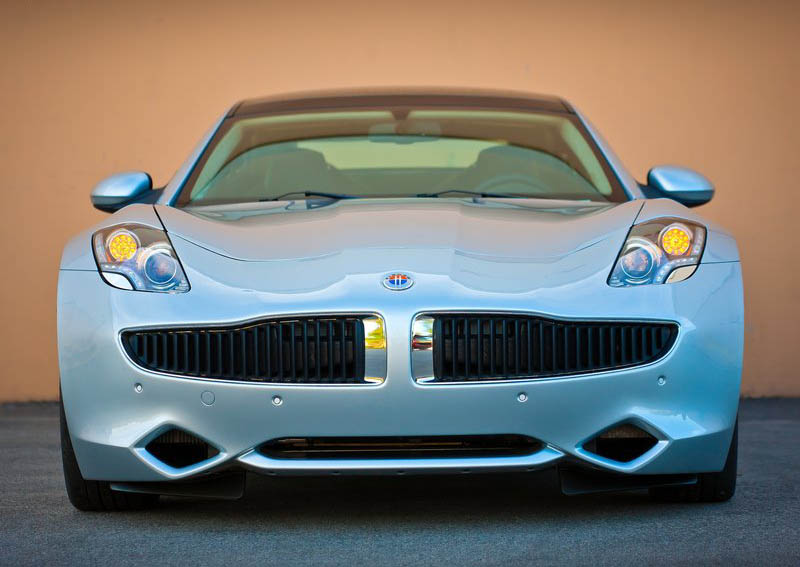
Fisker Karma, 2012


Fisker Karma, 2012

From the California automaker Fisker Automotive comes the Fisker Karma, the world's first true Electric Vehicle with extended range (EVer™) and a radical expression of what is possible in the automotive world.

Loosely translating from Hindi, Karma implies good deeds are rewarded. The Fisker Karma allows drivers who appreciate style and performance to own and enjoy a car that is also environmentally conscious, one that achieves fuel consumption and emissions performance that is simply beyond the capability of today's conventional luxury automobiles.
Combining striking, elegant design with high performance, ultra-low fuel consumption and zero emissions on demand, the four-door, four-seat Fisker Karma embodies the brand's commitment to creating Uncompromised Responsible Luxury vehicles that deliver Pure Driving Passion.

The Fisker Karma - an all-new car with all-new technology from an all-new company - arrives in showrooms this summer, setting a new benchmark for time-to-market after being unveiled as a concept in 2008 and creating the Premium Luxury EV segment.
The Fisker Karma can run purely on electric power supplied by a rechargeable lithium-ion battery for up to 50 miles (80 km); after that, a 175 kW generator driven by an efficient, 2.0 liter, direct-injection, turbocharged gasoline engine extends the range an additional 250 miles (403 km). The Fisker Karma's total range between recharge/refuel can reach 300 miles.

With a U.S. Manufacturer's Suggested Retail Price (MSRP) of $95,900 before federal tax incentives of $7,500, and a €85,500 suggested retail price in Europe, the world-class Fisker Karma will be competitive with more conventional luxury sedans such as the BMW 750i AcitveHybrid, Mercedes-Benz S400 Hybrid, Porsche Panamera S and Audi A8 TDI. Fisker Karma also offers a tremendous value over such super sedans as the $120,000 Maserati Quattroporte and $200,000 Aston Martin Rapide.

With incredible economy, and the ability to drive tailpipe-emission free, the Fisker Karma is the only truly responsible choice for luxury car buyers.
The Karma is Fisker Automotive's first car. It is built according to the company's Sustainable and Accountable Design philosophy, which represents a dramatic leap forward for the entire auto industry.
Fisker understands that developing, building, marketing and disposing of cars is an incredibly energy- and resource-intensive proposition. As a new company starting with a clean slate, Fisker sees great opportunity to improve this process and reimagine what the world can expect of its automakers.

By adamantly pursuing ways to raise efficiency and reduce environmental impact - including its carbon footprint - across the entire value chain, Fisker Automotive is striving to be the automaker most dedicated to sustainability and accountability.
The Fisker Karma and all future Fisker vehicles will be sold and serviced through a global network of established, reputable, independent retailers. In the U.S., 45 locations have been identified, with a similar number planned for European markets.

Fisker's European retail network is being developed and will be managed by importers like the Emil Frey Group in Zurich, Switzerland, and Nellemann in Copenhagen, Denmark. Fisker Italia in Merano, Italy, and BD Otomotive in Istanbul, Turkey, round out the company's presence on the continent. Fisker also entered into a non-exclusive distribution agreement with China Grand Automotive in Shanghai in December, 2010.
Significantly, the Fisker Karma is the first American-designed and engineered luxury vehicle specifically developed to appeal to world markets. It is the only luxury sedan in the world that meets future fuel consumption and emission requirements, making it suitable for any international city.

Other variants of the Fisker Karma, including a convertible, are planned, and Fisker is preparing to build a second, lower-priced model line in a 3.2 million square foot (297,000 m2) assembly plant the company is refitting in Wilmington, Delaware.
Fisker's approach to Uncompromised Responsible Luxury goes well beyond minimizing fuel consumption and tailpipe emissions. At every stage of engineering, production and marketing - even in the furnishing of company facilities - Fisker employs reused or renewable materials and the lowest-impact technologies available.

As one example, the three types of interior wood trim available in the Fisker Karma are sourced from timber reclaimed from California forest fires and windstorms and raised off Michigan lake bottoms. No live growth is ever harvested for this purpose. Also, 'Bridge of Weir Low Carbon Leather™' interior trim is made with a uniquely low-impact process in an energy self-sustaining facility.

True EVer
The Fisker Karma is the first and only true production Electric Vehicle with extended range (EVer™). Simply put, that means the Karma is driven solely and at all times by electric traction motors. An on-board range-extending gasoline engine drives a generator to power the motors as needed; there is no mechanical link between the internal-combustion engine and the drive wheels.
This exclusive EVer powertrain was inspired by a high-performance stealth vehicle created for U.S. Military special operations. At its heart is a 20 kWh rechargeable lithium-ion battery developed by Fisker Automotive's strategic partner A123 Systems of Watertown, Massachusetts. State-of-the-art Nanophosphate technology maximizes energy, power, reliability and safety.

Running on the battery alone - which can be charged in about six hours using Fisker's available 220V wall charger - the Fisker Karma can cover 50 miles (80 km); after that, the range extender - a front/mid-mounted gasoline engine/generator set - provides another 250 miles of range by supplying supplemental power to dual rear-mounted electric motors, for a total range of 300 miles (483 km).
The Fisker Karma contributes to sustainability even when parked, with the world's largest and most powerful automotive solar panel integrated into its roof, as standard. It is the only solar installation on a production vehicle that collects energy to be stored. Enough energy can be collected by the roof over the course of a year to power the Fisker Karma for nearly 200 cost- and emission-free miles.

2 Driving Modes
The Fisker Karma is also the first and only car that allows the driver to manually select all-electric or hybrid-electric drive modes on demand. The default Stealth mode maximizes efficiency, giving the car its greatest range on battery power before activating the gas engine-driven generator to sustain battery charge. In Stealth mode, the Fisker Karma can accelerate from zero to 60 mph in 7.9 seconds and achieve a top speed of 95 mph (153 km/h).

More telling of the Fisker Karma's acceleration capability and feel, however, is the massive 981 lb.-ft. (1,330 Nm) of peak torque available instantaneously (from zero rpm). By comparison, most conventionally-powered luxury sedans develop less than half of that torque and at a much higher rpm. Because the Karma is always driven by its electric motors and a single-ratio transmission/differential combination, the driver can always feel and enjoy powerful, seamless, linear acceleration.
A single pull on the Fisker Karma's left-hand steering wheel paddle engages Sport mode. Now the gasoline engine drives the generator to provide additional current that supplements that from the battery. This is enough electricity for 403 total system horsepower, allowing the Karma to accelerate from zero to 60 mph in just 5.9 seconds and achieve a top speed of 125 mph (201 km/h).

The electric motors' torque characteristics, the Fisker Karma will feel even quicker.
Sport mode conserves, and in certain circumstances replenishes, battery charge. The driver can switch back to Stealth mode at any time; this can be useful when arriving in low-emission zones, which are being designated in many cities around the world.
The Fisker Karma also features a fully-blended regenerative braking system. Regenerative braking captures kinetic energy that would otherwise be wasted as brake-rotor heat, and feeds it back into the battery. Using the right-hand steering wheel paddle, the driver can operate Hill Mode to vary regenerative braking effect in three steps; this unique function provides an effect similar to downshifting a conventional car's transmission to offer varied levels of speed control. Hill Mode is ideal for downhill grades and can be used to shorten braking distances.

World Class Ride and Handling
In all aspects of performance, the Fisker Karma is designed to be a true driver's car, one dedicated to the concept of Pure Driving Passion. Its proprietary, advanced aluminum space frame incorporates new levels of rigidity and strength that give the Karma world-class ride and handling characteristics.
Fisker Automotive's engineering team designed the Karma's space frame around the car's unique EVer™ powertrain, filing for multiple patents in the process.
Housing the car's battery pack in a structural tunnel running down the car's centerline helps endow the Fisker Karma with a very low center of gravity, and also contributes to the car's ideal weight distribution.
As a result, the Fisker Karma drives more like a midsize sport sedan than a full-size luxury sedan. In addition, the Karma does not need expensive, complex and power-robbing suspension aids to deliver flat cornering.

The four-wheel independent SLA suspension, also employing aluminum components, has been specially tuned to work with the first standard 22-inch aluminum wheels on a production car.
The Fisker-designed Circuit Blade wheels first appeared on the original concept vehicle in 2008. Electro-hydraulic, variable-ratio and variable-assist power steering is tuned for optimum control and feel.
The Fisker Karma's space frame also forms the foundation of occupant safety - and protection for the sealed batteries - helping the luxury sedan to exceed global crash protection standards.
Eight advanced airbags, Antilock Brakes (ABS), traction control (TCS), Electronic Stability Control (ESC) and Panic Brake Assist (PBA) are all part of the package.
Brembo 6-piston monoblock front brakes and 4-piston rear brakes provide incredible stopping power, bolstered by the regenerative braking.

Timeless Styling, Revolutionary Design
Fisker Automotive is a new company, without entrenched attitudes, where designers and engineers have the liberty to pursue uncompromised solutions to previously unsolved problems. The sculptural quality of the Karma's body shape is one result of that liberty.
The Fisker Karma's elegant and striking exterior design incorporates the dramatic proportion that is signature Fisker style. In his previous career positions, company CEO Henrik Fisker designed some of the most iconic automobiles of the modern era, including the BMW Z8 roadster and the Aston Martin DB9 and V8 Vantage.

True to Fisker Automotive's goal of bringing the Karma concept to reality in its original form, the production car retains, and even adds to, all of the original concept's elegant design, powerful stance and unique detailing.
A sedan with coupe-like appearance, the Fisker Karma exudes a distinctly athletic presence highlighted by a long hood and short deck, a low roofline, wide stance, pronounced fenders and standard 22-inch wheels.
The Fisker Karma is built on a long 124-inch (3,160mm) wheelbase, yet short overhangs keep overall length to 196.7 inches (4,996mm). The car's 53.4-inch (1,330mm) height is as low as some sports cars, though interior room is comfortable for four. These dimensions are nearly identical to those of the original Fisker Karma concept car.

Sustainability is Beautiful
Fisker Automotive's Sustainable and Accountable Design philosophy is apparent throughout the Fisker Karma's cabin, exemplified by the use of reclaimed, recycled and reusable materials.

Fisker leads the luxury category by offering the most sustainability-conscious interior in its top-line EcoChic™ package. The exclusive EcoChic™ series replaces leather with a high-grade textile and Premium EcoSuede™ trim.

Leather for the mid-line EcoSport™ model is sourced from the world's first energy-self-sufficient, closed-loop leather manufacturing plant; both gas and electricity are generated on-site from by-products of the leather making.

Hides are purchased exclusively from suppliers that adopt the Five Freedoms set of principles for humane animal treatment. The processing is low-pigmentation and chrome-free, greatly reducing environmental impact. Yield is the highest in the industry, which means fewer hides are used. Each Karma EcoSport interior has its own unique texture and appearance; no two are the same.

Optional Diamond Dust paint - another world first - contains a 35 to 55 percent recycled glass flake mixture, and the water-based paint process releases no volatile organic compounds (VOC). This luxurious paint option leads the industry in reflectivity, shine and gloss.

As in the original concept car, the production Fisker Karma has a four-seat cockpit with a large center console running from the dashboard to the rear seatback. Fisker designers took inspiration from both nature and classic sports cars to craft the Karma's interior. The lines of shifting desert sand dunes inspired interior shapes; metal and glass-inspired materials add depth and clarity. The Fisker Karma's chrome-bezel digital instrumentation, reminiscent of the finest Swiss timepieces and classic sports car instrumentation, focuses on ease of use.

Easy-to-Use Technology
The centerpiece of the Karma's cabin is the Fisker Command Center, which uses an industry-first 10.2-inch (250 mm) haptic force-feedback touch-screen that consolidates controls for climate, audio, standard navigation, telephone and other vehicle systems.

It nearly eliminates the engineering, tooling, assembly and user complexity associated with the dozens of buttons found on traditional dashboards, and greatly reduces associated waste at the end of the vehicle's service life. Inputs are met with instantaneous tactile, audio and visual feedback that enables the driver to confidently confirm system commands.

The full-featured Fisker Command Center also offers iPod integration and Bluetooth phone pairing. In addition, the Fisker Command Center can display vehicle power flow from the battery pack, engine-driven generator and regenerative brakes, as well as energy gain from the integrated solar roof panel.

Operational modes are accessed via fixed icons; individual controls within each mode instantly appear on the touch screen. There is no computer paradigm to learn, nor menus to navigate.

Quality Build
Assembly for the first-generation Fisker Karma has been contracted to Valmet Automotive in Finland, and reputable Tier 1 OEM suppliers. Valmet has built more than one million quality cars for various automotive brands since 1969. It currently builds the Porsche Boxster and Cayman sports cars.

The Fisker Karma comes standard with a New Vehicle Limited Bumper to Bumper Warranty for 50 months or 50,000 miles (100,000 kilometers), whichever comes first.

Technical Specifications
  •     Motors: Two rear-mounted electric traction motors, mid-mounted lithium ion battery pack and front/mid-mounted range-extending gasoline engine/generator set
  •     Battery: 20 kWh, 180 kW lithium ion w/Nanophosphate technology (A123 Systems)
  •     Range-extending gasoline Engine/Generator set: 2.0-liter, 260hp, low-emission, four-cylinder direct fuel-injection w/ turbocharger (GM Ecotec) and 175 kW generator
  •     Traction motors: 403 hp (300 kW) total [2 x 201.5 hp (150 kW)]
  •     Torque: 981 lb.-ft (1300 Nm)
  •     Transmission: Single-ratio gearbox/Limited Slip Differential combination

=    Dimensions
        Overall Length: 196.7 in. (4996mm)
        Overall Width: 78.1 in. (1984mm)
        Overall Height: 52.4 in. (1330mm)
        Overhang [f/r]: 35.9 in. (913mm) / 36.3 in. (923mm)
        Wheelbase: 124.4 in (3160mm)
        Track [f/r]: 66.6 in. (1692mm) / 67.0 in (1701mm)
        Cargo Capacity: 6.9 cu. ft. (195 l)
        Curb Weight: 5600 lbs. (2539 kg)
        Fuel Capacity: 9.5 US Gal. (36 l)
        Turning Radius: 40.4 ft. (12.3m)
 
=    Performance
        Stealth Mode
            Lithium-ion battery power only
            0-60mph (97 km/h): 7.9 sec
            Top Speed: 5mph (153 km/h)
        Sport Mode
            Lithium-ion power with Engine/Generator
            0-60mph (97km/h): 5.9 sec
            Top Speed: 125mph (201 km/h) electronically limited
        Range
            Total Range: 300 miles (483 km)
            Electric only: 50 miles (80km)
            Extended range: 250 miles (403 km)
Read More

Monday, April 9, 2012

Jaguar XJ Sentinel, 2011

 Jaguar XJ Sentinel, 2011

The new Jaguar XJ Sentinel offers the ultimate in discreet protection, being virtually indistinguishable from the standard Jaguar XJ model, yet featuring a state-of-the-art armouring package which provides occupants with up to B7 levels of ballistic protection.
Benefiting from Jaguar Land Rover's extensive experience in the armoured vehicle market, the Jaguar XJ Sentinel is supplied with a full three-year 50,000 mile factory warranty, along with comprehensive after-sales support from specialised technicians.

The Jaguar XJ's aerospace-inspired lightweight aluminium body structure also makes it possible to offer a very generous 500kg payload for passengers and luggage without compromising vehicle performance.

Comprehensive Armouring System
The Jaguar XJ Sentinel is equipped with a purpose-built armouring system which has been specially developed to ensure that the vehicle offers outstanding occupant protection, while being almost impossible to detect from outside the car.

Constructed from specialised high strength steels with Kevlar backing, the armoured inner cell was engineered in partnership with Centigon, a leading global specialist in vehicle armouring. The Jaguar XJ Sentinel offers ballistic protection up to B7 level (BS EN 1522 level FB7 and BS EN 1063 BR7-), blast protection against 15kg TNT equivalent detonated within close proximity of the vehicle, and substantial under floor grenade protection.

To ensure that the armouring meets the latest national and international standards, the protection offered was certified by QinetiQ, a globally recognised independent blast and ballistic testing organisation.

The Engineered Without Compromise
Just like the other models in the highly-acclaimed XJ range, the Sentinel has been engineered without compromise to deliver sophisticated performance, peerless vehicle dynamics and reassuring levels of active and passive safety.

The Sentinel is based on the long wheelbase Jaguar XJ saloon powered by the refined and responsive 5.0-litre 385PS AJ-V8 Gen III naturally aspirated direct-injection V8 petrol engine, which is paired with a six-speed automatic transmission.

This powerful and sophisticated powertrain ensures that the Jaguar XJ Sentinel is capable of swift and agile performance, accelerating from 0-100 km/h in 9.7 seconds and achieving a top speed of 195km/h.

The Sentinel's chassis, which features the advanced Adaptive Dynamics system with continuously variable dampers, has been comprehensively uprated to cope with its increased body weight. Jaguar's dynamics specialists have tuned the suspension and steering to ensure that the armoured model offers the same qualities of poise and agility found in the standard XJ.

Impressive stopping power is provided by a new high performance braking system which has been sourced from the formidable 510PS Supercharged non-armoured XJ model, while active safety is further improved by the XJ's full array of advanced traction and stability systems.

To enhance passive safety, the Sentinel retains full functionality of the standard XJ restraint system, including dual-stage driver and front passenger airbags, side thorax airbags and side curtain airbags.

Total Luxury and Real-World Usability
The comprehensive occupant protection offered by the Jaguar XJ Sentinel has not been achieved at the expense of comfort or practicality. Jaguar engineers have ensured that the armoured model retains the supreme luxury and real-world usability which are core features of the standard car.

The design of the armoured inner cell has been optimised to maintain the extremely spacious interior package of the long wheelbase XJ, which provides rear seat passengers with a full metre of legroom.
With its elegant and contemporary style, the cabin surrounds occupants with beautifully-crafted leather and veneer surfaces, creating a supremely relaxing, comfortable and luxurious environment.

A generous 500kg payload - maximised by the XJ's lightweight aluminium body structure - means that the Sentinel is comfortably able to accommodate four occupants along with their luggage and additional security equipment.
This day-to-day practicality provides government organisations, security forces, businesses or high net worth individuals with a discreet yet highly desirable form of armoured transportation.

Complete Support Package
Jaguar XJ Sentinel customers benefit from a comprehensive support programme, both before and after purchase.
A dedicated security consultant works closely with the customer during the sales process, to ensure their full requirements are met. A wide range of specialised optional security and vehicle features are available and can be tailored to meet individual requirements.

Once the vehicle is in service, the customer has access to a full support package including driver training and on-site servicing from dedicated specialists when required.
The Jaguar XJ Sentinel has been carefully developed to allow regular servicing and repair to be carried out at Jaguar dealers, using standard diagnostic equipment, and is covered by a full three-year 50,000 mile factory warranty.

Specifications

=    ENGINE
        5.0-litre V8 Petrol AJ-V8 GEN III
        Maximum power: 385 PS (283 kW)
        Maximum torque: 515 Nm (380 lb ft)
        Transmission: 6-speed automatic
 
=    PERFORMANCE
        Acceleration 0-100km/h: 9.7 sec
        Top Speed: 195 km/h

=    WEIGHT
        Weight: 3,300 kg
        Gross vehicle weight: 3,800 kg

=    DRIVING DYNAMICS
        Up-rated suspension with active dampers front and rear.
        Jaguar High Performance Braking System.
        Strengthened 19" Aleutian Alloy Wheels with 245/45 19" Dunlop Self Supporting Technology.
        Run on Flat tyres (RoF).

=    PERSONALISATION
        An extensive range of exterior paint colours, interior colours themes and optional equipment is available.
Read More

Honda Accord Coupe Concept, 2012


Honda Accord Coupe Concept, 2012

The Honda unveiled the dynamic Honda Accord Coupe Concept at the 2012 North American International Auto Show, providing the first official glimpse of the athletic styling direction, as well as revealing a host of new technologies for the all-new, ninth-generation 2013 model, set to go on-sale in the fall of 2012.

The 2013 Accord feature three all-new powertrains, including the first U.S. application of both a 2.4-liter direct-injected engine and two-motor plug-in hybrid system from Honda's suite of next-generation Earth Dreams powertrain technologies. In addition, the V6 Accord will be the first Honda sedan to feature a new 6-speed automatic transmission. Both the Accord Sedan and the Accord Coupe models are expected to achieve class-leading fuel economy ratings and will be available with a number of innovative new safety and technological features.

The Design and Packaging
The Honda Accord Coupe Concept features an athletic styling direction for Honda's best-selling model. The front bumper's dynamic lines are highlighted by a revised four-sided honeycomb grille and deeply set multi-reflector headlights. Lower fog-light spoilers are accented by crystallized chrome inlays.

The Honda Accord Coupe Concept's 20-inch, machine-finished, 5-spoke wheels contribute to its solid stance. The rear taillights aggressively sweep into the body, while a trunk -lid spoiler and large exhaust finishers integrated into the bumper underscore the Honda Accord Coupe Concept's muscular exterior.

While the Accord Coupe  remain similarly sized, the Accord Sedan will feature a more compact exterior footprint, adding to its sportier appearance. A shortened length and reduced weight will also give the 2013 Accord Sedan more responsive handling and improved driving dynamics. Both the 2013 Accord Sedan and Accord Coupe will retain the current model's generous cabin space.

Advanced and Efficient Powertrains
The Accord offer three all-new powertrains for the 2013 model year. The Accord Sedan and Accord Coupe will be the first models in the U.S. to receive the new Earth Dreams 2.4-liter, 16-valve DOHC i-VTEC four-cylinder engine featuring direct- injection (DI). The engine will be paired to a 6-speed manual transmission or a new Continuously Variable Transmission (CVT), which utilizes an innovative cooperative control system for excellent acceleration and responsive shifting. The all-new 2.4-liter DI engine generates significant performance improvements compared to the 2.4-liter 4-cylinder engine it replaces, producing more than 181 horsepower and 177 lb-ft of torque. In addition to an overall improvement in fuel economy compared to the 2012 model, the new four-cylinder-equipped 2013 Accord models are targeted to deliver class-leading fuel economy.

The 2013 Accord Sedan and Accord Coupe will also be offered with a re-engineered 3.5-liter, 24-valve, SOHC, i-VTEC V6 engine, paired to a new 6-speed automatic transmission or an available 6-speed manual transmission. The new V6 engine generates an increase in horsepower and torque over the current model. The 2013 Accord Sedan and Accord Coupe models equipped with the 6-speed automatic transmission will utilize Honda Variable Cylinder Management (VCM) technology and are targeted to achieve class-leading fuel economy along with an overall improvement in fuel economy compared to the outgoing model.

The 2013 Accord lineup will also feature the first application of a new two-motor plug-in hybrid system to the Accord Sedan. The Honda two-motor hybrid system moves continuously through three modes - all-electric, gasoline-electric and direct-drive - to maximize driving efficiency and fuel economy.

In all-electric mode, the 2013 Accord Plug-In Hybrid will use a 6 kilowatt-hour lithium-ion battery and a powerful 120 kW electric motor to achieve an all-electric range of approximately 10-15 miles in city driving scenarios and a top speed of 62 mph. Fully recharging the battery will take less than four hours using a 120-volt, outlet and less than 1.5 hours using a 240-volt charger.

In the gasoline-electric hybrid mode, the Accord is powered by its fuel-efficient 2.0-liter, i-VTEC inline four-cylinder, Atkinson cycle engine, paired with an electric Continuously Variable Transmission (E-CVT). For more efficient high-speed cruising, the Accord Plug-In Hybrid can engage in a direct-drive mode, in which only the engine drives the front wheels. The Accord Plug-In Hybrid launch next winter.

All 2013 Accord models incorporate the Honda ECO Assist system, an innovative technology that can enhance efficient vehicle operation at the touch of a button, while also providing visual feedback to the driver to promote and confirm a more efficient driving style.

Safety and Technological Innovations
The 2013 Accord will introduce numerous new features for enhanced driver safety, visibility and security. The new Accord will be available with Honda's first application of Lane Departure Warning (LDW) and Forward Collision Warning (FCW) technology. Both systems use a camera mounted behind the windshield to alert drivers if the car is moving out of its lane or to warn drivers of a potential collision in front of them.

The 2013 Accord is targeted to earn top scores in both the federal government's New Car Assessment Program (NCAP) and the Insurance Institute for Highway Safety (IIHS) vehicle evaluations.

Additionally, the Accord will be equipped with several new technologies to help improve the driver's visibility around the vehicle. The Accord will be the first model to receive the Honda-exclusive LaneWatch blind-spot display, which uses a camera system mounted on the passenger mirror for an enhanced view of the passenger-side roadway. The Accord will also receive a rearview back-up camera and an Expanded View Driver's Mirror as standard equipment.

The Accord has always been an exceptional value and the 2013 model will offer more standard equipment compared to the current model, including new advanced technology features. High-tech features that will be found on all 2013 Accord models include Bluetooth Hands Free Link phone interface, a full-color intelligent Multi-Information Display (i-MID) and an SMS text messaging function, which can read received texts from compatible cell phones aloud over the audio system. Another standard feature and first for the Accord is the introduction of a Pandora Internet Radio interface, compatible with the Apple® iPhone®, which works with the vehicle's audio controls and i-MID.
Read More

Honda AC-X Concept, 2011


Honda AC-X Concept, 2011

The Honda AC-X Concept, on display at the 2011 Tokyo Motor Show, is a next-generation plug-in hybrid vehicle which offers a more comfortable and enjoyable time in the vehicle during all driving situations, from urban to long-distance driving. 

With the choices of an "engine drive mode" for more aggressive driving or an "automatic drive mode" for more relaxed driving, the vehicle broadens the joy of mobility.

Read More

Sunday, April 8, 2012

Lincoln MKZ Concept, 2012


Lincoln MKZ Concept, 2012

The Lincoln MKZ Concept, revealed at the 2012 North American International Auto Show in Detroit, signals a significant step in Lincoln's reinvention, providing a clear vision of its next-generation vehicles. 
 
The  Exterior
The Lincoln MKZ Concept strongly hints at the production model arriving in dealerships later in 2012, as well as Lincoln's design future.
Warm hues are evident in every aspect of the new vehicle's Cognac-colored exterior. The deep finish is achieved with a rich base coat covered in multiple layers of tinted clear-coat finishes.
 
By retaining key, recognizable brand design elements, the Lincoln MKZ Concept remains clearly identifiable as a Lincoln. One example is the more refined interpretation of the split-wing grille, introduced on the 1938 Lincoln-Zephyr.
 
The sedan's profile is dominated by a long, sleek and sweeping roofline that allows the design to break away from the traditional sedan three-box shape. The lengthening of the roofline enables a more flowing, elegant and more naturally aerodynamic appearance.
A panoramic glass roof spans uninterrupted from the windshield to the top of the backlight. Integrated into the sedan's aluminum and boron steel superstructure, the fixed-glass expanse extends to the side roof rails of the cabin, creating an airy, open interior.
LED technology enabled an extremely thin and distinctive full-width taillamp graphic. Exhaust tips are cleanly integrated into the rear fascia.
 
The Interior
The Lincoln MKZ Concept's four-seat interior is open, warm and inviting. "The front graphic is repeated in the dramatic sweep of the instrument panel, helping tie the interior to the exterior. These flowing forms create a comfortable and functional interior that particularly appeals to the younger, more diverse customers we are targeting," said Wolff.
Innovative interior features include push-button transmission gear selection, an open, tiered center console and liquid crystal instrumentation. The reconfigurable 10.1-inch Thin Film Transistor (TFT) LCD positioned ahead of the driver operates with the latest version of MyLincoln Touch™ as does the nearly flush-mounted center 8-inch LCD touch screen.
Responsibly harvested poplar wood, aluminum in bright and satin finishes as well as leather help create a sculptural, luxurious and comfortable interior space. Champagne-colored leather seats with dark taupe accents feature a champagne perforation pattern, so-called because the perforations on the seat backs conjure the image of champagne bubbles rising from the bottom of a glass.
 
The Engineering
The Lincoln MKZ Concept is a styling study that rides on an all-new midsize platform. The sedan is capable of utilizing multiple powertrain options in front-wheel-drive and all-wheel-drive configurations.
Like the recently introduced MKS and MKT with EcoBoost, the Lincoln MKZ Concept features Lincoln Drive Control and the sophisticated Continuously Controlled Damping (CCD) adjustable suspension.
Read More

Lamborghini Gallardo LP550-2 Spyder, 2012


Lamborghini Gallardo LP550-2 Spyder, 2012

The Automobili Lamborghini is expanding the most successful model line ever built under the sign of the bull with a very special car - the new Lamborghini Gallardo LP550-2 Spyder combines the open spyder body style with purist rear Wheel Drive. This version brings together that stunning level of open-air driving fun that can come only from a super sports car with a folding roof and an unbelievably agile and spontaneous handling.

The most important technical characteristics of the Lamborghini LP550-2 Spyder are already recognizable from the model designation - LP stands for Longitudinale/Posteriore, for the mid-engine built longitudinally in front of the rear axle. 550 refers to the power output in hp, and the 2 stands for the drive to the rear wheels. At Lamborghini, the word spyder means the ultimate synthesis of a fascinating, powerfully expressive super sports car design, the ultimate open-air thrill and sheer pleasure for all the senses.

A driving experience of the highest precision

The Lamborghini Gallardo LP550-2 Spyder with rear-wheel drive is the perfect fit for the kind of sports car driver that enjoys a particularly hands-on and spirited style of driving. The setup is laid out to ensure that the rear end remains reliable and stable at all times, while the front axle steers with the highest level of precision and limits movement to an absolute minimum.

Further developed chassis, drive system and engine
In order to shape this unique character of driving fun and safety, the engineers in Sant'Agata Bolognese carried out extensive modifications to the Lamborghini Gallardo LP550-2 Spyder, developing it specifically for these new characteristics. Not only was drive concentrated on the rear axle, the vehicle was also completely retuned in all its dynamic details. This Includes a specific dampers setting. The aerodynamics were also adapted to account for the change in the distribution of forces.

The vehicle show out its goods with a rear axle with the 45-percent locking differential, and the adoption of the e-gear transmission. All completed with a fine adaptation of the ESP stability control system. While the standard program puts a priority on stability, the CORSA program allows larger drift angles and delivers a highly intensive appreciation of the full dynamics of the LP550-2. All the excellent characteristics of the Gallardo chassis are fully retained - its pleasing bodyroll comfort, as well as its excellent directional stability at high speed.

Outstanding performance is guaranteed

The heart of the Gallardo - the 5.2-liter ten-cylinder - was also retuned and its characteristics optimized for rear-wheel drive, delivering that perfect and breathtaking synthesis of high-revving pleasure, pulling power, exuberant temperament and powerful melody in all keys. In the LP550-2 Spyder, the compact and lightweight power unit delivers 405 kW (550 hp). Thanks to systematic Lamborghini lightweight design and an extremely low dry weight of just 1,520 kilograms, phenomenal performance is guaranteed - the LP550-2 catapults itself from zero to 100 km/h in just 4,2 seconds. And its top speed of 319km/h guarantees it a place among the ultimate super sports cars. The soft-top of the Gallardo Spyder is designed for unlimited top-speed enjoyment both open and closed.

Careful individualization of the lineup
With the Gallardo LP550-2 Spyder, Lamborghini is expanding its most successful model line of all time (to-date a total of nearly 11.800 have been built in Sant'Agata Bolognese) with a stunning variant that continues the successful individualization of its lineup. This includes the LP560-4 Spyder, as well as the ultra-high-performance Gallardo LP570-4 Spyder Performante, which boasts an even further weight reduction through carbon-fiber lightweight engineering. The latest version among the coupe variants is the Gallardo LP570-4 Super Trofeo Stradale - the road-going version of the race car featured in the world's fastest single-brand racing series.
Read More

Lamborghini Gallardo LP570-4 Blancpain, 2011


Lamborghini Gallardo LP570-4 Blancpain, 2011

Automobili Lamborghini and Blancpain are uniting their phenomenal engineering skill and honoring the huge success of the Lamborghini Blancpain Super Trofeo racing series with a very special super sports car: the new Lamborghini Gallardo LP570-4 Blancpain Edition.

This extraordinary super sports car joins the competition spirit of the Super Trofeo race car with an exclusive design and one hundred percent road-going usability. The first Gallardo from the exclusive and limited Blancpain Edition production run has been presented by Stephan Winkelmann, President and CEO of Automobili Lamborghini, and Marc A. Hayek, President and CEO of Blancpain, at the final race weekend of the Lamborghini Blancpain Super Trofeo on Sunday September 26, 2010 in the "Piero Taruffi" circuit, Vallelunga.

Automobili Lamborghini, the manufacturer of extreme Italian super sports cars, and Blancpain, the world's oldest luxury watchmaker, are among the very best brands in their respective sectors worldwide. Blancpain was recently voted the "Best of the Best" among the world's most exquisite watch brands by the "Luxury Institute" in New York. Now the two brands have come together to develop a unique blend of technology and design to create the Lamborghini Gallardo LP570-4 Blancpain Edition, putting the power of the world's fastest mono-marque race series into a road-legal vehicle.

Blancpain is the title sponsor of the successful Lamborghini Blancpain Super Trofeo series. The cooperation between these two brands brings together the highest levels of engineering excellence from the automotive and chronometry industries. Blancpain has been producing innovative masterpieces of watch-making art in Switzerland's Vallée de Joux since 1735. Each timepiece is assembled by one single watchmaker, reflecting the quality and individual attention with which Lamborghini builds its super sports cars for the road, and its 570 hp Super Trofeo race cars.

Both brands share an enormous passion for racing. Blancpain is not only intensely involved with the Lamborghini Blancpain Super Trofeo, but is also official timekeeper for the FIA GT1 World Championship - where Lamborghini cars also compete against other prestigious marques. In July, Lamborghini secured its first win in the newly-formed championship at the iconic Spa-Francorchamps circuit in Belgium, where former Formula One driver Riccardo Zonta and Frank Kechele charged to a first-place finish.

In the special configuration, the Lamborghini Gallardo LP570-4 Blancpain Edition shows the spirit of competition - the mighty rear spoiler for maximum stability and the engine cover for optimized ventilation were derived directly from the race car featured in the world's fastest one-make series. The Edition is also equipped with Skorpius wheels with yellow-painted brake calipers and discs made, of course, from carbon-ceramic composite. One striking visual feature that fits perfectly with the matt black paintwork is the carbon-fiber used to make external components, such as the diffuser and mirror casings.

The interior of the Blancpain Edition further reinforces the extremely sporty character of the Gallardo without sacrificing the comfort of the driver and passenger. The entire interior is finished in black Alcantara with yellow accents and visible carbon-fiber. The Blancpain logo is placed on the exterior and also featured on the seats and cockpit in yellow stitching. Propulsion for the Lamborghini Gallardo LP570-4 Blancpain Edition comes courtesy of the 570 hp V10 power unit from the series Superleggera production car - as is the case for the Super Trofeo race car. Superb traction from the all-wheel drive ensures perfect stability in every situation.

The super sports car from Sant'Agata Bolognese boasts a dry weight of no more than 1340 kilograms (2954 lb) - the lightest road-going model in Lamborghini's range.

One key factor is the exterior and interior components made from carbon-fiber. Carbon-fiber is ideal for the manufacture of sports cars as its use allows for weight reduction and improved mechanical features. The car's performance is thus enhanced thanks to a better power-to-weight ratio and reduced total mass, which means that CO2 emissions are also lower.

The V10 power unit with 5.2 liters (317.6 cu in) of displacement generates 419 kW (570 hp) in the Lamborghini Gallardo LP570-4 Blancpain Edition. This puts the power-to-weight ratio of the vehicle at only 2.35 kilograms (5.18 lb) per hp and guarantees breathtaking performance. This super sports car handles the dash from zero to 100 km/h (0-62 mph) in 3.4 seconds and flies past the 200 km/h (124 mph) mark only 6.8 seconds later, ultimately exceeding 320 km/h (199 mph).
Read More