Tuesday, April 23, 2013

Scion iQ, 2012


  • Scion iQ, 2012

Scion announced that its 2012 iQ premium micro-subcompact will begin arriving in dealerships October 2011. The Scion iQ is only 10 feet long yet seats four people, making it the world's smallest four-seater.

Meeting the needs of a new trendsetting generation of urban drivers, the iQ succeeds at taking big ideas and concentrating them into a small package. Made possible by intelligent and functional packaging, the iQ is a small car that offers the functionality and comfort that drivers expect from a car twice its size.

Intelligent Design, Not Sacrifice
Instead of sacrificing features or comfort to reduce its footprint, the iQ relies on intelligent design. Six engineering innovations are responsible for the iQ's ability to be small in size, but large in capability. A compact front-mounted differential, high-mount steering rack with electronic power-steering, and a compact air-conditioning unit all amount to significant decreases in front-end length. In addition, the iQ is equipped with a flat gas tank housed beneath the floor that reduces rear overhang. Slim-back front seats optimize rear legroom, while the "3+1" offset seating arrangement allows one adult to sit behind the front passenger and a child or small package behind the driver.

Driving Performance of a Larger Car
With a 78.7-inch wheelbase and a unique suspension design - consisting of MacPherson struts up front, and a compact torsion beam rear suspension - the three-door hatchback can deftly maneuver through city traffic. In addition, its overall length of only 120.1-inches, and short front and rear overhangs allows the Scion iQ to fit into virtually any urban parking scenario. Although short in length, the iQ has a wide stance at 66.1-inches, giving it a confident stance that handles like a much larger car.

Smooth Drivetrain and Better Fuel Efficiency
The 2012 Scion iQ is equipped with a 1.3-liter, four-cylinder engine that produces 94 horsepower and 89 lb.-ft of torque. It features the latest dual VVT-i, which allows the engine to be efficient, providing a broader powerband yet requiring less fuel and generating fewer emissions.

The engine is paired with a Continuously Variable Transmission (CVT) that helps deliver smooth acceleration and excellent fuel efficiency. The iQ is rated an Ultra Low Emission Vehicle (ULEV-II) and achieves an EPA-estimated combined fuel economy rating of 37 miles per gallon, comparable to similar vehicles of its size.

Small in Size but Big on Safety
In order to be considered a premium micro-subcompact, the Scion iQ comes standard with safety features that drivers expect and demand. The iQ is packed with an industry leading 11 standard airbags, including the world's first rear window airbag. Other airbags include driver- and front-passenger airbags; driver- and front-passenger seatmounted side airbags; side curtain airbags; driver- and front-passenger knee airbags; and a Scion-first driver- and front-passenger seat-cushion airbags.

All iQs will come standard with the Star Safety System, which includes antilock Brakes (ABS), Electronic Brake-force Distribution (EBD), Brake Assist (BA), Traction Control (TRAC), Vehicle Stability Control (VSC) and Smart Stop Technology brake-override. A tire-pressure monitoring system is also standard equipment.

Iconic Styling
The iQ's profile, defined by a strong and high beltline, glides from the large, stout headlamps, up the A-pillar, across the roof and wraps around the rear, emphasizing the iQ's geometric shape. Side mirrors with integrated turn signals accent the clean design and give it a premium look.

The rear emphasizes the vehicle's modern style. Trapezoidal lines run toward the wheels, from the hatch to the bumper's rear diffuser-like accent, creating a substantial presence.

The iQ will be available in seven exterior colors, including Blizzard Pearl, Classic Silver Metallic, Magnetic Gray Metallic, Black Sand Pearl, Hot Lava, Pacific Blue Metallic and Black Currant Metallic.

High-Tech Interior
The iQ's functional "3+1" seating equates to the world's smallest four-passenger vehicle. The four-seat configuration is made possible because the driver and frontpassenger seats are slightly off set.

The rear seats are extremely versatile, featuring a 50/50 split and the ability to fold flat, creating enough storage to accommodate large suitcases. The iQ comes standard with a leather-wrapped steering wheel with red stitching, and features a flat bottom that provides additional thigh room. The steering wheel incorporates audio controls to manage the iQ's impressive sound system.

The Scion iQ comes standard with a Scion Drive Monitor that displays information like outside temperature, average MPG and an ECO-drive indicator that helps the driver maximize the iQ's fuel efficiency.

Impressive Audio with Standard Bluetooth® and HD Radio™ Technology
The iQ truly focuses on youth with its all-new standard AM/FM/CD/HD/USB 160-watt maximum output Pioneer™ audio system. Standard features for all 2012 Scions include Bluetooth connectivity, which allows both hands-free phone connection and streaming audio capability, and HD Radio technology. Streaming audio allows compatible phone or personal media devices to pair with the audio system and deliver music through the vehicles sound system. The audio system also features an organic electroluminescent (OEL) screen with a personalized welcome screen, iPod®/USB connectivity, Advanced Sound Retriever (ASR), and a subwoofer RCA output. The USB port and universal auxiliary (AUX) port are located on the center console, which allows users to listen to their portable music collection through the iQ's four Pioneer speakers.

The optional 200-watt maximum output Pioneer Premium audio system has the same features as the standard Pioneer audio, but it is enhanced with a 5.8-inch LCD touch-screen display, features iTunes® tagging, Pandora® internet radio connected through iPhone®, and six RCA outputs to add external amplifiers.

A Scion Navigation audio system is also available for urban drivers who would like the added convenience of easily finding their way around the city. The 200-watt SNS 200 system has all of the features of the standard and premium audio systems but it adds a navigation system and DVD player that are accessible through an easy-to-use seven-inch touch-screen LCD display. Navigation functions include a Global Positioning Satellite (GPS) system with comprehensive U.S. and Canada map coverage, plus guidance to millions of points of interest.

All three of the audio systems retain key Scion audio system features such as Scion Sound Processing® (SSP), where listeners can choose from three pre-set equalizer settings, satellite radio compatibility and MP3 and WMA capability. In addition, all units have the capability to adjust the volume control based on driving speed.

Pricing
The 2012 Scion iQ will begin arriving at dealerships on the west coast starting this October. The car will be available in other regions of the country beginning in early 2012. The Manufacturer's Suggested Retail Price (MSRP) for the 2012 Scion iQ is $15,265. The delivery, processing and handling (DPH) fee for all Scion models is $730 and is not included in the MSRP. DPH fee for vehicles distributed by Southeast Toyota (SET) and Gulf States Toyota (GST) may vary.
Read More

Monday, April 22, 2013

Renault Clio, 2013


  •  Renault Clio, 2013

Taking all its different generations into account, Renault Clio stands out as one of Renault's best-selling cars, as well as a market benchmark that has generated total sales of almost 12 million cars since 1990. Today, Renault has capitalised on the model's hallmark strengths and everyday versatility to deliver New Clio which seeks to win over customers thanks to its attractive blend of emotion and solid core strengths.

New Renault Clio also champions Renault's new design identity which places the emphasis on simplicity, warmth and sensuality.

Thanks to the availability of two systems, including the introduction of Renault R-Link, New Renault Clio breaks new ground in the world of automotive multimedia. it also delivers a high standard of comfort and safety equipment across the range and features an affordable personalisation programme on an unprecedented scale for Renault.

New Clio's versatility is founded on even more efficient road holding and enhanced travelling comfort, while power is provided by a choice of engines that show the way forward in terms of low fuel consumption and CO2 emissions. the range includes a diesel powerplant which returns an unbeatable 3.2 litres/100km and 83g of CO2/km.

Meanwhile, New Renault Clio boasts a spacious cabin and a particularly big boot (300dm3). it is also rigorously designed, targets the highest possible level of active and passive safety (5 stars euro NCAP new rating) and is built to Renault's exacting quality standards.

Buoyed by the passion of the teams behind its design, New Clio, like its predecessor, continues to pack features that are normally only associated with larger cars and responds to market demands in a rational, yet emotional way.

The hatchback version of New Clio will go on sale in October 2012, while Clio Estate and Clio RS are scheduled to follow in the first quarter of 2013.

New Clio: an incarnation of Renault's new design identity
New Renault Clio is the first production model to give full expression to the Renault design renaissance inspired by Laurens van den Acker. the objective was to take the style and emotion of the brand's concept cars and carry them over to production models. New Clio meets that goal.

New Clio is instantly recognisable thanks to its front-end styling which features a prominent Renault logo, set bold and upright against a gloss black background, a signature first seen on the DeZir concept car. This frontal treatment is made more distinctive still by the headlights units, which include chrome details, and LED daytime running lights.

Available exclusively in five-door form, New Renault Clio has a sporty silhouette, accentuated by the integrated rear door handles concealed close to the rear quarter lights.

New Renault Clio will be available from launch in a choice of eight body colours, four of which are new. One of these is the distinctive launch colour, Flame Red, which takes its inspiration from the DeZir concept car.

Balanced, dynamic exterior proportions which express sportiness and confidence

Renault designers paid particularly careful attention to achieving balanced proportions for New Clio. Standing at 4,062mm in length, 1,732mm wide (excluding mirrors) and 1,448mm tall, it sits 45mm closer to the ground than its predecessor. Meanwhile, the front and rear track have been significantly widened (by between 34 and 36mm).

The lower ride-height ensures an assertive stance which is also beneficial to the car's aerodynamics. pronounced shoulder lines make New Renault Clio visually distinctive.

New Clio's coupé-like silhouette is accentuated by the integrated rear door handles concealed close to the rear quarter lights.

The ratio of wheel-size to vehicle-height has been fine-tuned for a more dynamic look. The large-diameter wheels are pushed 15mm outwards compared with Clio III in order to fill and finish flush with the wheel arches. A steeply raked windscreen adds to this dynamic feel, as does the improved glass / body ratio when New Clio is seen from the side (one-third and two-thirds respectively).

A modern, welcoming, occupant-friendly interior
The desire to combine beauty with functionality shows through clearly in numerous aspects of the interior design, from the dashboard in the shape of an aircraft wing, to the neat packaging of the multimedia systems in the centre console, the availability of stowage space throughout the cabin and careful attention to detail. The wide choice of colours and the use of chrome and gloss-black highlighting add to the warmth exuded by the cabin.

New Clio's range of easily distinguishable equipment levels and interior trims provides customers with a choice of inspiring, exciting and status-enhancing ambiences.

A choice of finishes, each with its own personality

Each of the New Clio range's equipment levels and trims has its own personality and ambience. The quality of the design and materials (e.g. colour inserts in the upholstery) is apparent even in the case of the extensively-equipped entry-level version (height- and reachadjustable steering wheel, 60/40-split folding rear bench seat, electric front windows and mirrors, plus keyless entry and ignition - all of which are standard across the range).

A lavishly-appointed, range-topping 'initiale paris' version will be added in 2013.

The exact specification and name of the different equipment levels will differ in some of New Clio's markets.

A personalisation programme covering core-range versions
Both inside and outside, New Clio was designed from the very beginning to take personalisation to a new level, from the steering wheel to the side protection mouldings. there are countless combinations and buyers will be able to select a specific character for their New Clio based around one of the three decor themes: 'trendy', 'sport' or 'elegant'. there is something for every budget, while personalisation features are fitted at the factory and available for the best-selling versions.

Original and "Unmistakably Renault"
The personalisation programme is structured around three distinct decor themes ('Elegant', 'Sport' and 'Trendy'), plus a selection of configurations based on a careful match between body colour and the dominant colour of the graphics and wheels.

The personalisation programme features:
    Five exterior decor packs to enhance different areas of the body with chrome or colour trims.
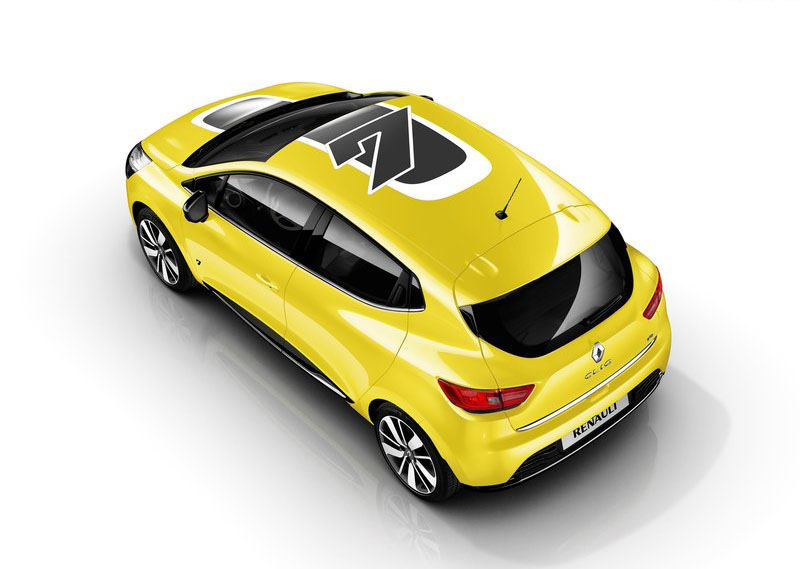
    Three different roof graphics.
    A choice of two colours for the 16-inch diamond-effect wheels and a choice of the 17-inch diamond-effect wheels.
    Seven interior decor packs which highlight different parts of the cabin with colours or motifs.
    Four interior ambience packs which co-ordinate the colour of the dashboard colour with that of the upholstery and door panels.

For the exterior:
    Exterior decoration elements are available in five different finishes: Chrome, black, Red, blue and Ivory. These finishes concern the grille, rear hatch and side protective moulding trims. In addition, the door mirror housings, rear bumper apron and side protective mouldings are picked out in gloss black lacquer.
    The roof graphics come in a choice of three different themes: 'Elegant', 'Sport' or 'Trendy'.
    The 16-inch diamond-effect 'Passion' wheels are available in a choice of two colours: Black or ivory.
    The 17-inch diamond-effect 'Drenalic' wheels will be available from November 2012 in a choice of our colours: Black, red, Blue or ivory.

For the interior:
Interior gloss colour touches are available in a choice of four colours (black, Red, blue, or Ivory) and echo the same three themes as the exterior graphics ('Elegant', 'Sport' and 'Trendy'). These highlights concern the steering wheel, door panels, gear lever surround and air vent surrounds and are directly incorporated using a technique known as insert moulding.

In the case of the Dynamique equipment level, customers can choose from four colours for the interior ambience (black, Red, blue or Havana). These colours apply to the dashboard trim strip and door panels, with a matching colour for the upholstery fabric. A finishing touch for each ambience comes in the form of colour co-ordinated carpet mats, available as accessories.

Purposely designed
The personalisation programme emphasises New Clio's assertive character. From the very start of the project, areas lending themselves to highlighting were incorporated into the model's design. Meanwhile, quality is assured by the fact that features are assembled at the factory.

Affordable and versatile
New Clio's personalisation programme means that made-to-measure looks are now available for a versatile five-door family car. The programme covers all the different engine variants and the best-selling versions, making it an affordable reality for the bulk of the model's customers.

Create and share your favourite Clio
Examples of Clios personalised with off-the-shelf configurations will be on display at dealerships from launch date to show customers the scope of possibilities opened up by the three different personalisation themes.

A dedicated website provides a taste of the range of personalisation possibilities available for New Clio. Web users can configure and view their ideal New Clio.

Packed with innovations
New Renault Clio is poised to shake up the market by bringing a number of technological innovations to a much wider audience. true to tradition, it also establishes a new benchmark for its class in terms of its performance and equipment packages. On the multimedia front, New Renault Clio packs an unprecedented double punch for this level of range, while audio quality has been boosted by the introduction of the Renault Bass reflex system, not to mention the availability of a reversing camera among the long list of equipment...

Advanced Bluetooth® radio from the entry level version
New Renault Clio features a range of Bluetooth® radios with audio streaming. Occupants can enjoy music stored on portable players and also benefit from hands-free use of their telephone. The radio has access to numbers stored on the driver's cell phone (depending on telephone), while the car is equipped with its own microphone. sound processing quality has been optimised and all radios come with a jack socket and a UsB port to charge and scroll through the menus of portable music players and cell phones.

Media Nav: essential multimedia functions
New Renault Clio proposes a choice of all-new multimedia solutions. built into the centre console, the Media Nav system provides all the basic multimedia functions and is standard equipment for two of the model's three equipment levels. Thanks to its seven-inch (18cm) touchscreen display, it is intuitive to use and, in addition to the radio, includes Bluetooth® connectivity for audio streaming and hands-free telephony. Portable music players can be connected via the fasciamounted USb port or jack socket. Media Nav also incorporates Nav N Go navigation with 2D and 3D (birdview) display. The UsB port and a dedicated web interface make it easy to update NAVTEQ maps.

Renault R-Link: an integrated tablet connected to the car and the Internet
Having been first on the market with notable innovations such as steering wheel-mounted remote control of the radio (1982, R11 Electronic) and in-car navigation (1994, Safrane); after bringing keyless entry to volume cars (in 2001) and GPS navigation with high-resolution graphics (Carminat TomTom®, priced at under €500 for Clio in 2009); and having launched on-board connected navigation in the shape of Carminat TomTom® LIVE for Clio, Renault continues its stream of innovations with Renault R-Link.

Available as an option for New Clio, Renault R-Link will certainly appeal to technically-minded motorists and provides a bridge between the vehicle and the connected world outside thanks to:
    A large seven-inch (18 cm) touchscreen display, intuitive voice commands and, a market first, a home page that can be personalised by the user for safe, simple access to key functions, without the driver having to take his or her eyes off the road.
    A menu with six icons which provide access to the six main functions: Navigation, Multimedia, Phone, Vehicle, Services and Applications, and System.
    TomTom® connected navigation including LIVE services: the market's best real-time traffic information service, minimisation of journey times and fuel consumption, plus Coyote Series alerts.
    A connection with the car's own electronic systems permits access to an advanced eco-driving function (Driving eco²) which analyses the driver's behaviour and provides advice to help reduce fuel consumption.
    Renault R-Link store, the automobile world's first ever evolving Application Store. Users can easily view or download a comprehensive selection of apps from their car or computer (via 'MyRenault').

Key functions and information available on the centre console
Renault R-Link's user-friendly seven-inch (18cm) touchscreen display forms an integral part of the modern centre console and provides a full range of multimedia functions (navigation, radio, bluetooth® telephony and audio-streaming, connectivity for portable music players, connected services, 'eco' driving, etc.) in one place for maximum comfort and enjoyment.

Renault R-Link ensures that information is available as and when it is needed, thereby avoiding the driver having to take his or her eyes off the road. Renault R-Link's touchscreen display permits fingertip control which doubles up with the steering wheel-mounted remote controls for the audio and telephone functions. Renault R-Link can also be controlled using intuitive voice commands to dictate the address of a destination for navigation purposes, for example, or to call up different functions using instructions such as 'telephone', 'apps', 'send an e-mail', etc. This facility makes use of the system even more practical and safer. The Text To Speech function (TTS) permits messages or RSS feeds to be read out loud.

R-Link apps cover a wide range of useful functions:
    Communication: e-mails, social networking, web navigation, etc.
    Journey optimisation: TomTom® LIVE services (HD Traffic®, speed control warnings [where authorised], TomTom Places, weather forecasts, Coyote Series alerts [where available], fuel prices, location of parking places, etc.).
    Practical information: personal phone numbers, Yellow Pages, hotels, restaurants, etc.
    Mobility: multi-mode journey planning, public transport.
    Budget guides: 'by-the-kilometre' insurance, Renault tips, etc.
    Vehicle information: monitoring of vehicle servicing, owner manual, etc.
    Entertainment and leisure: games, information, travel information, engine sound profile, personalisation, etc.
    Professional use: Fleet Managers will benefit from services for their business needs thanks to the vehicle connections

The apps developed for Renault R-Link are adapted for use by motorists, either by ensuring they are simple to use or by restricting access to certain functions while on the move. For example, functions which are overly interactive or long to use may only be used when the vehicle is at a standstill.

The catalogue of apps will cover a large spectrum of uses, extending from journey optimisation (TomTom LIVE services, fuel prices, location of parking places) and vehicle information (the monitoring of servicing, etc.), to budget guides ('by-the-kilometre' insurance, Renault tips, etc.), practical help (phone numbers, Yellow Pages, etc.), communications (e-mails, social networking, R-Tweet app) and entertainment/leisure (travel information, etc.) and emergency calls.

Renault's intention is to make R-Link store the benchmark automotive app store. To achieve this, it has favoured an open innovation strategy founded on input from major partners and development companies, as well as from start-ups which are brimming over with exciting ideas in the field of connected services and apps for automotive use. Partners in France include Pages Jaunes, La Poste, I-Dispo, Elle, balumpa, Michelin, Falk, Métro, Euronews, La Fourchette, Apila and NavX.

3D Sound by Arkamys®
All versions of New Renault Clio equipped with R-Link also benefit from 3D sound by Arkamys®. Thanks to special digital signal processing software, this system adds depth and texture to listening pleasure thanks to spatial positioning of the sound. Drivers can select where sound is to be directed in the cabin: for their ears only, for front occupants only or for all occupants.

Plus basic multimedia functions
To cater for the rapidly expanding use of portable music players, R-Link is equipped with bluetooth® audio and telephony connectivity, as well as a USB port and a jack input.

Bringing innovation to the widest possible audience
For enhanced safety and driving pleasure, nearly all the engines available for New Renault Clio incorporate hill start assist. When the driver lifts his or her foot from the brake pedal on a slope, the system - which is connected to the ESC - holds the vehicle stationary for two seconds, allowing the driver to pull away without the vehicle moving backwards. Every version of New Clio is equipped with esC, Asr traction control, ABs and emergency brake assist, as well as more direct variablerate electric power steering which ensures a level of agility that is particularly appreciable in built-up areas.

The standard equipment list also includes cruise control with speed limiter, while New Clio comes with 'motorway-mode' indicators, an extremely practical feature which produces three flashes of the indicator when preparing to overtake by lightly moving the indicator stalk.

Practical
New Renault Clio is an entirely keyless car. The key is replaced by an electronic card (depending on equipment level) which locks and unlocks the doors and permits the engine to be started without the driver removing the card from his or her pocket, bag, wallet, etc.

All versions of New Clio come with a height - and reach - adjustable steering wheel.

The long list of standard equipment is rounded off by electric, heated door mirrors, and electric front windows.

New Clio occupants benefit from plenty of practical stowage space located throughout the cabin:
    A tray in front of the gear lever which can hold items like a portable music player, mobile phone or portable CD player.
    A large seven-litre glove box capable of containing a 1.5-litre bottle of water.
    A 1.2-litre tray situated above the glove box.
    Two easy-to-access cup holders and additional stowage for small items between the seats at the foot of the centre console.
    Storage in the optional central armrest (almost one litre).
    Bins in each door designed to contain a 1.5-litre bottle of water.

A single switch allows all the windows of New Renault Clio to be demisted at the same time, while the climate control system has been improved to run even more quietly and more efficiently than that of Clio III.
Read More

Saturday, April 20, 2013

Qoros 3 Cross Hybrid Concept, 2013


  •  Qoros 3 Cross Hybrid Concept, 2013

At the 83rd Geneva International Motor Show, Qoros presents a five-door crossover - the Qoros 3 Cross Hybrid Concept - that features a compact hatchback body, enhanced traction properties and an advanced hybrid drive.

The concept illustrates how the design themes introduced in the Qoros 3 Sedan may be applied to its future model range. It also offers a glimpse ahead to the brand's future technological developments with a pioneering hybrid drive that not only enhances efficiency but that also provides an exceptional all-wheel driving experience.

The intelligent Qoros modular vehicle architecture is a key factor in ensuring that new models can be introduced quickly and efficiently, and the Qoros 3 Cross Hybrid Concept is based on the same vehicle platform as the Qoros 3 Sedan.

With the same long wheelbase (2,690 mm) and wide track as the sedan, the Qoros 3 Cross Hybrid Concept exhibits generous proportions and a solid, planted road presence.

Hallmark design features reinterpreted
The Qoros 3 Cross Hybrid Concept showcases a mild evolution of the styling introduced on the production sedan. Elegant lines and balanced proportions reflect sporty aspirations. Short body overhangs and the coupé-like roof line flowing into the hatchback tailgate give the five-door model a touch of dynamic flair. Horizontally oriented lines highlight the width of the boldly shaped rear, which featuresa large tailgate.

The front view of the concept is almost identical to the Qoros 3 Sedan, but the core elements of the Qoros 'face' are supplemented with bespoke accents. The lower air inlet at the bottom of the trapezoidal grille stretches further back, highlighting the concept's powerful front stature. Also distinctive are the rounded contours of the fog lamps, which are placed wide apart.

The headlamp clusters, featuring LED bars at their top edge as daytime running lights, are the same as those on the Qoros 3 Sedan, stretching far into the flanks and into a striking contour edge which runs through the door handles and rises continuously to the rear. The rear light clusters - unique to this concept, feature horizontal LED light bars in a neat compact arrangement.

Its raised ground clearance and specific design features that emphasise its robust, versatile characteristics hint at the Qoros 3 Cross Hybrid Concept's potential for excursions beyond the asphalt. It features underbody protection at the front and rear to protect against impacts, as well as uprated suspension and damper systems that ensure occupants remain comfortable even on rough terrain.

A combination of hybrid drive and all-wheel system for increased driving pleasure and efficiency

The development of advanced engineering innovations is a core strategic activity for the brand and the Qoros 3 Cross Hybrid Concept features an advanced hybrid drive system developed in partnership with leading electric drive systems specialist American Axle.

A three-cylinder 1.2-litre turbocharged petrol engine with 97 kW (130 bhp) is installed transversely at the front to drive the front wheels.

A 50 kW electric motor is housed between the luggage compartment floor and the rear axle, not only convenient for power transfer but also safely isolated from rear collision impacts. The motor is powered by a LG Chem lithium-ion battery with a maximum capacity of 1.9 kilowatt-hours.

A second electric motor - the Integrated Starter Generator (ISG) - is mounted between the petrol engine and the transmission. Its role, as well as to start the petrol engine more discreetly - with less noise and less vibration - than a traditional starter motor, is to charge the rear electric motor's dedicated battery so that the Qoros 3 Cross Hybrid Concept can operate continuously in all-wheel drive mode. And, during the most demanding driving, the ISG delivers additional power to the front axle, allowing the concept to deliver surprisingly swift performance: zero to 100 km/h is achieved in less than 7.0 seconds (provisional target, not yet verified).

Intelligent control software ensures seamless transition between petrol-engine front-wheel drive, electric motor rear-wheel drive, and all-wheel drive, depending on the most efficient mode to respond to the driver's inputs and the prevailing road conditions.

The Qoros 3 Cross Hybrid Concept can be driven in pure-electric mode at a speed of up to 120 km/h, and for a maximum range of approximately four kilometres (provisional target, not yet verified).
Read More

Friday, April 19, 2013

Porsche 911 Carrera, 2013


  •  Porsche 911 Carrera, 2013

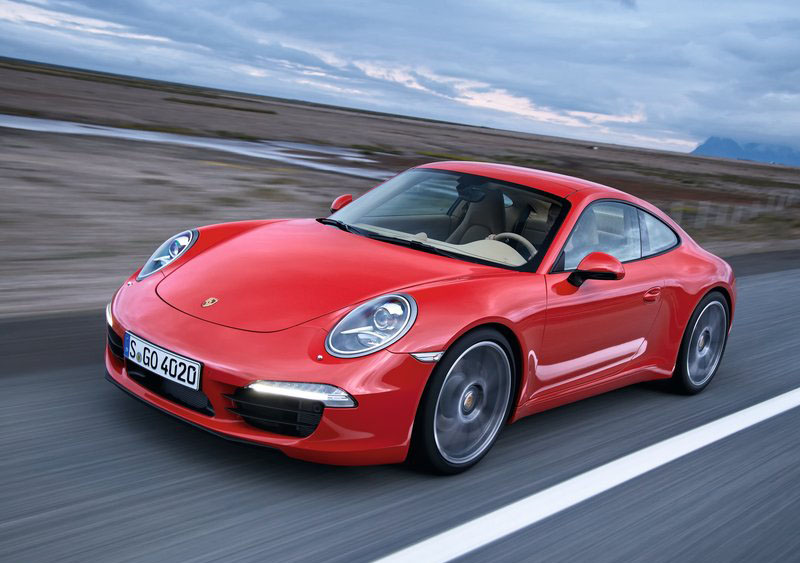
The new generation Porsche 911 Carrera is emerging from one of the biggest development steps in the long history of this classic sports car. Almost 90 per cent of all components have been redesigned or redeveloped. With its all-new lightweight body, further drivetrain efficiencies and new suspension systems, the Coupé offers the driver improved Porsche Intelligent Performance. This manifests itself in yet further enhanced driving dynamics, up to 16 per cent lower fuel consumption and emissions combined with even greater everyday practicality.

The Porsche 911 Carrera's design and proportions have developed in step with the technology. One of the most pronounced points of differentiation is the 100 millimetre (3.94 inch) longer wheelbase.The body on the other hand is only 56 millimetres (2.20 inch) longer overall lengthwise, the overhangs being shortened by 32 millimetres (1.26 inch) at the front and twelve millimetres (0.47 inch) at the rear. The Carrera's roof line is around seven millimetres lower than that of its predecessor and around six millimetres for the Carrera S. The maximum headroom remains virtually unchanged. For Coupés with a sunroof, which for the first time is of the electric slide/tilt type, headroom has even increased by 15 millimetres. With an overall length of just under 4.5 metres (176.81 inch) and a maximum width of approximately 1.8 metres (71.18 inch) the 911 Carrera remains the most compact sports car in its class.

The Porsche 911 Carrera's stylistic evolution is apparent from every angle. Viewed from the side, new styling, larger alloy wheels and the more convex windscreen contribute to the even jauntier, more coupé-like character. Typical of the revised, wider front end are the new headlights and larger side air intakes. The wider, variably extending rear spoiler emphasises the new 911 Carrera models' greater power output. Together with other aerodynamic optimisations, it also ensures significantly lower lift while retaining an equally good cd value. Redesigned, narrower LED technology rear lights complete the rear profile.

The Porsche 911 Carrera sets new standards in Porsche Intelligent Performance. The innovative aluminium-steel lightweight body, combined with a raft of new components and functions, benefits efficiency and driving dynamics in equal measure.

The new 911 Carrera is the first passenger car in the world to feature a seven-speed manual transmission as standard. It is based on the module of the optional seven-speed Doppelkupplungsgetriebe (PDK). The close ratio of the first six gears affords the driver outstanding acceleration capability, with the seventh gear's quasi overdrive attributes offering further scope for fuel economy.

The Porsche 911 Carrera is the first sports car that Porsche has equipped with an auto start/stop function. The system can save up to 0.6 litres per 100 kilometres based on the New European Driving Cycle (NEDC). The auto stop/start function is married with both the PDK and manual transmission as standard. The joint thermal management system for engine and transmission and on-board electrical system recuperation reduce the new 911 generation's fuel consumption by a further 0.35 l/100 km. As the new cooling design dispenses with ventilation openings in the underbody, it also affords aerodynamic advantages, which are of benefit to performance.

The "sailing" function, making its very first appearance in a sports car with the optional PDK transmission, can save up to one litre of fuel for every 100 kilometres in everyday driving. If the driver takes his foot off the accelerator, depending on the driving situation, the engine is disengaged from the transmission; the 911 Carrera continues on its way with the engine idling. Especially at higher speeds, this function taps additional potential fuel economies.

In the Porsche 911 Carrera, optimised fuel consumption is complemented by Porsche-style downsizing: The 3.4-litre engine delivers more power from a smaller displacement than its predecessor with a displacement of 3.6 litres. That means the Porsche 911 Carrera with PDK is the first Porsche sports car to make it below the 200 g/km CO2 emissions threshold.

With its completely revamped suspension featuring numerous redeveloped components, the Porsche 911 Carrera raises the driving dynamics bar yet another notch. The longer wheelbase alone, combined with the wider track width at the front, generates an entirely different geometry with more sure-footed tracking and roll stability at high longitudinal and cornering speeds.

With the new electro-mechanical power steering, the Porsche engineers managed to develop a system that combines Porsche's trademark precision and feedback with superior consumption and comfort for the very first time. As the system only requires power when steering, the electro-mechanical system saves at least 0.1 litres per 100 kilometres.

The new active Porsche Dynamic Chassis Control (PDCC), available for the Carrera S as an optional extra, expands the lateral dynamics boundaries yet again by a sizeable margin. PDCC is an active roll compensation system that detects the very instant the vehicle begins to roll when cornering, eliminating it almost entirely. The system makes for greater agility in every speed regime, improved cornering and stable load change behaviour. PDCC therefore represents a new highlight in terms of driving dynamics.

Making its debut in the Porsche 911 Carrera S, Porsche Torque Vectoring (PTV), featured as standard, ensures even better tracking and tracking stability, together with reduced sensitivity to load changes. Together with a seven-speed manual transmission, this system comprises a mechanical rear differential lock and variable torque distribution to the rear axle. In vehicles fitted with the Doppelkupplungsgetriebe (PDK), the even higher-performance PTV Plus comes with the electronically controlled, fully variable, rear differential lock. PTV or PTV Plus further improves agility and steering precision by means of selective braking interventions applied to the inside rear wheel. PTV and PTV Plus are also available for the 911 Carrera as an optional extra.

To complement the Porsche 911 Carrera's new exterior, the Porsche designers created an interior, the architecture of which takes its cue from the Porsche Carrera GT. The driver is now even more closely integrated with the cockpit thanks to the centre console rising up to the front with the high-mounted gear lever or gear selector located especially close to the steering wheel in typical motorsport fashion. The most important function and settings buttons for operating the vehicle are grouped in logical clusters on the centre console. Centrally located in the completely redeveloped dashboard, a larger seven-inch touch screen is used to control a rich array of functions. Naturally, the classic, established Porsche touches, such as the five round instruments with the centrally located rev counter and the ignition lock to the left of the steering wheel are also to be found in the new model. Also, both driver and front passenger are seated on newly developed sports seats with electric four-way adjustment. Additional sports seat versions with 14 and 18-way adjustment are also available as an option.

The new Porsche 911 generation made its debut in two versions
911 Carrera: 350 hp (257kW) 3.4-litre boxer engine; rear-wheel drive, seven-speed manual transmission, optional seven-speed Porsche-Doppelkupplungsgetriebe (PDK); acceleration 0 - 100 km/h (0-62 mph) in 4.8 seconds, with PDK in 4.6 seconds (4.4 seconds with Sport Chrono Package); top speed 289 km/h (179.6 mph), with PDK 287 km/h (178.3 mph); fuel consumption (NEDC) 9.0 l/100 km, CO2 212 g/km; with PDK 8.2 l/100 km; CO2 194 g/km.

911 Carrera S: 400 hp (294 kW) 3.8-litre boxer engine; rear-wheel drive, seven-speed manual transmission, optional seven-speed Porsche-Doppelkupplungsgetriebe (PDK); acceleration 0 - 100 km/h (0-62 mph) in 4.5 seconds, with PDK in 4.3 seconds (4.1 seconds with Sport Chrono Package); top speed 304 km/h (188.9 mph), with PDK 302 km/h (187.7mph); fuel consumption (NEDC) 9.5 l/100 km; CO2 224 g/km; with PDK 8.7 l/100 km; CO2 205 g/km.
Read More

Thursday, April 18, 2013

Pininfarina Cambiano, 2012


  •  Pininfarina Cambiano, 2012

It's a new approach to luxury in the car, according to Pininfarina's school of thought. The Cambiano is launched, a concept car that is elegant and sporty, refined and comfortable. An enticing combination of pure, cutting edge design and uncompromising engineering that respects the environment in both in the engine and in the choice of materials.

The Cambiano is an expression of Pininfarina today, embodying all the company's skills in terms of style, planning and research in the field of sustainable mobility. It is no coincidence that its chosen name is that of the town where Pininfarina has its headquarters. In 2012 the company celebrates a dual anniversary: the 30th anniversary of the Style Centre, which was set up in Cambiano in 1982 as "Pininfarina Studi e Ricerche", and the 10th anniversary of the Engineering Centre, which was inaugurated there in 2002, adding contract engineering to its activities of styling and niche design/production, and concentrating cutting edge technological tools and a team of outstanding specialists in one place.

The luxury sports saloon embodies the innovative archetypes of Pininfarina design in full. Another example was a milestone in the company's history, the Florida II, a concept car of 1957 which the founder Pinin Farina conceived and built for his own personal use, a saloon-coupé with an architecture and line that influenced global production for many years. In a way, it was Pininfarina's first real concept car.

Today, in 2012, the Cambiano redefines and reinterprets the ideas that are the basic tenets of Pininfarina design: harmonious proportions, taut lines and fluid surfaces, and a simple element that extends all along the side to underline its dynamism. The result is a very strong visual impact, emphasised by an extremely pure, aerodynamic shape based on essential and purely functional stylistic elements.

The Cambiano breaks with the general trend of design that is overloaded with elements, and confidently embraces the return of pure form as the absolute value, in the best "tradition" of Italian Style, reflecting the deepest essence of Pininfarina Design.

The Cambiano reveals its true character at first glance, starting from the unconventional layout of the doors: on the driver's side the car is a sports coupe with a single door, but on the passenger side there are two doors that open from the centre with no central pillar. This simplifies access and makes the most of the spacious, luminous passenger compartment.

The Cambiano is an expression of the car as a global project, and there is total consistency between every detail of the exterior and interior design, and between the colours, materials and the use of technology. Elegance and formal harmony blend in the association of complementary values: balance and contrast, the relation between full and empty, between solid and transparent. Formal purity and simplicity become elements of iconic design.

The proportions of the Cambiano convey dynamism and fluidity, thanks to the low tapered front and the light, fleeting rear-mounted cabin. The body of the car is one of simple, solid volumes, with large taut but sensual surfaces, enhanced by the innovative golden grey colour and iridescent blue reflections specifically developed for this project by Standox. The metal inserts in the sides are a new take on decorative mouldings and they continue all along the side glazing, incorporating the lighting and opening functions of the doors. The large honeycomb roof is ethereal and transparent and completes the body of the car, imparting a sense of solidity and of elegant refinement.

The front, with its clean, essential design, returns to a motif that is typical of Pininfarina: headlights incorporated into the grille and protruding wheel arches. The grille also incorporates a dynamic opening that is an air inlet for the turbo. The LED front headlights are simple "blocks" of pure, crystalline light. The tail lights and side indicators are almost intangible: only the light exists, appearing as if by magic on the surface of the bodywork. In the purest spirit of Pininfarina, the essentiality of the form becomes a very elegant expression of pure function.

The light is an integral part of the Cambiano design concept, inside and out. The relationship with natural light is simplified by the panoramic roof, which is translucent in some areas and transparent in others. With a carbon honeycomb structure mounted between the outside glass and a polycarbonate inner lining, the roof enhances visibility in the car - heightening the sense of luminosity and space inside.

The light is not only a natural element, but also emphasises the sensory experience of the passenger compartment thanks to a refined and functional lighting system, which exploits light channels inserted into the ceiling, the doors and the floor. The Cambiano is the first car to incorporate into the passenger compartment a contemporary video-art projection, created specifically by the Spanish artist Javier Fernandez with a very personal language of manipulated, overlapping images. The work is projected onto the ceiling where it can be enjoyed by rear seat passengers during the drive. Contemporary art, a preeminent feature of luxury, is thus incorporated into the concept of the car, leaving behind its elite aura and becoming accessible.

The complementarity between apparently contrasting elements is also expressed in the interior. Natural materials contrast with sophisticated details, and the physicality of pure matter with the immateriality of the most advanced forms of communication, which simplify the interaction between the driver and the car and his surroundings. It is a fascinating mixture of luxury craftsmanship and innovation: exclusive materials and outstanding manual work combined with the use of advanced technologies and innovative concepts.

Elegant and modern design converges in the interior with comfort, ergonomics and environmental sustainability, maintaining the same stylistic approach of the exterior. Fluid, sensual surfaces, a light, essential environment, with clearly defined functional zones: interactive controls and surfaces turned towards the driver, a more comfortable and tactile area for the other passengers. A fine, light facia, light but enveloping front seats suspended between the consoles and the sill, in a delicate balance between solid and hollow designed to create tension. The asymmetrical access to the passenger compartment determines the leaf structure of the two rear seats, which are almost suspended in the car, where occupants enjoy an environment that is made more comfortable and refined by the generous legroom. The interior is upholstered with Foglizzo leather, personalised in certain points with a special diamond point punched patter. The leather used on the Cambiano was chosen from the Pininfarina Leather Collection for Foglizzo, a collection of personalised natural and imitation leathers developed by the two Turin companies. The uprights and door panels are upholstered with polylactic acid, a plastic derived from sugar substances, treacle and milk serum, a solution that reduces the use of petroleum.

Like the entire lower part of the passenger compartment, the perfectly flat floor is made of recycled wood. This is the strongest and most typical element of the interior of the Cambiano, the fusion of matter and transformation, technological research and respect of cultural and environmental values. A choice dictated by the discovery of a wonderful material, which is both poor and noble: the wood of the "briccole", the poles of European oak used to indicate the navigation channels and moorings inside the Venice lagoon.

Riva1920, a historical Italian producer of solid wood furniture that has been working with Pininfarina Extra for over ten years, had the brilliant idea of recuperating the wood of these 12 metre poles, thousands of which are replaced every year. The wood is marked by the lagoon water and by marine microorganisms, which come alive again, creating a new manufact that is destined to last. Following the same principle, Riva1920 has created all the wooden elements for the interior of the Cambiano, using numerical control milling machine followed by manual final polishing and oiling. The result is surprising and evocative. The material is about to embark on its third lease of life, and it reveals its unique texture and the wear and tear of passing time: the holes made by the marine molluscs are still visible on the surface. Not only. This complex, delicate technological craftsmanship makes the interior of the Cambiano something unique that expresses an outstanding level of creativity and experience, thanks to this eco-friendly re-use of a natural, discarded material with the enormous evocative force of the huge cultural, emotional and artistic dimension attributed to Venice all over the world.

The atmosphere of extreme refinement in the car is underlined by another precious detail in the instrumentation: the timepiece manufactured in Limited Edition by the Swiss watchmaker Bovet 1822. This "Cambiano" Chronograph designed by Pininfarina can be removed from the dashboard and worn as a wristwatch, or used as a sports timer and even a table clock, due to its convertible concept.

The instrumentation of the driving position is divided into three priority zones according to use: the car's functions and performance, navigation and comfort, multimedia and connections. The main display shows the power delivered by the 4 electric motors backed up by the turbine, the battery charge and the fuel gauge, the total range and the range with all-electric operation, the driving mode (Ecocity, Snow/Ice, Efficiency, Sport, Drifting), and the speedometer. The driver monitors the navigator, the warning messages and the multimedia functions on the secondary display. The "swap" control transfers the navigator and other functions to the central display and vice versa. And a touch pad gives access to the interactive instrumentation and climate control. The driver controls the lights and the gear selector on the steering wheel, while the "Start" control and a device holder are on the centre tunnel.

The attention paid to detail is evident from the work carried out on the tyres. For the Cambiano Pininfarina specifically developed with Fate, Argentina's largest tyre production and exporting company, the first tyre for top of the range cars, Concept Tyre, from Eximia by Pininfarina. Fate's experts engineers contributed with precise studies and creative capability, making possible a further step in design, technology and security. Concept Tyre, from Eximia by Pininfarina, synthesizes the last progresses in the search of perfection: environmental care, superior constructive quality, and an advanced esthetic model.

Cambiano: new architecture, a generous range and maximum attention to environmental sustainability

The Cambiano also sets new parameters for eco-sustainability in the high performance luxury car segment, its strong points include electric drive which guarantees zero emissions in the urban cycle and a range with all-electric operation that is higher than any offered on the market today. And how could it be otherwise on a concept car from Pininfarina, whose genes have always included sustainable mobility, now one of the pillars of the company's industrial plan?

Pininfarina was concentrating on aerodynamics and alternative sources of energy as early as the 1970s: for example, with prototypes like the CNR Energetica 1 or Ecos, the first electric car developed by Pininfarina. In the 1990s Pininfarina offered new solutions with the Ethos, a family of 3 cars with an aluminium chassis, a body of recyclable resin, and an innovative combustion engine with low emissions, culminating in 1995 with the Ethos 3EV, another zero emissions car. More recently Pininfarina engineers turned their attention to research into hybrid vehicles with the Eta Beta and Metrocubo projects, the focussing on safety in 2004 with the Nido. In 2008 the Sintesi proposed a futuristic concept cap supplied by 4 fuel cells (one per wheel). Which brings us to the present: the BlueCar in 2008, the Nido EV in 2010 and the Hybus in 2011, a project to convert buses currently equipped with Euro 0-1-2 engines into buses with serial hybrid power packs.

This consolidated technological expertise and the ability to manage cutting-edge projects with great flexibility and innovation are expressed in the Cambiano. The perfect integration of the styling and engineering activities has produced an extended range plug-in electric car that combines top performance and roominess with the comfort of a luxury car and total respect of the environment. The type of engine chosen and the position of the battery pack in the rear of the car (under the luggage compartment) have created a vehicle architecture with a perfectly flat floor, that is regular and low, guaranteeing excellent access, liveability on board and a lower centre of gravity.

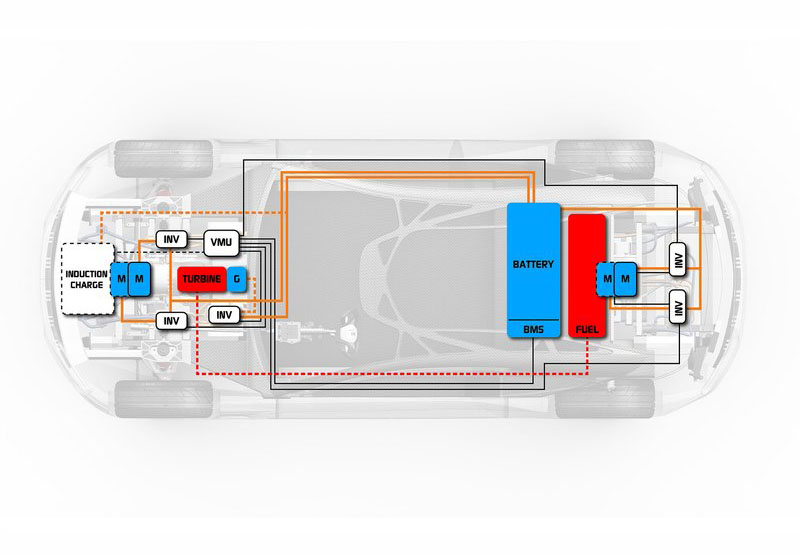
The drive system is based on four electric motors, one for each wheel, and the respective deceleration unit. The four motors, which are produced by Magneti Marelli, are mounted on the front and rear frames and each delivers a continuous supply of 60 kW with peaks of 150 kW for a total of 600 kW maximum power output, with torque of 640 Nm. Each motor is controlled separately and electronically to guarantee various functions, including energy regeneration when decelerating and braking, traction control with the option of continuously varying the torque split between the wheels independently (Vectoring Stability Program) and anti-lock braking assistance. The traction control strategies make the vehicle even more enjoyable to drive, guaranteeing outstanding performance and maximum safety over all types of routes.

The drive system incorporates an APU (Auxiliary Power Unit) to charge the batteries and, when necessary, to supply energy directly to the motors: this is a 50 kW Bladon Jets micro turbine which normally runs on diesel but which can be calibrated to be compatible with various types of fuel. In addition to this advantage, the turbine is smaller than those of piston engines with a similar power delivery, it weighs just 40 kg, and generates low polluting emissions. The micro turbine chosen for the Cambiano has technical features that make it particularly quiet and vibration-free, enhancing comfort for passengers. This type of extended range electric drive is thus amply in line with EURO 6 legislation, and is already compatible with possible evolutions (EURO 7 ready).

The battery pack developed by FAAM is installed between the seats and the rear axle, where it is protected from possible collisions and easily replaced during servicing. The battery is of the high power, high energy density lithium ion type, has a capacity of 50 kW/h, a peak power delivery of 500 kW, and can be recharged in 6 hours using a 6 Kw/h grid and in 52 minutes with the APU. Combined with the micro turbine, it guarantees a range of 205 km in the urban cycle in all-electric mode, and a total range in the NEDC (New European Driving Cycle) mixed cycle of over 800 km in extended range mode, higher than that of luxury sports cars with conventional drive systems. The battery is the fruit of FAAM's experience in the development of lithium batteries. FAAM's research into lithium ion cells will make it possible in the short term to achieve specific energy density values that are more than double those of lithium ion batteries currently on the market. This, associated with a larger specific power reserve, will make it the ideal solution for future electric cars. This result has been made possible by the improvement in the specific capacity of the electrodes: current anodic and cathodic materials are replaced by materials with a higher specific capacity, cells with high potential cathodes based on lithium nickel manganese oxide, LiNi0.5Mn1.5O4, with a spinel structure.

The composition of the pack is simplified by the small size of each cell, which allows for a certain amount of flexibility and adaption when installed on the vehicle. The battery case was designed to respect current crash test standards and it complies with ISO 26262 vehicle safety regulations. The battery is liquid cooled and protected by an insulating casing that guarantees that it will function in all use conditions, with a temperature range of da -20° C to +60° C. Battery functioning is monitored by a BMS (Battery Management System) unit, which verifies that the individual cells operate within the established normal functioning range. In the event of a malfunction, the battery is immediately isolated from the rest of the vehicle.

The Cambiano's generous range was achieved by the innovative drive system, by focussing attention on aerodynamic efficiency, obtained in the Pininfarina Wind Tunnel, and by a significant weight reduction: the Cambiano weighs 1695 kg empty, an excellent result if we consider the size of the car. The chassis is light, resistant and modular, comprising a carbon fibre cell for occupants and two aluminium modules, one at the front and one at the rear, which act as crumple cells, absorbing impact and supporting all the mechanical parts. This engineering solution allows the same modules to be used for an entire family of derived vehicles. The central cell can be built with materials and dimensions that will allow it to adapt to the various requirements of cost, manufacturing volumes and furnishings of the cabin of a future derived vehicle The front and rear structural modules will also adapt effectively to different wheelbases and tracks.

Where the energy management system is concerned, the objective is to minimise consumption and polluting emissions into the atmosphere, keeping turbine operating times to a minimum. This is triggered automatically when the battery charge falls below 20% of maximum capacity and turns off automatically when the speed is below 50 km/h (like restricted traffic areas in city centres). When necessary, the driver can activate or deactivate the turbine manually. On the road, the need to generate energy with the micro turbine will depend on how the vehicle is used, on the type of route (urban, rural, out of town) and on traffic. This information can be obtained by GPS navigator. The turbine can be controlled ready to generate a certain calculated quantity of energy, trying to keep its ignition and operating times to a minimum.

The Cambiano also delivers road-holding at physical limits in all road conditions and types of use. The driver can choose his preferred driving mode using a selector lever. For example, the Ecocity mode zeros local emissions, activates exclusively electric drive and excludes the turbine. In Snow/Ice mode, the load sensors on the four suspension units calculate the available friction coefficient: this automatically limits performance. Efficiency mode regulates the acceleration and top speed to maximise the range, but does not penalise enjoyment excessively. The Sport mode makes driving more exciting, accelerating from 0 to 100 in 4.2 sec, and limits the continuous top speed to 250 km/h. And finally, with Drifting mode, the individual control of the electric motors artificially sets the behaviour of the limited slip differentials. It is also possible to adjust the front/rear drive split so that the vehicle can be driven in rally mode, underlining the entertainment of driving on snow-covered or dirt roads.
Read More