Monday, April 8, 2013

Land Rover Defender Electric Concept, 2013


  •  Land Rover Defender Electric Concept, 2013

Land Rover is continuing to champion British innovation and cutting-edge automotive engineering by unveiling seven new Electric Defender models at the 2013 Geneva Motor Show. The research vehicle delivers zero emissions while retaining its tough, go-anywhere capability.

"Investing in innovation has always been the lifeblood of our business and our engineering teams are working hard to develop innovative new technology to provide sustainable motoring solutions," said John Edwards, Land Rover Global Brand Director.

The standard diesel engine and gearbox have been replaced by a 70kW (94bhp), 330Nm electric motor twinned with a 300-volt, lithium-ion battery with a capacity of 27kWh, giving a range of more than 50 miles. In typical, low speed off-road use it can last for up to eight hours before recharging. The battery can be fully charged by a 7kW fast charger in four hours, or a portable 3kW charger in 10 hours.

The electric vehicles (EVs) retain the Defender's legendary four-wheel drive system and differential lock. Because the electric motor delivers maximum torque from the moment it starts, there's no need for gear shifting and the transmission comprises a single speed, 2.7:1 reduction gearbox combined with the existing Defender four-wheel drive system. A modified version of Land Rover's Terrain Response® System has also been incorporated.

The vehicles were developed by Land Rover's Advanced Engineering Team following successful trials of the Defender-based electric vehicle, Leopard 1. The vehicles' capability has been tested in extreme and environmentally sensitive conditions, demonstrating capabilities not shared by conventional road-going EVs. Trials included pulling a 12-tonne 'road train' up a 13 percent gradient and wading to a depth of 800mm.

In keeping with Land Rover's 'Tread Lightly' philosophy the smooth, low-speed capability of the electric drivetrain makes the Electric Defenders especially well suited to climbing obstacles without damaging the ground unnecessarily.

The battery weighs 410kg and is mounted in the front of the Defender in place of the diesel engine. Kerb weight is 100kg more than a basic Defender 110 and ranges from 2055kg to 2162kg depending whether the body style is a pick-up, hard top or station wagon.

All the major components in the electric powertrain - including the battery, inverter and motor - are air-cooled rather than liquid cooled, saving a considerable amount of weight and complexity and adding robustness. Regenerative braking has been optimised to such an extent that using Hill Descent Control, the motor can generate 30kW of electricity. Because the battery technology can be charged very quickly at a rate of up to twice its capacity of 54kW without reducing battery life, almost all of the regenerated energy can be recovered and stored. Up to 80 percent of the kinetic energy in the vehicle can be recovered in this way, depending on conditions.

Though there are no plans for the all-terrain Electric Defender to enter series production, the seven EVs will go into service in specialist applications later in 2013.
Read More

Sunday, April 7, 2013

Kia Ceed SW, 2013


  • Kia Ceed SW, 2013

Just three months after the arrival of the stylish all-new Kia cee'd hatchback a second model joins the family - the Kia cee'd Sportswagon. Replacing the former Kia Ceed SW, it introduces a new model name which perfectly captures the new car's character: adventurous, sporty, modern and technologically advanced, but with even more of the practicality and value which made its predecessor a major success in the UK fleet and business market.

The Kia cee'd Sportswagon was revealed alongside the cee'd hatchback at the 2012 Geneva Motor Show, and matches it throughout for style, quality, technology, equipment and safety. Like its predecessor, it was designed and engineered at Kia's Frankfurt design studios and technical centre, and is made at the company's Žilina plant in Slovakia. The cee'd Sportswagon is exclusively for European markets.

The Kia Ceed SW has been one of Kia's leading models in the fleet market, and this year it is outselling the hatchback among business users. With more daring styling and advanced technology features, the cee'd Sportswagon is expected to have even more widespread appeal among user-choosers.

With the fleet market so dominant, the cee'd Sportswagon will be sold exclusively in the UK with advanced and highly efficient turbodiesel engines. With their high torque outputs and low operating and running costs, they are ideally suited to the heavy loads and high mileages often inflicted on estate cars by business operators.

The entry-level 89bhp 1.4 CRDi engine develops 220Nm of torque from just 1500rpm, while the 126bhp 1.6 CRDi raises the torque output to 260Nm from only 1900rpm. Both transmissions, including the automatic offered with the 1.6-litre engine, are six-speed units, while manual-gearbox models are fitted with Kia's Intelligent Stop & Go (ISG) fuel-saving, emissions-reducing engine stop/start technology.

As a result the 1.4-litre Kia cee'd Sportswagon is capable of 67.3mpg and has CO2 emissions as low as 109g/km, which means a Benefit-in-Kind (BIK) taxation rate of 15 per cent in 2012-13. Manual 1.6-litre versions, with CO2 emissions of 116g/km, fall into the 17 per cent BIK band, and are almost as sparing in their use of fuel, with official combined economy of 64.2mpg. With prices starting at £16,895 and rising to £24,795, and low maintenance and insurance costs, the new Kia cee'd Sportswagon will be an inexpensive car to run for business motorists and fleet operators, as well as private consumers.

Practical matters
On a practical level the new Kia cee'd Sportswagon will also appeal to those looking for a stylish and capacious estate car with the smallest possible footprint. At just over 4.5 metres long the Kia cee'd Sportswagon is more compact than its major European rivals, and just 15mm longer than the cee'd SW. Yet it offers greater luggage capacity than the majority of the competition - 528 litres up to the load cover with all seats upright and 1642 litres up to the roof with the 60:40 split rear seats folded flat.

Ease of loading has also been taken into consideration. The boot floor is flush with the tailgate opening and 60:40 split rear seat bases and backrests fold to ensure a completely flat load deck. Every version of the Kia cee'd Sportswagon has an under-floor storage compartment and side load areas, a retractable luggage cover, load-securing net hooks, a boot light and a 12-volt boot-mounted power socket.

Higher-specification models also have sliding aluminium luggage area rails and straps plus a high-level luggage barrier net to secure objects and prevent them from falling into the passenger compartment. Roof rails are standard on every model so that extra cargo can be carried outside the car. The cee'd Sportswagon has a payload of up to 500kg and can tow a braked trailer of 1500kg (manual versions).

Putting the 'sports' into Sportswagon
To ensure that the cee'd Sportswagon has the lean, lithe silhouette that its name suggests, it is not only a fraction longer than the previous cee'd SW but also 10mm narrower and 40mm lower, while still managing to offer full five-seater family space. Unusually for an estate car in its class, it has different rear doors to the cee'd hatchback so that the stylish upward sweep of the lower window graphic can continue all the way to the rear of the car without making the cabin dark or claustrophobic for passengers travelling in the back.

As with the new cee'd hatchback, the wheelbase - one of the longest in class at 2650mm - is unchanged, but the track widths have increased by 17mm at the front and 27mm at the rear to give the car a sportier stance and, along with revised suspension geometry, greater high-speed stability and cornering prowess. The cee'd Sportswagon remains unusual in its class in having fully independent front and rear suspension, with inherent advantages for ride and handling. These have been honed even further in the new car.

The Kia cee'd Sportswagon has a more sporty and premium look and feel than its predecessor, emphasised by its radically different proportions. It has a more cab-forward design and a rakish, coupé-like roofline which gives it a sportier stance and greater presence. Even the Kia badge is new - simpler, sleeker and more modern, with 'Kia' script in a raised section. At the front it is now mounted on the bonnet rather than in the radiator grille - another premium-class upgrade.

No stone has been left unturned in the quest to ensure the cee'd Sportswagon is more than a match for its European rivals. Every detail of the previous model came under scrutiny. If something needed to be changed, it was. One seemingly insignificant detail is the fuel-filler flap. In the Far East and America buyers like a separate release lever inside the car, while Europeans prefer it to be linked to the central locking system so that it can be opened with just a push - so that's what you will find.

European quality, safety and technology
The improvements in quality in the cee'd Sportswagon are actual as well as perceived. The tight shutlines would not look out of place on a premium-price luxury car, while most versions have an elegant chrome window surround. The entry-level model has a chromed grille surround, while all other versions have a graphite chrome surround with a black high-gloss mesh grille.

First impressions are matched when stepping into the cabin. Soft-touch surfaces, high-quality materials and lidded storage areas, subtle red ambient lighting, tactile door grab handles and precise panel gaps combine to give the interior of the cee'd Sportswagon a solid, mature, made-from-a-mould feel. This is emphasised by the improved refinement of the latest car. Torsional body strength has been increased by 51 per cent over the previous model. The windscreen is now bonded in rather than mounted in a seal, thus shutting out more exterior noise and adding to body rigidity. There is more filling in the pillar areas, new-style weather strips around the door frames, restyled door mirrors and thicker front door glass. All play a part in adding to refinement. Even the sealing strips on the door sills have been modified to make it more difficult for noise to enter the cabin.

The stiffer bodyshell is the result of a comprehensive package of reinforcements in critical areas with the aim of making the new Kia cee'd Sportswagon not just among the most efficient in its class, but also the safest. In total, 57 per cent of the new body is made from high-tensile steel, with ultra-high-tensile steel in the B-pillar structures.

There is an i-type subframe with a more rigid front apron, dashboard and side members. Horizontal and centre tunnel supports have been added in the dash area. The A-pillars, inner door rail and upper and lower body structures have been reinforced. New transverse cross-members link the front and rear suspension mounts, while the angle of the front side crash members has been decreased for better deformation. And there is a ring-type support around the rear roof rail and tailgate opening. The cee'd Sportswagon also provides better pedestrian protection in the event of a collision, and is easier and cheaper to repair after a low-speed (9mph or lower) accident.

The extensive standard active and passive safety equipment of the previous generation cee'd SW - including Electronic Stability Control (ESC), Vehicle Stability Management (VSM), Hill-start Assist Control (HAC) and six airbags - has been supplemented with new features in the Sportswagon. All versions have Emergency Stop Signalling (ESS), which causes the rear brake lamps to flash in an emergency stop to alert following drivers. Depending on model, static and active cornering lights, a colour reversing camera, a Parallel Park Assist System (PPAS) which automatically steers the car into kerbside spaces and a Lane Departure Warning System are also available.

Driver and passenger comfort have also been substantially upgraded. Most models now have a Flex Steer function within the standard Motor Driven Power Steering with three settings - Comfort, Normal and Sport - so that the level of assistance can be increased when parking and decreased to make the car more stable at highway speeds.

An electronic parking brake, a heated steering wheel, automatic lights and wipers, larger vents to deliver more air to the rear footwells, dual-zone automatic air conditioning with soft and fast air-flow modes, 10-way adjustable driver's memory seat and electric lumbar support are all new features for Kia's mid-sized estate car.

The audio systems have been upgraded and are now fully integrated into the dash for a higher-quality appearance, and feature improved functionality. They incorporate Bluetooth with voice recognition in 10 languages and music streaming, iPod connectivity through the original iPod cable and 600Mb of MP3 memory within the head unit. The high-grade Audio plus Navigation system now has a 20 per cent more powerful control unit and permits voice recognition in 13 languages, full UK postcode entry when setting navigation instructions, Traffic Messaging Channel information and full phone number download from the owner's mobile telephone.

The Kia cee'd Sportswagon in the UK
The cee'd Sportswagon is available in four trim grades - named '1', '2', '3' and '4' in the now-customary Kia UK fashion - with the option of a '4 Tech' version of the cee'd Sportswagon '4'.

All models from the '1' feature a comprehensive list of standard equipment, including luggage area under-floor tray and side tray, a retractable and removable load cover, a boot light and a rear 12-volt power socket and roof rails. Also standard are electrically adjustable heated door mirrors, tilt and telescopic steering wheel adjustment and a height-adjustable driver's seat, air conditioning, steering wheel-mounted controls, front electric windows with auto up and down function, daytime running lights, remote central locking, cooled glovebox, flat-folding 60:40 split rear seats, ambient front lighting, an iPod-compatible audio system with radio and CD player, USB port and Bluetooth connectivity, ESC and VSM, HAC (Hill-start Assist Control), six airbags, speed-sensitive auto door locking and alloy wheels on all 1.6-litre versions.

cee'd Sportswagon '2' adds cornering lights, LED daytime running lights and rear combination lamps, electrically folding and heated door mirrors with LED indicators and kerbside lights, leather trim on the steering wheel, gearshifter and handbrake, greater use of chrome highlights, a rear centre armrest, all-round electric windows, luggage net, cruise control with speed limiter, reversing sensors and the Flex Steer function.

cee'd Sportswagon '3' has in addition privacy glass, automatic headlights with a 'follow-me-home' function, rain-sensing front wipers with de-icing elements, a height-adjustable front passenger's seat, electric lumbar support on both front seats, black and silver seat cloth, auto-dimming rear-view mirror, dual-zone automatic air conditioning with two-step air-flow control and a seven-inch touchscreen satellite navigation with European mapping, UK postcode entry with built-in colour reversing camera.

cee'd Sportswagon '4' introduces the luggage area rail and partition system and barrier net, larger (17-inch) alloys, exterior illumination on the front door handles, black leather seats with contrasting grey inserts and three-stage heating, a heated steering wheel and electronic parking brake, an engine stop/start button and smart entry system, rear air ventilation, a premium centre console with sliding cover and a speed and multi-function LCD high-definition colour display, while the cee'd '4 Tech' is distinguished by its panoramic sunroof, 10-way power-adjustable driver's seat with memory, Parallel Park Assist System including front parking sensors, Lane Departure Warning System and Xenon adaptive front lighting system with automatic levelling.

As with every Kia, the new cee'd Sportswagon comes with a fully transferable seven-year, 100,000-mile warranty.

KIA cee'd SPORTSWAGON: BUSINESS CLASS
The Kia Ceed SW has been one of Kia's leading models in the fleet market, and this year it is outselling the hatchback four-to-one among business users. With more daring styling and advanced technology features, the new cee'd Sportswagon is expected to have even more widespread appeal among user-choosers.

The success of Kia's compact estate car in the business market has been built not just on price but also on its value-for-money specification, and this is even more evident with the more highly equipped cee'd Sportswagon.

Even the entry-level cee'd Sportswagon '1' leaves nothing to be desired. Highlights of the standard specification include electrically adjustable heated door mirrors, tilt and telescopic steering wheel adjustment and a height-adjustable driver's seat, air conditioning, steering wheel-mounted controls, Bluetooth, an iPod-compatible audio system and alloy wheels on all 1.6-litre versions.

Further up the range, cornering lights, cruise control with speed limiter, reversing sensors, Flex Steer, automatic headlights and front wipers, dual-zone automatic air conditioning, a seven-inch touchscreen satellite navigation system, leather seats, a speed and multi-function LCD full colour display, a panoramic sunroof, 10-way power-adjustable driver's seat with memory, a Parallel Parking Assist System, Lane Departure Warning and Xenon adaptive front lighting are fitted, depending on model.

And as with every Kia, the new cee'd Sportswagon comes with a seven-year, 100,000-mile fully transferable warranty.

With the fleet market so dominant, the cee'd Sportswagon will be sold exclusively in the UK with advanced and highly efficient turbodiesel engines. With their high torque outputs and low operating and running costs they are ideally suited to the heavy loads and high mileages often inflicted on estate cars by business operators. The 1.4-litre CRDi turbodiesel engine is new to Kia's compact estate model, while the 1.6-litre CRDi turbodiesel develops 5Nm more than that in the previous Kia Ceed SW.

Six-speed gearboxes become standard across the range. Manual-gearbox models are fitted with Kia's Intelligent Stop & Go (ISG) fuel-saving stop/start technology, which means improved fuel economy, lower CO2 emissions and a Benefit-in-Kind (BIK) taxation of 15 per cent for the 1.4 CRDi and 17 per cent for the manual 1.6 CRDi in 2012-13.

With prices starting at £16,895 and rising to £24,795, fuel economy of well over 60mpg for all manual models and low maintenance and insurance costs, the new Kia cee'd Sportswagon will be an inexpensive car to run for business motorists, fleet operators and retail customers.

Servicing
Routine servicing is needed only once a year or every 20,000 miles for both petrol and diesel versions.

Care-3 - Kia's servicing package for retail customers - is available for the cee'd Sportswagon and offers a fixed cost and inflation-proof servicing for the first three or five years. All work will be carried out by trained product technicians, using genuine Kia replacement parts and specified oils.

The Care-3 package is just £299 including VAT, which covers the first three services, while the Care-3 Plus package is £549 including VAT which covers the first five services.

Both packages are transferable should the vehicle be sold, and if a vehicle with a Care-3 package is sold on the new next owner may upgrade to the five-year service package. The cost of the vehicle's first MoT test fee can be included for an additional £30.

EUROPEAN BY DESIGN
The cee'd family is fundamental to Kia's policy of creating specific cars in and for the markets where they are sold, and the Kia Ceed SW and new cee'd Sportswagon perfectly illustrate that. While there is little or no appetite for estate cars in the Korean domestic market, Kia recognises their importance in Europe, and planned one right from the start of the design stage for the first cee'd family.

The cee'd range is designed and engineered at Kia's Frankfurt design studios and technical centre, and is made at the company's Žilina plant in Slovakia. It is sold exclusively in European markets. From the outset, it was therefore imperative that it was seen as European - not just in styling and ride and handling, or through the availability of state-of-the-art diesel engines, but also in the hundreds of small details which separate European preferences from those in other parts of the world.

Haptics - how things feel and move - and ergonomics, the placement of controls and inter-relation between them, were of paramount importance and played a large part in the design. Europeans like handwheel-type seat adjusters because they offer a fine degree of backrest angle variation, for instance, and they prefer the indicator stalk on the left of the steering column rather than the right. The cee'd designers took note of this. In Europe, quality is also as much about how things feel and look as it is about durability, so the designers also addressed these issues.

For the new cee'd range there is an even finer amount of small detail to ensure the car is in many ways more European than its European competitors. No stone has been left unturned. Every detail of the previous model came under scrutiny. If something needed to be changed, it was. One seemingly insignificant detail is the fuel-filler flap. In the Far East and America buyers like a separate release lever inside the car, while Europeans prefer it to be linked to the central locking system so that it can be opened with just a push - so that's what you will find.

In cold, hard figures, the cee'd Sportswagon is 15mm longer, 10mm narrower and - partly as a result of a 10mm reduction in ride height - 40mm lower than its predecessor. The wheelbase, one of the longest in class at 2650mm, is unchanged, but the track widths have increased by 17mm at the front and 27mm at the rear to give the car a sportier stance and, along with the revised suspension geometry, greater high-speed stability and cornering prowess.

At just over 4.5 metres long the cee'd Sportswagon is more compact than all its major European rivals, yet it offers greater luggage capacity than any of them - 528 litres up to the load cover with all seats upright and 1642 litres up to the roof with the 60:40 split rear seats folded flat. This is 10 per cent more than at least one leading European estate car.

Ease of loading has also been taken into consideration. The boot floor is flush with the tailgate opening and the 60:40 split rear seat bases and backrests fold to ensure a completely flat load deck. Every version of the cee'd Sportswagon has an under-floor storage compartment and side load areas, a retractable luggage cover, load-securing net hooks, a boot light and a 12-volt boot-mounted power socket.

Higher-specification models also have sliding aluminium luggage area rails and straps plus a luggage barrier net to secure objects and prevent them from moving around in the rear. Roof rails are standard on every model so that extra cargo can be carried outside the car. The cee'd Sportswagon has a payload of up to 500kg and can tow a braked trailer of 1,500kg (manual versions).

The most obvious change between the Kia Ceed SW and the cee'd Sportswagon is found in their proportions. The new model has a more cab-forward design and a rakish, coupé-like roofline which gives it a sportier stance and greater presence, without impinging on the original car's outstanding passenger space. Unusually for an estate car in its class, it has different rear doors to the cee'd hatchback so that the stylish upward sweep of the lower window graphic can continue all the way to the rear of the car without making the cabin dark or claustrophobic for passengers travelling in the back.

Kia's Chief Design Officer Peter Schreyer says: 'We wanted to build on the strengths that have already made the first-generation model such a success, but with added emotion and character and improved proportions and stance.'

The athletic appearance of the new cee'd Sportswagon is emphasised by its significantly wider front and rear tracks and heightened by the availability of wheels of up to 17-inches in diameter, tightly encased by the stylish bodywork. With its steeply angled A-pillars, low belt line and emphatic glasshouse, the cee'd Sportswagon has something of a coupé-like profile, while the front is dominated by the latest interpretation of the Kia 'tiger-nose' grille flanked by wrap-around lamp clusters housing signature LED daytime running lights on the majority of models.

Even the Kia badge is new - simpler, sleeker and more modern, with 'Kia' script in a raised section. At the front it is now mounted on the bonnet rather than the radiator grille - another small, premium-class upgrade.

The aerodynamics have been improved so that the cee'd Sportswagon cuts through the air more efficiently at speed. The co-efficient of drag is 0.30. Even a tiny improvement in Cd brings measurable benefits in fuel economy. Kia aerodynamicists spent more than 100 hours in the wind tunnel at the company's research and development centre at Namyang, in Korea, to effect an improvement in the car's Cd.

Improvements in quality are actual as well as perceived. The tight shutlines would not look out of place on premium car, while most versions have an elegant chromed window surround. The entry-level model has a chromed grille surround, while all other versions have a graphite chrome surround with a black high-gloss mesh grille.

First impressions are matched when stepping into the cabin. The classy new key fob with metallised inserts is merely a foretaste of what is to come. Soft-touch surfaces, high-quality materials, damped sun visors and lidded storage areas, red ambient lighting, tactile door grab handles and precise panel gaps combine to give the interior of the new cee'd a solid, mature, made-from-a-mould feel. Even the operation of the tailgate has come in for scrutiny, and now features improved self-closing force.

The elevation in quality is emphasised by the improved refinement of the latest car. Torsional body strength has been increased by 51 per cent over the previous model, aided by a windscreen which is now bonded in rather than mounted in a seal, thus shutting out more exterior noise. There are new-style weather strips around the door frames, more filling in the pillar areas, restyled door mirrors and thicker front door glass. Even the sealing strips on the door sills have been modified to make it more difficult for noise to enter the cabin.

The driver-centric dashboard layout features intuitive controls clearly grouped, with superb attention to detail. Kia's familiar three-dial sporty instrument layout is enhanced by a speed and multi-function LCD full colour display on the '4' and '4 Tech' versions, while trim level '3' and above have the Audio and Navigation system with seven-inch touchscreen and built-in reversing camera.

There are newly shaped seats offering greater side support, with 10-way power-adjustment and memory on the driver's side in the '4 Tech'. Fin-style door grab handles, an asymmetric centre console surround framing a deep storage area, bright chrome highlights in the majority of models, soft-touch surfaces and padded door trims and storage boxes all attest to the attention to detail and enhanced quality of the cee'd Sportswagon.

In the UK the car is available with a choice of seven exterior colours, depending on version. The interior of cee'd Sportswagon '1' is trimmed in black 'Abstract' cloth, cee'd Sportswagon '2' is in black and silver 'Oval' cloth and cee'd Sportswagon '3' has either black or stone cloth - dependent on exterior colour, with a contrasting Mesh design and faux leather inserts. cee'd Sportswagon '4' and '4 Tech' have black leather upholstery with grey inserts.
Read More

Saturday, April 6, 2013

Jeep Wrangler Unlimited Moab, 2013


  •  Jeep Wrangler Unlimited Moab, 2013

To kick off the 2013 model year, Jeep Wrangler debuted a limited-edition model named after one of the most popular off-road destinations in the world - Moab, Utah - home of the annual Moab Easter Jeep Safari. The Jeep Wrangler Moab is based on the premium Sahara model and is equipped with hardware that off-roading enthusiasts desire.

Off-road modifications to the Wrangler Sahara model to create the Moab edition include 17-inch Rubicon alloy wheels painted gloss black and wearing new 245/75R17 Goodyear Silent Armor off-road tires with Kevlar reinforcement, a standard Trac-Lok anti-spin rear differential with an available electronic rear locking differential, winch-ready steel bumpers and premium rock rails. When equipped with a manual transmission and a 3.73 rear axle ratio, Wrangler Moab has a crawl ratio of 45:1.

Other unique exterior features on the Jeep Wrangler Moab include a unique Mopar power dome hood, black fuel filler door and tail lamp guards. Also included are Wrangler's new-for-2013 premium soft top, black wheel arches, matte black Jeep grille badge and "Moab" decals on the hood. A body-color three-piece hard top is optional.

Interior modifications include black or saddle premium leather seating with black stitching on the newly-designed 2013 Wrangler seats, "Moab" embossed instrument panel grab handle, Mopar slush mats and Iron Gray trim on the vent rings, grab handles and steering wheel spokes.

The Jeep Wrangler Moab is available as a two-door Wrangler or four-door Wrangler Unlimited model and is offered in Crush, Dozer, Rock Lobster, Gecko, Black and Bright White exterior colors.
Read More

Friday, April 5, 2013

Hyundai HCD-14 Genesis Concept, 2013


  •  Hyundai HCD-14 Genesis Concept, 2013

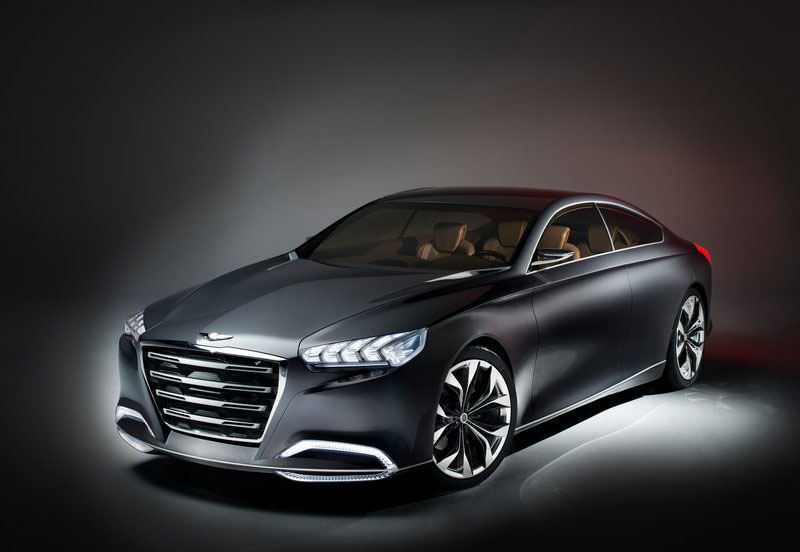
Having finished 2012 with five-straight years of premium segment sales growth with its Genesis and Equus vehicle lines, Hyundai unveiled its design direction for future premium vehicles with the Hyundai HCD-14 Genesis Concept at the 2013 North American International Auto Show.

FLUIDIC PRECISION DESIGN
The Hyundai HCD-14 Genesis Concept conveys a fluidic-precision, liquid-metal design language. Craftsmanship quality is conveyed via gemstone-like design surfaces. A bold front fascia surrounds brushed metal grille surfaces with a deep vertical grille opening. The corners of the rear hood incorporate heat extractor design accents that integrate seamlessly with exterior mirror design. From the side view silhouette, classic rear-drive sport sedan proportions are conveyed by an extended dash-to-axle length, short overhangs, large-diameter wheels, sharply-tapered greenhouse, and short rear deck. Large wheels were developed from a mix of premium lightweight alloys with carbon fiber surrounding the voided areas of the wheel design.

REAR-HINGED REAR DOOR CABIN ACCESS
Opening the rear door reveals a rear-hinged configuration, with a single, oversized, brushed-aluminum hinge articulating diagonally from the rear door cutline. With both doors open, Hyundai HCD-14 Genesis Concept has an inviting and commodious cabin ambience. Inside the cabin, a double-cresting-wave center console design carries from the instrument panel through to the rear seats. This design-wave theme further influences the interior door handles and rear headrest hoods. Gauges and driver data are provided via an eclectic fusion of both analog and digital sources, with aviation-derived design cues. The driver-focused cockpit offers an asymmetrical center stack, with critical driving functions separated from passenger comfort functions. The center console even includes an iPad® tablet storage station, keeping it secure in spirited driving.

ACTIVE DRIVER SAFETY TECHNOLOGY
While the Hyundai HCD-14 Genesis exterior design makes a statement all its own, the driver's environment is where its technological innovation breaks new ground. Ergonomics engineers eliminated the traditional center stack, developing an intuitive driver interface system that allows the HCD-14 driver to better keep his eyes on the road. Freed from traditional design restrictions, designers created a controls layout devoid of intimidating clusters of buttons and knobs. Using state-of-the-art driver eye-tracking and 3-D hand-gesture recognition, Hyundai HCD-14 Genesis is able to recognize driver commands free from the distractions associated with manual controls. Once a specific feature is selected via eye-tracking, thumb controls or gesture recognition can be used to select navigation, infotainment, audio, HVAC, and even smartphone connectivity functions. This intuitive interface provides the driver with complete control while keeping his eyes safely above the cowl plane, using a windshield heads-up display (HUD) for minimal driving distraction. This proprietary interface represents Hyundai's vision for future vehicle HMI and sets a new benchmark in active driver safety technology.

DRIVER-CENTRIC VEHICLE DYNAMICS
HCD-14's innovative eye-tracking and gesture-based controls reduce typical driving distractions, resulting in a more focused driver able to better appreciate the day-to-day satisfaction of exceptional vehicle dynamics. To this end, Hyundai HCD-14 Genesis vehicle dynamics take the driver to a new level of involvement, focus, and control. An ultra-rigid chassis with strategic use of high-tensile steel provides a vault-like platform for the rear-drive powertrain configuration. Sophisticated five-link front and rear suspension reduces suspension-travel changes to camber and toe for consistent grip out of bends. A multi-mode power steering system retains road feel and feedback advantages while yielding the efficiency benefits of an electronic system. Low-profile performance tires yield outstanding turn-in response, mid-corner grip, and road feel. A sophisticated yaw-control system provides multiple driver-selected options for changing road conditions and driving preferences. Such an advanced complement of tarmac-gripping technologies requires an equally-impressive powertrain to be fully exploited, and the Hyundai-developed Tau® V8 engine is more than up to the task.

DIRECT-INJECTED TAU® V8 POWER
The Hyundai HCD-14 Genesis powertrain features the award-winning Hyundai Tau® V8 engine, displacing 5.0-liters, with direct injection and Dual Continuously Variable Valve Timing (D-CVVT), for impressive power, low emissions and superb efficiency. Hyundai HCD-14 Genesis uses optical recognition to identify the driver and initiate the starting sequence, while gear selection for the 8-speed automatic transmission is performed via paddle shifters. Hyundai HCD-14 Genesis exhaust is ceramic-lined and was tuned for minimal backpressure, maximum high-rpm horsepower, and a deep baritone note, with cooling fins integrated into ultra-wide exhaust tips.
Read More

Thursday, April 4, 2013

Honda Civic Coupe, 2013


  • Honda Civic Coupe, 2013

The top-selling and award-winning Honda Civic returns for 2013, with a host of design upgrades and a bevy of new standard features, while still maintaining the efficiency and value that has made the Honda Civic an automotive icon for the past 40 years. The 2013 Honda Civic Sedan receives all-new front and rear exterior styling, along with extensive interior styling upgrades on all models. Retuned steering and suspension sharpen the Civic's handling, while extensive body and chassis upgrades improve the ride comfort and interior quietness.

Across the board, every 2013 Civic model is equipped with a suite of class-leading standard features. Standard equipment on every Honda Civic includes Bluetooth® HandsFreeLink®, Bluetooth® Audio, rearview camera, color i-MID display, USB/iPod® connection, Pandora® Interface, an SMS text feature, steering wheel audio controls, exterior temperature gauge and sliding center-console armrest. Even with hundreds of dollars of standard features added, the 2013 Civic arrives with only a modest $160 increase in MSRP across the lineup, with pricing for the exceptionally well-equipped 2013 Civic LX Sedan beginning at $18,165.

New safety technologies built into the 2013 Honda Civic include the application of the next-gen Advanced Compatibility Engineering™ II (ACE™ II) body structure, which includes additional front end structures designed to help increase occupant protection by dispersing crash energy in narrow overlap frontal crashes, and should help the Civic obtain a top rating in the new small-offset crash test conducted by the Insurance Institute for Highway Safety (IIHS). Also new are SmartVent™ side airbags, side curtain airbags with a rollover sensor and the availability of Forward Collision Warning (FCW) and Lane Departure Warning (LDW) systems, which make their compact-class debut in the 2013 Honda Civic Hybrid.

Featuring the widest array of powertrain choices available in the segment, the Honda Civic lineup is designed to meet the diverse needs of today's compact-vehicle buyer. The 2013 Honda Civic Sedan and Coupe will be available in LX, EX, EX-L and Si models, with the Civic Hybrid, Civic Natural Gas and Civic HF also available in sedan form. The entry model Civic DX has been discontinued for 2013.

Powertrains
The 2013 Honda Civic lineup includes sedan and coupe models with a conventional gasoline engine and "Si" performance models. Civic also offers a high fuel efficiency "HF," hybrid and exclusive natural gas alternative-fuel sedans.

Heavily revised for the ninth-gen Civic introduction for model year 2012, the Civic's all-aluminum, 140-horsepower, i-VTEC 1.8-liter 16-valve four-cylinder engine is unchanged for 2013, continuing to provide exceptional responsiveness, refinement, and fuel efficiency. Providing 128 lb-ft of torque at 4300 rpm, the Honda mill is paired with either a 5-speed manual or 5-speed automatic transmission. In the Honda Civic Sedan and Coupe, this powertrain has earned an EPA fuel-economy rating of 28/39/32 mpg city/hwy/combined when equipped with the automatic transmission. In the Civic HF Sedan, those figures climb to 29/41/33 mpg.

Now available in 37 states, the 2013 Honda Civic Natural Gas continues as the only mass produced natural gas sedan available in the U.S. In the Civic Natural Gas, the 1.8-liter engine produces 110 horsepower, and earns an EPA fuel economy rating of 27/38/31 mpg2 (city/hwy/combined). The 2013 Civic Hybrid features a 1.5-liter four-cylinder engine equipped with Honda's Integrated Motor Assist (IMA®) system, which when coupled with its Lithium-Ion battery pack, produces 110 horsepower and 127 lb-ft of torque. Paired to a Continuously Variable Transmission (CVT), the Honda Civic Hybrid earns a city/hwy/combined EPA rating of 44/44/44 mpg. The Civic Sedan and Coupe, Civic Natural Gas and Civic Hybrid models all feature Honda's ECO Assist™ technology, which with the push of the green, dash-mounted "ECON" button, can help drivers operate the vehicle more efficiently.

Along with strong fuel efficiency, the Civic lineup also offers strong performance. The 2013 Civic Si Sedan and Si Coupe models are equipped with an all-aluminum, 201-horsepower, i-VTEC® 2.4-liter DOHC 16-valve engine paired to a 6-speed manual transmission. Even though it provides 170 lb-ft of torque and offers exhilarating performance, the Honda Civic Si has a remarkable 31 mpg EPA highway fuel economy rating.

The Body
For 2013, the Honda Civic has received a host of changes that far exceed the typical mid-model refresh. The front and rear styling of the 2013 Honda Civic Sedan has been completely altered for a more youthful and premium feel, including sheet metal changes that include an all-new hood and trunk lid. Up front, a new open-mouth lower bumper with a horizontal chrome accent and a sportier, black honeycomb mesh grille is anchored by new integrated fog lights on EX-L and above trims. The grille is flanked by new clear-lens corner lights to provide a more premium look. The 2013 Civic's more sculpted front end flows into a new taller, more deeply faceted hood.

In back, a new rear bumper design and new rear trunk lid are capped by a clean, horizontal chrome trim piece. The all-new design of the jewel-like taillights now carries into the trunk face, providing a more finished and upscale look. The rear bumper features integrated reflector treatments and a new lower diffuser panel finished with a honeycomb mesh vent. While the expressive exterior styling of the 2013 Honda Civic Coupe remains unchanged, restyled wheels on all models help sharpen the look of the 2013 Civic.

Constructed of 55-pecent high-strength steel, the 2013 Honda Civic's body minimizes weight and maximizes strength for greater rigidity. The 2013 Civic's body has seen a host of changes to the front floor, side sill, A-pillar, upper wheel housing and front bumper extension. This addition of high-strength steel is expected to pay refinement dividends and provide a stiffer structure for the numerous chassis updates for the 2013 Civic. In addition, the Civic's new structure is designed to help it excel in the new Insurance Institute for Highway Safety (IIHS) small overlap crash test.

Chassis
Under the skin, the 2013 Honda Civic has had significant alterations aimed at enhancing handling refinement and noise isolation. A reworked Electronic Power Steering (EPS) setup reduces friction and provides a quicker ratio, while stiffer wheels, stiffer front springs and a thicker front stabilizer bar with new Teflon-lined mounting bushings are designed for more fluid suspension action and a flatter, more responsive cornering attitude.

The rear suspension also receives a thicker stabilizer bar, increased spring rate, new Teflon-lined stabilizer-bar bushings, and reworked suspension bushings to increase both bump- and roll-motion stiffness. With its retuned MacPherson strut front and multi-link rear suspension, handling linearity, responsiveness and overall vehicle composure have been increased, while at the same time improving ride quality and the characteristic Honda fun-to-drive feel. For 2013, front brake-rotor diameter on automatic-equipped Civic LX, EX and EX-L Sedans and Coupes jumps 20 mm from 262 to 282 mm for improved stopping performance.

A large range of new noise, vibration and harshness (NVH) countermeasures work together to reduce road, engine and wind noise in the 2013 Civic's interior. This includes a stiffer front subframe, new thicker windshield and front door glass, and additional soundproofing material in the dash, floor, doors, and rear tray to help reduce unwanted road noise, and provide a more serene ride and quieter cabin.

Interior
Inside, extensive refinements in design and construction gives the entire 2013 Honda Civic lineup a more premium feel, with an all-new tricot headliner, new soft-touch materials on the instrument panel and upper door treatment, and revised textures and panel junctions throughout the instrument panel and center console. Subtle silver accents in the interior lend a higher-quality look, along with door panel and seat fabric upgrades. Providing a more upscale environment, black carpeting and a trunk lid finisher are now standard on all Civic models. For the first time, Civic is available in both cloth and leather with an all-black interior.

The 2013 Honda Civic provides a host of new class-leading standard features, including Bluetooth® Hands Free Link®, Bluetooth® Audio, rear view camera, color i-MID display, Pandora® Interface, USB/iPod® interface, SMS text message function, steering wheel audio controls, exterior temperature gauge and a sliding finished center armrest. Available on Honda Civic EX, EX-L, Hybrid and Natural Gas models, the Honda Satellite-Linked Navigation System™ with voice recognition now includes a multi-view rear view camera and provides routing and guidance to individual addresses and more than 7-million points of interest within the continental United States. With its 16-GB flash memory system, it offers fast route calculation and includes FM traffic, a subscription-free service that alerts drivers to traffic conditions.

Safety
Named a "2012 Top Safety Pick" by the Insurance Institute for Highway Safety (IIHS), the Civic returns for 2013 with a re-engineered Advanced Compatibility Engineering™ II (ACE™ II) body structure. The changes that went into the ACE II body structure were designed to help increase the protection provided to vehicle occupants in a frontal collision, including the addition of front end structures to help disperse crash energy in narrow overlap frontal crashes. These changes should also help the Civic obtain top marks in the new Insurance Institute for Highway Safety (IIHS) small overlap frontal crash test.

Also new for 2013, the Honda Civic features Honda's new Smart Vent™ front seat side airbag construction that recently debuted in the 2013 Honda Accord. The new Smart Vent™ airbag design helps mitigate the risk of excessive side airbag deployment force, while eliminating the need for the prior Honda Civic's Occupant Position Detection System (OPDS). The elimination of OPDS allows improved heating of the seatback on Civic EX-L models. Additionally, the 2013 Civic is equipped with a side curtain airbag with rollover sensors, nearly two years ahead of regulatory requirements.

A first in the compact segment, the 2013 Honda Civic Hybrid will provide standard Forward Collision Warning (FCW) and Lane Departure Warning (LDW) systems. FCW is designed to detect a possible collision with another vehicle or object ahead and provide visible and audible alerts to the driver. LDW provides visible and audible alerts if the driver begins to drift out of a detected lane without using the turn indicator.

The 2013 Honda Civic's additional safety technologies include standard dual-stage, multiple-threshold front airbags, an anti-lock braking system (ABS), Vehicle Stability Assist (VSA) with traction control, a tire pressure monitoring system, and a pedestrian injury mitigation design in the front of the vehicle.
Read More

Wednesday, April 3, 2013

GMC Sierra, 2014


  •  GMC Sierra, 2014

The all-new 2014 GMC Sierra 1500 full-size pickup is the most powerful, most advanced and most refined truck in the brand's 110-year history. GMC Sierra's bold new exterior houses one of three all-new EcoTec3 engines, a fully updated cabin with available next-generation IntelliLink connectivity and other features designed for the most discerning truck owners.

In addition to all-new design and technology, the 2014 Sierra boasts the longest list of standard features ever for a full-size GMC pickup. From connectivity solutions, to a standard tie-down system in the rear, to the segment's only standard projector beam headlamps, many premium features are found on each and every all-new Sierra.

New EcoTec3 engines
GMC Sierra's engine portfolio is updated for 2014 with the goal of increased in power, torque and fuel efficiency across the board. There will be a 4.3L V-6, a 5.3L V-8 and a 6.2L V-8 offered, all from a shared EcoTec3 engine family. Each engine features standard direct injection, continuously variable valve timing and Active Fuel Management, which means they seamlessly switch to run on four cylinders during light-load driving to save fuel.

The increased power and efficiency of the new engines are the result of more than 10 million hours of sophisticated computer modeling, more than half of which were used to make the best of the combustion process.

The new 4.3L V-6 EcoTec3 engine will offer improved torque and towing capacity for the six in 10 truck owners who tow.

Today's GMC Sierra offers the best V-8 fuel economy in the industry and the new 5.3L EcoTec3 engine features significant updates intended to make it even more efficient. The available 6.2L V-8 EcoTec3 is engineered to provide outstanding capability.

SAE-certified horsepower and torque ratings and EPA fuel economy estimates for the new Sierra are not yet available, but are expected to be finalized early next year.

With the new engine designs and additional developments, customers should expect GMC Sierra's second-generation Active Fuel Management to be more seamless and capable of operating longer in four-cylinder mode.

All three engines use lightweight aluminum blocks and heads and are mated with durable six-speed automatic transmissions. A "cruise grade braking" feature down-shifts the transmission on downgrades, which is intended to reduce brake wear. V-8 models use new, larger 9.5- and 9.76-inch rear axles with the strength to accommodate the engines' higher output. Final power and torque ratings will be announced later.

Duralife brake rotors and electric power steering
Strong brakes are important for stopping trucks, whether they're full of people, payload or both. The 2014 Sierra features four-wheel disc brakes with Duralife brake rotors, which feature a hardened and strengthened surface to reduce corrosion. Duralife rotors - a GM-exclusive technology - are expected to last twice as long as conventional rotors and provide quieter braking with less vibration.

The 2014 Sierra also uses electric power steering. An electric motor in place of an engine-driven hydraulic pump saves fuel and allows for tuning that's expected to result in a more consistent, crisp steering feel and plenty of assist for parking maneuvers.

The new standard in truck interiors
Premium materials, attention to detail and purposeful technology define GMC Sierra's all-new cabin. New soft-touch materials and available aluminum trim line an interior that's focused on usable and productive space.

"Truck owners want a well-crafted cabin, but also one that still feels like a truck," said Helen Emsley, Sierra interior design director. "They want a purposeful interior, not one that's flowing like you'd find in a car or crossover."

Sierra has an upright instrument panel designed for visibility and accessibility. Knobs and buttons are large, legible and within reach. All knobs are coated using a rubber-over-mold technology, so they're easy to grip even through gloves.

A new instrument cluster on all models features six gauges with an available centrally located, 4.2-inch color Driver Information Center with vehicle status information, a trip computer, and other information, like radio and navigation.

A second, high-mounted glove box with a flat floor joins the traditional box below. Each of GMC Sierra's doors has storage crafted to hold most beverage containers and other personal items. Along the center stack and center console are additional cupholders, discreet compartments large enough for most laptop computers, and connectivity options. Sierra is available with a 110-volt outlet, up to five USB ports, four 12-volt outlets and an SD card slot.

Available IntelliLink connectivity uses an available high-definition, fully reconfigurable eight-inch color touchscreen with an intuitive layout and easy-to-read icons that control audio features, a Pandora app, Bluetooth phone features, and available navigation with all-new map displays. Many of the system's features can be controlled by voice command, allowing the driver to keep eyes on the road and hands on the wheel.

GMC Sierra's seats use dual-density foam designed to stay comfortable over long hours and continue to look great after years of use. Leather and cloth will be offered, and Sierra's new high-wear cloth is designed to last longer and resist staining. A spilled drink will bead on the fabric, not soak in. Heated seats are available with cloth seats and standard with leather.

New door and bed configurations
For the first time on Extended Cab models, the 2014 Sierra has new front-hinged rear doors with outside pull handles at the rear, providing improved access in tight parking spaces. Unlike trucks with rear-hinged doors, Sierra's layout allows rear passengers to enter and exit the vehicle with the front doors remaining closed.

Crew Cab customers, who represent more than 60 percent of retail GMC Sierra customers, can choose between two bed lengths; in addition to the current 5-foot, 8-inch box, a new 6-foot, 6-inch box is available. Regular cabs continue to be available with the 6-foot, 6-inch or 8-foot box lengths, while the extended cab will come exclusively with a 6-foot, 6-inch box.

Cargo box innovations
Sierra's rear bumper features standard corner steps that make climbing into the bed easy, regardless of whether the tailgate is up or down. The steps are paired with grips formed into the top of each bed side. Four movable upper tie downs are also standard. They can be placed in nine different locations and can bear a 500-pound (227 kg) load. Available LED cargo lights integrated beneath the bed rails will illuminate the bed when a tonneau cover is in place. The available EZ Lift and Lower tailgate uses an integrated torsion bar and damper to ease lifting and lowering.

Driver Alert Technology
A suite of active safety features will be optional for the 2014 Sierra, including Forward Collision Alert, which uses a forward-facing camera to notify the driver of an imminent collision, and Lane Departure Warning, which uses the same camera to track the truck's position in relation to a road's lane markers.

The camera technology was recently named a "Top Ten Tech Breakthrough of 2012" by Popular Mechanics.

Paired with Forward Collision Alert and Land Departure Warning is GMC's first-ever Driver Alert Seat, which generates vibrating pulse patterns on the left and/or right side of the lower seat cushion bolster to alert the driver of potential dangers, such as an un-signaled lane change or approaching another vehicle too quickly. According to GM research, the seat's vibrations may direct driver attention to the location of a potential collision more quickly and accurately than audible alerts. Drivers have the option of selecting either audible or vibrating alerts.

Quieter, stronger, more aerodynamic
Quietness doesn't only come from factors within the cabin. The 2014 Sierra features new aerodynamic measures that benefit fuel efficiency and reduce wind noise. Updated mirrors that reduce wind turbulence, triple-sealed inlaid doors, as well as roof and tailgate design features all help air flow smoothly quietly over the GMC Sierra. Additional sealing around the grille, headlights and space between the cab and box are also designed to lower drag for the new trucks, along with new aerodynamic spats located in front of the rear wheels.

Updates to Sierra's body and chassis are designed to improve ride and handling, comfort and capability. The fully boxed frame uses high-strength steel and hydroforming to provide more strength and rigidity with less weight. New cab structures incorporate high-strength steel in the A-pillars, B-pillars, roof rails and rocker panels, while ultra-high-strength steel segments of the rocker panels provide added protection for shallow offset crashes.

GMC Sierra's hood is aluminum, saving approximately 17 pounds versus a comparable steel hood. At the rear, a roll-formed box is stronger, lighter and more durable than a traditional stamped steel box.

GMC Sierra uses aluminum for some suspension components for additional rigidity and weight saving, and new lightweight wheels are paired with low-rolling-resistance tires in most applications. The tires, along with new shear-style and redesigned hydraulic cab mounts, are designed to help reduce noise and vibration in the cabin.

Attention to detail
GMC designers approached the exterior of the 2014 Sierra with respect for its predecessors, evolving its familiar shape while adding distinctive details like standard projector headlamps, available LED signature accent lighting and detailed new grilles. All GMC Sierra models have chrome grille surrounds and premium black wheel arch moldings. Different trim levels feature chrome belt moldings, mirror caps and door handles, as well as unique wheel designs and grille details.

Other new features include available front Park Assist, in addition to the rear Park Assist already available, and a sliding rear window with a defroster.

Distinctive All-Terrain model
Sierra All-Terrain has all-new styling for 2014. It includes a unique exterior appearance with a painted grille and less chrome, and is available as an extended cab or crew cab in a limited number of colors.

Standard equipment for GMC Sierra All-Terrain includes the Z71 off-road suspension with monotube Rancho shocks, hill descent control, front recovery hooks, a transfer case shield and unique wheels and tires, along with an automatic locking rear differential that reacts in milliseconds in low-traction situations to improve safety and confidence on wet, snowy or muddy surfaces.

GMC Sierra All Terrain is available exclusively with an ebony interior and with front bucket seats on SLE models. A carbon fiber-look seat accent is standard on SLT models.
Read More