Monday, March 25, 2013

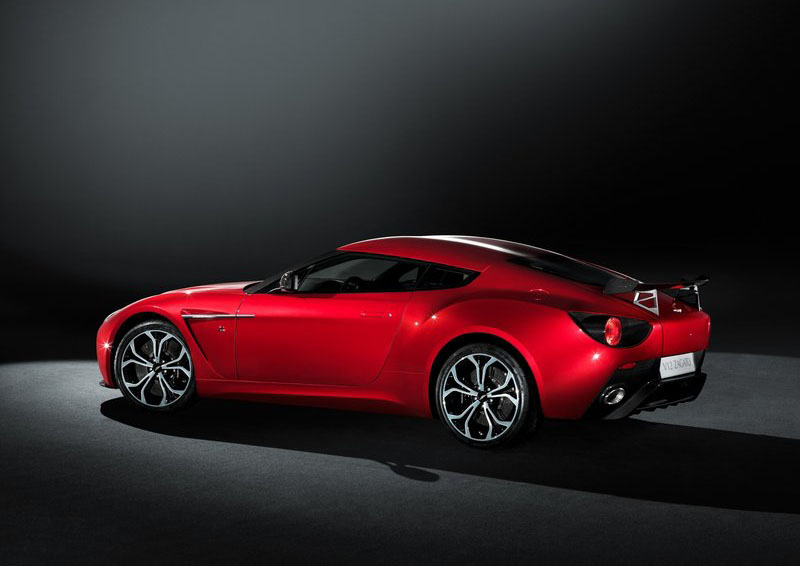
Aston Martin V12 Zagato, 2013

  •  Aston Martin V12 Zagato, 2013

The final design signed-off and engineering development work progressing apace, Aston Martin reveals the first images of the new Aston Martin V12 Zagato (road car) scheduled for production later in 2012.

The Aston Martin V12 Zagato is the pinnacle of the Vantage range. It is also the latest expression of a successful creative collaboration that has given rise to a series of striking GT cars over the last half-century, the original and most iconic of which being the DB4GT Zagato. Not only does this masterpiece rank amongst the most desirable, collectable and valuable cars in history, its 50th anniversary provided the inspiration for the V12 Zagato.

Though commemorating a great Aston Martin of the past the Aston Martin V12 Zagato could be no mere pastiche of the original. Instead the project was seen as the perfect opportunity to take Aston Martin's ethos of technology and tradition to a new and exciting level. To this end the V12 Zagato combines the modern ideas, materials, processes and technology pioneered on One-77, while remaining true to the purity and craftsmanship of its illustrious forebear.

For Aston Martin's CEO, Dr Ulrich Bez, the V12 Zagato is "a celebration of both Aston Martin's heritage and its future". He continues: "Our relationship with Zagato stretches back more than 50 years. Together in that time we have created a series of very special cars. The first - the DB4GT Zagato - is a true icon: fast, beautiful and incredibly desirable. In the V12 Zagato I believe we have captured the spirit of that car and combined it with a confident twist of modernity to give it a character all of its own."

Initial design concepts for the Aston Martin V12 Zagato were explored in early 2010. Inspired by Zagato's bold and individual styling signatures Aston Martin's Director of Design, Marek Reichman, and his Gaydon-based design team relished the challenge of shaping the V12 Zagato, creating a car that pushes the boundaries of Aston Martin's design language, yet pays tribute to the DB4GT Zagato. Demonstrating Aston Martin's ability to rapidly bring ideas to fruition the Zagato programme quickly gained momentum, the design team working hand-in-hand with engineers and artisans to complete the build of a pair of concept cars in the spring of 2011.

May 2011 saw the Aston Martin V12 Zagato make its world debut at the prestigious Villa d'Este concours. Entered in the Concept Cars and Prototypes class, the V12 Zagato wowed the judges and the crowd, taking first place against impressive opposition. In June the Villa d'Este winner - along with the second prototype car - made the Aston Martin V12 Zagato's world racing debut at the gruelling 24 hour endurance race held at the Nürburgring. Both cars completed the ultimate durability test, continuing Aston Martin's 100 per cent finishing record in this notoriously tough race.

After an overwhelmingly positive response from customers, the decision was made in July 2011 to build a strictly limited run of V12 Zagatos. Since then, Aston Martin's design team have worked to refine the sports car's detailing and aerodynamic performance while staying faithful to the original design concept. At the same time engineers based at Gaydon have been putting prototypes through the company's rigorous development programme to ensure the V12 Zagato performs as well as it looks.

Every Aston Martin is a unique combination of advanced materials, technology and time-honoured craftsmanship. The Aston Martin V12 Zagato takes this philosophy to a level previously seen in the company's exquisite One-77 supercar, which completes its build run this year. Built at Aston Martin's global headquarters in Gaydon, Warwickshire, production of the V12 Zagato will be strictly limited to no more than 150 cars.

Creating each V12 Zagato is a painstaking process that takes approximately 2,000 man-hours to complete. Just like the One-77, the V12 Zagato is constructed from a combination of hand crafted aluminium and carbon fibre. The bonnet, signature 'double-bubble' roof and doors are hand-crafted aluminium, while the front and rear fenders, door sills and boot lid surround are made from carbon fibre.

The finished body is then painted in the same dedicated area as the One-77. Four unique colours have been created for the Aston Martin V12 Zagato: Scintilla Silver, Alloro Green, Alba Blue and Diavolo Red. The painting process alone takes some 100 hours to complete and is followed by the marriage of the body and the drivetrain within the sports car production area. From there the V12 Zagato is transferred to the standalone facility originally built to house One-77 production, where the build is completed.

This serene, laboratory-like space is perfectly suited to the task of creating special cars such as the V12 Zagato. It is here that time is lavished upon the fitment and installation of an array of bespoke components, including the side glass and the distinctive rear window, which features a curved surface that continues the sculptural lines of the 'double-bubble' roof. All the exterior brightwork around the windows has a contemporary black finish to compliment the exposed carbon fibre components. Fitment of the hand-crafted interior and upholstery is also completed in this dedicated build area.

Like all Aston Martins when viewed as a whole the Aston Martin V12 Zagato is an artful composition of powerful lines and compelling proportions, but when viewed up close it reveals sophisticated, sculptural surfaces and jewel-like details. The exposed elements of carbon fibre on the front splitter, A-pillars, rear lamp pods, diffuser, door mirror cases and rear wing all display the same perfectly symmetrical weave and smooth resin finish. Likewise the bold new grille is formed in a unique three-dimensional composite material mesh that echoes Zagato's famous 'Z' moniker.

More delights are found inside. Seven Bridge of Weir hides - in semi-aniline finish to offer durability while preserving the natural texture of the leather - are used to trim the V12 Zagato's interior. Hand-stitched quilting of a unique design creates a flowing pattern that evokes a dynamic sense of movement across the seats and headlining, while 'Z' embroidery in the headrests and rear parcel shelf add a further flourish. Satin-finish carbon fibre on the dashboard and centre stack is perfectly complimented by piano black accents and satin black rotary switchgear. Carbon fibre sill plaques with 'V12 Zagato' inlaid metal script provide a distinctive finishing touch.

A work of art built by skilled craftsmen to be driven and enjoyed by the world's most discerning car collectors, the Aston Martin V12 Zagato is a fitting tribute to its illustrious ancestor. On-sale now priced at £330,000 (plus local taxes) the production specification V12 Zagato will be showcased at the Geneva Salon International in March 2012. First deliveries are scheduled for Autumn 2012.
Read More

Sunday, March 24, 2013

Vauxhall Astra GTC, 2012


  • Vauxhall Astra GTC, 2012

Since the Vauxhall Astra GTC shares no body panels with either the Astra Hatch or Sports Tourer, it has a unique appearance in the range, and one which has largely stayed faithful to the stunning 2010 GTC Paris concept.

At the front of the car, a centreline crease is complemented by slim, 'eagle-eye'-style headlamps featuring wing-shaped daytime running light graphics. A chrome emblem bar running across the dramatic trapezoidal grille - mounted lower than on other Astras - completes the picture from the front.

Equally dramatic is the GTC's rear treatment. Its powerful shoulder section gives the car imposing proportions and a purposeful road presence. The line from the C-pillar wraps around the tail and the rear spoiler, which in turn integrates with the roofline. LED rear lighting - optional across the GTC range - highlights the stretched 'wing' motif created by the tail lamps.

The Vauxhall Astra GTC has a Cd figure of just 0.33.
Standard on both Sport and SRi trims are 18-inch alloy wheels, with each getting a unique design. For the first time on a Vauxhall coupe in this class, 20-inch rims are available as an option on SRi models, with 19-inch wheels a further cost option on both trims.

On the upper-spec SRi model, tinted glass is standard, while the latest generation AFL (Adaptive Forward Lighting) is optional across the GTC range.

The Interior
Despite the GTC's rakish exterior appearance, unlike many of its competitors, interior accommodation and functionality have not been compromised.

Not only can the GTC accommodate five adults, but its luggage compartment provides between 380 and 1165 litres of volume - over 200 litres more than some of the competition.

In line with the current Astra, storage volume in the cabin has also been improved by 50 per cent versus the old Sport Hatch, with items like the electronic park brake liberating space around the console in SRi models.

High quality materials feature in all GTCs, as do chrome-edged instruments in deep-set binnacles that give drivers clear and well laid-out information. Standard on all GTCs are DAB stereo and USB functionality, while SRi drivers get an onboard computer and leather-rimmed steering wheel, among many other standard items.

Two new colours - Seashell and Flaming Yellow - and a selection of new materials, bespoke to the GTC, set the car apart from others in the Astra range. Morello Red, and a new premium leather trim, is also available as an option and brings with it a six-way adjustable driver's seat.

THE CHASSIS
The Vauxhall Astra GTC's appeal runs far deeper than its rakish lines. Unlike many three-door versions of existing compact hatches, the GTC - like the Astra Sports Hatch before it - will be a standalone model in Vauxhall's range, conceived to resonate with a more driver- oriented customer base who value the way a car handles and performs as much as the way it looks.

To do this, engineers from both Vauxhall Engineering Centre at Millbrook and Opel in Rüsselsheim have developed a bespoke platform for the GTC. Key components - such as the HiPerStruts used on the front axle - have been derived from the 325PS Insignia VXR, while significant upgrades have been made to the GTC's unique Watt's link/compound crank rear end. So while the GTC line-up currently includes a broad range of engines producing from 120 to 180PS, drivers can always be assured of class-leading levels of dynamic control.

However the best chassis can only be honed through intense testing on the most demanding surfaces. Britain will be by far the biggest market for the GTC, which is why Vauxhall and Opel engineers have conducted much of their evaluation on UK roads, with their unique (and some may say diabolical) blend of undulations, cambers, rough surfaces, blind apexes and crests. The theory is this: if the GTC can work well in the UK, it will work much more effectively on other markets' roads, too.

High tech front suspension boosts GTC's appeal
From the start of the GTC's development programme the target was to deliver a driver-oriented feel to the car, and one that worked well on UK roads. "Our aim was to exceed the best in class with the GTC's dynamics," said Gerry Baker, Vauxhall Engineering Centre's chief dynamicist. "We also wanted to change the emphasis in steering and damper-feel from the regular Astra Hatch to a set-up that was more focused, yet still comfortable enough for British roads and drivers."

Much of the development centered around the introduction to the GTC of Vauxhall's HiPerStrut, a first for an Astra model. Based on the system currently seen on the 325PS Insignia VXR, the HiPerStrut uses the Astra's existing pick-up points, but reduces the kingpin inclination angle by 44 per cent and shortens the spindle length (kingpin offset) by 46 per cent versus the MacPherson strut-equipped models. This helps prevent torquesteer - a trait of many powerful front-wheel-drive cars - allowing drivers to make more use of the GTC's performance without the steering being corrupted.

Adding the HiPerStrut has also reduced the amount of camber change on the GTC's front wheels during cornering, improving grip. Steering feel is enhanced, too, helped by a reduction the steering system's friction levels. The geometry changes brought by the HiPerStruts also mean that the GTC can be fitted with wheels of up to 20-inches in diameter.

Rear suspension revisions complement GTC's ride-height & track changes
Compared with the Astra Hatch, the GTC's ride height has been lowered by 15mm, while the wheelbase has grown by 10mm, from 2685mm to 2695mm. Both tracks are wider, too, at 1584mm (+40mm) front and 1585mm (+30mm) rear.

The Astra's GTC compound crank/Watt's link rear suspension system has also been revised, with bespoke roll-stiffness and roll-centre height settings for this application. The system has many advantages over a modern multi-link design, including improved packaging, greater wheel camber stiffness and reduced suspension friction. The Watt's link also ensures that lateral stability is maintained at all times.

The Watt's link is carried on a small cross-member attached to the underside of the car, just behind the rear wheel centre line. It comprises a short, pivoting centre link with a ball joint at each end, to which the lateral links from the wheels are bolted.

In a straight line, the set up ensures excellent stability, but during cornering it minimises lateral deflection in the same way a modern multi-link system would do. Vauxhall's engineers estimate that the linkage absorbs around 80 per cent of all lateral loadings on the rear suspension. In addition, the Watt's link allows for softer bushings, which no longer have to compensate for toe changes at the rear of the car, and thus provide greater compliance and ride comfort from the rear axle.

Unique steering programme for UK drivers
Precision, Feedback & Confidence. These were the three target elements for the GTC's UK-specific steering programme. The challenge was to maintain the system's ease of use at lower speeds, but dial in a greater degree of involvement and slightly more effort at higher speeds.

The Vauxhall Astra GTC uses a rack and pinion steering system with speed sensitive assistance. But in order to provide drivers with more steering feedback, the system's electric motor is mounted directly on the steering rack, as opposed to the base of the steering column.

The key benefits of using an electric power steering (EPS) are well known. At low speeds, the level of power assistance is increased to minimise steering effort. At higher speeds, assistance is automatically reduced to ensure a high degree of steering feel for the driver. The second important benefit is that, because it does not require an energy consuming hydraulic pump and responds directly to the amount of power needed at any speed, fuel consumption is also reduced.

Flex Ride enhances GTC's driver appeal still further
Flex Ride, Vauxhall's adaptive damping system, will be available as a £790 option across the GTC range, complementing the significant revisions to the new model's chassis. FlexRide automatically adapts to prevailing road surfaces and driving styles, providing drivers with fully optimised handling, even in the event of an emergency situation.

At the heart of FlexRide is the Driving Mode Control (DMC) which oversees and executes the system's settings, allowing the car to react to sudden changes in driving style or emergency situations. For example, if the driver needs to avoid an obstacle while in 'Tour' mode - the softest of the three settings - chassis sensors convey this to the DMC and the dampers are adjusted in a split second.

Standard mode (the default setting) reacts in the same way as Tour, but when drivers select Sport they not only get stiffer dampers, but more steering effort, sharper throttle response and an instrument panel that's back-lit in red, rather than white. Each of these settings can be dialled in or out of Sport mode via the GTC's configurator.

British roads: the ultimate challenge for dynamicists!
Vauxhall and Opel engineers are making increasing use of British roads as a key part of their overall chassis development programmes. In the last three years, the Insignia, Astra, Astra Sports Tourer, Meriva, and now the Vauxhall Astra GTC, have all benefited from the UK's unique mix of road surfaces.

So what makes our roads so bad, but so good for chassis engineers?

"Our road system is like no other in Europe," said Gerry Baker. "We obviously test cars in many different countries, but the UK's severely undulating and heavily cambered roads often reveal handling traits that would otherwise be hidden on smoother surfaced and more predictable continental roads.

"It's not just the surfaces, either. Corners with changing radii are commonplace in the UK, as are blind apexes and crests, which mean that extra demands are put upon our cars and drivers. A good example is a driver who has to make a mid-corner adjustment on an unfamiliar road where the bend tightens unexpectedly and he throttles-off or brakes suddenly. The car needs to work with him, and respond intuitively to steering inputs, but it still needs to be rewarding to drive under normal conditions."

Recognising that British drivers don't always have access to winding, smooth-surfaced roads, the GTC has also been tuned to deal with the worst rutted and broken surfaces, even when equipped with its optional 19- and 20-inch wheels (18-inch wheels are standard).

1.4-litre Turbo
Strong performance and flexibility are the core strengths of this engine, which is available with either 120PS or 140PS power outputs. Torque generation is even more impressive, with 200Nm available in both engines from just 1,850rpm to 4,900rpm, translating to a 0-60mph acceleration time of 9.0 seconds (140PS) or 10.2 seconds (120PS).

The water-cooled turbocharger, spinning at up to 200,000 rpm, is integrated into the exhaust manifold, close to the engine, for a fast throttle response. Air-to-air intercooling increases the intake charge density.

The adoption of a steel crankshaft with reinforced pistons and con-rods allows the use of a relatively high 9.5: 1 compression ratio, despite higher stresses and loads. Under-skirt piston oil cooling jets and exhaust valves filled with sodium are further measures to ensure durability under higher internal temperatures.

All 1.4 Turbo models come equipped as standard with Start/Stop, helping them achieve competitively low emissions of between 140-142g/km, depending upon wheels/tyres fitted.

1.6-litre Turbo
The most powerful engine in the Vauxhall Astra GTC's line-up produces 180PS and achieves a specific output of just over 100PS per litre. Available across the range, the 1.6 Turbo is the most powerful series production engine in its displacement class.

Its high power is matched by an impressively wide plateau of torque, with 230Nm available from 2,200rpm to 5,400rpm. With this engine, the GTC can accelerate from 0-60mph in 7.8 seconds, and on to a top speed of 137mph.

The 1.6T's cylinder barrels are laser-etched for minimal piston friction. To withstand higher operating temperatures, the exhaust valves are filled with sodium and under-skirt piston cooling with oil jets is used. A map-based thermostat control raises the coolant temperature at low engine speeds, or under light loads, to help reduce internal lubricant friction and improve fuel consumption.

Diesel engines
All Vauxhall Astra GTC diesel engines are fitted with:
    16-valve, dual overhead camshafts
    A weight-saving aluminum cylinder head
    Threaded intake ports for exceptional 'swirl' and burn characteristics
    Oil jet cooled pistons
    A dual-mass flywheel and a maintenance-free exhaust particulate filter

Common Rail, Multiple Fuel Injection
Operating at high pressures up to 1,800 bar, this sophisticated fuel delivery system ensures extremely fine atomisation in the combustion chamber and enables up to five injection pulses per cycle to extract as much energy as possible from a given amount of fuel. The result is exceptionally low fuel consumption and exhaust emissions, as well as reduced engine noise. Multiple injection helps iron out the strong vibrations associated with compression ignition. For example, a pre-injection during the warm-up period reduces cold-start 'knock' to a barely perceptible level.

Variable Geometry Turbocharger (VGT)
The pitch of the vanes on the turbine wheel is continuously varied according to engine load and speed, giving an excellent throttle response, particularly during pick up from low speeds.

Improved Exhaust Gas Recirculation (EGR)
The electronically-controlled EGR system has an additional cooling function. Electro-pneumatically operated bypass flaps, controlled by the engine management system, ensure that the exhaust gas reaches a temperature suitable for combustion on its way back into the cylinder. This contributes to increased power, as well as reduced emissions.

The diesel line-up comprises:

1.7 CDTi
Available in two states of tune, providing either 110PS and 280Nm of torque, or 130PS and 300Nm. Combined cycle fuel consumption for both is 62.8mpg with standard wheel rims fitted, and each achieves 119g/km. Despite being the most frugal models in the range, the 1.7 CDTis allow the GTC to accelerate to 60mph in either 10.0 (130PS) or 11.0 seconds (110PS). In 2012, an ecoFLEX model using a version of this engine will be available in the UK with emissions of just 109g/km. Start/Stop is fitted to all 1.7 CDTi models as standard.

2.0 CDTi
The 2.0 CDTi packs 165PS with an exceptionally strong 350Nm of torque from just 1,750rpm. This helps it achieve a 0-60mph time of just 8.4 seconds and 50-70mph in 6.4 seconds, together with a combined fuel consumption of 58.9mpg and emissions of just 127g/km (18 & 19-inch wheels fitted). Vauxhall's Start/Stop system is fitted to all 2.0 CDTi models as standard.

Hydraulically-damped mountings for improved NVH performance
All powertrains are bolted in position via hydraulically-damped mountings that minimise vibration through the body structure. Adaptor plates enable the same four fixing points to be used for all applications, two on the front sub-frame and one on each longitudinal beam.

The fuel supply system uses an electric pump and filter mounted in the 56-litre fuel tank, which is located low under the rear seat for optimal weight distribution and crash impact protection.

Start/Stop reduces emissions, improves urban fuel consumption
Vauxhall's Start/Stop technology, which is available on all 1.4 Turbo, 1.7 CDTi and 2.0 CDTi engines, is highly efficient and helps to reduce emissions. As soon as the driver selects neutral, the Start/Stop system is activated and the engine unit cuts out automatically. The rev counter needle then assumes the Autostop position. When the driver wants the engine to start up again, he/she just selects first gear and departs. A powerful battery ensures that there is no delay in the engine starting up again.

For safety reasons and to ensure the comfort of passengers, the temperature and pressure functions of the brake power assist unit remain active during the Auto-Stop phase of the Start/Stop system. When necessary, for example during slow city traffic, the driver can manually de-activate the system, using the "eco" switch.

Transmission
Six-speed manual gearboxes, offering a wide spread of ratios and a tall, fuel-saving top gear, are standard fit across the entire range. All gearboxes include triple cone synchronization on first and second gears for easy engagement, and a synchronized reverse gear.

A six-speed automatic gearbox is also available on 1.4 Turbo 140PS and 2.0 CDTi 165PS engines.

MARKET
The all-new Vauxhall Astra GTC replaces the successful Astra Sports Hatch, and will lay down the gauntlet to VW Scirocco and Renault Megane Coupe when it appears in showrooms at the end of November 2011 with a heady mix of dynamic excellence, dramatic design and competitive pricing.

Closely based on last year's stunning GTC Paris concept, the Vauxhall Astra GTC enters the UK market - the biggest in Europe for this model - priced from just £18,495, nearly £1,350 less than the basic VW Scirocco. But even in entry-level trim, the Vauxhall Astra GTC adopts the sophisticated HiPerStrut front suspension derived from the Insignia VXR, offering precision handling and unmatched stability.

The third body style to come off the Astra's Delta platform (following the Hatch and Sports Tourer), the only exterior design elements the GTC shares with its siblings are door handles and the roof aerial - even the wheelbase and tracks are different. Brit, Mark Adams, Vauxhall's Vice President of Design, has aimed to create a car that looks like it's been plucked from the class above, with its low, wide stance and simple, yet rakish lines.
Read More

Friday, March 22, 2013

Tramontana Tramontana, 2007


  •  Tramontana Tramontana, 2007

The Chassis, 100% carbon fibre
It has never been seen in the automotive history a street sports car which resembles so much a Formula 1 like the Tramontana does. It is the first time in the sports car market that it has been incorporated a 100 % carbon fibre monocoque chassis inspired in the design of a Formula 1 and manufactured with the same criteria, guaranteeing a high protection for its passengers. Moreover, it introduces a new structural system that combines an indeformable central zone (cockpit) with a weight of 128kg with other 8 deformable zones calculated for the absorption of the impact energy. In fact, the results extracted of the Crash Test (according to the FIA regulation) confirm that the structural calculation guarantees the integrity of its passengers displacing the lateral components toward the outside. This shows the high impact resistance of the carbon fibre used in the vehicle.

On the other hand, the monocoque, especially developed for the Tramontana, contributes a lightness and maximum rigidity to the whole, factor that together with its suspension system, unique on its market of double wishbones with pushrod and a great length of arms, improves the dynamical aptitudes of the vehicle. All this elaborated with materials of last generation of aerospace technology like the steel to the cromolibdenium, magnesium and duraluminium. Without doubt in the Tramontana the efficiency of the geometry and the weight has been tested, obtaining as result an unequalled performance.

The structure of the monocoque carried out in carbon fibre offers a high torsion resistance, which makes the driver feel like going on a rail.

In the assembly process have been adopted handcraft techniques like the obsession by pre-impregnate and cured in autoclave to 120 ºC, that provides an exceptional finish level and makes the construction of light and strong pieces easier.

Engine, from the competition to the asphalt
Among the final solutions of the Tramontana, we find a new electronic system and a central gasoline engine V12 Biturbo capable to offer a power from 550 Hp to 720 Hp, selectable through a switch situated in the dashboard.

Associated to a 6-speed gearbox, specially developed for the Tramontana, this 12 cylinders propeller in V reaches the 720 Hp to 5.750rpm with a maximum pair torque of 920nm at 4.000rpm. The result, 345 km/h of top speed and 3,7 seconds to reach the 100 km/h from stopped departure.

The weight-power relation is elevated to the 1,7 Kg/Hp, significant data that allow us to discover the kind of sensations that this fantastic assembly of chassis and engine can offer us.

The development of the electronic switchboard is made to measure, in a craft process of more than 2000 hours, that includes full silver wiring and a power map capable to obtain the maximum performance of the engine. Moreover, for the first time in a street car, lifelong relays, fuses and protections have been replaced by a module with just one connector that has only one terminal that brings together all the functions of a conventional device. This innovative system has reduced the wiring, the complexities of the consoles of relays and the fuses, avoiding any electromechanical deterioration.

Car body, beauty and functionality
Without doubt, the design of the Tramontana combines the curves of a fighter with a narrow front and a wider rear of big dimensions and finished in first quality leather and wood imported of the classics of the Spanish automotive industry. This aesthetics remains totally clear thanks to the design of the hardtop, which covers and protects the passengers, and to the rear and front spoilers, in the form of an airplane wing, that assures a great beauty and an excellent support at the same time. In short, a perfect harmony between sensuality, fine materials and elegant lines, an authentic jewel for the collectors.

All the pieces of the Tramontana car body are also elaborated in carbon fibre, assuring the maximum lightness of the vehicle with a total weight of 1.250 kg.

The dynamic study carried out by a.d. Tramontana, the pieces that form part of the car body have been created by considering its functionality and the important vehicle performance.

The result is some compacted forms, an expressive front and a suggestive aerodynamic outline with a marked silhouette. Everything in the Tramontana transmits force, character, personality and, above all, sportsmanship, nevertheless the new model is a worthy heir of the sports tradition of the Formula 1.

Suspensions, balance between sportsmanship and comfort

One of the key items of the Tramontana is its system of suspensions of double wishbones with push-rod and its great length of arms, elaborated with a sort of steel of aeronautical and competition specifications of the latest generation.

2 special programs have been used for the development, which have permitted the static and dynamic simulation of the whole vehicle. Different defined adjustments in theoretical calculations have been projected and experienced on it in order to analyze the performance before proceeding to the validation and arriving this way to the definition of the suspensions rates. Finally, a.d. Tramontana has bet on a suspension system that provides a better control, driving comfort, smaller oscillation and better speed cornering, due to the distance between axes, identical to that of a Formula 1.

In the same way, the Tramontana has a system of double electronic height regulation especially developed for the Tramontana, which allows the driver to raise or to lower the height of the vehicle according to the driving needs. It has been looked for a balance between the performance of a street car (at 130mm) and a sports car (at 85mm) considering the different driving styles.

Aerodynamics, the exigency of the geometry
The engineers team from a.d.Tramontana has worked very hard to find the maximal exigency and perfection regarding the aerodynamic performance of the Tramontana, an aesthetical reasoning as similar as possible to a Formula 1.

The aerodynamic performance is though to great speed cornering and, at the same time, get a minimum air penetration coefficient Cx=0,4.

The air intakes and cooling of the motor they have been designed with the objective to minimize the friction of the air and to optimize the performance of the motor.

Moreover, the vehicle has a laminated sheet situated under the vehicle, that eliminates turbulences and improves the drag.

In the same way, the wishbones, designed in the form of drop of water, they help to minimize this coefficient. In fact, all the external elements that stand out from the vehicle are thought to obtain the minimum air resistance. This is the reason of the airplane wing profile of the wishbones.

The front spoilers offer a higher lift compared with the rear ones to avoid loss direction sensations. In this sense, there is an important work to obtain a ground effect thanks to the air flow that penetrates in the lower part of the vehicle. This generates a negative lift toward the ground, making driving to high speeds easier.

Finally, another remarkable factor, has been the study to situate the centre of gravity of the Tramontana as low as possible to increase the cornering speed.
Read More

Thursday, March 21, 2013

Toyota Auris, 2013


  •  Toyota Auris, 2013

Representing the first step in Toyota's product offensive in the European C-Segment, the new Toyota Auris is bolder, more dynamic, better equipped and cheaper to run than ever before.

The new Auris reflects Toyota's determination to engineer more appealing, dynamically engaging cars and builds on a long-established reputation for quality, durability and reliability

It offers bolder, more confident and sleek styling, a higher quality interior design, improved driving dynamics and further enhancements to the technical leadership of its flagship, full hybrid model.

Aerodynamic improvements, weight savings and engine enhancements have seen fuel consumption and CO2 emission reductions across the range, further lowering running costs and the Total Cost of Ownership.

Toyota is the world's leading producer of C-segment vehicles, with 39 million units sold in over 140 countries since the introduction of the Corolla in 1966. The launch of the Toyota Auris Hybrid in 2010 made Toyota the first manufacturer to offer a choice of three powertrains in the C-segment.

Designed for the European market, its largest volume market, the new Auris will be built at Toyota Motor Manufacturing UK alongside the Avensis, reinforcing the company's commitment to its European operations.

TMUK celebrates its 20th anniversary this year with 3,265,000 vehicles produced since start of operations in 1992. Toyota Auris production currently stands at some 418,000 units.

Improved Packaging
At 4,275 mm the overall length of the new Auris has increased by 30 mm, though its wheelbase remains the same at 2,600 mm. The front and rear overhangs have both increased by just 15 mm, and the Auris remains one of the most compact cars in its class.

Significantly, the frontal projected surface area of Toyota Auris has been reduced by 4% over the current model and, without impacting on passenger accommodation, its overall height lowered by 55 mm (the cabin by 45 mm and the ride height by 10 mm), making it one of the lowestvehicle in the segment. In combination, these changes offer considerable aerodynamic benefits, contributing to improved fuel efficiency and driving dynamics.

The extensive use of high tensile steel in the bodyshell construction has helped to reduce the overall weight of the new Auris by up to 40 kg, whilst its overall reduction in height has also lowered the centre of gravity. The seat height has been reduced by 40 mm and the steering wheel tilt angle lowered by 2 degrees, creating a more engaging driving position with a low hip point.

A new front seat design increases rear seat knee room by 20 mm, and the rear door opening width has been enlarged. The loadspace length has been increased by 50 mm and the tailgate opening width increased by 90 mm. Featuring the added flexibility of a dual-level loadspace deckboard and 60:40 split-folding rear seats, all versions, including the hybrid, offer an increased luggage capacity of 360 litres.

More Dynamic Exterior Design
Designed to maximise the benefits of a reduced overall height and lower centre of gravity, the new Auris features an all-new exterior with more confident, sleek, and dynamic styling.

Nowhere is the next generation Toyota Auris' confidence and agility more immediately apparent than in its new frontal design. The new face of Toyota combines the company's Under Priority grille design style with Keen Look headlamp and LED Daytime Running Light (DRL) detailing to bring boldness to the Auris range, and a markedly more powerful road presence.

The Under Priority design features a large, trapezoidal lower grille set within the front bumper, and a smaller upper grille running full width between the new headlamps.

Beneath a low sweeping bonnet line dominated by a new, larger Toyota badge which is set lower than its predecessor, the upper grille features a central, chrome-plated horizontal trim bar which is visually extended into the headlamp clusters to accentuate the width of the vehicle.

Within the narrower, more purposefully styled headlamp clusters, the horizontal chrome trim bar flows into an 'eyebrow' form which accentuates the exceptionally narrow clearance between the bonnet and the Bi-HID (High Intensity Discharge) or halogen lamp projector unit. This highly innovative headlamp packaging also incorporates LED Daytime Running Lights (DRLs). Fitted as standard on all grades, they give the new Auris a unique visual signature.

Flanked by integral foglamp housings with chrome surround detailing, the large lower grille combines a piano black finish with a floating, lower chrome accent to the lip spoiler, once again accentuating the width of the new Toyota Auris and emphasising its planted, solid stance.

In profile, beneath a steeply raked windscreen flowing seamlessly into and new, lower, drag-reducing stepped roofline, an equally dramatic styling change sees a lengthening of the side glazing into three panels above a stronger, more pronounced rising belt line crease.

The door mirror has been repositioned within the glazed area, blacked-out pillars include a piano black finish to the B pillar, and, allied to a chrome accented beltline trim, a sweeping, more dynamic treatment of the rear pillar further accentuates the new Auris' lower, more elegant and sporting silhouette.

The new Toyota Auris' ride height has been lowered by 10 mm, narrowing the gap between the wheel arches and tyres, and aligning the wheel more closely with the bodywork to further accentuate the new vehicle's sleeker, more streamlined appearance. And a choice of wheels includes a new 15" and 16" wheelcap design and 16" and 17" alloys.

To the rear, a wider opening tailgate features powerful, convex and concave surfacing. It is topped by an integral roof spoiler and flanked by a new, wraparound rear combination lamp design which reinforces the shape of both the rear wing and rear screen, as well as the added strength of the shoulder over the rear wheel arch. The new bumper with reflectors integrated at the extremities reinforces the new Toyota Auris' broad, stable and sporting rear stance.

The new Auris will be available in a choice of ten exterior colours, of which four -Grey, Avant-Garde Bronze, Dark Steel and Blue- are new. Pearl White is exclusive to full hybrid models.

Class-leading Aerodynamics
This all-new exterior design awards the next generation Auris an excellent aerodynamic performance, contributing to both improved handling stability and reduced fuel consumption.

Allied to a lowering of the overall height by 55 mm, the 4% reduction in frontal projected surface area has a significant impact in lowering vehicle wind resistance. Flowing from the seamless sweep of a lower bonnet line and steeply raked windscreen, the new, stepped roof profile further reduces drag, whilst the rear spoiler is now fully integrated within the rear roofline, connecting seamlessly with the rear pillar to minimise turbulence in air flowing astern from the vehicle.

In conjunction with a lowering of ride height by 10 mm, equal attention has been paid to ensuring the smoothest possible airflow beneath the new Auris.The underfloor features a front spoiler, a lower absorber, an engine undercover, front spats, centre floor undercovers, tank side floor undercovers, a rear floor undercover and rear spats to maximise aerodynamic efficiency.

This underfloor aerodynamic performance is further enhanced through the positioning of wing-shaped vertical wings to the centre and rear floor undercovers, further smoothing the air flow under the vehicle to promote greater handling and high-speed stability.

As a result of the comprehensive aerodynamic measures, the new Toyota Auris' coefficient of drag has been reduced from Cd 0.292 to just Cd 0.28.

Higher Quality, More Unified Interior Design
Offering more space and greater comfort for occupants, the design of the new interior places the emphasis on improved sensory quality and -through consistency of lighting, font, colour and finish- a greater sense of unity for a more premium feel.

A new, cleaner design features bold forms, excellent functionality and high quality materials. The dashboard combines a strong sense of horizontality to reinforce front cabin width and spaciousness with a more ergonomic, driver-focused layout of instrumentation and switchgear.

The more driver-oriented nature of the design is reinforced by the strong curve of the instrument binnacle hood flowing down the side of the centre console to give a visual focus to the driver's cockpit area.

Within the new instrument binnacle, a clear, simple two or three dial design features white needles and numerals. All switchgear uses the same font, and both instrument binnacle and centre console are backlit in clear blue for a premium look and complete visual consistency.

Bringing a strong sense of visual coordination to the new interior, the meter surrounds, centre stack, transmission tunnel trim, air conditioning and audio controls, and door handles are all finished in a matching, high quality, satin silver finish.

The air vents, audio panel, transmission tunnel, steering wheel and gear lever are trimmed with a silver paint finish. On higher grades, the dashboard itself is finished in leather.

The new interior's sensory quality and visual harmony is further enhanced by the improved tactility of finishes through the cabin, with careful consideration given to every surface texture with which the occupants will come into contact.

The instrument panel upper surface and door trim shoulder areas are finished in soft touch materials, and the cockpit pillars are trimmed with fabric. The gearshift knob is of a new design, and the steering wheel is clad in the highest quality Nappa leather with single baseball stitching. Both assist grips and door grips are finished in a soft texture grain, and the door armrests are padded.

Incorporating longer travel and greater height adjustment, a new seat design offers excellent comfort. Standard on Style (Sport) grade, a newly developed sports seat offers a high level of additional lateral support.

Live (Entry) and Active (Mid) grade seats are finished in a high quality fabric; Style grade seats adding red panels. Lounge (High) grade seats are finished in black velour with genuine leather seat bolsters. Black, full leather upholstery is available as an option on Lounge grade models, with an Ice Grey leather option exclusive to Hybrid models.

The new Auris will be available with a new black interior colour scheme featuring matt textures. A matt grain with the appearance of real leather is created by combining a geometrical pattern of dots with leather grain texture.

The practicality of the new Auris interior is hallmarked by functional features and generous storage space. These include a glove box, a sunglasses holder, coat hooks, a coin box, 4 cup and 4 bottle holders, a sliding centre console armrest with document holder, dashboard and rear centre console storage space for small items, 3 12-Volt accessory sockets and an AUX external input plug, a removable package tray, deck hooks and a dual level loadspace deckboard.

Improved Driving Dynamics
The new Toyota Auris range benefits from enhancements to its bodyshell rigidity, suspension, steering, driving position and NVH characteristics to offer drivers a more comfortable and engaging driving experience.

New bracing and reinforcements to the underbody, front and rear structures, and front suspension have increased body rigidity. The extensive use of high tensile steel in the bodyshell construction has helped to reduce the overall weight of the new Auris by up to 40 kg.

Allied to this weight loss, reducing the overall vehicle height by 55 mm, ground clearance by 10 mm and the height of the new front seats by 40 mm has lowered the new Toyota Auris' centre of gravity, further improving the vehicle's high speed stability and cornering agility.

The reduced centre of gravity also allows for a reduction in spring rates and anti-roll bar diameter, helping to improved ride comfort, body control and steering response.

Numerous components of the front MacPherson strut suspension have been revised, including the design of the upper support, bound stopper, coil spring and shock absorber. The spring rate has been reduced and the shock absorbers fine-tuned to combine class-leading ride comfort with improved stability and excellent steering response.

1.33 litre petrol and 1.4 litre diesel engine models feature torsion beam rear suspension, whilst 1.6 litre petrol, 2.0 litre diesel and full hybrid models are fitted with a double wishbone system to the rear.

The Electric Power Steering (EPS) itself has also been improved. The steering column benefits from a more rigid attachment to ensure a linear steering feel, a new EPS control suppresses changes in steering force for improved linearity and a high gear ratio provides greater steering response. In all, these revisions equip the EPS with more directness, better feedback and quicker turn for greater vehicle agility.

Extensive improvements to the new Auris' NVH measures ensure that the new Toyota not only offers a more comfortable ride, but is also noticeably quieter. Extensive soundproofing within the engine bay, front wheel arches and dashboard has reduced both engine and road noise within the cabin.

Efficient Petrol and Diesel Powertrains
Average emissions for Auris have fallen steadily over the last years. When the first generation Auris was launched in 2007, the average emissions were 152 g/km. This fell to 142 g/km in 2009, and then down to 125 g/km in 2011 after the pioneering full hybrid version was introduced.

Now, with the launch of the new Auris, the average CO2 emissions level will drop to just 109 g/km, a further13% reduction on average compared to the previous generation.

This has been achieved by taking a total vehicle approach to emissions reduction and fuel consumption improvement, whilst at the same time improving drivability and dynamic performance.

Key to that have been improvements to the new Auris' powertrain line-up, which now features a choice of an improved full hybrid or two petrol and two diesel engines offering the performance- and economy-enhancing benefits of Toyota Optimal Drive.

At launch, the anticipated pan-European sales mix will be approximately 1/3rdfull hybrid, 1/3rddiesel and 1/3rdpetrol. This not only demonstrates the wide range of customer choice the line up brings, but also that full hybrid is a mainstream proposition, accessible to the largest possible audience - not a niche solution.

Toyota Optimal Drive
Toyota Optimal Drive showcases a combination of wide-ranging advanced technologies and internal improvement programmes designed to optimise the balance of performance and driving enjoyment with fuel economy and low emissions.

These diverse core technologies focus on three key aspects of powertrain development:

Firstly, the reduction of powertrain weight through the use of super-lightweight and highly compact engine components and transmissions throughout the new Auris engine range.

Secondly, the minimisation of mechanical losses through the adoption of Valvematic -a further development of VVT-i -in the 1.6 petrol engine, new roller rocker technology and smaller, lighter pistons in both petrol engines, low viscosity oil and 6-speed manual transmissions throughout the new Toyota Auris engine range.

Thirdly, the maximisation of combustion efficiency. This has been achieved within the new Auris petrol engine range through the use of high, 11.5:1 compression ratios, Valvematic, the refinement of intake port and combustion chamber design and piston cooling by oil jet. All new Auris diesel engines benefit from low compression ratios, optimised combustion chamber dimensions and enhanced Exhaust Gas Recirculation (EGR) cooler efficiency.

1.33l Dual VVT-i
Featuring innovative Stop & Start technology, the 1.33 litre petrol engine is equipped with Dual Variable Valve Timing-intelligent (VVT-i) and a high compression ratio of 11.5:1, which increases the thermal efficiency of the engine. It generates 73 kW/ 99 DIN hp and maximum torque of 128 Nm at 3,800 rpm.

This excellent dynamic performance is combined with fuel consumption from 5.4 l/100 km and CO2 emissions from 125 g/km, a reduction of 0.4 l/100km and 11 g/km versus the outgoing model.

Profiting from Toyota's extensive motorsport experience, the small bore, long stroke unit is exceptionally lightweight and compact, improving the vehicle's power-to-weight ratio. It features a resin-type cylinder head cover and intake manifold, and the intake channel has been streamlined to optimise airflow for improved combustion efficiency.

Dual VVT-i helps boost response levels across the entire rev range by varying the air-fuel intake and exhaust valve timing to suit the conditions at any given time. In addition to improving torque at low and medium engine speeds, the system also reduces emissions and enhances fuel efficiency.

1.6l Valvematic petrol engine
Offering class-leading efficiency, power and torque, Valvematic is a further development of Toyota's highly successful Dual Variable Valve Timing-intelligent (Dual VVT-i) system.

Valvematic takes VVT-i technology a step forward by adding lift and duration control to the inlet valve variable timing. This improves intake airflow volume and speed management -and, subsequently, combustion process management- to deliver more power for less fuel consumption, with reduced CO2 emissions. The adoption of Valvematic further reduces friction and pumping losses under light engine loads, further lowering fuel consumption.

Valvematic efficiency is further improved through the adoption of a variable length inlet manifold. This acts as an accelerator at low to medium engine speeds, maximising inlet air speed for optimum combustion efficiency. At higher engine speeds the manifold is fully open. This allows air to travel via a shorter route, maximising the volume of air entering the combustion chamber and, hence, engine power output.

Available with either a six-speed manual or MultiDrive S automatic transmission, the 1.6-litre Valvematic engine develops 97 kW / 132 DIN hp and a maximum torque of 160 Nm at only 4,400 rpm. When equipped with the manual transmission the unit returns a combined cycle fuel consumption of 5.9 l/100 km and generates CO2 emissions of only 138 g/km - reduction of 0.7 l/100km and 12 g/km. MultiDrive S transmission further reduces both fuel consumption and emissions, to 5.7 l/100 km and 134 g/km respectively.
Read More

Wednesday, March 20, 2013

Peugeot 208, 2013


  •  Peugeot 208, 2013

Right from the start of the project, the technical choices structuring the "A9" project (internal code name of the Peugeot 208) were directed on the basis of the PSA Group's platform 1 to obtain a particularly efficient "architectural performance" in order to obtain a vehicle which is compact, light, spacious and aerodynamic.

Compactness and lightness
The reduced front overhang (- 6 cm compared with the 207) and the shorter rear overhang (- 1 cm) , alongwith the reduced weight of the vehicle, directly benefit improved proportions, agility and everyday practicality (parking, manoeuvres, etc.).

To obtain a maximum reduction in the weight of the vehicle, a true "hunt to eliminate excess weight" took place at the same time to create, overall, a "virtuous spiral", favouring fuel consumption, passive safety and the dynamic performance of the vehicle. Each component designed, each technique used, each part of the vehicle, etc. has been considered with this in mind, by every member of the project team working on the vehicle: aluminium front beam-absorber, size of the front subframe, laser welding of the roof, extensive use of VHSS and UHSS (Very High Strength Steel and Ultra High Strength Steel) panels, soundproofing of the engine at source, etc. Finally, the Peugeot 208 weighs 110 kg less than the 207 with the same 1.4l HDi engine, up to 173 kg less with the entry level petrol engine of comparable power; in short, a feat which allows the Peugeot 208 to start from a weight of 975 kg!

A generous passenger compartment
A wheelbase identical to that of the 207, the adoption of more compact front seat backs and an overall optimisation of the design provide significantly more space in the rear for passengers (+ 5 cm knee room compared with a 207 which already offers good provision) as well as a larger boot: 311 l liquid volume below the rear shelf (285 dm3 VDA standard) and up to 1152 l liquid volume (1076 dm3 VDA standard) when the rear seats are folded.

Optimised aerodynamics
The dimensions of the Peugeot 208, in particular the width (-2 cm) and the height (-1 cm compared with the 207), its volumes which have been designed with particular attention, the care given to each of its parts (shields under the body, spoiler on certain versions, etc.) permit maximum optimisation of its aerodynamics. So, the best versions have a CdA of 0.61 (Cd of 0.29), which positions it among the best in its segment and which, again, favours fuel consumption and CO2 emissions.

Stylistic re-generation
"Agile, sensuous, athletic, intuitive, concentrated energy, generation jump"... these words were included in the specification of the A9 project and the stylists have succeeded in giving them meaning, coherence and illustrating them from volumes predisposing them to inspiration. From a compact silhouette, reduced overhangs, fluid lines between bonnet and windscreen pillar,... the aesthetic codes of the Marque have been re-invented, both in their main characteristics and in every detail.

A very charismatic front face
The front face, a true genetic signature, unveils a new, particularly charismatic face of the Marque. Its feline expression is more modern, rich and refined, with, in particular (according to version), LEDs and a light guide emphasising the expression of the headlamp unit, both day and night. The same care is given to each part, such as the treatment given to the foglamp surrounds.

As for the grille, this is modelled as a true floating sculpture. In fact, it appears to detach itself from the bodywork and float in the air, with its chrome surround of precisely formed sections. Inside it, a full and technological mesh, or chrome bars, reinforce the modernity and richness of the line. With this original design, it successfully expresses the idea of environmental efficiency: the optimised size of the air intake in fact suggests optimisation of its fuel consumption.

Finally, the front shows itself to be both strong and alive, soft and thoroughbred, technological and cheerful, natural and sophisticated.

Overall coherence of the design
The volume of the vehicle appears sculpted by the wind. From the "PEUGEOT" lettering machined in the block at the top of the grille issues a veritable spine which crosses the bonnet, bites into the top of the windscreen, leaves its mark in the centre of the roof and imprints its movement right to the rear and the line of the boot aperture. The rear lamps, true technological adornments, also incorporate a light signature with, notably, three illuminated claws. With their boomerang shape, and this is a technical feat, they appear at one with the body.

2 differentiated body types
The muscular sculpted body sides offer an identity, a posture which is very different in the 3-door and 5-door body types. The doors of this latter appear to be crossed by a "nerve" running from the rear lamps towards the front. On the top-of-the-range versions, the glazing is entirely surrounded with chrome, a feature never seen before in the segment. The profile of the 3-door is much more sculpted, hollowed out, in the image of the SR1 concept car (presented in January 2010 and chronologically designed alongside the 208). Another detail on this, the shape and movement of the quarter panel look at a glance like that of the 205, another iconic Peugeot.

Completely re-thought instruments and controls
Sometimes, things are noticed that seem intangible. A hatchback has 4 wheels, a steering wheel... and through this we read the instrument panel. The history of the motor vehicle, technical developments, habits,... have established this as fact.

Then one day someone has an idea.
What if, to make manoeuvring easier and increase driving sensations, the diameter of the steering wheel were reduced? And what if, to make it easier to read the information on the instrument panel and increase comfort and safety by eliminating the need for the driver to take his eyes off the road, the position of the instrument panel were raised?

Here again, the Peugeot 208 does not undergo development: It breaks the established codes to offer new driving ergonomics, clear, natural, benefiting ease of driving, manoeuvrability, precision,... a more intimate relationship with the vehicle, the feeling of being at one with it.

The numerous people who have tested it, in all situations, are won over by the agility that the vehicle offers, a promise of practicality for everyday manoeuvres. Some drivers see in it a stimulating and interactive environment, others find more sporty attributes, with a more sensitive position, and an ease and precision of involvement passed down in certain situations.

The touch screen: intuitive connectivity
In keeping with its time, consistent with the new ergonomics of its instruments and controls, the Peugeot 208 will offer the majority of its customers, that is from the 2nd level of the range (i.e. approximately 80% of the mix!) a large 7" colour touch screen with carefully designed graphics (resolution 800 x 480) and intuitive operation.

It allows easy access to the various functions: radio, Bluetooth hands-free kit or playing music files via a USB connection or audio streaming.

The screen adopts a semi-floating style as the designers wanted to highlight it in a way which is very enhancing. It is positioned prominently, within easy reach and at eye level, for maximum safety, comfort and harmony with the other components of the dashboard.

Access to reasonably priced navigation
This graphic touch interface is pre-equipped for the navigation option with map of Europe. And this is available at a reasonable price, less than 500 euros, placing it in a very competitive position in the motor vehicle domain of on-board navigation systems.

A pure, contemporary and refined interior ambiance
The instruments and controls, which have been re-thought structurally, have provided a previously unheard of field of expression for the stylists.

The design of the dashboard blends style lines which are both floating and graphic. Concern for perceived quality can be seen everywhere, the obsessive attention to detail, like the vents at the end of the dashboard in the shape of a cat's eye, the numerous "faceted" components echoing certain sections of the exterior style (grille, roof, cut-out of the boot...)... everything has been thought about and re-thought, from the shape of the door trim pads to the gear lever.

The grouping of all the audio controls on the touch screen also permits simplification of the "manmachine" interface with a significant reduction in the number of buttons and controls, favouring a pure and modern design.

Ambiance lighting, decorations... attention to detail
The interior of the instrument panel has been given a very technological treatment, with analogue dials as a reference to precision mechanics, a digital screen on which the speed is always clearly visible and back-lighting effects giving the whole purity and elegance.

Furthermore, the light ambiance has been paid particular attention by the stylists with predominantly white lighting, very top-of-the-range, particularly for the displays, or LEDs with a bluish light outlining the glass panoramic roof at night, if fitted on the vehicle, with a "comet" effect (varying shades of blue).

The decorations are also very elaborate and available according to ambiance and range level. Lacquered black on the front panel, decorations of varying shades of black/blue or dark chrome on the door crossbars,... a range with numerous personalities which are always in a contemporary and refined ambiance.

An interior offering day-to-day practicality
This interior offers no less day-to-day practicality as a result, with numerous well-thought-out storage compartments, such as the deep compartment situated in front of the gear lever which can be used for cans or as an area for a Smartphone, or the generous door pockets, etc.

Well-designed acoustics
This ambiance is also particularly well designed in terms of acoustics and vibration comfort. Following the example of the work carried out on the 508, by tracking the noise to the source (acoustic "encapsulation" of the power trains), the silence on board has been significantly improved compared with the 207, while at the same time contributing to reducing the weight of the vehicle.

Finally, the atmosphere of the passenger compartment is in harmony with the rest of the vehicle: simple and sophisticated, technological and intuitive, modern and high quality.

A range of high-performance power trains
The weight, the aerodynamics, the very low and ultra low rolling resistance tyres and, of course, the expertise and technological innovation of the Group in the engine domain are factors which allow the 208 range to move to a new level in the CO2 performance of a vehicle of the Marque. The efficiency of the HDi PEF diesel engines and the VTi and THP petrol engines, reinforced by the arrival of a new generation of 3-cylinder petrol engines, in fact contributes to the reduction of 34 g/km in the average emissions of CO2 of the Peugeot 208 range compared with the launch range of the 207, and a difference of up to 46 g for the entry-level petrol engine. So, the 208 is aiming to take up the position of leader in its segment.
Read More

Tuesday, March 19, 2013

Opel Mokka, 2013


  • Opel Mokka, 2013

The all-new Opel Mokka has captured the hearts of its customers. During the first 4 months that it has been available more than 40,000 orders were received for the SUV throughout Europe. Demand has been particularly strong in Germany, the United Kingdom, Italy, France and Russia. With the Mokka Opel is the first German manufacturer to enter the rapidly growing segment of sub-compact Sports Utility Vehicles (SUV-B segment). The 1.6 liter ecoFLEX entry level Opel Mokka variant with 85 kw/115 hp can be ordered from 18,990 euro (Germany, including VAT). In addition, a turbocharged gasoline unit offering 103 kW/140 hp of output and a diesel 1.7 liter engine variant with 96 kW/130 hp are included in the Mokka's powertrain line-up.

Despite its 4.28 meter measurement, the Opel Mokka generously accommodates five people in a commanding position. It also delivers on Opel's promise to combine attractive design with innovative technologies and upmarket functionalities, making them accessible to a wider segment of customers. Furthermore, the Opel Mokka introduces ergonomic seating for the first time to the sub-compact SUV market as well as adaptive forward lighting (AFL+) and the integrated FlexFix bike carrier. Drive and comfort enhancing features and technologies include the Electronic Stability Control (ESC), and across all Mokka versions the Traction Control (TC) as well as the Hill Start Assist (HSA) and Hill Descent Control (HDC) systems. Apart from front-wheel drive (FWD), the Mokka can be fitted with an intelligent all-wheel drive (AWD). The optional AWD technology recognizes automatically when traction is needed on all four wheels and ensures that it is provided at a maximum level when necessary.

Front or All-Wheel Drive: dynamic driving for active lifestyles
The Opel Mokka blends functionality and a comfortable, high seating position with a flavor of adventure. One of the main focal points of the Mokka's development was the chassis which was designed and fine-tuned in Germany. The Mokka chassis has been tailored to the daily needs of European customers and is also very suitable for off-road conditions.

Apart from front-wheel drive (FWD), the Opel Mokka can be fitted with an all-wheel drive (AWD) technology for better traction and handling. The AWD technology is efficient, clever and affordable. The main components of the AWD system are the front axle differential, the cardan shaft, the 4x4 rear axle drive and the control module as well as the electro­ magnetic multi-plate clutch. In addition sensors constantly supply the control modules with data. When the road surface is dry, the front wheels drive the vehicle forward which means that fuel consumption is kept low. Depending on the road conditions the range varies from 100 percent front-wheel drive to a maximum distribution of torque of 50 percent on the front and rear axle, for example when the roads are covered in a thick film of water. When requires it, the electronic torque transfer device (TTD) automatically and seamlessly sends torque to the rear wheels. The AWD system further sharpens the already agile handling characteristics of the Mokka. This especially noticeable when the car has to take off quickly or negotiates corners at higher speeds. It is activated automatically within a fraction of a second as soon as there is wheel slip due to a lack of traction. The system also realizes when no AWD is required. It offers even better handling performance in bends and provides maximum traction in those situations. The AWD system with all its components only weighs 65 kilograms so that the car remains efficient and environmentally friendly.

The Mokka chassis ensures maximum ride comfort and handling performance, even in difficult road conditions. To achieve this Opel engineers further developed tried and tested MacPerson struts on the front axle. Side load springs were added to compensate the lateral forces. Dual path strut mounts, strong stabilizers and double bonded handling bushings were also applied to improve handing and performance on the road as well as noise and vibration reduction. On the rear suspension, the Opel engineering team included a U-section tubular shaped torsion beam ahead of the wheels.

In addition, to get the most out of the vehicle chassis, the Opel engineers opted for state of the art Electric Power Steering (EPS) which is standard kit throughout Europe and provides more speed sensitive steering assist with great responsiveness.

Agile and efficient - two gasoline and one diesel engine
Power is provided by three efficient engines. All manual transmissions are equipped with the fuel saving Opel Start/Stop system. The gasoline offer comprises an 85 kW/115 hp, 1.6 liter naturally-aspirated engine with 155 Nm torque that uses 6.5 liters of fuel on 100 kilometers and emits 153 g/km CO2 and a 103 kW/140 hp 1.4 l Turbo with 200 Nm of torque. The 1.4 Turbo will initially be available with the same manual transmission but later on also with automatic transmission. The manual six-speed 4x4 turbocharged Opel Mokka reaches a top speed of 190 km/h. Acceleration from zero to 100 km/h can be achieved in 9.9 seconds. The fuel consumption in the combined cycle is 6.4 l/100 km, equivalent to 149 g/km CO2.

Customers who prefer diesel engines can order the Mokka with a 1.7 liter turbocharged CDTI unit with 96 kW/I30 hp and maximum torque of 300 Nm. This engine unit is available with six-speed manual plus front or all-wheel drive, or as a six-speed automatic with front­ wheel drive. As an FWD with a manual gear box the diesel unit only needs 4.5 liters of fuel in the combined cycle per 100 kilometers. This is equivalent to 120 g/km CO2. The 1.7 CDTI is thus one of the most fuel efficient vehicles of its segment. The performance figures speak for themselves: with a six-speed manual gear box and front-wheel drive the Mokka achieves a top speed of 187 km/h. A sprint from standstill to 100 km/h only takes 10.5 seconds.

Key driving assistance systems with exclusive safety and comfort features

With the all-new Opel Mokka SUV, Opel is for the first time bringing its wealth of unique, German-engineered driving assistance systems to the sub-compact SUV segment. Technologies that enhance both safety and comfort and are exclusive to Opel are now being made available to a wider segment of customers. They include sophisticated Electronic Stability Program (ESP®Plus) with Hill Start Assist (HSA) and Hill Descent Control (HDC) for a more comfortable drive in hill terrain. The traction control which is standard across all Mokka versions acts like a limited slip differential. It prevents wheel spin and supports the all-wheel drive system of the Mokka with special algorithms to enhance the car's handling.

Another key driver assistance system that is available in the Mokka is Opel's Adaptive Forward Lighting (AFL+) which is based on third generation bi-xenon headlamps. It adapts its intensity and range for best possible illumination of urban and country roads as well as highways. Its functions include adverse weather light, increased high beam, static bending light, dynamic bending light, daytime running light with LED and High Beam Assist. The latter adjusts the high beams automatically so that following or oncoming traffic is not dazzled.

The second generation Opel Eye front camera provides the basis for the Forward Collision Alert (FCA), Traffic Sign Recognition and Lane Departure Warning (LDW). The Forward Collision Alert (FCA) warns the driver with a loud alarm as well as a visual warning if a collision with the preceding vehicle is imminent. Apart from the Lane Departure Warning that alerts drivers when they unintentionally stray out of their lane, engineers also further developed the Traffic Sign Recognition system. Apart from round road signs that new front camera now also recognizes rectangular signs for motorways or play areas on street as well as any other speed-related restrictions. The camera can also pick up dynamic LED displays. In that respect it helps to prevent contraventions of road traffic regulations or accidents caused by tiredness. Parking is now made easier thanks to a rear view camera with its parking sensors at the front and the rear.

Healthy and comfortable: ergonomic AGR seats and FlexFix bike carrier system
The Opel Mokka can be equipped with ergonomic seats that have been certified by the independent healthy back experts AGR ("Aktion Gesunder Rücken e.V."). The 8-way adjustable driver seat is the first time AGR has approved a seat in the SUV-B segment with its seal. The seat had to meet a list of ten criteria including four-way lordosis support and that the seatback contours had to adapt exactly to the natural curvature of the spine. In addition, the ergonomic seat offers many additional adjustments such as tilting, extra lumbar support and thigh extension. The head-rests are four-way adjustable.

The loading capacity of the Opel Mokka can be expanded with the second generation FlexFix bike carrier system. The optionally available enhanced storage system exclusive to Opel is integrated in the rear bumper of the vehicle and is always on board. The standard version of the FlexFix system when mounted on the Mokka is geared towards carrying one bicycle of up to 30 kg. Thanks to a clip-on adaptor a further two bicycles can be transported which increases the total load capacity up to 60 kilograms. Even when fully loaded, the FlexFix system can be tilted so that the tailgate of the vehicle can be opened easily, providing quick access to the Mokka's luggage compartment. In addition, the rear bench of the Opel Mokka can be folded down in a 60-40 ratio so that an additional flat loading bay area is created. With all of these elements the Mokka is the perfect solution for people with active lifestyles and high standards.

Bold SUV design combined with refined functionality
The new Opel SUV reflects the traditional strengths of the brand: driving dynamics, flexibility for everyday life and emotional design. With the Mokka, Opel's design philosophy of blending "sculptural artistry with German precision" finds a new expression in a compact SUV. The Opel Mokka displays a bold attitude with sculpted and elegant traits while retaining a sporty edge with muscular and athletic body lines. The pronounced front grille, the protective cladding around the bumpers and wheel arches are energized by Opel's typical "blade" on the bodyside that sweeps upwards to the rear. The Mokka's sporty and muscular build is also re-enforced by its higher ground clearance which also makes it suitable for gravel roads, as well as its tread width of 1,540 mm.

The interior of the new Opel Mokka is also typical for Opel. Sculptural design cues are captured through the Opel brand signature wing-shaped instrument panel and also in the artfully sculpted surfaces in the doors. Characteristic Opel values such as versatility and user-friendly functionality are also visible: from the dual glove box configuration of the instrument panel, the closed storage in the tunnel console to the deep lower pockets in both the front and rear doors. With up to 1,372 liter of loading space and up to 19 storage locations including side pockets at the front that can store 1.5 liter bottles, the functional needs of families have been clearly accounted for.

Thus the Opel Mokka fulfills all the requirements of everyday life and is just as suitable for weekend pursuits. As a sub-compact SUV it is just as at home in urban as in suburban environments. Research has shown that the typical Mokka customer is middle aged and leads a very active lifestyle where leisure activities play a central role in his or her life. That is why the Mokka with its many optional extras and Opel exclusive technologies like the Opel Eye front camera or the FlexFix bicycle carrier is perfect for people who want to balance their busy daily lives with leisure activities. With all these qualities and its groundbreaking SUV appearance, the Opel Mokka is highly appealing for new customers.

Bold SUV appearance with strong Opel design DNA
With the all-new Mokka SUV, Opel's design philosophy of blending "sculptural artistry with German precision" finds a new expression in the sub-compact SUV segment. The Opel Mokka displays a bold attitude in a tight package with sculpted and elegant traits while retaining a sporty edge with well-defined body lines. Overall the SUV has a very solid look and maintains a good muscular stance on the road. These elements are combined with iconic design cues typical for Opel.

Viewed from the front, the Mokka is full of self-confidence without being aggressive. A pronounced and dominant front grille with a neatly tailored trademark chrome bar featuring the Opel lightning logo at its center is framed by a pair of iconic Opel headlamps. They contain the Opel typical wing shaped LED signature of the daytime running lights.

The Opel Mokka's hood has several creases and a power dome-like feature in the center. This is another design cue that adds to the SUV's bold appearance. At the front, the skirting around the bumpers and solid looking fog lamps emphasize the SUV traits of the Mokka. Protective cladding around the bumpers and wheel arches are energized by Opel's typical "blade" light catcher on the body side that sweeps upwards to the rear. The fluid design execution creates flowing and dynamic look. Upper trim levels benefit from chrome window inserts as well as door handles adding an extra upmarket touch.

At the rear, the Mokka has skid plate in polished aluminum finish, displaying its SUV credentials in a stylish way. The rear window with its fluid shape is combined with a spoiler at the end of the roof and distinctly shaped tail lights that have defined edges. All of these elements underscore the sporty and dynamic nature of the Mokka. However, they also help to enhance the aerodynamics of the vehicle. Roof rack panels emphasize the almost coupé-like roofline of the Mokka, adding to its unique appearance. Another outstanding element in its segment is the Opel exclusive FlexFix bike carrier system that is fully integrated and always on board. When not in use it is stored in the rear bumper, so that the Mokka's design can be fully appreciated.

"The Mokka is very different to its competitors: it is small in size but big in attitude," says Lead Design Director Opel Design, Malcolm Ward. "We are proud that we managed to develop a car that is perfectly designed for the urban environment while retaining typical SUV traits."

There is a broad offer of ten exterior paints including solid, metallic and three-coat premium colors. On the solid side, customers can choose from Summit White and Royal Blue. Metallic colors available include Sovereign Silver, Carbon Flash, Borocay Blue, Velvet Red, Satin Steel Grey, Misty Lake and Deep Espresso Brown. Those who wish to opt for a three-coat premium color can do so when they order the Snowflake White exterior color.

Robust wheel design for a bold SUV
The Opel Mokka's strong character is also reinforced by its off-road capability, while its 1540 mm wide tracks reinforce its muscular stance. Its looks are further enhanced by 18" alloy wheels (type 215/55 R 18) which are standard in the Enjoy and Cosmo trim levels. In this size, the wheels make a strong statement and underscore the Mokka's robust appearance. No other manufacturer in the SUV-B segment offers the 18" wheels as standard in upper trim levels. Classic five spoke wheel design that is sporty and has a rugged feel conveys typical SUV values. Nineteen inch wheels will be added to the list of possible options later on.

Roomy interior layout
In the interior, the new Mokka also reflects Opel's typical sculptural design DNA which is captured through the signature wing-shaped instrument panel that wraps around the door inserts and the artfully sculpted surfaces in the doors.

Though the Mokka is small on the outside, the interior comes across as belonging to a much larger upmarket vehicle. Such components and finish, subtle fine chrome accents that are sensitively surfaced all add to the high quality feel. For example, center chrome rings and chrome dividers give a technical, modern impression.

Typical Opel values such as versatility and user-friendly functionality are also visible: from the dual glove box configuration of the instrument panel, the closed storage in the tunnel console to the deep lower pockets in both the front and rear doors. Many of the 19 storage spaces have been designed with active families in mind, such as the cleverly concealed armrest in the rear bench that also contains a cup holder or the storage areas in front and behind the gear shifter. With up to 1,372 liter of loading space and a cleverly designed hat shelf in the trunk which can be easily adjusted by hand, the Mokka offers many useful storage solutions. In addition, the rear bench can be split and folded in a 60:40 ratio providng even more flexible loading and transportation.

The Mokka is very much a driver's car with excellent ergonomics and comfort. This is reflected in a high seating position, a great all-round view out the vehicle as well as optional AGR certified seats ("Aktion Gesunder Rücken e.V."). Another driver-friendly feature are the simple and precise chronograph-like graphics in the instrument panel.

A touch of style and elegance is brought to the Opel Mokka in its upper "Cosmo" trim levels where embossed seat fabrics and high quality two-tone colored stitching can be found throughout the cabin, underscoring its refinement. Leather like "Moroccana" seat bolsters are provided either in Jet Black/Dark Galvanized combinations or in the new brown Cocoa/ Saddle Up fabric. The instrument panel and doors décor is covered in a striking tungsten brush (Jet Black seats) or sephia bronze film (Cocoa seats). For an even more luxurious atmosphere, customers can opt for black or the brown Cocoa/Saddle Up leather seats.

In the entry to mid trim levels "Essentia" and "Enjoy", customers benefit from high quality woven Jet Black cloth or Cocoa / Dark Adriatic seat fabrics (depending on trim), soft seat inserts, liquid platinum instrument panel and door décor moldings and chrome door release handles. All of these features give the Mokka a functional and comfortable environment.

Efficient engines, clever all-wheel drive technology and dynamic handling
An intelligent chassis system in combination with front wheel or adaptive all-wheel drive technology and electronic safety features mainly to be found in upper vehicle segments ensure that the handling of the all-new Opel Mokka remains dynamic and the ride comfort is high. The SUV sets new standards in its segment with its combination of modern gasoline and diesel engines as well as automatic and manual transmissions. With the Mokka, Opel is expanding its product portfolio and is the first German car maker to enter the growing sub-compact SUV segment.
Read More