Wednesday, March 20, 2013

Peugeot 208, 2013


  •  Peugeot 208, 2013

Right from the start of the project, the technical choices structuring the "A9" project (internal code name of the Peugeot 208) were directed on the basis of the PSA Group's platform 1 to obtain a particularly efficient "architectural performance" in order to obtain a vehicle which is compact, light, spacious and aerodynamic.

Compactness and lightness
The reduced front overhang (- 6 cm compared with the 207) and the shorter rear overhang (- 1 cm) , alongwith the reduced weight of the vehicle, directly benefit improved proportions, agility and everyday practicality (parking, manoeuvres, etc.).

To obtain a maximum reduction in the weight of the vehicle, a true "hunt to eliminate excess weight" took place at the same time to create, overall, a "virtuous spiral", favouring fuel consumption, passive safety and the dynamic performance of the vehicle. Each component designed, each technique used, each part of the vehicle, etc. has been considered with this in mind, by every member of the project team working on the vehicle: aluminium front beam-absorber, size of the front subframe, laser welding of the roof, extensive use of VHSS and UHSS (Very High Strength Steel and Ultra High Strength Steel) panels, soundproofing of the engine at source, etc. Finally, the Peugeot 208 weighs 110 kg less than the 207 with the same 1.4l HDi engine, up to 173 kg less with the entry level petrol engine of comparable power; in short, a feat which allows the Peugeot 208 to start from a weight of 975 kg!

A generous passenger compartment
A wheelbase identical to that of the 207, the adoption of more compact front seat backs and an overall optimisation of the design provide significantly more space in the rear for passengers (+ 5 cm knee room compared with a 207 which already offers good provision) as well as a larger boot: 311 l liquid volume below the rear shelf (285 dm3 VDA standard) and up to 1152 l liquid volume (1076 dm3 VDA standard) when the rear seats are folded.

Optimised aerodynamics
The dimensions of the Peugeot 208, in particular the width (-2 cm) and the height (-1 cm compared with the 207), its volumes which have been designed with particular attention, the care given to each of its parts (shields under the body, spoiler on certain versions, etc.) permit maximum optimisation of its aerodynamics. So, the best versions have a CdA of 0.61 (Cd of 0.29), which positions it among the best in its segment and which, again, favours fuel consumption and CO2 emissions.

Stylistic re-generation
"Agile, sensuous, athletic, intuitive, concentrated energy, generation jump"... these words were included in the specification of the A9 project and the stylists have succeeded in giving them meaning, coherence and illustrating them from volumes predisposing them to inspiration. From a compact silhouette, reduced overhangs, fluid lines between bonnet and windscreen pillar,... the aesthetic codes of the Marque have been re-invented, both in their main characteristics and in every detail.

A very charismatic front face
The front face, a true genetic signature, unveils a new, particularly charismatic face of the Marque. Its feline expression is more modern, rich and refined, with, in particular (according to version), LEDs and a light guide emphasising the expression of the headlamp unit, both day and night. The same care is given to each part, such as the treatment given to the foglamp surrounds.

As for the grille, this is modelled as a true floating sculpture. In fact, it appears to detach itself from the bodywork and float in the air, with its chrome surround of precisely formed sections. Inside it, a full and technological mesh, or chrome bars, reinforce the modernity and richness of the line. With this original design, it successfully expresses the idea of environmental efficiency: the optimised size of the air intake in fact suggests optimisation of its fuel consumption.

Finally, the front shows itself to be both strong and alive, soft and thoroughbred, technological and cheerful, natural and sophisticated.

Overall coherence of the design
The volume of the vehicle appears sculpted by the wind. From the "PEUGEOT" lettering machined in the block at the top of the grille issues a veritable spine which crosses the bonnet, bites into the top of the windscreen, leaves its mark in the centre of the roof and imprints its movement right to the rear and the line of the boot aperture. The rear lamps, true technological adornments, also incorporate a light signature with, notably, three illuminated claws. With their boomerang shape, and this is a technical feat, they appear at one with the body.

2 differentiated body types
The muscular sculpted body sides offer an identity, a posture which is very different in the 3-door and 5-door body types. The doors of this latter appear to be crossed by a "nerve" running from the rear lamps towards the front. On the top-of-the-range versions, the glazing is entirely surrounded with chrome, a feature never seen before in the segment. The profile of the 3-door is much more sculpted, hollowed out, in the image of the SR1 concept car (presented in January 2010 and chronologically designed alongside the 208). Another detail on this, the shape and movement of the quarter panel look at a glance like that of the 205, another iconic Peugeot.

Completely re-thought instruments and controls
Sometimes, things are noticed that seem intangible. A hatchback has 4 wheels, a steering wheel... and through this we read the instrument panel. The history of the motor vehicle, technical developments, habits,... have established this as fact.

Then one day someone has an idea.
What if, to make manoeuvring easier and increase driving sensations, the diameter of the steering wheel were reduced? And what if, to make it easier to read the information on the instrument panel and increase comfort and safety by eliminating the need for the driver to take his eyes off the road, the position of the instrument panel were raised?

Here again, the Peugeot 208 does not undergo development: It breaks the established codes to offer new driving ergonomics, clear, natural, benefiting ease of driving, manoeuvrability, precision,... a more intimate relationship with the vehicle, the feeling of being at one with it.

The numerous people who have tested it, in all situations, are won over by the agility that the vehicle offers, a promise of practicality for everyday manoeuvres. Some drivers see in it a stimulating and interactive environment, others find more sporty attributes, with a more sensitive position, and an ease and precision of involvement passed down in certain situations.

The touch screen: intuitive connectivity
In keeping with its time, consistent with the new ergonomics of its instruments and controls, the Peugeot 208 will offer the majority of its customers, that is from the 2nd level of the range (i.e. approximately 80% of the mix!) a large 7" colour touch screen with carefully designed graphics (resolution 800 x 480) and intuitive operation.

It allows easy access to the various functions: radio, Bluetooth hands-free kit or playing music files via a USB connection or audio streaming.

The screen adopts a semi-floating style as the designers wanted to highlight it in a way which is very enhancing. It is positioned prominently, within easy reach and at eye level, for maximum safety, comfort and harmony with the other components of the dashboard.

Access to reasonably priced navigation
This graphic touch interface is pre-equipped for the navigation option with map of Europe. And this is available at a reasonable price, less than 500 euros, placing it in a very competitive position in the motor vehicle domain of on-board navigation systems.

A pure, contemporary and refined interior ambiance
The instruments and controls, which have been re-thought structurally, have provided a previously unheard of field of expression for the stylists.

The design of the dashboard blends style lines which are both floating and graphic. Concern for perceived quality can be seen everywhere, the obsessive attention to detail, like the vents at the end of the dashboard in the shape of a cat's eye, the numerous "faceted" components echoing certain sections of the exterior style (grille, roof, cut-out of the boot...)... everything has been thought about and re-thought, from the shape of the door trim pads to the gear lever.

The grouping of all the audio controls on the touch screen also permits simplification of the "manmachine" interface with a significant reduction in the number of buttons and controls, favouring a pure and modern design.

Ambiance lighting, decorations... attention to detail
The interior of the instrument panel has been given a very technological treatment, with analogue dials as a reference to precision mechanics, a digital screen on which the speed is always clearly visible and back-lighting effects giving the whole purity and elegance.

Furthermore, the light ambiance has been paid particular attention by the stylists with predominantly white lighting, very top-of-the-range, particularly for the displays, or LEDs with a bluish light outlining the glass panoramic roof at night, if fitted on the vehicle, with a "comet" effect (varying shades of blue).

The decorations are also very elaborate and available according to ambiance and range level. Lacquered black on the front panel, decorations of varying shades of black/blue or dark chrome on the door crossbars,... a range with numerous personalities which are always in a contemporary and refined ambiance.

An interior offering day-to-day practicality
This interior offers no less day-to-day practicality as a result, with numerous well-thought-out storage compartments, such as the deep compartment situated in front of the gear lever which can be used for cans or as an area for a Smartphone, or the generous door pockets, etc.

Well-designed acoustics
This ambiance is also particularly well designed in terms of acoustics and vibration comfort. Following the example of the work carried out on the 508, by tracking the noise to the source (acoustic "encapsulation" of the power trains), the silence on board has been significantly improved compared with the 207, while at the same time contributing to reducing the weight of the vehicle.

Finally, the atmosphere of the passenger compartment is in harmony with the rest of the vehicle: simple and sophisticated, technological and intuitive, modern and high quality.

A range of high-performance power trains
The weight, the aerodynamics, the very low and ultra low rolling resistance tyres and, of course, the expertise and technological innovation of the Group in the engine domain are factors which allow the 208 range to move to a new level in the CO2 performance of a vehicle of the Marque. The efficiency of the HDi PEF diesel engines and the VTi and THP petrol engines, reinforced by the arrival of a new generation of 3-cylinder petrol engines, in fact contributes to the reduction of 34 g/km in the average emissions of CO2 of the Peugeot 208 range compared with the launch range of the 207, and a difference of up to 46 g for the entry-level petrol engine. So, the 208 is aiming to take up the position of leader in its segment.
Read More

Tuesday, March 19, 2013

Opel Mokka, 2013


  • Opel Mokka, 2013

The all-new Opel Mokka has captured the hearts of its customers. During the first 4 months that it has been available more than 40,000 orders were received for the SUV throughout Europe. Demand has been particularly strong in Germany, the United Kingdom, Italy, France and Russia. With the Mokka Opel is the first German manufacturer to enter the rapidly growing segment of sub-compact Sports Utility Vehicles (SUV-B segment). The 1.6 liter ecoFLEX entry level Opel Mokka variant with 85 kw/115 hp can be ordered from 18,990 euro (Germany, including VAT). In addition, a turbocharged gasoline unit offering 103 kW/140 hp of output and a diesel 1.7 liter engine variant with 96 kW/130 hp are included in the Mokka's powertrain line-up.

Despite its 4.28 meter measurement, the Opel Mokka generously accommodates five people in a commanding position. It also delivers on Opel's promise to combine attractive design with innovative technologies and upmarket functionalities, making them accessible to a wider segment of customers. Furthermore, the Opel Mokka introduces ergonomic seating for the first time to the sub-compact SUV market as well as adaptive forward lighting (AFL+) and the integrated FlexFix bike carrier. Drive and comfort enhancing features and technologies include the Electronic Stability Control (ESC), and across all Mokka versions the Traction Control (TC) as well as the Hill Start Assist (HSA) and Hill Descent Control (HDC) systems. Apart from front-wheel drive (FWD), the Mokka can be fitted with an intelligent all-wheel drive (AWD). The optional AWD technology recognizes automatically when traction is needed on all four wheels and ensures that it is provided at a maximum level when necessary.

Front or All-Wheel Drive: dynamic driving for active lifestyles
The Opel Mokka blends functionality and a comfortable, high seating position with a flavor of adventure. One of the main focal points of the Mokka's development was the chassis which was designed and fine-tuned in Germany. The Mokka chassis has been tailored to the daily needs of European customers and is also very suitable for off-road conditions.

Apart from front-wheel drive (FWD), the Opel Mokka can be fitted with an all-wheel drive (AWD) technology for better traction and handling. The AWD technology is efficient, clever and affordable. The main components of the AWD system are the front axle differential, the cardan shaft, the 4x4 rear axle drive and the control module as well as the electro­ magnetic multi-plate clutch. In addition sensors constantly supply the control modules with data. When the road surface is dry, the front wheels drive the vehicle forward which means that fuel consumption is kept low. Depending on the road conditions the range varies from 100 percent front-wheel drive to a maximum distribution of torque of 50 percent on the front and rear axle, for example when the roads are covered in a thick film of water. When requires it, the electronic torque transfer device (TTD) automatically and seamlessly sends torque to the rear wheels. The AWD system further sharpens the already agile handling characteristics of the Mokka. This especially noticeable when the car has to take off quickly or negotiates corners at higher speeds. It is activated automatically within a fraction of a second as soon as there is wheel slip due to a lack of traction. The system also realizes when no AWD is required. It offers even better handling performance in bends and provides maximum traction in those situations. The AWD system with all its components only weighs 65 kilograms so that the car remains efficient and environmentally friendly.

The Mokka chassis ensures maximum ride comfort and handling performance, even in difficult road conditions. To achieve this Opel engineers further developed tried and tested MacPerson struts on the front axle. Side load springs were added to compensate the lateral forces. Dual path strut mounts, strong stabilizers and double bonded handling bushings were also applied to improve handing and performance on the road as well as noise and vibration reduction. On the rear suspension, the Opel engineering team included a U-section tubular shaped torsion beam ahead of the wheels.

In addition, to get the most out of the vehicle chassis, the Opel engineers opted for state of the art Electric Power Steering (EPS) which is standard kit throughout Europe and provides more speed sensitive steering assist with great responsiveness.

Agile and efficient - two gasoline and one diesel engine
Power is provided by three efficient engines. All manual transmissions are equipped with the fuel saving Opel Start/Stop system. The gasoline offer comprises an 85 kW/115 hp, 1.6 liter naturally-aspirated engine with 155 Nm torque that uses 6.5 liters of fuel on 100 kilometers and emits 153 g/km CO2 and a 103 kW/140 hp 1.4 l Turbo with 200 Nm of torque. The 1.4 Turbo will initially be available with the same manual transmission but later on also with automatic transmission. The manual six-speed 4x4 turbocharged Opel Mokka reaches a top speed of 190 km/h. Acceleration from zero to 100 km/h can be achieved in 9.9 seconds. The fuel consumption in the combined cycle is 6.4 l/100 km, equivalent to 149 g/km CO2.

Customers who prefer diesel engines can order the Mokka with a 1.7 liter turbocharged CDTI unit with 96 kW/I30 hp and maximum torque of 300 Nm. This engine unit is available with six-speed manual plus front or all-wheel drive, or as a six-speed automatic with front­ wheel drive. As an FWD with a manual gear box the diesel unit only needs 4.5 liters of fuel in the combined cycle per 100 kilometers. This is equivalent to 120 g/km CO2. The 1.7 CDTI is thus one of the most fuel efficient vehicles of its segment. The performance figures speak for themselves: with a six-speed manual gear box and front-wheel drive the Mokka achieves a top speed of 187 km/h. A sprint from standstill to 100 km/h only takes 10.5 seconds.

Key driving assistance systems with exclusive safety and comfort features

With the all-new Opel Mokka SUV, Opel is for the first time bringing its wealth of unique, German-engineered driving assistance systems to the sub-compact SUV segment. Technologies that enhance both safety and comfort and are exclusive to Opel are now being made available to a wider segment of customers. They include sophisticated Electronic Stability Program (ESP®Plus) with Hill Start Assist (HSA) and Hill Descent Control (HDC) for a more comfortable drive in hill terrain. The traction control which is standard across all Mokka versions acts like a limited slip differential. It prevents wheel spin and supports the all-wheel drive system of the Mokka with special algorithms to enhance the car's handling.
Another key driver assistance system that is available in the Mokka is Opel's Adaptive Forward Lighting (AFL+) which is based on third generation bi-xenon headlamps. It adapts its intensity and range for best possible illumination of urban and country roads as well as highways. Its functions include adverse weather light, increased high beam, static bending light, dynamic bending light, daytime running light with LED and High Beam Assist. The latter adjusts the high beams automatically so that following or oncoming traffic is not dazzled.

The second generation Opel Eye front camera provides the basis for the Forward Collision Alert (FCA), Traffic Sign Recognition and Lane Departure Warning (LDW). The Forward Collision Alert (FCA) warns the driver with a loud alarm as well as a visual warning if a collision with the preceding vehicle is imminent. Apart from the Lane Departure Warning that alerts drivers when they unintentionally stray out of their lane, engineers also further developed the Traffic Sign Recognition system. Apart from round road signs that new front camera now also recognizes rectangular signs for motorways or play areas on street as well as any other speed-related restrictions. The camera can also pick up dynamic LED displays. In that respect it helps to prevent contraventions of road traffic regulations or accidents caused by tiredness. Parking is now made easier thanks to a rear view camera with its parking sensors at the front and the rear.

Healthy and comfortable: ergonomic AGR seats and FlexFix bike carrier system
The Opel Mokka can be equipped with ergonomic seats that have been certified by the independent healthy back experts AGR ("Aktion Gesunder Rücken e.V."). The 8-way adjustable driver seat is the first time AGR has approved a seat in the SUV-B segment with its seal. The seat had to meet a list of ten criteria including four-way lordosis support and that the seatback contours had to adapt exactly to the natural curvature of the spine. In addition, the ergonomic seat offers many additional adjustments such as tilting, extra lumbar support and thigh extension. The head-rests are four-way adjustable.

The loading capacity of the Opel Mokka can be expanded with the second generation FlexFix bike carrier system. The optionally available enhanced storage system exclusive to Opel is integrated in the rear bumper of the vehicle and is always on board. The standard version of the FlexFix system when mounted on the Mokka is geared towards carrying one bicycle of up to 30 kg. Thanks to a clip-on adaptor a further two bicycles can be transported which increases the total load capacity up to 60 kilograms. Even when fully loaded, the FlexFix system can be tilted so that the tailgate of the vehicle can be opened easily, providing quick access to the Mokka's luggage compartment. In addition, the rear bench of the Opel Mokka can be folded down in a 60-40 ratio so that an additional flat loading bay area is created. With all of these elements the Mokka is the perfect solution for people with active lifestyles and high standards.

Bold SUV design combined with refined functionality
The new Opel SUV reflects the traditional strengths of the brand: driving dynamics, flexibility for everyday life and emotional design. With the Mokka, Opel's design philosophy of blending "sculptural artistry with German precision" finds a new expression in a compact SUV. The Opel Mokka displays a bold attitude with sculpted and elegant traits while retaining a sporty edge with muscular and athletic body lines. The pronounced front grille, the protective cladding around the bumpers and wheel arches are energized by Opel's typical "blade" on the bodyside that sweeps upwards to the rear. The Mokka's sporty and muscular build is also re-enforced by its higher ground clearance which also makes it suitable for gravel roads, as well as its tread width of 1,540 mm.

The interior of the new Opel Mokka is also typical for Opel. Sculptural design cues are captured through the Opel brand signature wing-shaped instrument panel and also in the artfully sculpted surfaces in the doors. Characteristic Opel values such as versatility and user-friendly functionality are also visible: from the dual glove box configuration of the instrument panel, the closed storage in the tunnel console to the deep lower pockets in both the front and rear doors. With up to 1,372 liter of loading space and up to 19 storage locations including side pockets at the front that can store 1.5 liter bottles, the functional needs of families have been clearly accounted for.

Thus the Opel Mokka fulfills all the requirements of everyday life and is just as suitable for weekend pursuits. As a sub-compact SUV it is just as at home in urban as in suburban environments. Research has shown that the typical Mokka customer is middle aged and leads a very active lifestyle where leisure activities play a central role in his or her life. That is why the Mokka with its many optional extras and Opel exclusive technologies like the Opel Eye front camera or the FlexFix bicycle carrier is perfect for people who want to balance their busy daily lives with leisure activities. With all these qualities and its groundbreaking SUV appearance, the Opel Mokka is highly appealing for new customers.

Bold SUV appearance with strong Opel design DNA
With the all-new Mokka SUV, Opel's design philosophy of blending "sculptural artistry with German precision" finds a new expression in the sub-compact SUV segment. The Opel Mokka displays a bold attitude in a tight package with sculpted and elegant traits while retaining a sporty edge with well-defined body lines. Overall the SUV has a very solid look and maintains a good muscular stance on the road. These elements are combined with iconic design cues typical for Opel.

Viewed from the front, the Mokka is full of self-confidence without being aggressive. A pronounced and dominant front grille with a neatly tailored trademark chrome bar featuring the Opel lightning logo at its center is framed by a pair of iconic Opel headlamps. They contain the Opel typical wing shaped LED signature of the daytime running lights.

The Opel Mokka's hood has several creases and a power dome-like feature in the center. This is another design cue that adds to the SUV's bold appearance. At the front, the skirting around the bumpers and solid looking fog lamps emphasize the SUV traits of the Mokka. Protective cladding around the bumpers and wheel arches are energized by Opel's typical "blade" light catcher on the body side that sweeps upwards to the rear. The fluid design execution creates flowing and dynamic look. Upper trim levels benefit from chrome window inserts as well as door handles adding an extra upmarket touch.

At the rear, the Mokka has skid plate in polished aluminum finish, displaying its SUV credentials in a stylish way. The rear window with its fluid shape is combined with a spoiler at the end of the roof and distinctly shaped tail lights that have defined edges. All of these elements underscore the sporty and dynamic nature of the Mokka. However, they also help to enhance the aerodynamics of the vehicle. Roof rack panels emphasize the almost coupé-like roofline of the Mokka, adding to its unique appearance. Another outstanding element in its segment is the Opel exclusive FlexFix bike carrier system that is fully integrated and always on board. When not in use it is stored in the rear bumper, so that the Mokka's design can be fully appreciated.

"The Mokka is very different to its competitors: it is small in size but big in attitude," says Lead Design Director Opel Design, Malcolm Ward. "We are proud that we managed to develop a car that is perfectly designed for the urban environment while retaining typical SUV traits."

There is a broad offer of ten exterior paints including solid, metallic and three-coat premium colors. On the solid side, customers can choose from Summit White and Royal Blue. Metallic colors available include Sovereign Silver, Carbon Flash, Borocay Blue, Velvet Red, Satin Steel Grey, Misty Lake and Deep Espresso Brown. Those who wish to opt for a three-coat premium color can do so when they order the Snowflake White exterior color.

Robust wheel design for a bold SUV
The Opel Mokka's strong character is also reinforced by its off-road capability, while its 1540 mm wide tracks reinforce its muscular stance. Its looks are further enhanced by 18" alloy wheels (type 215/55 R 18) which are standard in the Enjoy and Cosmo trim levels. In this size, the wheels make a strong statement and underscore the Mokka's robust appearance. No other manufacturer in the SUV-B segment offers the 18" wheels as standard in upper trim levels. Classic five spoke wheel design that is sporty and has a rugged feel conveys typical SUV values. Nineteen inch wheels will be added to the list of possible options later on.

Roomy interior layout
In the interior, the new Mokka also reflects Opel's typical sculptural design DNA which is captured through the signature wing-shaped instrument panel that wraps around the door inserts and the artfully sculpted surfaces in the doors.

Though the Mokka is small on the outside, the interior comes across as belonging to a much larger upmarket vehicle. Such components and finish, subtle fine chrome accents that are sensitively surfaced all add to the high quality feel. For example, center chrome rings and chrome dividers give a technical, modern impression.

Typical Opel values such as versatility and user-friendly functionality are also visible: from the dual glove box configuration of the instrument panel, the closed storage in the tunnel console to the deep lower pockets in both the front and rear doors. Many of the 19 storage spaces have been designed with active families in mind, such as the cleverly concealed armrest in the rear bench that also contains a cup holder or the storage areas in front and behind the gear shifter. With up to 1,372 liter of loading space and a cleverly designed hat shelf in the trunk which can be easily adjusted by hand, the Mokka offers many useful storage solutions. In addition, the rear bench can be split and folded in a 60:40 ratio providng even more flexible loading and transportation.

The Mokka is very much a driver's car with excellent ergonomics and comfort. This is reflected in a high seating position, a great all-round view out the vehicle as well as optional AGR certified seats ("Aktion Gesunder Rücken e.V."). Another driver-friendly feature are the simple and precise chronograph-like graphics in the instrument panel.

A touch of style and elegance is brought to the Opel Mokka in its upper "Cosmo" trim levels where embossed seat fabrics and high quality two-tone colored stitching can be found throughout the cabin, underscoring its refinement. Leather like "Moroccana" seat bolsters are provided either in Jet Black/Dark Galvanized combinations or in the new brown Cocoa/ Saddle Up fabric. The instrument panel and doors décor is covered in a striking tungsten brush (Jet Black seats) or sephia bronze film (Cocoa seats). For an even more luxurious atmosphere, customers can opt for black or the brown Cocoa/Saddle Up leather seats.

In the entry to mid trim levels "Essentia" and "Enjoy", customers benefit from high quality woven Jet Black cloth or Cocoa / Dark Adriatic seat fabrics (depending on trim), soft seat inserts, liquid platinum instrument panel and door décor moldings and chrome door release handles. All of these features give the Mokka a functional and comfortable environment.

Efficient engines, clever all-wheel drive technology and dynamic handling
An intelligent chassis system in combination with front wheel or adaptive all-wheel drive technology and electronic safety features mainly to be found in upper vehicle segments ensure that the handling of the all-new Opel Mokka remains dynamic and the ride comfort is high. The SUV sets new standards in its segment with its combination of modern gasoline and diesel engines as well as automatic and manual transmissions. With the Mokka, Opel is expanding its product portfolio and is the first German car maker to enter the growing sub-compact SUV segment.
Read More

Monday, March 18, 2013

Oldsmobile Alero, 2003


  • Oldsmobile Alero, 2003

The Oldsmobile Alero was introduced in spring 1998 as a 1999 model to replace the Achieva and Cutlass. The Alero went into production on April 6, 1998. All Aleros were built in Lansing, Michigan. The Alero was Oldsmobile's last compact car as well as the last vehicle sold under the brand. Production ended on April 29, 2004.

History
The design of the Alero was originally previewed in 1997 with the Alero Alpha concept car, a futuristic V6-powered sport coupe that featured many design elements seen in the production Alero as well as some that were never meant for production.

The Alero was sold either as a 4-door sedan or as a 2-door coupé. It shared its chassis and many parts, including engines, with the Pontiac Grand Am. It was part of the GM N platform.

In 2003, the Alero's daytime running lights were changed from high-beam to low-beam.

The Alero was also sold in select European countries as the Chevrolet Alero, although only available as a sedan. The car still featured its Oldsmobile badges even though sold under the Chevrolet brand, since most European consumers would not recognize what the badge stood for. Chevrolet badges were added to the grille and rear fascia during the 2000 model year. The Toronado was sold similarly.

Alero production ended with a special Final 500 Edition. These last 500 Aleros featured custom graphics inspired by vintage Oldsmobile logos, dark cherry metallic paint, and a plate featuring the car's number out of 500.

The final Alero Final 500 Edition (#500 of 500) also happened to be the final Oldsmobile ever built, and was signed under its hood by the employees of the General Motors Lansing plant and then given to the R.E. Olds Transportation Museum.

A preview of the planned replacement for the Alero was seen in 2001 with the unveiling of the "O4" concept, designed by Bertone. The car was an open top 4-seater with European styling but some Oldsmobile traits, and powered by the latest Ecotec I4 engine. The name had multiple meanings, including "Oldsmobile 4-Seater" as well as implying the year 2004 as a planned date for production.

Unfortunately, the O4 concept was unveiled a few weeks after General Motors announced that they would be phasing out the Oldsmobile brand, meaning that production possibilities of the O4 would never see reality. Because of this, a second generation Alero was never built and the car was phased out in 2004.

The Engines
    1999–2004 LA1 3.4 L (207 in³) V6 – 170 hp (Optional on GL, Standard on GLS)
    1999–2001 LD9 2.4 L (146 in³) I4 – 155 hp (Standard on GX & GL)
    2002–2004 Ecotec 2.2 L (134 in³) I4 – 140 hp (Standard on GX & GL)

Variant prototypes
General Motors commissioned the construction of Alero prototypes either for testing or to gather public opinion on possible future plans for the Alero. These variants :
  •     Alero OSV - "Oldsmobile Speciality Vehicle", an experiment in an aftermarket parts brand for Oldsmobile. Featured a body kit, supercharged I4, custom interior, and special cherry red paint.
  •     Alero OSV II - Another experimental vehicle, this time featuring an LX5 DOHC 3.5L V6 (used in the Oldsmobile Intrigue and Aurora and featured custom dark green paint.
  •     Alero 442 - A set of show cars based on the Alero coupe fitted with a body kit similar in design to the Oldsmobile 442. Each Alero 442 show car had a unique color, including white with gold stripes and white with pink stripes.
  •     Alero California - A custom built version of the Alero coupe featuring racing parts including a large rear wing, racing seats, sport tires, and custom graphics painted in brown and yellow.
  •     Alero Convertible - An experiment in the possibility of creating an Alero with a convertible soft top to help broaden the appeal of the car to young buyers. The Oldsmobile O4 concept also hinted that the next generation Alero could have had a convertible model.
  •     Alero Pace Car - Built by General Motors as part of their fleet of Oldsmobile safety cars for the Indy Racing League, featuring custom yellow and white checkered flag graphics.

Read More

Sunday, March 17, 2013

Nissan 370Z, 2013


  •  Nissan 370Z, 2013

Nissan debuted the revised 2013 Nissan 370Z on the floor of the 2012 Chicago Auto Show. The new Z®, which is scheduled to go on sale at Nissan dealers nationwide next June, features a number of enhancements designed to keep the legendary sports car fresh and exciting. For 2013, the Nissan 370Z will once again be available in Coupe, Roadster and NISMO Z configurations.

The updates for the new model year:
    Refreshed front fascia with vertical LED daytime running lights
    Red reflector added to rear fascia (replaces previous black center cover)
    Revised 19-inch aluminum-alloy wheels (Sport Package equipped models)
    New 18-inch wheels for 370Z Coupe
    Red-finished brake calipers (Sport Package equipped models)
    Dark-finish fuel gauge trim
    Euro-tuned shock absorbers (Sport Package equipped models)
    And two new exterior colors - Magma Red and Midnight Blue

The NISMO 370Z also adds a new Bose® Premium Audio Package with two additional speakers and two subwoofers, premium gun metallic dark-finish 19-inch wheels, and Nissan GT-R style high-rigidity brake hoses and performance brake fluid. The NISMO 370Z does not adopt the new front fascia/rear reflector, Euro-tuned shocks or Midnight Blue exterior color.

As in 2012, the 2013 370Z Coupe and 370Z Coupe Touring will each be available with a standard 332-horsepower 3.7-liter DOHC V6 engine and choice of 6-speed manual transmission or a 7-speed automatic transmission. The 2013 370Z Roadster and 370Z Roadster Touring will be offered with the same engine but with the 6-speed manual offered only with the Touring model (the 7-speed automatic transmission is available with both).

The Nissan NISMO 370Z, a tuner-Z® enthusiast's dream, will once again cap off the lineup - offering racing-inspired exterior and interior styling, a specially tuned suspension and unique super-lightweight forged alloy wheels. Its 3.7-liter DOHC V6 engine is matched with an exclusive H-configured exhaust system design, muffler tuning and optimized ECM (Engine Computer Module) control - creating 350 horsepower and 276 lb-ft of torque. Only one transmission is available, a close-ratio 6-speed manual transmission with standard SynchroRev Match®, which allows rev-matched heel-toe-like downshifting.
Read More

Saturday, March 16, 2013

Mini Clubman Bond Street, 2013


  •  Mini Clubman Bond Street, 2013

While fashion statements come and go, authentic style is here for the duration. As a one-off in the premium small car segment, the MINI has cemented its place in the street scene of modern cities in inimitable style. And now the British brand is poised to unveil the MINI Clubman Bond Street design model - and deliver an eye-catching statement of signature charisma and premium quality in the process. Generously equipped and with a searching eye for detail, this is a MINI tailor-made for style-conscious customers of the particularly discerning variety. The MINI Clubman Bond Street will step out for the first time to a public audience at the International Geneva Motor Show in March 2013.

The MINI Clubman Bond Street bears the name of the most exclusive shopping street in London, a place steeped in the tradition of classical style, the British way of life and the appreciation of quality. Setting off for a shopping trip here, in the heart of the City of Westminster, therefore is an expression of fine taste. But the MINI Clubman Bond Street doesn't just cut a fine dash in terms of looks. Its Midnight Black metallic paintwork teams up with the Cool Champagne contrast colour for the roof, exterior mirror caps, lower sections of the C-pillars and bonnet stripes to provide a striking showcase for the MINI Clubman's dynamically flowing body lines and extended wheelbase. And, like the range of high-quality equipment provided, the bespoke interior colour and materials concept - which includes exclusively designed sports seats and a leather-covered instrument panel - makes the perfect fit for the generous levels of on-board spaciousness.

The new MINI design model go on sale worldwide in March 2013 with shoppers able to browse a collection of up to four engine variants, depending on the market: the 90 kW/122 hp MINI Cooper Clubman and MINI Cooper D Clubman with 82 kW/112 hp jostle for attention alongside the MINI Cooper S Clubman (135 kW/184 hp) and MINI Cooper SD Clubman (105 kW/143 hp). All the engines link up as standard with a six-speed manual gearbox, while a six-speed automatic is available as an option.

Harmoniously coordinated design and equipment features for the exterior and interior allow the MINI Clubman Bond Street to stand out discreetly but unmistakably from the automotive crowd. The exclusive colour scheme for the exterior boasts the addition of special details which further accentuate the distinctive character of the MINI Clubman Bond Street. Its 17-inch light-alloy wheels in Twin Spoke Black design come with an exclusive trim ring in Cool Champagne, and the side indicator surrounds and door sill strips both display Bond Street lettering.

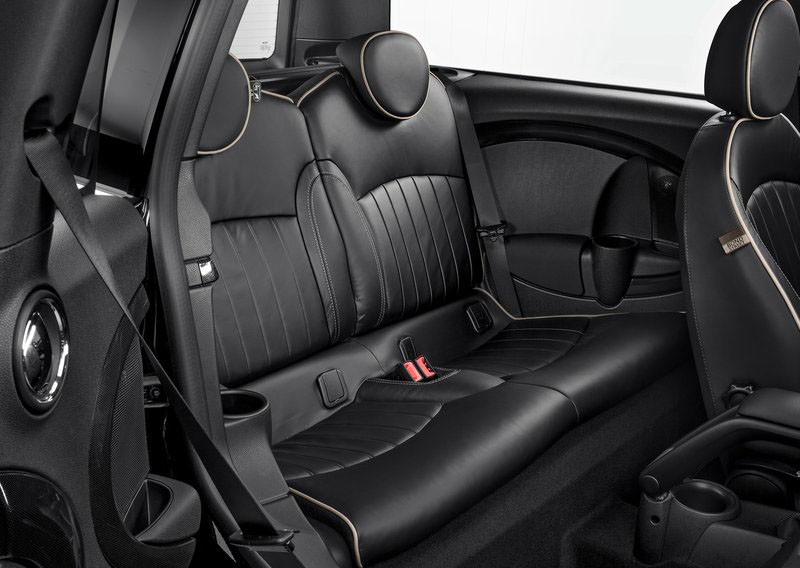
Other bespoke features of the design model are interior appointments including Lounge Leather sports seats in Carbon Black with piping and stitching in Deep Champagne, and a leather-covered instrument panel in Black/Carbon Black. These adornments blend in with interior surfaces in Deep Champagne, leather trim for the Colour Line and armrests with contrast stitching in Deep Champagne, floor mats with black piping and contrast stitching likewise in Deep Champagne, and the Chrome Line Interior package.

The stylish design of the exterior and interior is complemented by a particularly high-quality array of equipment. The MINI Clubman Bond Street will greet customers with features including front foglamps and the Chrome Line Exterior package, as well as an extra dose of driving fun and comfort thanks to options such as climate control, an onboard computer, the Sport Button, a rain sensor with automatic headlamp activation, a leather steering wheel with multifunction buttons and cruise control, and height adjustment for the front passenger seat. A storage package and lighting package are among the other items included in the exclusive specification list for the MINI Clubman Bond Street.
Read More

Friday, March 15, 2013

MG Icon Concept, 2012

 
  •  MG Icon Concept, 2012

The MG has scooped a major design award with its stunning MG Icon concept car.

It has been awarded the prestigious 'Best Concept' title at the 2012 Beijing Motor Show, one of the most sought-after awards on the international automotive show calendar.

The MG Icon beat the Lamborghini Urus, Mercedes-Benz Concept Style Coupe and Honda Concept C.

Autoweek, one of the USA's leading automotive magazines, announced the awards and will present MG with an engraved trophy at a later date. Greg Kable, a highly acclaimed international motoring journalist and Autoweek's German editor, was glowing in his remarks about the Icon.

Kable said: "The Icon continues MG's resurrection under parent company SAIC Motor, bringing newly interpreted heritage style to the compact-SUV ranks in a package that will see it compete directly against the likes of Nissan Juke and the Mini Countryman."

No plans have been announced concerning production of the MG Icon. It's the first SUV concept from MG and was created by the MG global design team headed by British director Anthony Williams-Kenny. It takes inspiration from some of the legendary MG models of the past, including the MGA and MGB GT.

Williams-Kenny said: "It's a great honour to win this very important award, particularly when the judges put the MG Icon ahead of so many other famous brands.

"The judges obviously shared our enthusiasm and vision for MG which is one of the best loved brands in the world."

Williams-Kenny, who also led the design team responsible for the awardwinning MG6 production car, has recently been promoted to his new role as Global Director, SAIC Design.
Read More