Friday, March 15, 2013

MG Icon Concept, 2012

 
  •  MG Icon Concept, 2012

The MG has scooped a major design award with its stunning MG Icon concept car.

It has been awarded the prestigious 'Best Concept' title at the 2012 Beijing Motor Show, one of the most sought-after awards on the international automotive show calendar.

The MG Icon beat the Lamborghini Urus, Mercedes-Benz Concept Style Coupe and Honda Concept C.

Autoweek, one of the USA's leading automotive magazines, announced the awards and will present MG with an engraved trophy at a later date. Greg Kable, a highly acclaimed international motoring journalist and Autoweek's German editor, was glowing in his remarks about the Icon.

Kable said: "The Icon continues MG's resurrection under parent company SAIC Motor, bringing newly interpreted heritage style to the compact-SUV ranks in a package that will see it compete directly against the likes of Nissan Juke and the Mini Countryman."

No plans have been announced concerning production of the MG Icon. It's the first SUV concept from MG and was created by the MG global design team headed by British director Anthony Williams-Kenny. It takes inspiration from some of the legendary MG models of the past, including the MGA and MGB GT.

Williams-Kenny said: "It's a great honour to win this very important award, particularly when the judges put the MG Icon ahead of so many other famous brands.

"The judges obviously shared our enthusiasm and vision for MG which is one of the best loved brands in the world."

Williams-Kenny, who also led the design team responsible for the awardwinning MG6 production car, has recently been promoted to his new role as Global Director, SAIC Design.
Read More

Thursday, March 14, 2013

Mercedes-Benz A-Class, 2013


  •  Mercedes-Benz A-Class, 2013

The new Mercedes-Benz A-Class is opening up a new chapter in the compact segment: markedly emotive in design, with powerful engines ranging from 80 kW (109 hp) to 155 kW (211 hp), extremely efficient with emissions from just 98 g of CO2/km and a best-in-class drag coefficient of 0.27. At the same time the new model underlines that for Mercedes-Benz, safety is not a question of price - the standard specification includes, amongst other things, the radar-based COLLISION PREVENTION ASSIST system. Prices in Germany start at €23,978.50 (incl. 19% VAT) for the A 180 BlueEFFICIENCY.
Exterior design: The most progressive design in the compact class
Standing as much as 18 centimetres lower on the road than the preceding model, the new A-Class communicates design and dynamism at the very first glance. This radical form language, presented and enthusiastically acclaimed around the world with the A-Class Concept, was consistently implemented in the series production car. The appearance of the new Mercedes-Benz A-Class reflects this new Mercedes-Benz design strategy. The result is what is known as a two-box design with a distinct character of its own, a sportily emotive exterior and an exceptionally high-quality feel to the interior.

Defined edges and tautly drawn surfaces mark out the exterior design of the new A-Class. The constant interplay between concave and convex surfaces creates a characteristic play of light, particularly along the sides of the car, which contributes to its unique appearance.

Typical features of the long, sporty front are its pronounced V-shape, the separate headlamps, the radiator grille with central Mercedes star and double slats to either side of the star, as well as the additional air intakes on the sides. The "dropping line" apparent in the side profile dissipates towards the vehicle's front end. The design of the headlamps, together with the configuration of the light functions within them, are a key element of the design concept.

The light modules and LEDs behind the headlamp cover glass have been arranged in such a way as to create the characteristic "flare effect" for the daytime driving lights and indicators. The so-called "flare" is made up of the feature line within the headlamp, the LED modules for the daytime running lamps and the bulb sets for the indicators. This signature effect gives the car its energetic look and so helps to define a new, youthful face for Mercedes.

The perfect interplay of dynamic design and excellent aerodynamics is nowhere more apparent than in the roof, with its smooth surfaces and taut, arcing curve. The silhouette reveals smooth, flowing lines finishing in a flat edge. The roof spoiler, which conveniently hides all the aerials, provides an extra sporty touch and gives structure to the roof assembly. The beltline rises to the rear to form a pronounced wedge-shape. The side view is distinguished by sensuously moulded sculptural side panels and crisp lines. The front structural edge, above the wing, falls in what is known as a "dropping line" in a gentle arc towards the rear. The powerfully-shaped shoulder muscles above the rear axle serve to emphasise the car's coupé-like character. A further line sweeps up from just in front of the rear wheel arch, then gently fades away. All these lines give depth and dynamism to the car's profile. Dynamic side sill panels provide a final finishing touch towards the bottom of the car, enhancing the appearance of elegant light-footedness.

The broad emphasis of the tail end is revealed in an interplay of convex-concave surfaces and edges. The tail lights continue the line of the muscular shoulders back towards the rear, while their horizontal orientation emphasises the car's powerful breadth. The light functions are provided optionally by fibre-optic cables and LED modules. Here, too, the interaction between design and aerodynamics is very clear: the surface finish of the tail lights is not only an interesting design feature, but also improves the airflow around the vehicle thanks to defined airflow break-away edges in the rear section.

The interior design: Extraordinary perceived value
The starting point for the interior design was the interior sculpture "Mercedes-Benz Aesthetics No. 2" presented at the Detroit Motor Show in 2011 and which directed attention to the new Mercedes-Benz design language in the vehicle interior, too. The first concrete implementation of this was shown in April 2011 with the A-Class Concept.

"The inspiration from aircraft design is continued in the A-Class", explains designer Jan Kaul. "The instrument panel is clearly divided into an upper part inspired on a wing profile and a muscular lower section. This creates the impression that the upper section is supported by a muscle."

The process used for the production of this muscle allows diverse soft surface textures. It is thus possible to create different surface appearances with an attractive play of lights thanks to three-dimensional structures embedded in foil.

The instrument panel incorporates five round vents. "Like brilliant jewels they underscore the superior quality of the vehicle interior", explains Kaul. The outer rings of the round vents have a high-quality electroplated finish. The airflow direction is governed by an insert that is reminiscent of an aircraft turbine and reveals a meticulous attention to detail. This too has an electroplated finish in silver-chrome. The free-standing display screen features a black piano-lacquer-look front panel and a flush-fitting silver frame.

The instrument cluster comprises two large round instruments, each with a small dial set within it. When at rest, the dial needles stand at 6 o'clock. The pointer inlays are in white, although with the sportier design and equipment lines such as Urban and AMG Sport they are in red. The dials on the sporty equipment lines and packages are coloured silver with a chequered flag effect. The 3-spoke steering wheel comes with 12 function buttons and an electroplated bezel.

The centre dome and console, as well as the positioning of the various elements such as the head unit, lower control panel, air conditioning operating unit, stowage compartments, rotary pushbutton and armrest, reflect the findings of the ergonomics experts at Mercedes-Benz.

An extensive range of seat coverings, in terms of material (e.g. leather, fabric, ARTICO/fabric), colour combination and also geometry, provides scope for a broad range of individualisation options. Sports seats with integrated head restraints are available with all optional design and equipment lines. The sporty nature of the seats is emphasised by the opening between the upper edge of the seat backrest and the head restraint. On the back of the front seats this opening is edged with a frame in silver chrome and, in conjunction with the Light and Sight package, can also feature ambient lighting.

Designer Jan Kaul sums up: "If you were to take a seat in the A-Class with your eyes closed - you would never think, upon opening your eyes, that you were sitting in a compact-class vehicle."

The chassis and suspension: Agility and refined sportiness
Refined sportiness means maximum agility combined with the sense of safety, unspoilt driving stability and high levels of ride comfort which are all typical of the brand. The suspension of the new Mercedes-Benz A-Class has a four-link rear axle, electromechanical power steering with assistance functions and ESP® with "Extended Traction Control" (XTC). During development, the suspension experts made intensive use of simulations and the driving simulators at the Mercedes development centre in Sindelfingen as part of the so-called digital ride and handling test.

The preconditions for achieving dynamic handling are excellent in the Mercedes-Benz A-Class. This is because compared with its predecessor the centre of gravity (24 mm lower) and seating position (174 mm lower) has been reduced significantly. A new feature is the four-link rear axle: forces are absorbed by three control arms and one trailing arm per wheel. This means that longitudinal and lateral dynamics are virtually independent of one another. Wheel carriers and spring links are made of aluminium to reduce the unsprung masses. The goal was to achieve high lateral agility with high driving stability thanks to small sideslip angle on the rear axle.

Three chassis and suspension set-ups are available: the comfort suspension and optional sports suspension for sporty yet comfortable handling (in conjunction with the Dynamic Handling package or the AMG Sport equipment line). In addition, the A 250 Sport has a sporty, "engineered by AMG" high-performance suspension. Altogether this results in low dynamic rolling behaviour and low start-off pitch angle. Furthermore, the vehicle also has a reduced tendency to understeer in the higher lateral acceleration range: the driver is therefore able to control changes in direction with low steering input but high steering precision. When accelerating out of bends taken at speed, the tendency to understeer is reduced even further by "Extended Traction Control" (XTC): with this function, ESP®provides support in the form of directional stability by generating a yaw moment on the front and rear wheels located on the inside of the bend.

Steering: mechanical with electric assistance
The electromechanical steering of the A-Class has been redesigned. The electric motor of the servo assistance system is now located directly on the steering gear as a dual pinion EPS system. The steering system makes an important contribution to the vehicle's overall efficiency, as the steering assist function only requires energy when steering actually takes place. A Direct-Steer system is available in combination with the Dynamic Handling package or AMG Sport equipment line. This provides a noticeably more direct steering ratio over the turning angle thanks to the variable ratio, and enhances the vehicle's handling and agility substantially. The steering conveys a high sense of safety, as the driver experiences a consistent and precise response to all steering movements.

The electric power steering also enables various steering assistance functions which are activated by the ESP® control unit
    Countersteering in case of oversteering
    Corrective steering when braking on road surfaces offering different levels of grip (split-fraction braking)
    Mitigating the extent to which the front-wheel drive influences the steering
    Compensating crosswind and road gradients
    The electric power steering also makes Active Park Assist possible.

With all engine variants, the Mercedes-Benz A-Class comes with disc brakes on all wheels. The callipers on the rear axle and the brake boosters are made of aluminium. A particularly convenient feature is the HOLD function, which is familiar from the larger model series: when stopping, for example at traffic lights, the driver merely has to press the brake pedal slightly more firmly and the brake will remain engaged until he moves off again. The brake is released automatically when the driver steps on the accelerator. On versions with manual transmission, the Hill Hold function automatically prevents the vehicle from rolling back unintentionally when starting on a slope.

The Mercedes-Benz A-Class is equipped with an electric parking brake, which operates by means of actuator motors acting on the callipers of the rear axle. The parking brake is activated via a button under the light switch on the left of the dashboard. This creates additional space in the centre console, as the handbrake lever is no longer required. When the button is pressed at speeds of over four km/h, the parking brake acts as an emergency brake, activating all four wheel brakes via the ESP®'s hydraulic unit.

In conjunction with the 7G-DCT automatic transmission, the parking brake offers a particularly convenient mode of functioning: when the driver accelerates sufficiently after fastening their seat belt, the parking brake is released automatically.
Read More

Wednesday, March 13, 2013

Ford Focus ST, 2013


  •  Ford Focus ST, 2013

The covers finally came off the production version of the dramatic new Focus ST five-door at the 2011 Frankfurt Motor Show, revealing the performance car that enthusiasts around the globe are waiting for.

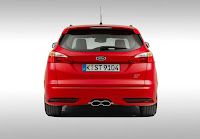
The European customers can also choose a stylish wagon version of the Focus ST, which will launch alongside the five-door model in 2012.

The Focus ST is Ford's first truly global performance car, building on the heritage of previous Focus ST models in Europe and evolving it to allow drivers around the world to experience and enjoy the exhilarating performance, unrivaled handling, addictive sound and muscular sports design that the ST badge represents.

With innovative design and technology throughout, the new Focus ST will be more powerful and surprisingly fuel efficient, raising the bar once again when it comes to handling too. For drivers who want refinement for everyday use but with exhilarating performance on tap, the passion, enthusiasm and expertise of Ford's Global Performance Vehicles group shines through and makes the new Focus ST the most rewarding and obvious choice.

The Ford ST Global DNA
Beneath the skin of the new Focus ST is a detailed DNA for the ST range, established in Ford's exciting global performance car strategy. Working together, the Global Performance Vehicles group - made up of Ford Team RS in Europe and the Special Vehicles Team (SVT) in the United States, along with input from Ford experts in the Asia Pacific and Africa region - devised a strategy that all future global performance Ford cars will adhere to.

Like all future ST models, the new Focus ST has key physical DNA attributes like the aggressively enhanced front and rear bumpers, the addition of a rear spoiler and sideskirts plus a unique signature colour.

In both five-door and wagon form, the scintillating Focus ST delivers the same driving attributes that makes all Ford 'Sports Technologies' models stand out amongst the competition. The chassis, engine, sound and comfort of the vehicle are tuned harmoniously to deliver a truly sporty experience with a level of refinement rarely seen in this sector of vehicle. These same attributes will form the genetic code for future models bearing the ST badge.

Ford's First Global Performance Car
The One Ford approach to working together across geographic boundaries has already seen successful global launches of the Fiesta and new Focus for the company. This approach is the great enabler for performance versions to be readily developed for a global market.

"The new Focus is a fantastic car to develop an ST model from," said Matthias Tonn, chief program engineer for the Focus ST. "It's a solid shell with precise handling as standard, as customers around the world have already found out. It doesn't compromise on any area in any region of the world, and Focus ST builds upon that strength to give our global performance customers the car they want, the car they have been asking for."

According to Capito and Tonn, performance vehicle customers around the world desire the same things from a car no matter on what types of road or in what weather conditions they drive. This is the insight that Ford's Global Performance Vehicles group gained and it forms the guiding principles for the company's global performance car strategy.

Destined to reach over 40 markets on six continents, the five-door Focus ST will bring affordable, everyday performance to the world. Only the smallest changes - to meet with regional legislation - will be implemented. In effect, no matter where in the world a driver gets behind the wheel, the new Focus ST five-door will deliver the same sensation of power, poise and refinement as for anybody else across the globe.

For Europe, where wagon derivatives are extremely popular in many markets, the opportunity to develop a stylish Ford Focus ST Wagon as a niche model was irresistible.

More Power and Economy
For global customers, Focus ST is powered by the 2.0-litre Ford EcoBoost engine, which offers an uncompromising mix of performance and efficiency. Ford's lightweight, all-aluminum EcoBoost engines provide the power of a larger engine in a fuel-efficient smaller displacement, utilising three key technologies.

High pressure direct injection, low-inertia turbocharging and Twin-independent Variable Cam Timing (Ti-VCT) all help to create an advanced combustion system which brings new levels of performance and fuel efficiency to Ford's petrol engines.

Ford's Global Performance Vehicles group has taken this technology and developed a 250PS high-output derivative of the 2.0-litre Ford EcoBoost engine for Focus ST.

Redesigned intake and exhaust systems with unique engine calibration deliver the ideal level of power and responsiveness.

The engine has a maximum output of 250PS and strong torque levels in a broad, flat torque curve peaking at 360Nm. The responsive torque output, a trademark of Ford EcoBoost engines, is maintained despite the impressive peak figures.

Compared to the 2.5-litre, 5-cylinder engine in the previous-generation European Focus ST, the new 4-cylinder engine offers increased performance, but its smaller capacity and innovative technology also allow it to be more fuel efficient.

The EcoBoost 2.0 in the Focus ST is expected to cut both CO2 emissions and fuel consumption by more than 20 per cent from the previous-generation European model when fuel consumption data is certified.

Mated to the 2.0-litre engine is a 6-speed manual transmission, which has specially revised gearing to produce the maximum punch from each throw of the gear shift. The Global Performance Vehicles group spent significant attention to detail to ensure the ratio of sixth gear was perfectly in tune with the Focus ST, giving the driver optimum performance while remaining long enough to help maintain excellent fuel economy on longer runs.

Sensational Sound
The previous generation Focus ST was acclaimed for its particularly sporty 5-cylinder engine sound. With the introduction of a 4-cylinder Ford EcoBoost engine into the new Focus ST, the Ford sound engineers were keen to ensure the audible delights from this totally different engine keep enthusiasts just as excited.

A significant part of this process is the reworking of the famed sound symposer, first found on the previous Focus ST and subsequently employed to devastating effect on the previous generation European Focus RS and RS500 models.

It's not only the engine note that sounds fantastic on the new Focus ST. The exhaust system - with unique centre exit tailpipes - has been tuned to deliver a perfectly balanced audible experience. Enthusiastic drivers will be rewarded with an orchestra of sporty sounds to heighten their driving adventure, but should they want a more relaxing drive, the refinement of the cabin and tuning of exhaust and engine note will give them exactly that at lower RPM.

Unprecedented Driving Dynamics
Incredible driving dynamics are at the heart of the Focus ST. Innovation and technology combine to create a chassis capable of exceeding the expectations of even the most demanding driving enthusiast, while giving even novice motorists an unforgettable drive.

From the driver's seat, customers will experience the newly-developed Ford Sport Steering System. This variable ratio steering rack is designed to increase the agility of the Focus ST on winding roads yet still inspire the same high-speed confidence.

The unique system makes steering less sensitive when driving in a straight line, but increases the sensitivity during cornering. Drivers can keep their hands firmly gripped on the steering wheel through tight hairpins, maximising their control over the vehicle. It also has benefits in slow-speed situations such as tight parking manoeuvres, with less input needed from the driver to direct the vehicle into the space.

The Focus ST's Electronic Power Assisted Steering (EPAS) is also enhanced with Ford's Torque Steer Compensation (TSC) system.

More aggressive tuning of the TSC allows Focus ST drivers to accelerate at full throttle and yet still find grip on roads with uneven surfaces or uneven levels of grip. The TSC system detects the torque steer that those conditions can create and communicates with the EPAS software, which then counteracts the effect to virtually eliminate the sensation for the driver.

Further enhancements have also been made to the Focus ST's Electronic Stability Programme (ESP), with emphasis put on driver enjoyment. Drivers will have three modes of ESP to choose from. These can be selected according to weather and road conditions or simply to match the driver's desire for help from additional driving aids.

In the first instance the ESP works much the same way as the innovative system found in the base model Focus, although for the ST it is tuned to be non-intrusive to the driver. This standard mode supports the driver on all surfaces, whether dry, wet or snowy, giving them the confidence to drive safely no matter what the weather.

The driver can opt to select the second mode, called reduced or wide-slip mode, in which the traction control is turned off. Traction is handled by the driver here, while the ESP is programmed to intrude only as absolutely necessary.

Of course, the ESP system can also be switched off completely resulting in the Focus ST in its purest form, giving full control of the sublime chassis to the driver when is a position to exploit it, such as on a race track. Only the sub-features such as the Enhanced Dynamic Cornering Control (EDCC) remain active, optimising the enjoyment of the Focus ST's abilities.

Enhanced Torque Vectoring Control
Through the corners, Enhanced Torque Vectoring Control is an essential help for Focus ST drivers, a tuned version of the Torque Vectoring Control found in the base model Focus. The standard system uses torque vectoring by braking, in which brake torque is applied to the inner wheel of the Focus through a corner, reducing the understeer behaviour and allowing for more traction, much like a traditional limited slip differential.

The Focus ST system applies this more aggressively and also adds Cornering Under Steer Control (CUSC), which applies torque to create yaw torque based on the vehicle's understeer behavior prior to ESP, both in power-on and power-off conditions. Combined, they ensure that Enhanced Torque Vectoring Control is a crucial element in helping the front-wheel-drive Focus ST be a true driver's machine, able to tackle any corner with supreme confidence.

Sports Suspension
Working in harmony with the advanced driver assistance features is the finely tuned suspension setup of the new Focus ST. Uprated shock absorbers and springs lower the ST chassis by 10mm for a more aggressive stance while the centre of gravity is brought closer to the road, which aids precise cornering.

The rear suspension has been revised with a number of new parts developed specifically for the Focus ST. Key components are the uprated suspension knuckles and an all-new anti-roll bar design, both the result of the development team's desire to give drivers an outstanding amount of feedback and control.

The rear suspension of the five-door and the wagon versions of Focus ST differ slightly. The wagon features angled shock absorbers - as in the base model - to maintain the optimum amount of capacity in the luggage compartment.

Ultimately, both Focus ST bodystyles offer the same handling characteristics that will have drivers searching out twisty roads.

Iconic Alloy Wheels
The iconic Y-shaped spoke design of the previous generation Focus ST has evolved for the new incarnation. A set of 18-inch alloy wheels carry on the recognised Focus ST style but subtle revisions bring them up-to-date for 2012.

ST customers will now have an additional 'Performance Pack' option which offers the wheels in black with a high contrast red finish on the performance brake calipers.

Wrapped around the alloy wheels are high performance 235/40R18 Goodyear Eagle F1 Asymmetric 2 tyres, developed after rigorous testing on all kind of road surfaces and conditions, including the infamous Nürburgring Nordschleife in Germany.

Bold and Muscular Outside
Globally the new Focus ST will be available in five-door hatchback bodystyle with European markets also able to order the newly-revealed wagon version. Both models build on the striking kinetic design of the standard Focus, yet add the muscular presence and specific performance cues associated with a Ford ST model.

The performance intent of the Focus ST is evident even from a glance. The new signature production colour, Tangerine Scream, reflects the exciting and energetic character of the Focus ST, but even in the other available colours - Performance Blue, Race Red and White - the car will shout performance. This is emphasised by the bold and muscular styling of the Focus ST.

From the striking one-piece design interpretation of Ford's signature trapezoidal grille at the front, through the sculpted side skirts and the dynamic rear bumper with prominent diffuser-style vents in the lower fascia, the Focus ST's design adds aggression and aerodynamic stability compared to the base models.

Drivers following the Focus ST will notice the highly effective roof spoiler on both models, optimised to deliver improved high-speed stability and reduced drag. They will also witness the unique centre-exit exhaust with a stunning tailpipe design influenced by the exclusive hexagonal mesh of the front bumper.

Around the world, the sporty design of the Focus ST will leave other drivers in no doubt that they are seeing something that boasts incredible performance beneath that impressive metal.

Stylish and Sporty Inside
The exhilarating drive of the new Focus ST will have customers spending as much time behind the steering wheel as possible. With that in mind, Ford's designers have worked hard to ensure the interior of the Focus ST is a great place to be, helping the driver to feel as connected to the vehicle as possible.

The interior of the core Focus model is already designed with a "cockpit" feel, giving any Focus driver a sporty sensation. In the ST variant, though, that sporty feeling is heightened with everything the driver touches and feels reinforcing that it is unmistakably an ST.

Details range from specially designed pedals, steering wheel and gearshift to the unique Recaro seats. The darker headlining and trim on the pillars, an integral part of the ST's design DNA, adds to the performance driving feel.

With the seats, Ford worked closely with Recaro to give ST customers the ultimate in comfort and support. The seats will not only hold the driver in place tightly during spirited driving, but will offer exclusive premium features like cushion tilt, plus length adjustment which is a unique option in this class of vehicle. A lower seating position has also been achieved to give drivers improved ergonomics and the perfect place from where to exploit the ST's performance.

Rear seat passengers aren't forgotten. An all-new rear bench has been developed for the ST, sculpted using special foam. This will help rear passengers feel as secure as those passengers in the front, highlighting not only the sporting intentions of Focus ST but also the practical considerations that are part of its core DNA.

New Focus ST will be offered to European customers in three distinct trim options - ST1, ST2 and ST3. This approach is already familiar to owners of the previous Focus ST in the UK.

While precise details of feature availability for each trim option will vary by market, ST1 is the standard model, offering the key features like cloth Recaro seats, keyless start, front door scuff plates with ST logo and standard ST rear bench with centre armrest.

Focus ST2 builds on this with the addition of partial leather Recaro seats and dual zone Electronic Automatic Temperature Control (EATC). For right-hand drive markets, ST2 will also include unique ST floor mats, automatic headlamp control, auto-dimming rear view mirror and automatic wipers, features that are standard on left-hand drive ST1 models.

The top spec Focus ST3 increases the features with the inclusion of those exclusive heated leather Recaro seats with 8-way adjustability and pull out cushion, plus the newly developed Recaro rear bench. ST3 customers also benefit from Bi-Xenon headlamps to keep the road ahead in total clarity throughout the night.
Read More

Tuesday, March 12, 2013

Fiat 500S, 2013


  •  Fiat 500S, 2013

The Fiat 500S, the new sporty version of the 500, which is characterized by an aggressive look and a wealth of standard features, can now be order in Italy. It will satisfy anyone looking for a sporty car with a strong personality. It is available as both a hardtop and a convertible.

The engines available are: 1.2 69 HP, 0.9 TwinAir 85 HP, 1.4 16v 100 HP and 1.3 Multijet 16v 95 HP. The price list starts at 13,750 EUR for Fiat 500S 1.2 69 hp and go up to 16,050 EUR for the version equipped with the 1.3 Multijet 16v 95 bhp (the price of convertible versions are 17,250 euro and 19,550 euro, respectively).

On the outside, the new Fiat 500S features rear spoiler, new side skirts, sporty bumper (front and rear), privacy glass, 15" alloy wheels (optional 16") and a 'dark chrome' finish. Changes on the inside include new sports seats with red stitching and a '500S' logo on the backrests.

In perfect harmony with the sporting spirit of the new version, the interior of the Fiat 500S is also enhanced by a racing steering wheel, gear knob and dashboard finished in Matt Silver. The extensive standard equipment list includes manual air conditioning, Blue & Me ™ system with radio controls on the steering wheel and electric mirrors. Upon request, there are several additional options available including: 16" alloy wheels, sporty roof design and a black painted spoiler.

The Fiat 500S is offered in nine body colors: White Ice Cream, Passion Red, Carrara White, Black Vesuvius, Pompeii Grey, Grey Coliseum, Blu Mediterraneo , Black Matte Stealth and the three-layer white pearl.
Read More

Sunday, March 10, 2013

Dodge Avenger Blacktop Edition, 2013


  •  Dodge Avenger Blacktop Edition, 2013

America's most affordable and powerful mid-size sedan, the Dodge Avenger, gets a menacing new look and a distinct set of new features with the Blacktop package, which also offers incredible value with a U.S. MSRP of just $595.

Available in Black, Redline Red 2, Bright White, Tungsten Metallic and Billet Silver Metallic, the 2013 Dodge Avenger Blacktop is based on the 2013 Dodge Avenger SXT model and adds standard 18-inch Gloss Black aluminum wheels with Gloss Black center caps, Gloss Black front grille, dark-tinted headlamp bezels and a body-color rear spoiler.

Additional standard features on the Avenger with the Blacktop package include: a six-speed automatic transmission with Auto Stick that delivers up to 31 mpg, automatic headlamps, projector fog lamps, eight-way power driver seat, leather-wrapped steering wheel and shift knob, six speakers, automatic temperature control, body-color heated exterior mirrors, SiriusXM Radio, Electronic Vehicle Information Center (EVIC), four-wheel disc anti-lock (ABS), Electronic Stability Control (ESC), six airbags and much more.

For an added dose of luxury with the customized black appearance, Avenger Blacktop offers a premium leather interior with heated front seats for only $400 MSRP, making Avenger the most affordable mid-size car with leather in the United States.

With optional equipments: the 3.6-liter variable-valve timing Pentastar V-6 engine, which produces a best-in-class 283 horsepower and 260 lb.-ft. of torque while providing impressive V-6 highway fuel economy of 29 miles per gallon (mpg), power sunroof, premium audio system and 6.5-inch touch screen with Navigation.

The 2013 Dodge Avenger offers great value with loads of standard features that customers appreciate and a starting U.S. MSRP of only $18,995. The Dodge Avenger was named an Insurance Institute for Highway Safety (IIHS) "Top Safety Pick" in 2012, the fourth consecutive year the Avenger has been named a "Top Safety Pick."

An athletic yet refined exterior, a high-quality, well-crafted interior, a spirited driving experience, fuel economy of up to 31 mpg highway and a 5-year/100,000-mile powertrain warranty make the 2013 Dodge Avenger the smart buy for sedan buyers, which explains why Avenger has set sales records for six of the past seven months.
Read More

Saturday, March 9, 2013

Dacia Sandero, 2013

 
  •  Dacia Sandero, 2013

The new Sandero is a modern compact hatchback with good looks expressing vitality and versatility. The new model continues to bring customers unrivalled equipment for money and in classic Dacia style is strong on cabin space and load volume.

Boot volume of 320 dm3 VDA remains unbeatable given the car's price and compact design. Sandero is no slouch on practicality and versatility either, with a 60/40 split-folding rear bench, which folds down to increase load volume to 1,200 dm3 VDA.

With New Logan, New Sandero and New Sandero Stepway, Dacia styling becomes more assertive and upmarket

Dacia's new design identity emphasises quality and strength. The three restyled models share the same harmonious front end, radiating outwards from the Dacia logo in the grille. The design of the large headlights and grille gives the cars a more expressive face.

The proportion of body to glazed surfaces underlines the impression of robustness, helped by a sculpted waist line, more emphatic wheelarches and flanks found on each new model.

More appeal inside
The three new models feature a new dark-carbon or two-tone dashboard (according to model and version) home to comprehensive and contemporary-style instrumentation, with chrome-surrounded dials and latest-generation, eminently functional controls.

The air-vent surrounds, steering-wheel logo and gear-stick handle label are chrome-finished (according to trim level). The central fascia is highlighted by a color wheel trim embellisher (according to trim) that matches the door handles and the design strip on the steering wheel.

Aesthetic quality has been enhanced through the clever choice of materials and flusher fit.

Gasoline: TCe 90
For the first time, New Dacia Logan and New Dacia Sandero are available with the TCe 90, a new symbol of the Renault group's powertrain excellence. This exceptional engine combines driving pleasure and comfort with controlled fuel consumption (54.3 mpg) and CO2 emissions (120 g/km) for reduced running costs.

Featuring the latest technology and downsizing techniques, the TCe 90 is a three-cylinder, 898cc turbocharged gasoline engine. With its ultra-low-inertia turbocharger plus variable valve timing, it delivers 66 kW (90 hp) at 5,250 rpm and generates 135 Nm from low engine speeds (90% from 1,650 rpm), making it a lively and responsive performer with smooth acceleration. It brings drivers a best-in-class balance between driving performance and fuel consumption.

Gasoline: 1.2 16v 75 (Euro 5)
This 1,149cc engine, developing 55 kW (75 hp), is an impressive all-rounder, equally at ease in the city or out on the open road. Fuel consumption is an impressive 47.8 mpg, for CO2 emissions of 137 g/km on New Dacia Logan and New Dacia Sandero. The 1.2 16V 75 engine is also available in an LPG version for lower running costs and just 125g/km of CO2 (in course of homologation, unavailable in UK).

Diesel: dCi 75 and 90 (Euro 5)
Renowned for its driving pleasure, performance reliability, and environmental respect, the 1.5 dCi is available in 55 kW (75 hp) and 66 kW (90 hp) versions. With a torque increase of 20 Nm - 200 Nm of torque at 1,750 rpm for the 75 hp unit and 220 Nm at 1,750 rpm for the 90 hp unit -the 1.5 dCi engine is responsive from even the lowest engine speeds. This performance comes hand in hand with some of the lowest fuel consumption figures in the segment, at 74.3 mpg, for CO2 emissions of 99 g/km for New Logan and Sandero, over a combined cycle representing a decrease of 5 g. Both engines naturally carry the Dacia eco2 signature.

New Dacia Sandero Stepway: TCe 90 and dCi 90
Equipped with the TCe 90, the latest example of the Group's mechanical expertise, New Sandero Stepway consumes 52.3 mpg for CO2 emissions of 125 g/km.

The dCi 90 version bears the Dacia eco² signature in recognition of its low consumption (68.9 mpg) and emission (105 g/km) levels over a combined cycle.

Dacia Plug&Radio
New Logan, Sandero and Sandero Stepway are available with the Dacia Plug&Radio multimedia solution. Plug&Radio consists of a wide screen and an MP3-compatible CD player, plus Bluetooth® technology, fascia jack and USB sockets, and steering wheel-mounted controls. With Bluetooth® technology drivers can make hands-free calls, with synchronised contacts book and call history, and listen to their favourite tunes by audio streaming through the car's speakers.

MEDIA NAV multimedia system
After debuting on Dacia Lodgy and Dokker, MEDIA NAV is available on all three new models. The simple and user-friendly system, fitted seamlessly in the central fascia, comprises in-car navigation, a radio, Bluetooth® hands-free connectivity and audio streaming, all controlled via a 7-inch (18-cm) touch screen. Navigating the system is easy, via the Menu page. Occupants can also hook up their nomad devices via the USB and jack sockets, mounted on the central fascia for enhanced access and ergonomics, and play them using the touch controls on the screen or the buttons on the steering wheel.

The intuitive touch screen features 2D and "Birdview" (3D) graphics. Customers can update and add mapping content using the USB socket and Naviextra website.

Speed limiter/cruise control and rear parking sensors
A cruise control system - new to the Dacia range - will be available (depending on the version) on New Logan and Sandero, alongside the speed limiter. Rear parking sensors are now available depending on trim level.

Passive safety
For maximum passenger protection, New Dacia Logan, Sandero and Sandero Stepway benefit from all the safety expertise of Renault's engineers. Seatbelts are equipped with calibrated load limiters for thorax protection in the event of impact. The three models also feature Isofix anchorage points in the two rear lateral seats for easy and 100% safe installation of child seats. Every trim level is fitted as standard with front and side driver and passenger airbags and ESC.

Wide range of accessories
For extra personalisation, Dacia proposes a broad range of accessories for everyday use including side mouldings, floor mats, headrest hangers and boot nets. Weekend getaways and holidays have never been easier thanks to a roof box, ski rack, towing hook, bike rack and portable coolbox. Customers can also customise their Dacia using decal strips, exclusive wheel rims and fog light surrounds.

Roominess and load capacity from the segment above
The interior and exterior dimensions of the three new models are as generous as ever, worthy of the segment above. Rear elbow room in New Sandero is 1436 mm, giving enough room to seat three adults comfortably or install three child seats.

Boot volume, as high as 510 dm3 VDA for New Logan (320 dm3 VDA for Sandero), remains unbeatable given the price and the compact exterior dimensions of the vehicle. Practicality and versatility also remain strong points, thanks to the 60/40 split-folding rear bench.

The cabin has been enhanced to bring occupants more storage possibilities, notably with the addition of a central cubby box. The storage spaces in the front and rear doors are large enough to house a 1.5-litre and 0.5-litre bottle respectively.

Driving comfort and efficiency
As all the models in the Dacia range, New Logan, Sandero and Sandero Stepway have excellent ground clearance enabling them to take on all kinds of road conditions. They also feature robust underbody protection for impressive performance on unpaved tracks.

Acoustic comfort has also been improved through additional soundproofing material in the engine compartment and controlled road noise.

Dacia, a reliable brand that perfectly meets customer needs
Dacia customers have simple and well-targeted needs. They are looking for generous, simple and reliable vehicles that are smart and affordable. Dacia's is a practical offering that responds perfectly to the expectations of its customers.

Marketing an increasingly wide range of vehicles (Logan, Logan MCV, Sandero Stepway, Duster, Lodgy, Dokker, Dokker Van), Dacia is posting remarkable quality results. In the latest 2012 results of ADAC, the benchmark German organisation, the reliability of Dacia vehicles has improved continuously over the last three years and Sandero is number four in its category. In February, the brand ranked number-one on reliability in a survey carried out with 30,000 customers by consumer organisations in Belgium, France, Spain, Italy and Portugal.

The Dacia builds durably reliable cars and is winning the trust of its customers
Dacia vehicles, like Renault ones, are tested in the most extreme conditions. In addition to conventional bench tests, the Renault group puts its vehicles through demanding tests in real-world conditions to confirm their durability. Logan, for example, was tested over 1.9 million kilometres. Dacia cars are designed from the outset to be sold internationally, and notably in emerging markets. They are developed according to demanding specifications given the diversity of road and weather conditions in such countries.

All Dacia models are covered by a 3 year/60,000 miles manufacturer warranty, with service at all dealerships in the network and top-level repair expertise with manufacturer parts. The warranty is targeted at winning new customers, raising awareness of the brand, and building a relationship of trust with customers.

Dacia benefits from the quality expertise of Renault, which has become a leading carmaker on reliability, largely the result of a global group quality policy launched in 2003.

Dacia relies on Renault group and Alliance know-how in standards and processes

New Logan, Sandero and Sandero Stepway will be produced at the Pitesti plant in Romania and the SOMACA plant in Casablanca, Morocco for the regional market (including Morocco and Tunisia). Starting in the second-half of 2013, New Sandero also be produced at the Tangier plant in Morocco.
Read More