Monday, January 7, 2013

Volkswagen E-Bugster Speedster Concept, 2012


  • Volkswagen E-Bugster Speedster Concept, 2012

The Beetle! - it is the successor to an automotive icon. The new car is considered the sportiest Beetle ever. Now Volkswagen has shown, in an Asian premiere at 2012 Auto China in Beijing, how this sportiness can also be transferred to a Beetle with pure electric drive. The Volkswagen E-Bugster was specially designed for this mission: a two-seat Beetle speedster, 85 kW in power, 0 to 100 km/h in 10.8 seconds, with zero emissions yet the sharpest of proportions.

Blue-e-Motion for a clean future
The central electric module of the Volkswagen E-Bugster has an innovative design; it weighs just 80 kg. The energy for powering the electric motor is stored in a lithium-ion battery whose modules are housed in a space-saving location behind the front seats. The battery's energy capacity of 28.3 kWh enables a range of at least 180 km in the urban world. And even in an enormous country like China, for the majority of commuters this is sufficient to drive to their workplaces and return home. Since the Volkswagen has a quick charging function, the battery can be 'refuelled' within 35 minutes at suitable charging stations. At home, the battery of the VW E-Bugster can also be charged from a conventional electric outlet. The interface for the charge cable is located behind the normal 'fuel door' near the C-pillar.

The Volkswagen E-Bugster can be 'filled up' flexibly via one interface using any available charging modalities. Possible are:
    Single-phase charging with AC current
    Ultra-fast DC charging at charging stations (quick charge)

This will be based on a new, uniform industry standard for the connectors of future electric vehicles that will be available to all manufacturers. And this standardisation goes beyond the plug itself: in the Combined Charging System, the charge controller and the electrical architecture must be able to handle all charging types. This will reduce costs and simplify widespread global implementation of electric mobility.

Charging the battery while braking
Just how much energy the driver of the Volkswagen E-Bugster is requesting with the 'electric pedal' at any moment is shown in a power display. Instruments also include a driving range indicator and a display showing the battery's charge state. Also new in the Beetle is an instrument that shows the driver the intensity of battery regeneration. Regeneration refers to the recovery of braking energy: as soon as the driver's foot leaves the accelerator pedal and/or brakes, kinetic energy is converted into electricity, which is stored in the battery. This increases the driving range of the VW E-Bugster. By the way, Volkswagen calls the complete electric drive unit Blue-e-Motion.

Visions become versions
Bugster? That sounds familiar. Of course: Ragster! That was in January 2005 in Detroit, where Volkswagen presented a New Beetle as a speedster with a swept-back ragtop (folding roof) - the Ragster. A design vision for the Beetle of tomorrow - wider, lower, sportier. In 2005, the slogan for the concept's feasibility was expressed as: "Everything is conceivable!" In 2012, it had advanced to: "Everything is feasible!" Because the idea of the Ragster - wider, lower, sportier - became a reality (with the exception of the ragtop) in October 2011 in the current production Beetle. So, what does the name E-Bugster actually signify? That is easy to explain: a combination of the 'E' for electric models, the American nickname for the Beetle, 'Bug' and the vehicle type 'speedster' that describes a low, open-top two-seater.

Proportions of a sports car
The Volkswagen E-Bugster is a Beetle that could hardly be made to look more dynamic. Actually, it is a sports car. It has a height of less than 1,400 mm, which is about 90 mm less than that of the hard top Beetle. And the production model already looks really powerful with its sharply sculpted proportions. The E-Bugster's width (1,838 mm) grew by 30 mm, while its length (4,278) remained the same as that of the production car. The Volkswagen E-Bugster displays unique dynamic styling from every viewing angle. Design details of the production version were supplemented by new styling elements. In its stance on the road, the concept car looks as though it were cast as a single piece. There is a very simple reason for this: in developing the production model introduced in October 2011, the Beetle design team had already considered all potential derivatives for future models on its radar screen of possibilities. And that is in part how a speedster with an E-motor evolved, the VW E-Bugster.

Bugster front and rear
In front, it is the swept-back and wide windscreen that catches the eye; its glass extends laterally to a point above the A-pillars. The Volkswagen E-Bugster, which is equipped with LED headlights, is also distinguished by the highly customized bumpers of the production Beetle: designers integrated the daytime running lights to the left and right of the central air intake as bands of LED lights in a C-shape (naturally mirrored on the right side). Ever since the e-up! concept car was presented in Europe, this form of daytime running light has been a feature on Volkswagen electric vehicle studies. These styling elements also appear in modified form as reflectors in the rear bumper, which was also redesigned. The rear windscreen of the E-Bugster proves that the rear windows of a speedster do not need to restrict visibility like the arrow slits in castle walls: it is extremely wide.

Speedster side profile
A speedster needs swept-back windows and a low roof, and the Volkswagen E-Bugster has them. First, let us survey the car's profile. The wheels beneath the flared wheel housings are 20-inch versions of the 18-inch Beetle 'Twister' wheels, equipped with 235/35 R 20 tyres. From the side sill, the viewer's gaze moves upwards over the large, smooth continuous surface of the door and the contour line above the door handle that looks as though it were carved with a knife. Just a few centimetres above this point, the Beetle becomes a speedster: designers lengthened the chrome strip of the lower window border towards the rear; it now runs (as it did on the New Beetle Cabriolet) once around the car, from A-pillar to A-pillar. The hard top of the 'Bug' extends in a low arc above this chrome line. Following the roof radius - in classic speedster style - is the upper border of the side windows. The height between the chrome lower window border and the uppermost roof line is a low 400 mm. And that is how it should be for a speedster!

Progressive interior
The combination of high-tech equipment and dynamic performance is also reflected in the interior. Sport seats and a continuous centre tunnel in body colour underscore the sportiness of the E-Bugster. The use of aluminium as the material for the door handles and belt guides, and the lightweight construction styling of the steering wheel also produce a direct connection between the exterior and interior. Starting the VW E-Bugster is a unique experience: the Start button not only activates the drive system; it also puts a light show into motion: first, the interior is immersed in a white light, then a blue light. It begins as a light pulse in the instrument cluster; from there the light emanates as a thin line of light, just one millimetre wide, coursing into the door window sills and around the air nozzles - a kind of visual awakening of the E-Bugster.
Read More

Dodge SRT Viper GTS-R, 2013


  •  Dodge SRT Viper GTS-R, 2013

The street legal 2013 SRT Viper unveiled to the world at the 2012 New York International Auto Show isn't the only high-performance snake making a triumphant return in 2012.

The purpose-built, non-street legal and competition-ready SRT Viper GTS-R also was revealed as part of the Chrysler Group's announcement that a factory-backed SRT Viper Racing team will return to the American Le Mans Series (ALMS) in 2012.

SRT Motorsports has partnered with Riley Technologies, based in Mooresville, N.C., on the design-and-build process of the new SRT Viper GTS-R.

Two identical SRT Viper GTS-Rs will compete in the production-based GT class in the series. Four drivers currently are signed to drive including Dominik Farnbacher, from Ansbach, Germany; Marc Goossens from Geel, Belgium; Ryan Hunter-Reay from Dallas and Kuno Wittmer from Montreal. Additional driver and team announcements will be forthcoming.

Both Viper GTS-Rs will race on the proven Michelin GT tires extending the successful technical partnership.

Scott Atherton, President and CEO of the American Le Mans Series, hails the SRT Viper's return to the Series as one of 2012's top announcements.

"I don't think it's possible to overstate the significance of the SRT Viper returning to the top level of professional sports car racing," Atherton said. "The Chrysler Group has a long, storied and very successful history of competing with the American Le Mans Series. The fact that they're coming back concurrently with the introduction of the new production car and doing it simultaneously, we would be hard-pressed to come up with a better-case scenario. What a great way for SRT Viper to come back to racing."

All ALMS teams compete in the prestigious MICHELIN GREEN X Challenge. Entering its fourth season, the program objectively ranks the competing cars in terms of their environmental footprint, their energy efficiency and speed on the racetrack. A separate, season-long award is given by the U.S. Department of Energy, the U.S. Environmental Protection Agency and SAE International, acknowledging the vehicle manufacturer and its technology contribution to improving efficiency and reducing environmental impacts of racing. The scoring system for the program was developed by series officials and the U.S. Department of Energy, and it is based on a combination of on-track performance and energy consumption. The LMP and GT teams that win MICHELIN GREEN X Challenge championship will earn an entry to the 2013 24 Hours of Le Mans.

Viper racing heritage
The Viper has enjoyed a successful racing heritage that began in 1996 with the first Dodge Viper racing entry, the original GTS-R, which earned five international GT championships and the 1997-1999 FIA GT championships. It also posted an amazing overall win at the Rolex 24 Hours of Daytona in 2000 - the first for a production-based American car.

Viper finished one-two at the 24 Hours of Le Mans in GTS class in three consecutive years - 1998-2000 - and also captured GTS class, and driver's championships in the American Le Mans Series in 1999 along with the Series class, manufacturer's and driver's championships in 2000.

The Dodge Viper Competition Coupe, introduced in 2003, delivered the next chapter of that history with its coupe-shaped carbon/Kevlar body and a track-ready chassis, based on the Dodge Viper SRT10. The Viper Competition Coupe continued the on-track prowess by capturing the 2004 SCCA Speed World Challenge GT title, championships in Formula D Drifting series in 2004 and 2006 and the British GT Championship in 2007 and 2008.

In 2010, the Dodge Viper Cup Series was founded using the limited-edition Dodge Viper ACR-X spec series cars. In 2012, now in its third year, the series has been renamed the SRT Viper Cup Series.
Read More

Sunday, January 6, 2013

Honda Pilot, 2012


  • Honda Pilot, 2012

The Honda Pilot eight-passenger SUV receives a wide range of upgrades for 2012 with a sleeker front-end design, enhanced interior features and an EPA highway fuel economy rating of 25 mpg on two-wheel-drive models, an increase of 2 mpg compared to 2011 models.

The new styling for the front fascia, with its three-bar chrome-style grille, conveys a more sophisticated crossover SUV appearance. Interior styling changes focus on instrument panel refinement and a more intuitive button layout. For 2012, audio system upgrades on Honda Pilot EX and EX-L models include a 2 GB CD-Library (CD-L) and Bluetooth® Audio Streaming, along with the addition of Bluetooth HandsFreeLink® to those trim levels.

Feature upgrades on the Honda Pilot EX-L include the addition of a full-color 8-inch intelligent Multi-Information Display (i-MID) for audio and vehicle information. Models equipped with the available Honda Satellite-Linked Navigation System for 2012 receive subscription-free FM Traffic, 15 GB audio hard disk drive memory (HDD), and a higher-resolution display.

The fuel economy gains for 2012 result from combined improvements to the powertrain, chassis and vehicle aerodynamics. The 250 horsepower i-VTEC V-6 engine includes additional measures for friction reduction and improved efficiency. The 2012 Pilot becomes quieter with additional noise insulation and other enhancements throughout the vehicle.

Body
The 2012 Honda Pilot's new grille and front fascia replace the prior model's six-sided grille insert with a distinctive three-bar horizontal design. Reconfigured multi-reflector halogen headlights and turn signals contribute to the new look with a layout that relocates the turn signal from an outboard position to an inboard position within the headlight housing. A new front air dam and optimized strakes (the rectangular air deflector in front of the wheels) help reduce frontal area and unwanted air turbulence, both of which impact fuel economy. Rounding out the exterior design changes, Pilot EX and above models receive an all-new five-spoke, 18-inch aluminum alloy wheel design (plus 1-inch compared to the previous model). Honda Pilot Touring alloy wheels feature an exclusive six-spoke design with a high-contrast machined surface. Pilot LX models are equipped with 17-inch styled-steel wheels.

Exterior dimensions for 2012 are similar to 2011 with identical measurements for width (78.5 inches), height (71.0 inches for Pilot LX and 72.7 inches for Pilot EX, EX-L and Touring) wheelbase (109.2 inches) and track (front 67.7 / rear 67.5 inches). Overall length increases 0.5 inches to 191.4 inches as a result of the front styling changes. Ground clearance is basically the same at 7.97 inches, down slightly from 8.00 inches in the previous model.

Interior
Interior styling changes are designed to increase refinement throughout the cabin while also enhancing the intuitive nature of the controls. The instrument panel uses a more unified color theme with less contrast between panels. A glossy black center panel for audio controls replaces the high-contrast silver panel of the previous model. Speedometer and tachometer gauge faces incorporate a new look with distinct segments surrounding each meter's perimeter, along with white background illumination for nighttime driving instead of the previous model's aqua-blue background illumination. The redesigned center stack adds a subtle U-shaped character line and different textures to create a layered effect on the panel. Ideal for phones and audio players, a larger center storage pocket is 0.4-inches taller. A simplified layout for the climate controls replaces some of the buttons with dials for a more intuitive, easy-to-use overall design.

The top of the center stack on each Pilot model contains a unique display that varies by model. Honda Pilot LX and EX models contain a three-line display. Pilot EX-L models for 2012 (without navigation) receive the new i-MID, which provides a convenient platform for integration of vehicle information and compatible personal electronics through a color LCD screen and intuitive steering wheel controls. The Pilot EX-L rearview camera display appears in the i-MID and includes guidelines for judging parking distance. The i-MID also shows HandsFreeLink® operation, user-loaded wallpaper such as photos, a fuel-economy display and an audio interface.

Available on Honda Pilot EX-L and standard on Touring, the 2012 Pilot adopts the latest version of the Honda Satellite-Linked Navigation System™2. Now with 60 GB of total system memory (includes 15 GB allocated for user media) and voice recognition for three languages, this system uses multiple global positioning satellites covering all of the U.S. including Alaska and Hawaii, as well as Canada and Puerto Rico. Its new FM Traffic feature provides free, continuous updates on traffic and incidents, helping drivers avoid gridlock. The hard drive can store thousands of minutes of music, which is accessible by simple voice commands using the Song By Voice™ feature. Additionally, 2012 Pilot models with navigation feature a multi-view rear camera (wide view, normal view and top-down view), with the image displayed on the navigation screen for convenient parking help when in Reverse.

Adding to the comfort level of the 2012 Honda Pilot is a reduction in noise, vibration and harshness (NVH). Enhanced body seam sealing around the unit-body connection points, and re-tuned rear suspension sub-frame mounts, result in lower noise levels in the passenger cabin. Other specific NVH countermeasures include body-seam sealants to reduce air leaks, enhanced pillar separators, revised insulation materials and acoustic windshield glass on all models.

The tailgate features a lift-up glass hatch for convenient access to the rearmost cargo area. The model's 18.0 cubic-feet of cargo space behind the third row matches or exceeds the trunk space of a typical large sedan and can accommodate items as large as a mid-size cooler or a folded stroller. For maximum cargo space, the second and third rows fold flat into the floor to create 87.0 cubic feet of storage capacity, while also providing sufficient width for 4-foot-wide items.

The cargo area has a hidden storage well that provides 2.8 cu-ft. of additional space and can combine with the above floor storage area by securing the hinged cover against the seatback. The Pilot Touring also provides a load-supporting cargo net (20 lbs. maximum weight) to further subdivide the rear cargo area.

Key interior dimensions are identical to the previous Pilot model, including front headroom (40.0 in. for Pilot LX and EX, 39.3 in. for moonroof-equipped Pilot EX-L and Touring), second-row headroom (39.8 in.) and rear headroom (38.2 in.), legroom (front 41.4 in., second-row 38.5 in., and third-row 32.1 in.). Passenger volumes are likewise identical (153.7 cu-ft. for Pilot LX and EX, 152.7 cu-ft. for Pilot EX-L and Touring), as are cargo volumes (87.0 cu-ft. total, 47.7 cu-ft. behind second-row seats, and 18.0 cu-ft. behind third-row seats).

Safety
Safety technology includes the Advanced Compatibility Engineering™ (ACE™) body structure that helps reduce the amount of crash energy reaching the passenger compartment and can enhance frontal collision compatibility. Additional safety equipment includes three-row side curtain airbags with a rollover sensor, driver's and front passenger's side airbags with passenger-side Occupant Position Detection System (OPDS), active front seat head restraints and anti-lock brakes with electronic brake distribution and brake assist. Vehicle Stability Assist™ (VSA®), commonly referred to as Electronic Stability Control, is standard on all models. The 2012 Honda Pilot also meets new federal regulations with taller rear head restraints.

Honda has targeted the new Pilot to achieve best-in-class safety ratings, including a NHTSA 5-Star Overall Vehicle Score, and a TOP SAFETY PICK designation from the Insurance Institute for Highway Safety (IIHS) reflecting the institute's new procedures for Front Offset, Side Impact Collision Evaluation (SICE), Roof Crush and Head Restraint tests.

Powertrain
Power comes from an advanced 24-valve, all-aluminum engine with "intelligent" Variable Valve Timing and Lift Electronic Control (i-VTEC) technology with Variable Cylinder Management (VCM). The VCM system allows the V-6 engine to operate in six-cylinder mode for power and four- or three-cylinder modes for efficiency. Fuel economy improves for 2012 with an EPA-estimated city/highway/combined fuel economy of 17/24/20 mpg on 4-wheel-drive models and 18/25/21 mpg on 2-wheel-drive models. Representing a 1-mpg increase in City, a 2-mpg increase in Highway and a 2-mpg increase in Combined, this gives the 2012 Pilot 2WD the highest fuel economy of any 8-passenger SUV and the Honda Pilot 4WD the highest fuel economy for any mid-size 4WD SUV.

Fuel-efficiency enhancements include the application of engine friction-reduction technologies including a plateau-honed engine block, low-friction piston treatments, ion-plated oil rings and a load-variable alternator. The use of dual-electrode spark plugs, 0W-20 low-friction oil and low-friction automatic transmission fluid contribute to higher efficiency. The VCM operation range has also been expanded.

The 5-speed automatic transmission features Grade Logic Control to help maintain the most appropriate gear when going uphill or downhill, thereby avoiding gear "hunting." The available VTM-4 system on Pilot 4WD models adds fully automatic 4-wheel-drive capability. VTM-4 delivers seamless, "decision-free" application of 4-wheel-drive when needed, a key benefit compared to conventional systems. The system also provides a "lock mode" - available when in first or second gears up to 18 mph and activated by a button on the instrument panel - that can deliver the maximum-possible torque transfer to the rear wheels to aid in extraction from extremely low traction or stuck conditions.

Chassis
The suspension is a fully independent system with front MacPherson strut and rear multi-link with trailing arm designs that contribute to responsive driving characteristics for an SUV. The 109.2-inch wheelbase facilitates a smooth ride. A tight turning diameter of 37.9 feet aids maneuverability in tight parking situations.

Chassis improvements that directly improve fuel economy include a variable-displacement power steering pump, low-rolling-resistance tires, and low-drag front ventilated and rear disc brakes. Improved aerodynamics, the front strakes, splash shields and inner fenders, and reduced frontal area also contribute to improved fuel economy.

Models and Features
As with the prior model year, the 2012 Pilot is available in four model choices (Pilot LX, EX, EX-L and Touring), and each is offered in either 2-wheel-drive or 4-wheel-drive configuration.

Honda Pilot LX

Standard comfort and convenience features on the Pilot LX include a front and rear air conditioning system with air-filtration system, keyless entry with simplified operation, tilt and telescope steering column, cruise control, power windows with auto-up/down driver's and passenger's window, power door and tailgate locks, AM/FM/CD stereo system with seven speakers including a subwoofer and Radio Data System (RDS), trip computer, heat-rejecting tinted glass, integrated Class III towing receiver, and more. For 2012, the Pilot LX adds AAC audio file playback capability from data discs to the CD player.

Honda Pilot EX
The Pilot EX adds a tri-zone automatic climate control system with humidity control and air filtration, a power driver's seat with 10-way power adjustment with lumbar support, security system, XM Radio®, body-colored side mirrors and door handles, alloy wheels, roof rails, fog lights, exterior temperature indicator, HomeLink® Remote System, and more. For 2012, the Pilot EX now also features Bluetooth HandsFreeLink (previously exclusive to EX-L with Navi and above models), Bluetooth audio streaming and a new 2 GB CD Library (CD-L) replaces the previous 6-disc CD changer.

Honda Pilot EX-L
Additional Pilot EX-L features include leather-trimmed seating surfaces, heated front seats, 4-way power front passenger's seat, one-touch power moonroof, an automatic-dimming rearview mirror and the availability of either the Honda Satellite-Linked Navigation System™ or the Honda DVD Rear Entertainment System with a 9-inch screen. The addition of either the navigation or the entertainment system also adds a 115-volt power outlet. New for 2012 is the addition of a power tailgate to the Pilot EX-L, a USB Audio Interface, and an intelligent Multi-Information Display (i-MID) with QVGA resolution. The i-MID includes a rearview camera display, iPod album artwork display and a user-loadable wallpaper function.

Honda Pilot EX-L with Navigation
The Pilot EX-L with Navigation adds an upgraded navigation system with higher VGA resolution replacing the previous QVGA display and an internal hard drive that replaces the previous model's DVD-based system. New features include FM Traffic, Song by Voice™, rearview camera with a 3-mode display and a Multi-Information Display in the center of the gauge cluster.

Honda Pilot Touring
The top-of-the-line Pilot Touring includes the Honda Satellite-Linked Navigation System™ with rearview camera, a Premium Audio System with 10 speakers, Bluetooth HandsFreeLink and Audio Streaming (with selected phones), the Honda DVD Rear Entertainment System, two-position memory seats, roof rails, corner and backup sensors, side-mirror integrated turn indicators and more.

Colors available for 2012 include Alabaster Silver Metallic, Bali Blue Pearl, Crystal Black Pearl, Dark Cherry Pearl, Polished Metal Metallic, Taffeta White, White Diamond Pearl, new Dark Amber Metallic (replaces Mocha Metallic) and new Glacier White (Pilot Touring). Fabric and leather interior color choices, which are matched to selected exterior colors, include beige, black or gray.

Awards and Accolades
From building initial quality impressions to providing fun-to-drive character with lasting durability and reliability, the Pilot carries forward the essential DNA that defines all Honda vehicles. These traits have previously earned the Pilot multiple awards, including "Best Value of the Year" from IntelliChoice, Edmunds.com's "Most Wanted SUV," and it was named one of Kelley Blue Book's "Top 50 Most Popular Cars." The Honda brand has also won the Edmunds.com "Best Retained Value Award" for Non-Luxury Brands.

The Pilot is assembled from domestic and globally sourced parts at Honda Manufacturing of Alabama in Lincoln, Alabama. Honda R&D Americas designed and developed the Pilot in Raymond, Ohio, and Torrance, California. The 2012 model became available for sale on August 31, 2011.
Read More

Saturday, January 5, 2013

Nissan Tiida, 2012


  • Nissan Tiida, 2012

Nissan Motor Co., Ltd. premiered an all-new hatchback model at the 2011 Auto Shanghai. This new model will be the new generation Nissan Tiida in China.

The Nissan Tiida hatchback, introduced in China in 2005 from Dongfeng Nissan, is a pioneer in the compact hatchback market in China, selling 85,000 units in 2010. Sold globally in 165 countries, the Nissan Tiida is the best-selling model in the current Nissan product lineup.

The all-new Nissan Tiida is targeted toward young families who value quality life. With appeal points such as 'premium and agile styling', 'class leading comfort' and 'PURE DRIVE revolutionary powertrain', the new model will continue to be a leading model in the compact hatchback market in China. Nissan will also be the first Japanese automaker to introduce a turbo-charged engine in the Chinese market, with the introduction of the new Tiida's turbo series.

Based on a keyword 'Fluid & Brisk', the new Nissan Tiida delivers a new, premium feeling with a smooth, streamlined bodyside, well-balanced proportions and advanced-design exterior parts, such as grilles and lamps with refined details. To further enhance its spacious interior, which has been well received in the previous generation Tiida hatchback, the wheelbase length has been increased by 100mm to ensure best-in-class rear knee room. With increased length and breadth of the front window and optimally-shaped side mirrors for ease of use, visibility is significantly improved contributing to stress-free driving.

Interior design is developed using another keyword - 'Calm & Refined'. With a comfortable interior to embrace the driver and passengers, an elegant and precisely-crafted meter, a floating center cluster, and wide, super-soft armrests, the car provides premium space offering comfortable feeling in driving.

Driving comfort is also realized by soft, comfortable seats with low vibration which brings about less fatigue during driving.

Installed is a reliable, easy-to-handle, fuel-efficient Nissan HR16DE engine which has been employed in a number of Nissan vehicles. In addition, a range of PURE DRIVE low-emission technologies has also been added, such as latest dual injectors that provides far greater combustion efficiency by finely splashing fuel and Xtronic CVT with an auxiliary transmission. Select models of the all-new Nissan Tiida fully meet the stringent third phase fuel-efficiency requirements in China (draft data issued in Nov. 2009).

This new model, to be produced in the Dongfeng Nissan Huadu Plant in Guangzhou,  released in late May 2011. Followed by its introduction in China, it will be launched in approximately 130 countries around the world by 2014.
Read More

Peugeot 107, 2013


  •  Peugeot 107, 2013

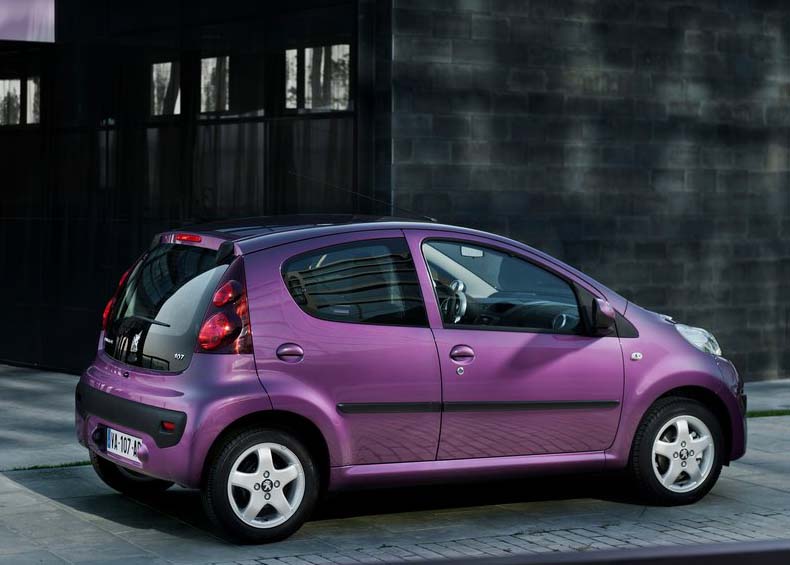
The Peugeot 107 is renewed, more modern and even more urban, a spirited response to the thirst for autonomy, independence and freedom!
Its subtle and sophisticated style, inspired by the new look of the Peugeot marque, gives it a new power of attraction.

Great attention has been paid to its appeal without making any sacrifices in terms of its advantages when facing the constraints of city driving; it has become even more practical and fuel-efficient.

A market and customer base which is constantly changing
The Peugeot 107 evolves and is enriched with a regularly renewed range, special editions and new equipment, in order to keep up with customer expectations.

Its markets have developed too with 16 new countries making a total of 48 countries where it is now sold.
Like most vehicles in this category, the 107 is often the second or even the third vehicle of the household. On the other hand, it distinguishes itself from its segment with an even more predominantly female customer base and appeals to a higher proportion of single people.

The satisfaction that it offers, above all through its manoeuvrability, driving pleasure and economy is above the average for its segment.
After more than 665,000 vehicles produced by the end of 2011, the 107 is now writing a new chapter in its history.

Its aim: to develop its advantages in an increasingly competitive segment.

A new exterior style, subtle and sophisticated
With a completely redesigned front face and unchanged dimensions, the Peugeot 107 adopts the new style of the Peugeot marque, with a look that is both subtle and sophisticated, cut as closely as possible to the mechanics, while retaining its compactness.

The new, more curved bonnet incorporates the new identity of the marque, so the rib of the bonnet which frames the two-tone lion and the number plate repositioned in the centre of the lower front panel hint at its relationship with the 208.

While retaining their shape and their high position, the light units are more refined: at the front, they are extended and adopt a two-tone mask, echoing the colour of the marque emblem situated on the bonnet, whereas at the rear they are adorned with a dark mask thus framing the lamps with a deep ruby colour.

The new radiator grille, composed of honeycomb cells specific to the 107, forms a fine and distinguished mouth, suspended by the body colour that surrounds it.

"It is another interpretation of the floating grille, adapted to the size and architecture of the 107." Ivo Groen, 107 style manager

The new lower front panel has contact cappings - one on the front face and the other two at the side - both aesthetic and protective, particularly useful in urban driving conditions.

The Peugeot 107 adopts a new visual signature at the lower front panel by means of LED day running lamps that emphasise the side protectors, and - according to the model - foglamps animated by a chromed bead.

All of these style components, designed with the utmost care, associated with a sharp body sill line and new trims, give the 107 a new identity, modern and likeable, combining refinement and a strong and thoroughbred appeal.

Furthermore, the range of colours sees the addition of an exclusive new "Plum" colour, modern and attractive, which matches perfectly with its character.

Inside, new equipment and colour schemes
The new "Mistral" interior colour scheme, the new "Manhattan" seat upholstery and the twomaterial door and dashboard trims, which now sport a single black colour, improve the perceived quality of the passenger compartment and give it a touch of refinement.

New comfort equipment makes an appearance, such as:
  •     The CD audio system has 2 additional speakers as standard or as an option according to the level of finish.
  •     A new PC Bluetooth CD audio system available as an option, combined with 2 additional speakers, offers USB, MP3 and Bluetooth connections that are usually found on vehicles of higher segments.
  •     A new steering wheel combined with a new gear lever knob, both leather trimmed, available as standard or as an option.

A simple range and improved features
The Peugeot 107 still has a simple range with 2 levels of finish, available in 3-door and 5-door versions and with 2 engines: 1.0i 5-speed manual and 1.0i 5-speed two-tronic manual.

Its features improve still further with its new audio system that contributes to a higher level of comfort.

The leather-trimmed steering wheel, standard with the two-tronic gearbox is also fitted with steering wheel paddles making the 107 even more manoeuvrable and agile.

It's LED day running lamps and the foglamps, now available as an option or as standard according to the model, contribute to the safety of its occupants, making it more visible in all conditions.

"Last but not least", already very well placed as regards environmental efficiency in its segment, the Peugeot 107 lowers its levels of CO2 emissions still further to 99 and 104 g/km respectively for the manual and two-tronic gearboxes.

It running costs are also improved with fuel consumption reduced to 4.3 and 4.5 l per 100km respectively for the manual and two-tronic gearboxes.

A truly feminine special edition!
A very feminine special edition christened "ENVY" will be available at the launch in March 2012. This fashionable and glamorous version, adorned with either the new "Plum" colour or "Caldera Black", bears special decorations with a cherry blossom branch motif, in particular stickers on the rear door, the bonnet and the tailgate, a "Plum" colour embroidered and braided mat and a rev counter central decoration.

Aluminium door sills and a badge give an additional touch of refinement.
A style line taking up the cherry blossom branch motif is also available. It has a clever handbag pocket, ideal for organising your belongings and changing handbag without forgetting anything, as well as a very practical handbag hook - retractable and therefore compact - which is extremely useful for keeping your handbag "to hand and in sight", without placing it on the floor.

A wide range of personalisation and comfort accessories
With accessories developed especially for it, the Peugeot 107 also fulfils the desire for distinction and adapts to different uses.

Alloy wheels, a brushed aluminium gear lever knob, chromed effect door sills or mats embroidered with "107" give a touch of elegance and a distinctive character.

On the practical side, a retractable navigation system which has a connection for an iPhone or iPod and which integrates perfectly into the dashboard and a central armrest with storage compartment improve comfort and driving pleasure still further.

As regards the side mouldings, these will protect the bodywork against urban impacts.
For leisure pursuits, the Peugeot 107 offers various roof boxes and roof bars for transporting bicycles, skis, etc. and numerous other accessories are also waiting to be discovered in the Peugeot network.
Read More