Friday, November 23, 2012

Kia Ceed, 2013


  •  Kia Ceed, 2013
Making its global premiere at the 2012 Geneva International Motor Show is the all-new Kia cee'd. More sophisticated, more efficient, more refined and with a more engaging driving experience than its predecessor, new cee'd is expected to build on the success of the original model, further establishing Kia as one of the leading automotive brands in Europe.

Launched in 2007, the original cee'd was a landmark and game-changing model for Kia. Designed, developed and built in Europe, cee'd was the first model to establish Kia as a serious contender to the established brands. Winning praise from media and public alike for its all-round ownership proposition, cee'd claimed fourth place in the European Car of the Year Awards that year - the highest ever ranking for a Kia vehicle.

New cee'd five-door goes on sale across Europe from the second quarter of 2012, depending on market, and will play a significant role in driving Kia's sales in Europe even higher. Further information about other models in the new cee'd family - including the SW version displayed at Geneva - will be made available later this year.

Longer, lower and more streamlined
New cee'd is both longer and lower than its predecessor, giving the five-door hatchback a more sporty profile. Overall length is increased by 50 mm (to 4,310 mm) and overall height has been reduced by 10 mm (to 1,470 mm) by lowering the ride height. Despite being based on a completely new platform, new cee'd carries over the 2,650 mm wheelbase, one of the longest in the C-segment, from its predecessor.

This more athletic appearance is further enhanced by a wider track. While the overall bodyshell is 10 mm narrower, the front and rear track have been increased (by 17 mm and 32 mm, respectively). The impact on the car's aesthetics is heightened by the availability of 17- and 18-inch diameter alloy wheels, resulting in a minimal gap between tyres and bodywork.

The new model's sleek silhouette was shaped by extensive testing in the state-of-the-art wind tunnel at Kia's R&D centre at Namyang, Korea. A reduced windscreen angle, smooth covers beneath the engine bay and the central floor, a rear spoiler above the tailgate and carefully profiled rear lamp clusters all help new cee'd achieve a Cd figure of just 0.30, placing it among the best-in-class, and helping to reduce fuel consumption and cabin noise.

New Kia cee'd will be manufactured exclusively at Kia's Zilina facility in Slovakia in a range of 10 exterior colours - including five new - and will be among the first models to bear the new-look Kia badge on its bonnet. Simpler, sleeker and with a more modern appearance, the new badge design echoes the premium feel of new cee'd and incorporates the Kia script in a single raised section for greater legibility.

Powerful and efficient engines with six-speed transmissions
In developing new cee'd, Kia's engineers had a strong focus on reducing fuel consumption and emissions without sacrificing engine response or power output. Updated engines and various small but impactful changes have resulted in an average fuel consumption improvement of four per cent across the model range.

Depending on individual market preferences, the new cee'd will be available with a wide choice of engines offering power outputs from 90 to 135 ps. Across most of Western Europe there will be two petrol engines - a 1.4 MPI and a 1.6 GDI producing 100 and 135 ps respectively - plus two diesels - a 1.4 WGT with an output of 90 ps and 1.6 VGT diesel offered in two states of tune (110 and 128 ps). Certain markets in Europe will also offer a 1.6 MPI petrol unit producing 130 ps.

Kia anticipates that its top of the range diesel - the highly-efficient 1.6-litre variable geometry turbo unit - will be the most popular choice in most markets. Generating 128 ps and 260 Nm, the engine will be offered with a choice of six-speed manual or automatic transmissions and will accelerate the new cee'd to 100 kph in less than 11 seconds. Fuel consumption will be just 4.1 l/100 km on the combined cycle (3.7 l/100 km in cars fitted with Kia's EcoDynamics technologies), and CO2 emissions start at just 97 g/km.

The 'Gamma' petrol engines also offer an excellent balance between performance and economy. The most powerful, the 1.6-litre Gamma GDI engine introduced in the Kia Sportage, features direct injection to maximise power (135 ps) and torque (165 Nm) while minimising fuel consumption and emissions. With this engine, new cee'd will accelerate to 100 kph in 9.9 seconds while delivering fuel consumption of 5.8 l/100 km (5.2 l/100 km with EcoDynamics), and tailpipe CO2 emissions from 119 g/km.

All engines will be offered with a choice of manual or automatic six-speed transmissions. Depending on version, the 1.6 GDI will also be available with Kia's all-new six-speed Dual Clutch Transmission (DCT), which improves fuel efficiency and delivers smooth automatic gear shifts for maximum comfort.

Developed by Kia's in-house transmission development team in partnership with a German-based engineering firm, the DCT makes the Korean brand one of a very small number of car makers in the world to produce its own dual-clutch transmission.

The DCT combines two manual transmissions within a single housing, each with its own dry clutch. One transmission shaft is dedicated to 2nd, 4th, 6th and reverse gear, while the other operates with 1st, 3rd and 5th gears.

Working in parallel, one shaft prepares to engage the next ratio, while the other is still engaged with a gear. Electric motor-driven actuators controlled by the Transmission Control Unit (TCU) execute gear selection and clutch engagement, resulting in swift and precise gear changes and uninterrupted torque transfer to the driven wheels, with a minimum of the efficiency loss normally associated with conventional automatics (with a torque converter).

As with other Kia models in Europe, new cee'd will be available with fuel-saving technologies developed under the company's EcoDynamics™ sub-brand to optimise efficiency and lower emissions. These technologies, which will be available on both diesel and petrol models with manual transmission, include ISG (Start/Stop), low-rolling resistance tyres and an alternator management system (AMS).

Smoother ride with improved handling, plus variable power steering
Ride and handling for new cee'd was benchmarked against class-leading competitor vehicles from near-premium brands.

Fully-independent, subframe-mounted suspension with MacPherson struts at the front and a multi-link set-up at the rear exploit the newcomer's wider track to deliver improved handling and road-holding.

The hugely increased torsional rigidity of the new cee'd bodyshell (45 per cent stiffer than the original model), has also enabled Kia's engineers to introduce numerous small changes to components, springs and shock absorbers that influence ride quality, refinement and NVH.

Improvements to the front suspension include an increased castor angle (from 4.4 to 5.2 degrees) for greater straight-line stability, larger wheel bearings in a reinforced hub, and larger diameter bushes for the subframe attachments. At the rear, geometry changes ensure more accurate tracking, the trailing arms have larger bushes and friction has been reduced throughout the system.

The standard steering system employs electric power-assistance and requires 2.85 turns lock-to-lock for a 10.34-metre turning circle. New cee'd is also available, on certain models, with an all-new Flex Steer™ system for improved driving dynamics. This system introduces three operating modes - comfort, normal and sport - allowing the driver to vary the level of steering assistance and the weight of feedback, in order to best suit the current driving conditions and the driver's personal preferences.

Less cabin noise, more cabin space

Kia's engineering team was determined to achieve significant improvements over the previous model in terms of cabin refinement and NVH. Measures adopted include fitting 14 per cent thicker front door window glass, low-drag exterior mirror housings, new vibration-damping engine mounts, hollow drive shafts, stronger bodyshell joints between the sills and B-pillars, double-layer door seals, and increased foam-filling in the A-, B- and C-pillars. As a result of these measures, cabin noise levels have been cut to match class-best standards.

Although the 2,650 mm wheelbase is carried over for new cee'd, the increase in overall length contributes to more interior space for people and cargo. Front seat occupants have 12 mm more headroom and 21 mm more legroom, while rear passengers gain 5 mm of shoulder room. Cargo capacity is boosted by 12 per cent to 380 litres (up 40 litres) with the rear seats upright and the split-folding rear seats can be made fully flat for maximum versatility.

High-quality equipment and advanced technologies
Higher quality cabin materials and a broader range of high-tech equipment will ensure the interior of new cee'd matches the premium exterior appearance.

Primary and secondary controls are grouped in a driver-oriented layout for intuitive ease of use, while new standard equipment will include tilt and telescopic steering wheel adjustment, iPod, Aux and USB support, six speaker audio system and a multi-mode trip computer.

A choice of bright chrome, piano black and anodized metal trim accents will be offered, while indirect LED lighting of the centre console and sweeping 'vertical fin' door handles establish an upmarket ambience for the cabin. The seat and cabin trim will be available in a choice of two colours as standard - black one-tone and stone beige two-tone - in cloth, with a full leather interior available on high specification versions.

Available features will include enhanced instrumentation - with a TFT 'Supervision' Cluster delivering high-definition resolution clarity of the instrument binnacle, dual-zone climate control, powered driver's seat adjustment with memory and a full length (1,045 mm long) powered panoramic glass sunroof.

New Kia cee'd will be available, depending on version, with LED daytime running lights, fixed cornering lamps (illuminated depending on steering angle), and advanced HID headlamps that turn the low beam to match curves in the road and enhance the driver's night vision.

Parking can be made easier with the new Parallel Park Assist System (PPAS). This features front, side and rear sensors and automatic steering control by an on-board computer to safely perform parallel parking. The driver remains in control of the accelerator and brake.

Safety structure and features target maximum rating
Kia continues to make safety a top priority and the new cee'd features advanced active and passive safety technologies to ensure maximum protection for its occupants and other road users. Kia is determined to achieve the maximum rating when tested by EuroNCAP with this new model.

Available active safety features will include ESP (Electronic Stability Program), ABS (anti-lock braking system), BAS (emergency Brake Assist System), HAC (Hill Assist Control) to prevent roll-back, VSM (Vehicle Stability Management) and ESS (Emergency Stop Signal) which flashes the brake lights when the system detects that the driver is making an emergency stop.

In terms of passive safety, the bodyshell is constructed using a high percentage (57 per cent) of ultra high-tensile steel and features numerous improvements to enhance impact resistance. New transverse cross-members are fitted to link the front and rear suspension mounts, new pressings link the rear trunk floor to the tailgate opening and the rear roof rail is connected to the C-pillars and a new floor cross-member to create an extremely strong 'safety ring'.

Side impact protection is enhanced with 50 per cent thicker door beams, plus a stronger roof cross-member between the B-pillars and side sills made from ultra high-tensile steel.

Each new cee'd is fitted with six airbags as standard - front, front side and full length curtain. Pedestrian safety is improved with the adoption of collapsible headlamps, a stiffer lower bumper lip, and shock-absorbing structures in the hood and its hinges.
Read More

Hyundai Elantra Coupe, 2013


  • Hyundai Elantra Coupe, 2013

Hyundai introduced the Elantra Coupe variant to its industry-leading Elantra line-up at the 2012 Chicago Auto Show. This two-door coupe model of the Elantra sedan, available this spring, will attract even more buyers to the Elantra line-up, further expanding its appeal to savvy consumers. It offers many of the same attributes that made the sedan version a sales success, while broadening its market reach to youthful, sporty buyers willing to forgo four-door versatility for coupe design appeal. The 2013 Hyundai Elantra Coupe marks the continuing evolution of Hyundai's "Fluidic Sculpture" design theme with sporty design language, while assuming a compact coupe segment leadership position with an eco-efficient powertrain, generous convenience features, exceptional roominess and abundant safety features.

Hyundai Elantra Coupe is the latest vehicle in Hyundai's 7/11 product initiative (seven new models in the next eleven months), following the Azera and Genesis Coupe.

The 2013 Elantra Coupe represents a modern approach to the sporty coupe segment, using youth-oriented design and premium features offered with Hyundai's strong value proposition. The 2013 Hyundai Elantra Coupe poses intriguing questions:
  • Why can't a sporty coupe combine generous interior space with sleek design?
  • Why pay premium coupe prices to get advanced safety and technology features?
  • Why can't a fun-to-drive sporty coupe offer 40-mpg fuel economy?
"FLUIDIC SCULPTURE" DESIGN LANGUAGE
Elantra Coupe takes Hyundai's dynamic "Fluidic Sculpture" design principles to the next level. "Fluidic Sculpture" design language replicates the interaction of wind with rigid surfaces to create a perception of fluid in motion.

Hyundai's signature hexagonal front fascia opening and jeweled swept-back headlights give Elantra Coupe a lean, aggressive demeanor. Fog lights and available side mirror repeater lamps complement the view from the front.

From the side, Hyundai Elantra Coupe conveys a wedge-like sport coupe silhouette with deeply sculpted surfaces. SE model sporty five-spoke 17-inch alloy wheels with dark spoke inserts add a dynamic presence, while fast A- and C-pillar angles frame a sharply tapered greenhouse, further accentuating the wedge profile. Just below the belt line, a prominent character line carries from the door through to the rear deck. Wheel arch creases give a subtle flared appearance around front and rear wheels, for a wide and aggressive presence. Further, a beveled rocker panel rounds out the lean and muscular effect.

From the rear, a blacked-out rear diffuser valance contrasts with dual chrome-tipped exhaust tips, and the SE model deck lid incorporates a lip spoiler design element.

These sculpted surfaces serve to create a highly aerodynamic body. The drag coefficient for the Hyundai Elantra Coupe is an exceptionally low 0.28 Cd, resulting in minimal cabin noise intrusion and optimal fuel economy. Elantra Coupe was designed at Hyundai's North American Design Center in Irvine, Calif.

40-MPG POWERTRAIN
Under the hood, the Hyundai Elantra Coupe is powered by the same 1.8-liter Nu four-cylinder engine with 148 horsepower (estimated) and 131 lb-ft of torque (estimated) found in the Elantra sedan (145 horsepower and 130 lb-ft of torque for Elantra Coupe PZEV). This high power-density 4-cylinder puts out a full six percent more horsepower than the Civic Coupe 1.8-liter. Thanks to advanced clean engine technology, most Elantra Coupes sold in California, Oregon and several Northeast states are certified as Partial Zero Emission Vehicles (PZEV) by the EPA. The PZEV Elantra Coupe is as clean as many hybrid electric vehicles, without the extra technological complexity and cost. The PZEV Elantra Coupe helps Hyundai meet and exceed its environmental requirements. Outside of these "green" states, the Hyundai Elantra Coupe is available as an Ultra Low Emission Vehicle (ULEV).

The Nu engine features an aluminum block with a cast-iron cylinder liner, cylinder head and crank. This unique configuration results in a block that is 30 percent lighter than an iron block, shedding more than 74 pounds of engine mass, while still providing equivalent strength.

The 1.8-liter Nu also offers Dual Continuously Variable Valve Timing (D-CVVT) camshafts and hydraulic engine mounts for optimum power, efficiency and refinement. Using D-CVVT on both camshafts has several advantages when compared with using it just on the intake camshaft. These advantages include a two-percent improvement in performance (via increased volumetric efficiency), two-percent improvement in fuel economy (via reduced pumping losses) and a 30 percent reduction in hydrocarbon emissions. In the valvetrain, roller swing arms and hydraulic lash adjusters reduce valve-driven friction to improve fuel economy one percent compared with direct valve tappets. The Nu engine also features a maintenance-free silent timing chain to enhance durability and reduce noise, vibration and harshness (NVH).

A plastic two-stage Variable Intake System (VIS) enables intake air to be directed between long and short intake manifolds, resulting in a broad, linear power band. This results in a four-percent improvement in performance, a 15 percent reduction in cost and 30 percent reduction in weight, when compared with aluminum.

Another technology Hyundai engineers have incorporated into the Hyundai Elantra Coupe is an electronic throttle control. Electronic throttle control replaces the conventional cable and mechanical linkage with instantaneous computerized control. This system accurately controls air intake and engine torque, improving drivability, response and fuel economy.

To further improve fuel economy, Elantra Coupe applies double-pipe plumbing technology to the internal heat exchanger. Double-pipe plumbing improves cabin cooling efficiency, while minimizing compressor size, reducing fuel consumption. In addition, an externally-controlled variable compressor is used to improve fuel efficiency when compared with an internal variable compressor.

The Nu four-cylinder engine also has an offset crankshaft design that reduces friction and pressure between the piston and cylinder wall for a one-percent improvement in fuel economy.

Hyundai Elantra Coupe's fuel economy is estimated at 29 mpg city, 40 mpg highway for the six-speed manual transmission, and 28 mpg city, 39 mpg highway for the six-speed automatic transmission. These ratings give Elantra Coupe a highway-only driving range of up to 500 miles.

SIX-SPEED TRANSMISSIONS
The Hyundai Elantra Coupe can be equipped with a six-speed manual (M6CF3-1) or automatic (A6GF1) transaxle with SHIFTRONIC® manual control. Hyundai now has in-house six-speed automatic transmissions in its small, medium and large FWD cars. Hyundai is also only one of four global car manufacturers building in-house unique six-speed automatic transmissions.

The six-speed automatic is 11 pounds lighter than Hyundai's global five-speed. It is considerably simpler, having 62 fewer parts, for greater durability, lighter weight and lower cost. It also features an ultra-flat torque converter that shortens the unit's overall length by 0.43 inches, while being 2.6 pounds lighter.

The transmission, mated to the 1.8-liter Nu engine, helps Elantra Coupe deliver improved fuel efficiency - 11 percent more than its closest competitor, the Honda Civic Coupe.

The Hyundai Elantra Coupe's six-speed manual transmission offers positive shift feel and further optimizes powertrain performance. Shifting performance is facilitated by durable triple-cone synchronizers for first and second gears, with double-cones for third gear and a single-cone for fourth, fifth and sixth gears.

OVERALL DIMENSIONS
The Elantra Coupe rides on a 106.3-inch wheelbase, an overall length of 178.7 inches, 69.9-inch width, and 56.5 inch height for uncompromised headroom. Elantra's total interior volume of 110.2 cubic feet exceeds the 2012 Honda Civic Coupe and 2012 Kia Forte Koup by large margins. The Coupe's long wheelbase allows for compact coupe efficiency with class-above relative comfort levels. Hyundai Elantra Coupe's trunk volume at 14.8 cubic feet also beats Civic Coupe and Kia Forte.

ELANTRA COUPE ARCHITECTURE
The Elantra Coupe is fitted with a McPherson strut front suspension, with coil springs and gas shock absorbers. The rear suspension is a lightweight coupled torsion beam rear design for enhanced steering stability and monotube shock absorbers for ride comfort and control. A substantial 22.0-mm diameter front stabilizer bar helps reduce body roll and turn-in response when cornering. Steering knuckle design, torsion beam rigidity and damper tuning have all been recalibrated for sportier handling and steering responsiveness compared with Elantra sedan. In addition, Hyundai Elantra Coupe offers a sportier SE model suspension calibration that is optimized for its lower-profile P215/45R17 tire.

All Elantra Coupes have column-mounted, motor-driven electric power steering (MDPS) that adjusts instantly to changing driving conditions while improving fuel economy over a hydraulic steering system. A quick-ratio steering rack is used for crisp feel on turn-in.

World-class weight efficiency was a key program target for the Elantra Coupe engineering team. As a result, Hyundai Elantra Coupe leads the Kia Koup in weight efficiency, while leading the Civic Coupe in power-to-weight ratio; both are key measures of overall powertrain and structural efficiency.

High-strength steel in Elantra Coupe's structure allows the suspension to work with precision in all driving conditions. This weight-efficient unibody architecture allows for Elantra Coupe to achieve an estimated 40-mpg EPA highway rating, without the need for a special eco model and its incremental costs.

SPORTY, SOPHISTICATED INTERIOR
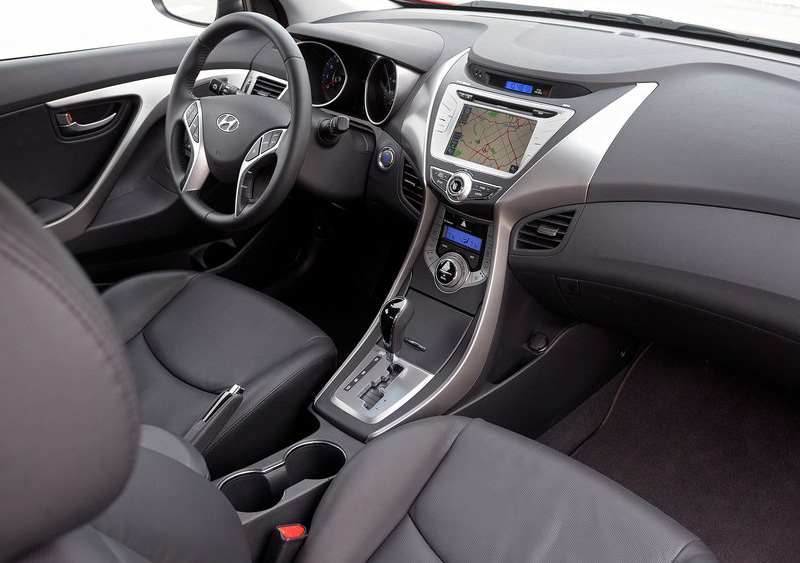
Inside the Hyundai Elantra Coupe, customers will find Hyundai's expertise in interior packaging, lighting, leading-edge design and craftsmanship. This approach is visible in gauge clarity and the tilt and telescopic steering wheel. Seat construction uses lightweight materials and environmentally-friendly foam for further benefits to fuel efficiency. Elantra Coupe seat design also provides deeper side bolsters compared with Elantra sedan for sportier driving. Heated seats are standard equipment on all Elantra Coupes, while the SE model offers sporty aluminum pedals.

The Hyundai Elantra Coupe offers two interior color choices, gray and black, available with either the GS or SE trim. All Elantra Coupes have cloth-like pillar trim made of fibrous tissue and volcanic rock for a premium look, feel and minimal environmental impact. Elantra Coupe will offer seven exterior colors, three of which are unique from Elantra sedan color choices: Monaco White Black Noir Pearl and Volcanic Red.

Hyundai Elantra Coupe is available with two audio systems. Standard is a 172-watt AM/FM/Satellite Radio/CD/MP3 audio system with six-speakers and iPod®/USB/auxiliary input jacks. A 360-watt system with external amplifier is optional with the SE Technology package.

Touch-screen navigation is available on SE trim and includes a high-resolution 7.0-inch screen and voice-activation by headliner-mounted microphone. The sound system plays compact discs, accesses digital music files via Bluetooth streaming audio or allows driver and passenger to access their personal listening devices through the iPod/USB/auxiliary inputs. Bluetooth audio wirelessly streams music from select mobile phones to the head unit. The XM Satellite Radio interface is also integrated into the navigation unit and features channel logos, real-time NavTraffic and XM Data services, such as XM NavWeather®, XM Stock Ticker and XM Sports Ticker. The system also integrates a rear-view camera, which cannot be found on the Honda Civic Coupe or Kia Koup. Users can even upload personal pictures from a USB rather than a CD to be displayed on the system's home screen.

Elantra Coupe owners can also get premium features, such as proximity key with push-button start, leather seating surfaces, heated front seats, power sunroof, and dual automatic temperature control with Clean Air Ionizer and auto-defogger.

ADVANCED STANDARD SAFETY TECHNOLOGIES: PART OF HYUNDAi'S ASSURANCE COMMITMENT
The Hyundai Elantra Coupe takes compact coupe safety to the next level with the introduction of Vehicle Stability Management (VSM). Similar to the one found in the Hyundai Equus, VSM optimally manages ESC (Electronic Stability Control) and the Motor-Driven electric Power Steering (MDPS).

VSM works to control two effects. The first is when a driver accelerates or brakes on a split-mu surface (slippery on one side, dry pavement on the other) and the vehicle wants to pull in one direction. VSM detects this condition and sends a signal to the MDPS to apply steering assist. VSM counters the pull and automatically provides eight Newton meters of counter steering force. VSM reacts the same way during sudden lane changes or fast cornering. ESC is still not standard on the Civic Coupe.

Elantra Coupe features six airbags—including dual front, front seat-mounted side-impact, and front and rear side curtain airbag.
The Elantra Coupe also features a state-of-the-art braking package. The package includes four-wheel disc brakes and an Anti-Lock Braking System (ABS) including Brake Assist, which provides maximum braking force when a panic stop is detected, and Electronic Brake-force Distribution (EBD), to automatically adjust the braking force to front and rear axles based on vehicle loading conditions and driving dynamics. Hyundai Elantra Coupe engineers even looked at something as simple as the parking brake for an integrated rear parking brake caliper for weight reduction.

In terms of passive safety, the Hyundai Elantra Coupe has strong unibody construction, along with front and rear crumple zones to effectively absorb and dissipate impact energy away from cabin occupants.
Read More

Thursday, November 22, 2012

Mitsubishi Outlander Sport, 2013


Mitsubishi Outlander Sport, 2013

Mitsubishi Motors North America, Inc. (MMNA) has unveiled an enhanced and improved 2013 Outlander Sport compact crossover utility vehicle (CUV) at the 2012 New York International Auto Show.

Beginning in July 2012, the 2013 Mitsubishi Outlander Sport will be built in the United States at the company's advanced automobile manufacturing facility in America's heartland in Normal, Illinois. The updated, American-made Outlander Sport models produced in the U.S will not only supply Mitsubishi dealers in the states but also be shipped to foreign markets. The 2013 Mitsubishi Outlander Sport will begin shipping to US dealerships in early August 2012 with a starting MSRP of $19,170.

With composed handling, a comfortable ride and roomy seating for 5 adults, this stylish crossover is currently the best-selling car in Mitsubishi Motors' North American model lineup.

The 2013 Outlander Sport features numerous design and feature improvements for the new model year:

Exterior
Front Fascia - Redesigned front bumper section; New grille styling; New fog lamp design.
Rear Bumper - New rear bumper design.
Side Sills - Side sills now black in color to match the lower sections of the redesigned front & rear bumpers.
Handsome 18-in. alloy wheels now standard on all on all trim levels for the 2013 model.

Interior
New interior fabrics; New chrome accent molding for the front doors; New All Wheel Control (AWC) push button switch.

Chassis
Revised rear multi-link suspension for improved handling and ride comfort.

Drivetrain
Enhanced Continuously-Variable Transmission (CVT) calibration for improved acceleration performance and smoother shift feeling.

Exterior Color Availability
New hues White Pearl and Quick Silver join Laguna Blue, Labrador Black Pearl, Mercury Gray and Rally Red.

Fresh Face, Same Exceptional Value
The entire front fascia of the 2013 Mitsubishi Outlander Sport has been completely made over versus last year's model. The signature pronounced, trapezoidal grille opening and recessed fog lamp housings are still present, but now feature a new, more simple and clean shape. Another appealing detail is the new chrome trim surrounding the outer perimeter of the recessed fog lamps.

Likewise, the rear fascia has been refreshed to complement the new look of the front fascia.

The highly-stylized front/rear fascia makeover - along with new black-colored side sills - enrich the Mitsubishi Outlander Sport's already athletic-looking aesthetic demeanor, further separating Mitsubishi's compact crossover from its more mundane peers.

With an impressive EPA fuel mileage rating of 31 highway mpg, and the availability of either front- or all-wheel drive, the stylish 2013 Mitsubishi Outlander Sport is a compelling choice for young families or active individuals that combines the space and versatility of an SUV with the outstanding ride quality and improved fuel economy of an exceptionally engineered car.

Standard equipment on all Mitsubishi Outlander Sport models includes stylish 18-in. alloy wheels; leather-wrapped steering wheel and shift knob; cruise control with steering wheel-mounted controls; Electric Power Steering (EPS); FUSE Handsfree Link System that allows voice-activated operation of an iPod and a cell phone, remote keyless entry; eye-catching rear LED combination tail lamps; heated outside mirrors; steering wheel-mounted audio controls; and air conditioning with micron filter. Among the included safety features are driver knee airbag; Hill Start Assist (HSA); Active Stability Control (ASC); Traction Control Logic (TCL); anti-lock braking system (ABS) with Electronic Brake-force Distribution (EBD) and Brake Assist; and an advanced front air bag SRS with passenger weight and driver's seat position sensors, front seat-mounted side-impact air bags, and curtain side air bags with roll-over sensors.

The top-flight SE version adds further luxuries such as a dynamic 6 speaker premium audio system with SiriusXM satellite radio with 3-months subscription service; heated front seats; one-touch Start/Stop (OSS) engine switch; climate control system with full-auto air conditioning; rain-sensing wipers; super-wide beam xenon head lights and FAST key passive entry system.
Read More

Rinspeed UC Concept, 2010


  • Rinspeed UC Concept, 2010

Rinspeed UC is filled with emotions and new ideas - that is the signature feature of all the concept cars from Swiss car visionary Frank M. Rinderknecht that have added colorful bright spots to the Geneva Motor Show for many years. Rinspeed boss Rinderknecht always has a surprise up his sleeve and this year is no different. Once again he does what nobody would have expected from the whiz kid known in the past for his affinity for powerful machines: He's building a subcompact car. But that's not all: For the first time in the long history of its concept cars the Swiss automobile and concept powerhouse has developed not just a vehicle but an entire mobility concept. The cute two-seater with electric drive is aptly called the Rinspeed UC which stands for "Urban Commuter." But the biggest surprise is that the Rinspeed UC was designed to be ready for future series production. The little speedster measures less than 2.60 meters in length and is intended to help avoid gridlock in the inner cities. At the same time an advanced railcar loading system will add the option to cover long distances by train, comfortable, without traffic jams and stress-free.

The goal is to create a new mobility concept that integrates individual car ownership and public transportation. A transverse loading system using custom railcars allows loading and unloading of numerous Rinspeed UC vehicles simultaneously and in a very short time. Train passages are booked and reserved online directly from the vehicle. Harman International provides the permanent 3G internet connection as well as marvelous sound on wheels. VoIP2Car technology provides IP telephone service, video chat, video conferences, e-mail and many more features in the Rinspeed UC.

Integrated charging stations on board the custom railcars ensure that upon arrival at the destination the Rinspeed UC battery is once again fully charged for maximum operating range. During the train trip drivers can visit the train restaurant, use any of the other train amenities or spend time in the privacy of their cars.

With the mobility concept Rinspeed elegantly circumvents the obstacle of limited operating range that so far has kept many interested parties from switching to zero-emission vehicles. As Frank M. Rinderknecht sees it: "I can make more efficient use of my time than spending it driving on a boring highway. I'd rather visit the train restaurant or retreat to work in my car." The Swiss visionary is already in discussions with international railroad companies about his new mobility concept.

Anyone who lays eyes on the clever high-tech bubble for the first time is reminded of the Fiat Topolino models from the '30s to '50s. This is loveable car design. Rinspeed boss Frank M. Rinderknecht: "Rinspeed UC is a new and highly emotional web-based car world that interweaves individual and public transport in an intelligent way. We want to create a community of people who are open for a new definition of mobility."

As in past years, the concept car was built by Swiss engineering company Esoro. The lightweight vehicle produces 130 Newton meters of torque, reaches a top speed of 120 km/h and has an operating range of 105 kilometers. That is more than enough for most traffic in urban areas. Statistics show that in Europe 82 percent of all trips cover distances of less than 60 kilometers - short-distance driving clearly represents the vast majority of all individual traffic.

The Rinspeed UC also features a number of technical highlights: Goodbye steering wheel, hello force-feedback joystick. The new joystick technology is supplied by German electronics specialist Rafi. Rinderknecht says: "Forget everything you have learned about joysticks so far. Finally this system provides a better steering feel and clear feedback from the road." The entire car is operated via Space Drive, a drive-by-wire system developed by Paravan, one of the leading manufacturers of handicap vehicles.

The Rinspeed and its partners had to master numerous challenges surrounding the electric drive system: The lithium-ion batteries come from Li-Tec-Battery in Germany, a joint venture of Evonik and Daimler AG. The efficient and reliable on-board charger is supplied by specialist Absaar; the external stationary charger comes from ABB Sécheron. Axpo Holding is yet another energy company that partnered with Rinspeed on this project. The electric heater and sphere-shaped vents were installed by the specialists from Eberspächer. Rinspeed also received support from the consortium Swiss Coop, which promotes decisive action and zero-emission mobility, and from the power plants of the Canton of Zurich that provide electricity and the required infrastructure.

To save as much energy as possible the developers have placed highest priority on lightweight design: Ticona, one of the world's leading manufacturers of engineering polymers, plays a major part in achieving this objective. The lightweight lift gate comes from Rehau, an OEM supplier for the automotive industry. The P7 Cinturato 'Green Tires' from Pirelli in size 195/40 R 17 are mounted on special lightweight rims from German-Austrian manufacturer AEZ. The delicate-looking rims weigh just 6.2 kilograms each. Eco-friendly lubricants are provided by Motorex.And of course the electric "love bug" has a number of features that will stir up emotions: An immediate eye-catcher is the paint that changes color from yellow to green.

The paint was supplied by Akzo Nobel, one of the world's largest paint manufacturers. A new adhesive paint called "Stickerfix" is perfect for touching up minor cosmetic paint blemishes sustained on the road.The jazzy leather interior including aluminum inlays and a custom leather suitcase for the roof come from specialist Sellner Group. VDO Continental Automotive has designed a new futuristic instrument cluster for the Rinspeed UC The new cluster also houses a Swiss-made mechanical watch from Swiss premium manufacturer Carl F. Bucherer. A beautiful crystal 'tank lid' from Swarovski covers the necessary 230-volt plug. A stylized laser-cut coil filament embedded in the crystal lid serves as a battery charge indicator: red=empty, orange=half charged, green=fully charged. Rinspeed wants to change the electric drive's image: The "E" signifying the electric drive isn't shamefully hidden but displayed openly and proudly: "Look here, I drive with electric power".

The Rinspeed UC is designed to be available in several distinct versions: The "Ultimate Commuter" is the comfortable lifestyle vehicle for urban commuters. The vehicle of choice for pizza deliveries, mail carriers and workmen in general will be the "Unlimited Commuter." The experts from renowned A.T. Kearney Consultants designed the modular production strategy to ensure that the car will be built as cost efficient as possible. The ultimate goal is to serve many different types of use and configuration variations: It will take just three days to build an electric car. There is a good chance the Rinspeed UC will enter series production. The concept is designed be easily adapted and integrated by volume manufacturers. Intensive dialogues at the highest levels are already well underway.
Read More

Wednesday, November 21, 2012

Nissan Juke Shiro, 2012


Nissan Juke Shiro, 2012

The Nissan Juke Shiro, a new top-of-the-range version of the hugely successful Juke, has arrived giving greater choice to customers looking for a car that's truly distinctive.

Launched at the 2012 Brussels Motor Show, Nissan Juke Shiro is aptly named. Shiro means white in Japanese, and the interior of the new version is dominated by a number of white flashes. The centre console, inspired by the shape of a motorcycle fuel tank, has until now only been available in red or grey; in Shiro, it's white. It's the same story when it comes to the door armrests which have white cappings.

The leather wrapped steering wheel, gear lever knob and the edges of the leather seats all feature white stitching while the seats themselves have a double layer feature on the squab and backrest with a white background colour that shows through the perforated leather facing.

Against a predominantly black and dark grey interior, the white elements provide a chic contrast and give customers even more opportunity to personalise their Juke.

Externally, Nissan Juke Shiro can be identified by its stylish dark grey 17-inch alloy wheels, the satin silver finish to the door handles and mirror caps and the glossy B-pillar. Although Juke Shiro is available in any of the colours available to all Juke models, it does have one unique hue in its palette: Nightshade, a sophisticated deep aubergine colour.

Nissan Juke Shiro builds on the top Tekna grade and is available with all three engine choices - 81kW (110PS) 1.5-litre dCi; 86kW (117PS) normally aspirated 1.6-litre petrol; and the turbocharged direct injection petrol 1.6-litre DIG-T which develops 140kW (190PS). All are front-wheel drive and are coupled to a five- or six-speed manual transmission depending on the engine.

The Nissan Juke Shiro 1.6-litre DIG-T version is also available with Nissan's advanced All-Mode 4x4-i four-wheel drive system which incorporates torque-vectoring technology and which is coupled to the latest generation CVT transmission. The Torque Vectoring System (TVS) - unique to Juke in this class - is designed to limit understeer giving Juke class-leading handling in spite of its higher ground clearance, while still preserving ride comfort.

Comprehensive standard technology includes Nissan Connect - Nissan's advanced media, communication and navigation centre - a colour reversing camera, Intelligent Key with engine start button, heated front seats, Climate Control, automatic wipers and lights, folding door mirrors and rear privacy glass.

Also standard is the Nissan Dynamic Control System which gives the driver the chance to optimise the car's dynamic functions. Safety equipment includes ESP, six airbags, ABS with EBD and Brake Assist and three head restraints in the rear.

Nissan Juke Shiro also benefits from a carefully selected accessory package which adds a number of useful features all designed to harmonise with Shiro's white interior features. It includes a centre armrest, complete with white stitching, which also provides additional storage; chrome plated sill protectors for the front door, illuminated in white; and Juke-branded velour floor mats for the front and rear.

Depending on the market, this package is either available as an option or as an integral part of the special Shiro version.

Since its launch in 2010, Juke has redefined the highly competitive B-Segment. Its combination of SUV toughness and sporting style sets it apart from class rivals with its unique design appealing to individual thinkers looking for something different - and the arrival of Nissan Juke Shiro increases the opportunity for them to make a real statement.

Built at Nissan's manufacturing plant in the UK, Juke has inspired customers across Europe and helped the Sunderland manufacturing plant reach an all-time production record during 2011 of 480,485 vehicles. Following in the hugely successful footsteps of its big crossover brother, Qashqai, Juke exceeded all expectations to sell over 136,282 units last year, a number that is expected to be beaten in 2012.

In line with Nissan's philosophy of constant development, a significant engineering change was made to Juke during 2011. Revisions to the final drive ratio of the normally aspirated petrol and diesel models reduced emissions and enhanced refinement by lowering noise levels without affecting the lively acceleration of either car. Emissions from the manual version of the 117PS petrol 1.6 Juke are now 139g/km, while the 1.5 diesel produces just 129g/km allowing it to wear Nissan's PURE DRIVE badge, which signifies a model producing less than 130g/km.
Read More

Mercedes-Benz C-Class Estate, 2012


  • Mercedes-Benz C-Class Estate, 2012

The new Mercedes-Benz C-Class launched in spring 2011 and is a comprehensive modernisation. The front and rear sections of this best selling model have a more striking design. There is now a high-resolution colour display screen in the instrument cluster, an elegant new dashboard with grained surface and prominent decorative trim emphasising the premium character of the interior. Fuel consumption has been improved by up to 31 per cent. Efficiency-enhancing measures including new engines, the improved 7G-TRONIC PLUS automatic transmission and the ECO start/stop function also feature. Ten new driving assistance systems ranging from the standard ATTENTION ASSIST drowsiness detection system to the optional DISTRONIC PLUS proximity control system are also now available for this model series for the first time.

A total of more than 2,000 new components distinguish the latest generation of the Mercedes-Benz C-Class from its predecessor. Both the Saloon and Estate versions can be ordered from 10 January 2011. The European market launch will take place from March 2011. In addition to the standard appointments - which now include a leather steering wheel - the two design and equipment lines ELEGANCE and AVANTGARDE are the basis for the individualisation programme of the C-Class. The two lines are now even more readily distinguishable from each other.

The Mercedes-Benz C-Class is the highest-selling model series for Mercedes-Benz. The current series has found well over one million buyers worldwide since its launch in March 2007. Since the introduction of the first Mercedes-Benz C-Class in 1982 (then known as the model 190), Mercedes-Benz has sold more than 8.5 million vehicles in total in this segment. In 2010 too, the C-Class has repeatedly won top places in the registration statistics.

More power, lower consumption: the engines
An improvement of up to 31 per cent has been achieved in fuel consumption and all Mercedes-Benz C-Class launch models will feature the ECO start/stop function as standard. All the engine variants are now classed as BlueEFFICIENCY units, showing that they are particularly efficient and environmentally compatible in their use of fuel. In future all automatic versions will feature the further-developed 7G-TRONIC PLUS seven-speed automatic transmission. In addition, the overall ratio of all new powertrain variants has been optimised for better fuel economy.

All the petrol engines in the model series have direct injection. One of the highlights is the introduction of the new V6 petrol engine with its innovative and highly efficient BlueDIRECT process in the C 350 BlueEFFICIENCY. The quantum leap in efficiency is particularly well illustrated by the six-cylinder unit: Power has increased considerably, the C 350 BlueEFFICIENCY delivering 306 hp and 370 Nm (previously 292 hp and 365 Nm).

The four-cylinder petrol engines, which made a great evolutionary leap forward in 2009 and all feature direct injection and turbocharging and excel with high performance and exemplary economy.

The most economical model in the Mercedes C-Class range has also become even more frugal: the C 220 CDI BlueEFFICIENCY with the manual six-speed transmission and the standard ECO start/stop function. This corresponds to 117 grams of CO2 per kilometre. In conjunction with the improved 7G-TRONIC PLUS automatic transmission and the ECO start/stop function included as standard, the C 220 CDI BlueEFFICIENCY and C 250 CDI BlueEFFICIENCY both deliver top-class figures with a combined diesel consumption of 58.8 mpg. This corresponds to CO2 emissions of 125 grams per kilometre.

Design: Dynamic, resolute, self-assured
The Mercedes-Benz C-Class greets spring 2011 having undergone a comprehensive makeover. The front and tail-end section of the million-seller are styled more strikingly, the front being brought closer to the brand's new design idiom. The front bumper has a more expressive and dynamic contour, and supports the shape of the radiator grille more prominently as the central element at the front.

The central air intake opens out upwards in a V-shape, forming a visual base unit for the radiator grille. Pronounced side sections extend from the sporty V-shape at the centre. Continuing beneath the headlamps, these sections blend into the feature lines along the vehicle flanks, forming a link with the sides. The side air inlets in the bumper are positioned low down, giving the car a more road-hugging appearance.

Both the saloon and the estate have been given a new bonnet made of aluminium. Its contour in the area around the headlamps and the radiator grille emphasises the V-shape of the front end to a greater extent than previously.

The shape of the clear-lens headlamps has been modified to create a more dynamic and resolute impression, and to act together with the bonnet, radiator grille and bumper to give the Mercedes-Benz C-Class a new face. The impression is reinforced by both the exterior form of the headlamps and the interior of the housings. The headlamps show their modernity by precision and an interplay between matt and high-gloss areas. The halogen headlamps are arranged in the classic way, with low beam on the outside, main beam on the inside and the indicators neatly arranged in the outer corner formed with the front wing.

If the optional bi-xenon headlamps with the Intelligent Light System (ILS) are ordered, the impression of depth is reinforced by a row of lighting modules. A position light with a distinctive C-shape emphasises the night design. Behind it is a cornering light extending to the main headlamp module on the outside. A visual base in the lower section of the headlamp is formed by a horizontal broadband LED indicator unit. The horizontal LED daytime running lamps in the bumper also make the Mercedes-Benz C-Class unmistakable from a distance.

In the case of the rear bumper, the light-catching contours and dividing lines have been modified to emphasise the width of the saloon and estate even more strongly. This change is particularly obvious in the more steeply rising course of the side light-catching contours towards the tail lights. A continuous light-catching contour at the upper end of the rear bumper extends into the flanks to connect the tail end with the sides to emphasise the sporty character of the rear aspect.

In the facelifted model, the tail lights are even more neatly integrated into the tail end by a continuous covering lens. The characteristic surface meander is now on the inside of the light, and reminiscent of preceding model series. The particular impression of depth is achieved by a centrally located LED indicator, which appears to float in front of the red upper and lower light bands.

In all its finery: restyled dashboard and high-grade surfaces
One of the design work's main points of focus in the interior was on restyling the dashboard with the aim of creating a sporty, high-quality look. At the same time the trim concept was also enhanced. The touch surfaces of the controls are more finely detailed and galvanised. With its stepped extension, the instrument cluster's panel now also accommodates the central display. The instrument cluster and a discreet light-catching contour continue to the front-passenger side. The central, trapezoidal air vents and the round vents on the outside are highlighted in detail by galvanised trim.

The large section of trim is an important part of the newly designed dashboard. This extends from the centre air vents across the front-passenger side to the outer air vent and creates a much wider look for the interior. The upper part of the dashboard with its new surface grain continues into the beltlines of the door panels.

The control panel of the new-generation communication and information unit has keys with high-gloss surface inserts. The combination of matt keys, high-gloss areas and a new knurled wheel design accentuates the higher perceived value of the interior. Together with the new telematics generation, the facelifted Mercedes-Benz C-Class also comes complete with a new instrument cluster with an integral display. Directed towards the driver are three tube-style surrounds with a galvanised surface, openly demonstrating the C-Class's sporting ambitions.

The premium character of the interior is underlined by the new-generation steering wheel, which was introduced with the new CLS and is now available in the sporty AVANTGARDE line for the Mercedes-Benz C-Class. The steering wheel with its chromed central spoke stylishly accentuates the sporty atmosphere in the C-Class.

Interior: Higher quality and more comfortable
Brimming with a wealth of high-grade details in the interior, all reminiscent of the new CLS, the Mercedes-Benz C-Class sets new benchmarks in its segment when it comes to quality and comfort. The interior designers have paid painstaking attention to restyling the dashboard, whose new features include its surface grain, the integral screen, prominent trim and, as an option, a high-resolution colour display in the instrument cluster. A nappa leather steering wheel comes as part of the standard specification. Time spent in both the saloon and the estate is now even more pleasant, thanks to the C-Class's tried-and-tested dimensional concept, along with its new comfort-enhancing equipment and appointments such as climatised seats and the luxury automatic climate control THERMOTRONIC, which now makes it possible for the occupants to select their own individual climate styles.

Generous: the interior dimensions and load capacity
The Mercedes-Benz C-Class is amongst the most spacious vehicles in its segment. The front shoulder room and the elbow width amount to 1390 and 1440 millimetres respectively. In the rear, the saloon and estate offer shoulder room of 1398 millimetres and an elbow width of 1462 millimetres.

And the Mercedes-Benz C-Class offers plenty of space for luggage, too: the saloon's load capacity is 475 litres (in accordance with the VDA measuring method). For the saloon Mercedes-Benz offers a divided backrest which can be quickly and easily folded forward on a 1:2 ratio. The head restraints move forward together with the backrests and do not need to be removed first.

Variability is the name of the game where the estate is concerned; its rear seat backrests are divided on a 1/3 to 2/3 ratio and can be folded forwards. The luggage compartment capacity can be extended from 485 or 690 litres when the vehicle is loaded to roof height up to 1500 litres (when the rear seat backrests are folded forward and the vehicle is loaded to roof height). And there is yet another peak value to note: the maximum usable interior length - from the tailgate to the front passenger's footwell - is 2.82 metres.

Thanks to a host of practical details, the Mercedes estate can be loaded easily, conveniently and safely. For instance, two bag hooks and four eyelets for anchoring loads are included in the load compartment as standard. Stowage compartments with net covers and a collapsible shopping crate are also part of the standard specification, as are the combined luggage cover and retaining net. The EASY-PACK tailgate opens and closes at the push of a button. Finally, the optional EASY-PACK load-securing kit presents drivers with even more possibilities for securing the load being carried.

Comfort on long journeys as standard: the front seats
The seats in the Mercedes-Benz C-Class make a valuable contribution to comfort on long journeys. As an optional extra, climatised seats are now available for the driver and front passenger. They ensure a high degree of thermal seating comfort thanks to small electric fans in the upholstery of the cushion and in the backrest which draw in ambient air, then push it through the perforated seat cover up to the surface. As well as this ventilation feature the climatised seats also include seat heating.

The height and backrest angle of the front seats can be electrically adjusted. Even more ease of operation is available as an optional extra in the form of fully electric adjustment of the driver's and front-passenger seat. In conjunction with the Memory package three settings can be stored.

The multicontour seat (available as an optional extra) has separately controllable air chambers under the upholstery material. They make it possible for the occupants to adapt the shape of the seat precisely to suit their anatomy or their preferences. This is all thanks to inflatable air chambers underneath the upholstery material which enable the contouring of the side bolsters to be individually set. Another attribute is the function for pneumatically adjusting the seat cushion length. At the push of a button the seat cushion length can be extended, allowing occupants to relax their legs and ensuring good blood circulation.

Comfortable and safe: the rear seats
The rear seat unit is of one-piece construction. Three head restraints and three inertia-reel seat belts ensure the safety of the occupants. The outer rear seats are also equipped with belt tensioners and belt force limiters, as well as head restraints adjustable for height and angle. ISOFIX, the standardised attachment system for child seats, is included as part of the standard specification.

Even more comfort: THERMOTRONIC now with climate modes
As part of the standard specification, all Mercedes-Benz C-Class models include the two-zone THERMATIC automatic climate control. Yet more climate comfort is available courtesy of the optional luxury automatic climate control THERMOTRONIC, which allows individual temperature settings for three zones - for the driver, the front passenger and the rear passengers. What are known as the THERMOTRONIC's climate modes constitute a new feature in the C-Class: the car occupants can select "Diffuse", "Medium" or "Focus" settings at the push of a button and thus adjust the air quantity and air distribution to their liking without having to leave the convenient automatic mode.

In "Diffuse" mode, for example, the THERMOTRONIC system operates with a low air speed and distributes the air over a wide area so that there are fewer draughts. In "Focus" mode, meanwhile, the air outlets in the centre area of the dashboard are used for the most part, meeting the need for a direct flow of a larger quantity of air.

More operating comfort, better connectivity: new-generation telematics
The new Mercedes-Benz C-Class also sees the debut of a new telematics generation which will also be gradually introduced in other model series. Major new features include greater operating convenience, larger displays, telephone directory transfer, display of SMS messages, wireless music reproduction via Bluetooth and a USB interface now accommodated in the centre armrest.

The multimedia system COMAND Online now provides internet access for the first time (via the customers data enabled mobile phone). When the car is stationary, customers are able to browse freely or surf to a Mercedes-Benz Online service whose pages load particularly rapidly and are also easy to use while on the move. The integrated services include weather information and a special destination search via Google, as well as the option of downloading a route that has been previously configured on a PC using Google Maps and sent to the car. The navigation system of COMAND Online also has added functions.

Also new: routes covered can be recorded and repeated later, specific personal destinations can be imported via an SD card and four alternative routes can be displayed on the navigation map, one of them a particularly economical variation.

As a first in the Mercedes-Benz C-Class, the Becker® MAP PILOT makes a low-cost navigation function, which can also be retrofitted, available for the entry-level Audio 20 CD radio. Its advantages over aftermarket solutions include integrated operation via the central controls and the Audio 20 display, a concealed location in the glove compartment and updating via an internet portal.

Chassis and suspension: Agile handling and high comfort
The AGILITY CONTROL suspension, which is standard equipment in both the C-Class Saloon and Estate, harmonises perfectly with the dynamic design. It is based on an amplitude-dependent damping system: when driving normally with low shock absorber stimulus, the damping forces are automatically reduced for a noticeable improvement in ride comfort - but without any compromise in handling safety. When shock absorber stimuli are of greater magnitude, for example when cornering at speed or taking evasive action, the maximum damping forces are set and the car is stabilised effectively.

The Mercedes-Benz C-Class's AGILITY CONTROL suspension is complemented by a rack-and-pinion steering system. Positioning the steering gear 80 millimetres in front of the wheel centre makes for predictable self-steering characteristics with a slight tendency to understeer. Speed-sensitive steering with variable steering-wheel support and a variable steering ratio is available as an optional extra.

Precise wheel location: the front axle with McPherson struts
At the front axle a three-link construction with McPherson struts is used. The lower link level consists of two separate elements which act as torque and cross struts and which are both forged from aluminium. In addition to more precise wheel location, this construction has the particular advantage of compensating vibrations caused by tyre imbalances or fluctuating brake forces better than rigid wishbones.

The third component in the three-link system is the track rod, which connects the transversely installed steering gear with the wheels. The reinforced stabiliser is linked to the spring strut, which is also actively involved in front wheel location.

The struts consist of cylindrical, lateral force compensated coil springs, twin-tube shock absorbers and newly developed three-phase head bearings. If severe body roll occurs, the stabiliser is supported by rebound buffer springs to ensure agile handling accompanied by a high level of comfort.

Controlled compression and rebound: the multi-link independent suspension
The series-production launch of the Mercedes-Benz 190 in 1983 also marked the beginning of the multi-link independent suspension's career. In many respects this is a feature that remains without parallel to this day, which is why this patented axle principle - naturally in a modified form - is also employed in the C-Class. With the multi-link independent suspension the wheel is fixed to five elastically mounted links that are independent of each other and which restrict its scope for movement in five directions:
  • The lower transverse control arms activate the suspension springs and dampers
  • The upper transverse control arms regulate the camber over the spring travel
  • The torque struts take up the drive and braking forces, and compensate for dive and squat when accelerating and decelerating
  • The diagonal struts are arranged differently from the torque struts, and also help to prevent dive and squat when braking and accelerating
  • The track rods limit changes in the wheel's toe-in to a desirable minimum
Owing to this intelligent control arm construction, each rear wheel basically retains freedom of movement in one plane only: namely during controlled compression and rebound.

Even more agile: sports suspension and Dynamic Handling package as an option

In addition to the standard-specification AGILITY CONTROL suspension, the C-Class offers two other options for adjusting the suspension's characteristics in line with drivers' personal preferences. As an optional extra a sports suspension can be selected - it has shorter springs, shock absorbers with tauter tuning, and stronger torsion bars.

A Dynamic Handling package is available as an alternative. It offers the driver two shift programs to choose from: Sport and Comfort. Within these shift programs the shock absorbers are electrically adjusted on a continuously variable basis. Sensors monitor each driving situation and send the information they gather to an electronic control unit. Depending on the current road or operating condition the system adapts the damping forces individually for each wheel - with infinite adjustment and fully automatically.

New styling: light-alloy wheels for AVANTGARDE and ELEGANCE
The saloon and estate both sport seven-spoke light-alloy wheels as part of their standard specification, whilst the AVANTGARDE and ELEGANCE lines are shod in newly styled twin-spoke wheels. Individuality comes courtesy of the extensive range of light-alloy wheels featuring around a dozen different designs in 16, 17 and 18 format. In place of the standard-fit 7.5 J x 17 wheel, the AVANTGARDE model can also be ordered with a 7 J x 16 wheel - providing an alternative for customers who want to make use of the consumption potential offered by a smaller and narrower wheel/tyre combination.

Electronic helpers: the new assistance systems in the Mercedes-Benz C-Class
Adaptive Highbeam Assist. When vehicles are detected ahead of or approaching the vehicle, this system automatically dips the beams and adjusts the range of the headlamps appropriate to the distance. This means that main beam can be used more frequently.

Active Lane Keeping Assist. The system kicks into action if the Mercedes-Benz vehicle inadvertently drifts over a solid line to the right or left of a lane. In such a case, a warning sign in the instrument cluster and vibration of the steering wheel give the driver warning. If the driver does not heed the warning in the case of the solid line, Active Lane Keeping Assist can use the ESP to brake the opposite wheels and thereby prevent the vehicle from crossing the solid line. The Lane Keeping Assist, which warns but does not actively intervene, is available as a favourably-priced alternative.

Active Blind Spot Assist. It warns the driver when changing lanes if a risk of collision is detected due to another vehicle in the neighbouring lane being in the blind spot of the exterior mirror. If the driver ignores the warning and nevertheless initiates the lane-changing manoeuvre, the Active Blind Spot Assist intervenes. By applying braking force to the wheels on the opposite side of the vehicle, a yaw movement is created which counteracts the collision course. The Active Blind Spot Assist was recently awarded the "Yellow Angel" prize for being a pioneering innovation by a jury of experts from the ADAC, the German automobile association and the biggest of its kind in the world. The favourably-priced alternative is the Blind Spot Assist; it warns the driver but does not actively intervene.

ATTENTION ASSISTwarns drivers when it detects that they are over-tired. Studies have shown that around a quarter of all serious motorway accidents are caused by drowsy drivers, making this factor an even bigger cause of accidents than drink-driving. With ATTENTION ASSIST (standard for Elegance and Avantgarde), Mercedes-Benz is therefore making another important contribution towards helping to avoid accidents: it employs high-resolution sensors to observe driver behaviour and can recognise whether the driver is tired or not paying attention, based primarily on steering wheel movements.

BRAKE ASSIST PLUS: this system is able to recognise an impending rear-end collision using radar sensors. It calculates the necessary degree of braking assistance and makes it available immediately when the driver presses the brake pedal.

DISTRONIC PLUS: the radar-based proximity control supports the driver at speeds between zero and 200 km/h by automatically adjusting the distance to the vehicles in front. In doing so it is able to apply the brakes to bring the vehicle to a complete standstill and also accelerate it again. As a result, the system is also particularly convenient in stop-and-go traffic. If the system detects that the distance is being reduced too quickly, it warns the driver with both visual and acoustic signals. The control system has also been refined even further through the inclusion of information from digital maps.

Speed Limit Assist: a camera fitted behind the windscreen detects speed limit signs at the roadside and compares this data to information contained in the GPS system. The relevant speed limit is then displayed in the instrument cluster.

PARKTRONIC including Parking Guidance:ultrasonic sensors measure the length of parking spaces as the car drives past; the cockpit display provides a schematic representation of the recommended parking manoeuvre. Ultrasonic sensors then support the driver whilst parking.

PRE-SAFE Brake:autonomous braking if acute danger of an accident is detected. At first the driver is given both an acoustic and an optical warning if the system identifies that there is a danger of collision. If the driver does not react to this, the system brakes the vehicle autonomously. This occurs in two stages: around 1.6 seconds before the calculated impact point the system decelerates the car with around 40 percent (approx. four m/s²) of the maximum braking power, gives the driver an additional, haptic warning of the impending impact and as a precaution activates the reversible PRE-SAFE® occupant protection systems. If the driver still fails to react, the PRE-SAFE® Brake activates the maximum braking power around 0.6 seconds before the now unavoidable collision - this emergency braking can greatly reduce the severity of the impact. The system therefore acts like an "electronic crumple zone", offering the car occupants even greater protection. The PRE-SAFE® Brake is active at speeds of between 30 and 200 km/h when moving vehicles are detected in front of the car. The system also reacts if the car approaches a stationary queue of traffic, providing its speed is below 70 km/h.
Read More