Tuesday, November 13, 2012

BMW 6-Series Convertible, 2012


  •  BMW 6-Series Convertible, 2012

Words such as "breathtaking", "irresistible" and "flawless" epper the history of BMW convertibles. And now the brand has added a new chapter to a tradition of open-top cars that stretches back decades. The new BMW 6-Series Convertible fulfils the wishes of discerning automotive aesthetes with its finely honed sense for sporty driving pleasure, groundbreaking luxury and sparkling looks. In the exclusive environs of the premium convertible market, the 2+2-seater makes a convincing case for itself with the most efficient engines, most advanced chassis technology and most innovative comfort, infotainment and safety features in its segment.

A sweeping bonnet, set-back passenger compartment, long wheelbase and flat waistline embody the hallmark proportions of a BMW convertible. The new BMW 6-Series Convertible combines these features with a classic soft-top roof in customary "fin" design. Powerfully contoured surfaces and the surging dynamism of its lines promise assured driving properties. The luxurious ambience of the interior is highlighted by the driver-oriented cockpit set-up and wraps the front passenger and rear passengers in a feeling of exclusive security. Nowhere is the high-class functionality of the interior underlined more prominently than in the redesigned freestanding Control Display of the standard-fitted iDrive control system.

The new BMW 6-Series Convertible is available with two engine variants from launch. The eight-cylinder powerplant in the BMW 650i Convertible produces 300 kW/407 hp, while an exclusive variant of the six-cylinder in-line engine with BMW TwinPower Turbo, direct injection and VALVETRONIC -generating 235 kW/320 hp - has been developed for the BMW 640i Convertible. Both engines team up as standard with an eight-speed Sports automatic gearbox. Standard-fitted BMW EfficientDynamics features include the Auto Start-Stop function in the BMW 640i Convertible.

Chassis technology unmatched in its segment works in tandem with the cutting-edge engines to ensure even greater dynamic capability and a similarly discernible improvement in ride comfort compared to its predecessor. The new BMW 6-Series Convertible comes as standard with Drive Dynamic Control, which allows drivers to choose their own suspension settings, while the Adaptive Drive system is available as an option with electrically controlled dampers and roll stabilisation. In addition to the standard-fitted electromechanical power steering, another unique feature in this segment is the optional Integral Active Steering system.

The new BMW 6-Series Convertible also underlines its progressive character with numerous BMW ConnectedDrive features that none of its rivals can match. The selection of optional driver assistance systems includes a rear-view camera, Surround View, BMW Night Vision with pedestrian recognition and BMW Parking Assistant. The new BMW 6-Series Convertible is the only car in its segment to be available with a Head-Up Display. Making its debut in the new soft top, the latest generation of the system uses a broader palette of colours to create an even more detailed and sharper image.

The design: athletic elegance, natural sportiness and sparkling looks.
The luxurious yet dynamic driving experience of the new BMW 6-Series Convertible is reflected in the athletic elegance and sense-tingling sportiness of its exterior design. A long, sweeping bonnet, set-back passenger compartment, long wheelbase and flat waistline combine to create the proportions typical of a BMW convertible. The precise interplay of eye-catching lines and meticulously sculpted surfaces help to give the new BMW 6-Series Convertible its arresting looks.

Like the lines projecting out from the nose of the car and continuing along its full length, the harmoniously curved surfaces of the body take their cue from the movement of waves sent out by a the bow of a motor boat piercing the water. Continuing the theme, the waistline surface which leads the body into the interior mimics the character of a boat deck.

The front end: surging forward and focusing on the road.
The new BMW 6-Series Convertible also displays its dynamic character in its front end design. The large, slightly forward-slanting BMW kidney grille - its "shark nose" - gives the car a sense of surging forward, while a broad air intake, strikingly contoured bonnet and muscular wheel arches hint at its powerful engine technology and impressive roadholding. High-quality chrome elements positioned on the outer edges of the front apron further accentuate the width of the car. The optional foglamps consisting of a string of three LED units are placed in front of these chrome elements.

The standard xenon headlights of the new BMW 6-Series Convertible pick up on the brand's familiar "twin round" look. As standard, an accent strip cuts across the top of them; this is replaced by an LED accent light if the optional Adaptive Headlights are specified. The daytime running lights take the form of LED light rings, whose bright white light illuminates the distinctive front end look. A horizontal light strip below the daytime running lights, meanwhile, performs direction indicator duties.

Side view: elongated lines, athletic curves.
Uninterrupted, flowing lines lend the silhouette of the BMW 6-Series Convertible a sweeping elegance. Powerful curves mimicking the natural movement of waves give the car's side view a natural athleticism. The hallmark BMW swage line at door handle level is spawned in the front wheel arch gill - which houses the side indicator - and extends all the way back into the rear lights.

Another character line is released from the bulge of the front wing, stretching powerfully over the front wheel like a wave before dropping down and continuing horizontally towards the rear. Together with the swage line, it creates a dynamic wedge shape which emphasises the car's forward-surging character.

The striking V-shape and accentuated width of the rear end create a powerful appearance.
Wide and flat surfaces define the rear of the new BMW 6-Series Convertible. The dominance of horizontal lines adds extra emphasis to the wider track of the new car compared to its predecessor. In addition, downward-converging lines underline the car's focus on the road, echoing the approach at the front end. This distinctive V-shape is created by lines including the side edges of the boot lid, the licence plate surround and the contours of the reflectors positioned in the bumper. The slightly concave lower section of the boot lid produces light and shade effects which lend an extra lightness to the rear of the car.

The two-part rear light clusters give the brand's familiar L-shape a particularly sporty, dynamic edge. Inside the units, two LED-powered light strips create the familiar BMW night-time look. The indicators and brake lights are also LED units.

The interior: seats for four - and each one made to measure.
The new BMW 6-Series Convertible is designed to be a 2+2-seater. Its interior offers individually tailored seats for the driver, front passenger and rear passengers. High-quality materials, carefully coordinated colours and, once again, meticulously formed surfaces combine to produce an ambience defined by luxury, sweeping dynamism and stylish functionality. A hallmark BMW element of the interior design is the driver-oriented cockpit layout. The central section of the instrument panel, containing the iDrive system's Control Display, the central air vents and the controls for the audio system and air conditioning, are all angled slightly towards the driver. Added to which, the gearshift lever and the buttons for the parking brake, roof operation and Drive Dynamic Control are located on a surface that opens out towards the driver and is set lower than the front passenger side of the centre console.

The front passenger area is bordered by a surface curving elegantly from the armrest over the side edge of the centre console, upwards and outwards into the instrument panel and then horizontally into the door trim. This provides a harmonious surround for the front passenger area, creating a feeling of exclusive security. The contour of the rear waistline surface, which extends slightly into the interior between the head restraints, highlights the individual seat layout of the rear.

Premiere: freestanding Control Display with flatscreen design.
The black-panel instrument cluster of the new BMW 6-Series Convertible combines the traditional sports car circular instruments with state-of-the-art display technology. The navigation system, telephone and entertainment functions are operated using the standard-fitted iDrive control system, whose Control Display boasts an innovative design. The on-board monitor takes the form of a freestanding display for the first time in the new BMW 6-Series Convertible. The standard 7-inch screen can be upgraded to 10.2 inches by ordering the optional Navigation system Professional, and the larger screen has a high-quality galvanised chrome surround. The minimal depth of the display gives it the character of a flatscreen unit. The new arrangement of the Control Display - which now reaches further into the passenger compartment - also influences the architecture of the instrument panel, which rises up steeply in front of the driver and front passenger in the style of a powerboat cockpit

This impression is further enhanced by the structure of the door trim panels. Their surfaces have a powerfully taut look and, like the black waistline surface, pull in and rise up to create a smooth transition into the instrument panel, giving the interior the effect of wrapping around the driver and front passenger.

Exclusive and distinctive: the fin roof.
The new BMW 6-Series Convertible again comes with an electrically powered soft-top roof with "fin" architecture. The multi-layer roof - which has been optimised once again in terms of its acoustic properties and structural rigidity - offers outstanding thermal insulation and thus enables the new convertible to be used comfortably all year round. The fins project out along the flanks of the 6-Series into its rear section, accentuating the car's gracefully sweeping silhouette even more keenly than on its predecessor and giving it an unmistakable appearance. The upshot is that the transition of the roofline into the rear end flows as smoothly as on a hard-top coupé. The upright, heated, glass rear window is positioned directly behind the rear seats and can be lowered separately from the roof.

The automatic opening and closing operation for the roof is activated as standard using a button on the centre console. The Comfort Access option allows the process to be initiated using the remote control button on the car key. Opening the roof takes 19 seconds, the closing process 24 seconds. Both operations can be activated while on the move at speeds of up to 40 km/h (25 mph).

The fin roof of the new BMW 6-Series Convertible is available in three colour variants, including new Anthracite Silver effect, which adds a stylish lustre. Two non-metallic exterior paint finishes and seven metallic shades are available. As an alternative to the standard Dakota leather trim, customers can also specify the Exclusive Nappa leather variant which can be ordered in four colour options. As well as the instrument panel, the centre console and the upper sections of the rear door panel and side trim can also be lined with Exclusive Nappa leather as an option. Plus, interior elements covered with Exclusive Nappa leather can also be ordered with optional stitching in a contrasting colour. The double stitching stands out from the leather surface, lending a particularly elegant flourish to the design of the interior.

Optimised seat comfort; boot capacity can be expanded as required.
At 4,894 millimetres (192.6 in.) in length, the new BMW 6-Series Convertible is 74 millimetres (2.9 in.) longer than its predecessor. Its similarly extended wheelbase now stretches to 2,855 millimetres (112.4 in.). The car has also grown by 39 millimetres (1.5 in.) in width, and now measures 1,894 millimetres (74.5 in.) across, while 9 millimetres (0.35 in.) have been shaved off its height (now 1,365 mm / 53.7 in.). These dimensions not only create a significantly more powerful and, at the same time, elegantly sweeping overall impression, they also take interior spaciousness to new levels. Despite its lower height, the new BMW 6-Series Convertible offers greater headroom in both the front and the rear. Added to which, the height adjustment of the driver and front passenger seats cover a greater range. The increase in the width of the interior is noticeable from all four seats, and passengers in the rear seats also benefit from additional legroom. The tilt angle of the rear seat backrest has seen further optimisation over the predecessor model and now achieves virtually the same angle as you will find in BMW saloons.

A ski bag with an opening in the rear seat backrest is available as an option and offers space for two sets of skis. The new BMW 6-Series Convertible boasts 300 litres (10.6 cu. ft.) of boot space with the roof open, allowing two 46-inch golfbags and a business case to be accommodated. With the roof closed, the variable soft-top stowage compartment can be folded up in a single movement to increase boot capacity to 350 litres (12.3 cu. ft.).

Newly developed lightweight seats, comprehensive safety equipment.
The new BMW 6-Series Convertible is fitted with newly developed lightweight seats with an integrated seatbelt system, and the seats are available in three variants. As an alternative to the standard items, customers can also order sports seats with integral head restraints or comfort seats with a wider range of adjustment. All seat variants come with crash-activated head restraints.

The range of standard safety equipment also includes front airbags, head-thorax side airbags integrated into the seat frame, three-point automatic belts for all seats, belt force limiters and front belt tensioners, ISOFIX child seat mounts in the rear and a roll-over protection system. The roll-over system further developed specifically for the new BMW 6-Series Convertible consists of two bars placed behind the rear head restraints. As soon as the central safety electronics register a danger of the car rolling over, the pyrotechnic release mechanism is activated, at which point the high-strength aluminium bars rise up from their rest position in a fraction of a second.

Carefully targeted advances in the use of materials and in the development of the car's load-bearing structure have significantly enhanced the body's construction in terms of the agility and safety it offers. Its static torsional rigidity is now around 50 per cent greater than that of its predecessor. In the interests of weight optimisation, the doors, bonnet and front axle spring mounts are all aluminium, while the front side panels, roof lid and boot are made from glass fibre composite.

Majestic power: eight- and six-cylinder engines with BMW TwinPower Turbo.
Instantaneous power development and majestic torque are the stand-out features of the two engines available for the new BMW 6-Series Convertible from launch. The V8 powerplant and six-cylinder in-line unit both have BMW TwinPower Turbo technology and direct injection, and combine their sporting character with outstanding smoothness and exceptional efficiency.

The 4.4-litre eight-cylinder engine in the new BMW 650i Convertible develops a maximum 300 kW/407 hp between 5,500 and 6,400 rpm, and puts its peak torque of 600 Newton metres (443 lb-ft) on tap between 1,750 and 4,500 rpm. This unique engine, whose turbochargers are positioned in the V-shaped area between the cylinder banks, produces an instantaneous and sustained wave of power, making it a feast for the enthusiast driver. The new BMW 650i Convertible completes the sprint from 0 to 100 km/h (62 mph) in 5.0 seconds, and the engine electronics eventually step in to halt acceleration at 250 km/h (155 mph). This range-topping engine also boasts extraordinary efficiency for a model in its output class, as average fuel consumption of 10.7 litres per 100 kilometres in the EU test cycle (26.4 mpg imp) and CO2 emissions of 249 grams per kilometre clearly show.

The six-cylinder in-line engine under the bonnet of the new BMW 640i Convertible complements its BMW TwinPower Turbo technology and petrol direct injection with VALVETRONIC fully variable valve control. All of which enables the 3.0-litre unit to develop a maximum 235 kW/320 hp at 5,800 rpm and maximum torque of 450 Newton metres (332 lb-ft) between 1,300 and 4,500 rpm. This engine propels the BMW 640i Convertible from 0 to 100 km/h (62 mph) in 5.7 seconds and on to an electronically limited top speed of 250 km/h (155 mph). Its average fuel economy in the EU test cycle comes in at 7.9 litres per 100 kilometres (35.8 mpg imp), while CO2 emissions are 185 grams per kilometre.

Eight-speed Sports automatic and BMW EfficientDynamics as standard.
The eight-speed Sports automatic gearbox fitted as standard in the new BMW 6-Series Convertible boasts a combination of sportiness, shift comfort and efficiency unmatched in its segment. Its minimal converter slip and rapid and precise gear changes set it apart from the crowd. An innovative gear set configuration allows this transmission to offer eight gears and a correspondingly wide gear range - which optimises the car's sprinting power yet also allows the driver to save fuel by driving at low revs - despite its compact construction and low weight. The driver can also change gear manually using shift paddles on the steering wheel.

In addition to the efficiency of the engines and eight-speed Sports automatic, an extensive range of BMW EfficientDynamics measures also contribute to reducing fuel consumption and emissions. Technology such as Brake Energy Regeneration, Electric Power Steering (EPS), the need-based operation of ancillary components, intelligent lightweight construction and low-rolling-resistance tyres ensure maximum efficiency. Plus, the new BMW 640i Convertible is also equipped with automatic active air flap control and the Auto Start-Stop function. When the driver draws to a standstill at junctions or in a traffic jam the engine is automatically switched off. As soon as the driver releases the brake pedal, the engine starts up again. If the driver is using the Auto Hold function, the engine is restarted when the accelerator is depressed.

Advanced chassis technology including Electric Power Steering; Integral Active Steering available as an option.
Cutting-edge chassis technology gives the new BMW 6-Series Convertible the tools it needs to lay on sporty handling characteristics and exceptional comfort. Both the double wishbone front axle and the integral rear axle are made predominantly from aluminium. The chassis set-up is geared to the requirements of drivers with sporting intentions, although the dampers also respond sensitively to bumps in the road surface under high lateral acceleration. The optional Adaptive Drive system, which includes Dynamic Damper Control and the Dynamic Drive active roll stabilisation system, offers the driver even more precise responses. The electronically controlled dampers adapt to both the nature of the road surface and the driver's style to prevent unwanted movements in the car body. The roll stabilisation system reduces factors such as body sway in fast-driven corners and sudden direction changes.

Electric Power Steering with Servotronic serves up the familiar BMW recipe of precision, comfort and efficiency, and is unique in the BMW 6-Series Convertible's segment. Added to which, the new BMW 6-Series Convertible is the first car in its class that can be ordered - as an option - with Integral Active Steering. This system combines the Active Steering system for the front axle already available for the predecessor model with a steering rear axle, allowing the steering angle and power assistance to be controlled at both the front and the rear with the help of electric motors. Precisely harmonised wheel turns pave the way for extraordinary agility in dynamic driving situations. And Integral Active Steering also displays an impressively deft touch around twisty mountain passes and in city traffic.

Drive Dynamic Control allows a choice of suspension settings.
With Drive Dynamic Control the virtues of sportiness and comfort can take precedence as the situation demands. The driver can make his own choice of suspension settings in NORMAL, SPORT and SPORT+ modes using a button on the centre console. If the Adaptive Drive option has been specified, he can also make use of the COMFORT setting. In this mode, as well as adjusting the accelerator pedal progression, engine responses, power steering characteristics, DSC response thresholds and the shift dynamics of the automatic gearbox, Drive Dynamic Control also tweaks the damper responses and roll stabilisation settings. On cars fitted with Integral Active Steering, the basic steering set-up is also adjusted according to the mode selected, not just the level of power assistance. As a result, in SPORT and SPORT+ modes the car's sporting responses are sharpened even further.

The lightweight floating-calliper brakes with inner-vented discs are easy to use with precision, and their effectiveness is reinforced by Dynamic Stability Control (DSC). This driving stability system brings together technology such as the Anti-lock Braking System (ABS), Dynamic Traction Control (DTC), Cornering Brake Control (CBC), Dynamic Brake Control (DBC), the Start-off Assistant, the automatic Brake Drying function and brake fade compensation. Standard equipment also includes 18-inch light-alloy wheels on the new

BMW 650i Convertible or 17-inch rims for the new BMW 640i Convertible, as well as runflat tyres and a runflat indicator.

Cutting-edge comfort-enhancing features and exclusive options from BMW ConnectedDrive.
Among the comfort-enhancing features included as standard in the new BMW 6-Series Convertible are 2-zone automatic climate control with convertible mode, a hi-fi audio system with CD player and AUX-IN socket, a multifunction steering wheel, electrically operated front seats with memory function and a rain sensor with integrated automatic driving lights control. Among the highlights of the optional equipment list are Adaptive Headlights, a heated steering wheel, active seat ventilation, active seats and the Navigation system Professional with a hard disk for storing maps and personal music collections.

The new BMW 6-Series Convertible is available with an even greater variety of driver assistance systems and mobility services from BMW ConnectedDrive. It can be ordered with technology such as the Lane Change Warning System, Lane Departure Warning System, Speed Limit Info, BMW Night Vision with pedestrian recognition, rear-view camera, Surround View and the BMW Parking Assistant. Innovative technologies optimise the integration of the Apple iPhone and other smartphones, as well as music players. And, in addition to internet access, BMW ConnectedDrive also allows email messages received on a smartphone to be shown on the Control Display as well as the use of internet-based services for navigation and entertainment.

What's more, the latest-generation Head-Up Display - a unique feature in this class - is making its debut in the new BMW 6-Series Convertible. The system projects driving-related information onto the windscreen within the driver's direct field of view. The graphics and symbols are now displayed using a full spectrum of colours, allowing traffic symbols, for example, to be realistically depicted.

The BMW 6-Series Convertible: exclusive driving pleasure and a unique heritage.
The new BMW 6-Series Convertible sees the world's most successful manufacturer of premium cars building on an unparalleled tradition. The allure of exclusive driving pleasure in open-top BMW sports cars continues to hold a magnetic attraction after more than 70 years. The extraordinary history of BMW convertibles stretches from the legendary BMW 328 - which provided the basis for the winning car in the 1940 Mille Miglia - via the highly coveted BMW 507 of the 1950s, to the dynamic and groundbreaking predecessor to the new BMW 6-Series Convertible.

The new BMW 6-Series Convertible is built at the BMW plant in Dingolfing, Germany. Also rolling off the assembly line at the BMW Group's largest production plant are the BMW 7-Series and BMW 5-Series models. The flexible and efficient processes at the plant combine state-of-the-art production technology with a standard of quality defined by meticulous craftsmanship in the manufacture of premium cars configured to customer requirements.
Read More

Audi Q3 Jinlong Yufeng Concept, 2012


  •  Audi Q3 Jinlong Yufeng Concept, 2012

Audi is presenting two themed vehicles based on the Q3 at Auto China 2012 in Beijing,  the Q3 jinlong yufeng and the RS Q3 concept. Both cars interpret the character of the compact SUV, which will launch on the Chinese market this year, in a very special way - the one is recreationally oriented and rugged while the other was systematically designed for dynamic performance.

2012 is the Chinese year of the dragon. Jinlong yufeng means "Golden Dragon in the Wind." In this way, jinlong yufeng fits in with the character of the themed vehicle. It follows the Detroit showcar and the RS Q3 concept as another variant of the compact Audi Q3 SUV and is based on the trendy and fast-moving sport of kitesurfing, in which the objective is to fearlessly control the power of the wind.

Mounted to the roof of the Audi Q3 jinlong yufeng are two kiteboards made of carbon fiber-reinforced polymer (CFRP). The designers developed a flat outdoor pouch as a special cargo floor liner. It not only provides protection against dirt, but can also be used to stow wet beach articles or can even be used as a sun umbrella or a seat cover. The kite itself can be stowed in a kite pouch, which was also specially designed for this themed vehicle. Two rugged and compact fun sport cameras known as "Audi Cams" are stored in the left side wall of the cargo space.

Kite surfers can mount the Audi Cams to the sail bar, their equipment or a helmet with an elastic band. The images are transmitted to the car via a strong WLAN router connection. From there, they can be sent with Bluetooth car phone online to any receiver via UMTS - a new unconventional idea within the range of features of Audi connect.

Zest for life and energy: the exterior
The Audi Q3 jinlong yufeng is an off-road vehicle for young, active sports enthusiasts. Its paint finish is Liuli Yellow, a luminous monochrome color that expresses a zest for life and high energy. The body add-on parts, many of which match those of the off-road package for production cars, are painted in matt quartz; this paint, built up from different gray pigments, has a natural look and is slightly rough to the touch. The high-gloss package adds small highlights around the windows.

Vertical aluminum struts in the single-frame radiator grille extend over its full height; they form a wave shape in the area where the logo appears on the production cars. The struts match the two-tone color scheme of the Audi Q3 jinlong yufeng: their sides are painted in a quartz color, while their front edges have a high-gloss finish. Certain areas inside the xenon plus headlights are tinted in anthracite, and aluminum panels cover the upper sections of the air intakes. The underbody guard protecting the engine is made of aluminum.

Flared wheel arches and brushed stainless steel running boards are prominent features on the sides of the Audi Q3 jinlong yufeng; these items will soon be added to the Q3 accessories program. The front cross-bar of the aluminum roof rail integrates small LED spotlights for illuminating the area around the car. The two flush tailpipes of the dual-branch exhaust system are integrated in the diffuser, which is partly made of aluminum - as is the rear underbody guard.

Yellow as contrasting color: the interior
Three colors dominate inside the themed vehicle, - black, gray and yellow. The roofliner consists of titanium gray Alcantara; many of the interior surfaces are black in color. The instrument panel is upholstered in black Fine Nappa leather and is decorated with yellow contrasting seams.

Fine aluminum accents glisten in the instrument cluster; cross-ribs and small fins give the dials and pointers a sculpted look. The leather-trimmed steering wheel has contrasting yellow seams, and behind it there are two large shift paddles for control of the seven-speed S tronic. The sturdy foot rests and pedal set are made of stainless steel with rubber caps.

The seats are upholstered in woven leather - narrow strips of leather just a few tenths of a millimeter wide are interwoven with yarn. The material is accentuated by yellow piping and contrasting seams. The side panels of the seat cushions and seatbacks are bright in yellow Velvet leather - a material whose look is similar to that of nubuck leather, but with a finer grain. Yellow Velvet leather is also integrated in parts of the door trim panels.

Stainless steel mesh is used for decorative inlays. Other decorative panels in high-gloss black appear all around the instruments and in large areas of the center console and tunnel; display elements and controls appear to hover in front of them. The gear selection lever has an aluminum plate with the "Q3" signature, and yellow seams decorate its shift boot.

High performance: the powertrain
The Audi Q3 jinlong yufeng employs a powerful engine. The 2.5 TFSI, a five-cylinder unit with direct injection and turbocharging, produces 228 kW (310 hp) from 2,480 cc engine displacement. The cylinder numbers are marked, and the valve cover is painted red. A cover panel conceals sections of the engine.

Power from the turbocharged five-cylinder engine flows to a seven-speed S tronic and then to the quattro permanent all-wheel drive. The Audi Q3 jinlong yufeng sprints from zero to 100 km/h (62.14 mph) in 5.5 seconds and can keep accelerating to a top speed of 250 km/h (155.34 mph).

The five-arm wheels are 8.5 J x 20 in size; their faces are machine-polished, while their sides are painted in matt quartz paint, similar in appearance to the single-frame grille. The off-road tires are 255/45. The front and rear track widths are 40 millimeters (1.57 inches) wider than those of the production version, while the ride height of the body is about 30 mm (1.18 inches) higher.
Read More

Monday, November 12, 2012

Porsche 911 GT3 RS 4.0, 2012


  • Porsche 911 GT3 RS 4.0, 2012
With the Porsche 911 GT3 RS 4.0, one of Dr. Ing. h.c. F. Porsche AG, Stuttgart's most popular, coveted and successful racing pedigree production cars is entering the home straight. Limited to 600 vehicles, the Porsche 911 GT3 RS 4.0 brings together in a road car all the attributes that have made the Porsche 911 GT3 a serial winner on the race track.

The new 911 GT3 RS 4.0 is a thoroughbred vehicle, uncompromisingly optimised for handling, with the performance of all vehicle components, including the suspension and aerodynamics, specially synchronised. Its true performance potential is especially evident on racing circuits: It makes it round the NĂĽrburgring-Nordschleife in 7:27 minutes. With its gearing designed for the racing circuit, the Porsche 911 GT3 RS 4.0, available exclusively with a six-speed sports transmission, reaches the 200 km/h (124 mph) mark in under 12 seconds.

The Porsche 911 GT3 RS 4.0's outstanding driving dynamics are the fruit of meticulously coordinated details. In addition to using the suspension components typically encountered in motor racing, weight reduction is also of supreme importance. Equipped as standard with lightweight components such as bucket seats, bonnet and front wings made of carbon fibre, plastic rear windows and weight-optimised carpets, the two-seater's ready-for-road weight is a mere 1,360 kilograms with a full tank of fuel. At 2.72 kg/hp, the Porsche 911 GT3 RS 4.0's power-to-weight ratio thereby dips below the magical threshold of three kilograms per hp.

The limited 911 edition is painted white as standard and emphasises its proximity to motor racing by its dynamic appearance. Trademark characteristics are the wide track, the low vehicle position, the large rear wing with adapted side plates, the typical central twin tailpipe and the aerodynamically optimised body. The lateral front air deflection vanes, socalled flics, making their first appearance on a production Porsche, testify to the aerodynamic precision engineering. They create increased downforce on the front axle and together with the steeply inclined rear wing bring the vehicle into aerodynamic equilibrium.

The most powerful naturally aspirated engine of all the 911s The Porsche 911 GT3 RS 4.0's six-cylinder, naturally aspirated engine saw the light of day under the tutelage of the Porsche engineer team, also responsible for racing car development. The four-litre engine offers motorsport technology to its innermost core. The flat engine's crankshaft has been lifted unchanged from the 911 GT3 RSR racing car's six-cylinder engine and the forged pistons' connecting rods are crafted from titanium. True to the highrevving concept, the engine is designed with a short-stroke; with a bore of 102.7 mm each cylinder's stroke is 80.4 mm, thus ensuring a compression ratio of 12.6:1. The four-litre displacement sports engine, the biggest ever sports engine in a production 911, is Porsche's most powerful naturally aspirated engine with 125 hp/litre (92 kW). It achieves its maximum power of 368 kW (500 hp) at 8,250 revs per minute. The maximum rpm is 8,500.

The engine delivers its maximum torque of 460 Newton metres at 5,750 rpm. The new Porsche 911 GT3 RS 4.0 is also fitted as standard with a sport button in the front centre console. Pressing this button increases the torque in mid-range engine speeds by up to 35 Nm. But the maximum torque remains unchanged. The increase in torque is achieved by additionally reducing the exhaust back pressure in the sports exhaust system and the associated improvement in the gas cycle.

The six-cylinder engine is rigorously optimised for uncompromising agility and high revving. This includes the use of a single-mass flywheel that makes the engine rev faster, thus exploiting an additional acceleration potential. This single-mass flywheel offers a weight advantage of over eight kilograms compared with the 911 GT3's dual-mass flywheel. Other important features are the dry-sump lubrication with external engine oil reservoir, the specially developed VarioCam valve control on the inlet and outlet camshafts with small and high rpm-resistant bucket tappets, a variable intake system with two tuning flaps and a reduced back pressure sports exhaust system.

Motor racing air filter in the carbon housing
The Porsche 911 GT3 RS 4.0's intake system is characterised by the short manifold with its large cross-section and conical geometry and the special air filter housing made of especially lightweight carbon surface finish. The air filter originates from the 911 GT3 R Hybrid racing car and is an all-new development with more than a ten percent reduction in intake resistance. This is achieved by large twin-flow inlets, the aerodynamic outflow to the mass air flow sensor and the use of two filter cartridges derived from the motorsport world. These slightly conically shaped filter cartridges have a large filter area and a thin filter paper that offers little resistance to airflow.

The exhaust gases exit the six-cylinder engine through fan-type exhaust pipes, catalytic converters and reduced back pressure silencers, thus comfortably complying with the Euro 5 emission limit values.

The engine was originally based on the power unit of the successful Porsche GT1 racing car that won the 1988 Le Mans race. This engine was refined over several generations of 911 GT3 and in the 911 GT3 RS 4.0 represents the ultimate development for a Porsche 911 performance vehicle with naturally aspirated engine and road use licence.

Power transmission rigorously optimised for driving dynamics
The Porsche 911 GT3 RS 4.0 is exclusively available with a six-speed manual transmission optimised to achieve short gate travel, low weight and high efficiency. To enhance performance, gears one to five have an approximately eleven percent lower gear ratio relative to the 911 GT3. This makes for a favourable power pick-up after the gear change, thereby tapping into an additional potential reservoir of acceleration. This is also catered for by a reinforced clutch pressure plate. The gear ratio of the sixth gear is also reduced by five percent relative to the GT3. This gearing deliberately sacrifices a higher top speed in favour of increased performance on the racing circuit.

The Porsche 911 GT3 RS 4.0's engine is complemented by an asymmetric effect mechanical rear differential lock. The locking values are 28 percent in traction and 40 percent in propulsion, offering both high traction on changing road surfaces as well as precise handling in corners when pushing the driving dynamics boundaries, especially under changing loads.

Precise motor racing standard chassis
As a sports car that is uncompromisingly designed with driving dynamics in mind, the Porsche 911 GT3 RS 4.0 features a chassis specifically tuned for performance. The new high performance sports car is fitted as standard with the Porsche Active Suspension Management (PASM), a sportily tuned variant of the Porsche Stability Management (PSM) system that can be deactivated in two stages, as well as dynamic engine mounts.

To enhance performance, the new Porsche 911 GT3 RS 4.0 features an especially light and sportily precise chassis. All wheel-bearing components are made from lightweight aluminium. An additional weight advantage is generated by the increased coil pitch, front axle spring setting as well as the use of additional springs - so-called "helper springs" - on the rear axle. They are located towards the bottom of the spring element, thus enabling the use of a short and light main spring. At the same time, they ensure the initial tension of the main spring in a fully rebound state. This design is widely encountered in motor sport and is employed in all 911 GT racing cars.

Lower wishbones, tie rods and the tie bar connections on the body and the spring strut on the wheel carrier are fitted with ball joints. They offer even greater precision than normal elastokinematic bearings. With the new 911 GT3 RS 4.0, as with all 911 GT models, in addition to the track it is possible to customise the stabilisers as well as the spring system, including vehicle height, to achieve the desired handling characteristics on racing circuits.

Wide sports tyres on wheels with central locking
To increase stability, not only has the rear axle track width on the new 911 GT3 RS 4.0 been designed to be especially wide, the same applies to the front axle as well. The bene fits: Even more agile steering behaviour and even faster cornering speeds. The Porsche 911 GT3 RS 4.0 is fitted with wheels with central locking and especially high lateral adhesion tyres for even better racing circuit performance. Nine inch wheels with 245/35 ZR 19 size sports tyres are fitted on the front axle. The rear axle is fitted with twelve inch wheels running on 325/30 ZR 19 tyres for high traction and transverse force potential. The air pressure in all four tyres is permanently monitored by the tyre pressure monitoring system (TPMS) fitted as standard.

The PSM's custom tuning also satisfies even extremely sporty drivers' handling requirements. Its independent control algorithm that can be completely deactivated in two stages, was specially developed for sporty use on racing circuits.

The dynamic engine mounts fitted as standard also contribute to the superior driving dynamics. Depending on the driving situation, the mounts change their stiffness and damping, ensuring that the engine is clamped almost rigidly to the body when being driven with a very dynamic driving style.

High-performance brake system with optional ceramic disc brakes
The GT3 RS 4.0's high-performance brake system comprises six-piston aluminium fixed caliper brakes at the front and four-piston aluminium fixed caliper brakes at the rear. All brake calipers are painted red. To reduce weight, all four composite disc brake hubs are made of aluminium. The disc brake diameter on the front axle is 380 millimetres and 350 millimetres on the rear axle. The discs are internally ventilated and perforated. The PCCB brake system is available as an option; the ceramic disc brakes are of the same diameter. To ensure braking power under high stresses, in addition to intensive brake ventilation on the front axle the Porsche 911 GT3 RS 4.0 also features brake ventilation on the rear axle. This involves special brake air ducts fitted laterally on the underbody directing cooling air to the rear brake system.

Also available as an option are the pneumatic lifting system for the front axle, which enables the front-end of the car to be lifted by approximately 30 mm as well as a 90 litre capacity long-range tank.

Further optimised aerodynamics generate additional downforce
The new 911 GT3 RS 4.0's motor racing influences are clearly apparent from the body, which boasts two important characteristics: It is particularly light and is aerodynamically particularly sophisticated.

The Porsche 911 GT3 RS 4.0's ready-for-road weight is 1,360 kilograms. That equates to a dry weight of approximately 1,280 kilograms. That means that the new road racer is only approximately 80 kilograms heavier than a GT3 racing car. The rigorous weight reduction can be seen in numerous details. As with all 911 sports cars, extensive use is made of aluminium, both the Porsche 911 GT3 RS 4.0's front wings are made of carbon fibre as is the bonnet. Both the rear window and rear side windows are made of lightweight polycarbonate. The rear centre panel adjoining the rear window is made of glass fibre-reinforced poly urethane and the rear lid of glass fibre-reinforced plastic (GRP). Both driver and front seat passenger are accommodated in particularly lightweight bucket seats; the floor is clad with weight optimised carpets.

An additional weight reduction option is the lithium-ion technology starter battery, which Porsche is the first car manufacturer to offer. Weighing less than six kilograms, the storage battery is more than ten kilograms lighter than a conventional 60 Ah lead battery. The lithium-ion battery is delivered with the vehicle and can be substituted for the conventional, standard starter battery. By delivering both batteries the vehicle is ready for use throughout the year because although the lightweight battery is very serviceable for everyday use, its starting ability - because of its specific characteristics - is limited at outside temperatures below zero degrees Celsius.

First production Porsche with front air deflection vanes
The Porsche 911 GT3 RS 4.0's motor racing bent is immediately recognisable from its aerodynamic design. The 911 GT3 RS 4.0 is the first Porsche production sports car to feature so-called flics, or air deflection vanes, mounted on the side of the front apron. In terms of their basic function they can be traced to motor racing, are aerodynamically highly effective and increase downforce on the front axle. The large fixed rear wing is a traditional feature of the 911 GT3 RS models and provides downforce on the rear axle. In the case of the new 911 GT3 RS 4.0 it is painted in the same colour as the car and features special side plates that provide aerodynamic compensation for the front end flics. As a result, at top speed, aerodynamic forces exert an additional 190 kilograms pushing the Porsche 911 GT3 RS 4.0 onto the road. As a result, the 911 GT3 RS 4.0 offers yet higher acceleration potential for even higher cornering speed on racing circuits.

The front end of the Porsche 911 GT3 RS 4.0 continues to be defined by the Bi-Xenon headlights fitted as standard, LED technology day running and position lights, the large air inlets and additional air outlet forward of the luggage compartment lid. The central, slightly protruding cooling air intake in GT metallic silver is particularly striking. Its slight wedge shape enhances aerodynamic efficiency and, together with the integrated cooling air duct and exhaust air opening forward of the luggage compartment lid, promotes aerodynamic downforce on the front axle. This effect is assisted by the bold contours of the black polyurethane front spoiler lip.

Other characteristic features are the air inlet and outlet grilles painted in a titanium colour and the widely-protruding exterior cooling air inlets. With the new Porsche 911 GT3 RS 4.0 the size of the air inlets and vehicle's width are further emphasised by a sickle-shaped decorative strip in GT metallic silver around the side air inlets and front lights. This is complemented by a decorative strip in GT metallic silver running centrally around the entire vehicle edged in red, beginning with the Porsche badge on the luggage compartment lid and ending on the red "RS 4.0" model lettering on the rear lid.

Light and high-quality interior equipment
The motor racing orientated interior equipment with red Alcantara highlights is entirely in keeping with the new 911 GT3 RS 4.0's intended purpose. For example, lightweight door panels with traditional door opening straps, a specifically GT3 SportDesign steering wheel with red centrally positioned markings and various carbon elements are used. For example, the door entry guards are made with a carbon finish. The Clubsport package comprising roll-over bar, fire extinguisher, six-point racing harness and flame-retardant seat covers is fitted as standard.

In conjunction with the Clubsport package the lightweight carbon fibre bucket seats are clad in black leather and, depending on specification, a seat centre section in red or black Alcantara. The "RS 4.0" lettering is embroidered on the headrests. Both sports bucket seats with folding back rest and adaptive sports seats are available as an option on the Porsche 911 GT3 RS 4.0 at no extra cost. These optional seats feature thorax airbags located in the seat bolsters.

Other exclusive details of the new Porsche 911 GT3 RS 4.0 are carbon finish door entry guards with the lettering "RS 4.0". This lettering is also to be found on the rev counter in the instrument cluster, on the rear floor carpet and on the decorative moulding on the dashboard above the glove compartment. The badge proclaiming the limited edition status is positioned on the glove compartment lid. The cup holder has been discarded on the grounds of weight. To optimise the weight yet further the RS 4.0 can also be ordered without air-conditioning and radio. The interior equipment and the audio system on offer are attractive options such as for example leather/Alcantara upholstery in black, cruise control, Sound Package Plus, Porsche Communication Management (PCM) with navigation system, telephone module and universal audio interface.

Specifications of the Porsche 911 GT3 RS 4.0
    Displacement: 3,996 cc
    Bore: 102.7 mm
    Stroke: 80.4 mm
    Compression Ratio: 12.6:1
    Engine Power: 368 kW (500 hp) at 8,250 rpm
    Max. Torque: 460 Nm at 5,750 rpm
    Power Output per Litre: 92 kW/litre (125 HP/litre)
    Maximum Revs: 8,500 rpm
    Fuel Type: Premium Plus

    Dimensions
        Length 4,460 mm
        Width 1,852 mm
        Height 1,280 mm
        Wheelbase 2,355 mm
        Track widths Front 1,509 mm
        Rear 1,554 mm
        Luggage compartment volume: 105 litres
        Fuel tank capacity: 67 litres (90 litres as an option)
        Unladen weight DIN: 1,360 kg
        Permissible gross weight: 1,680 kg

    Performance
        Top speed: 310 km/h (193 mph)
        0-100 km/h (0 - 62 mph): 3.9 s
        0-160 km/h (99 mph): 7.9 s
        0-200 km/h (124 mph): 11.9 s
        0-1000 metres (3,280 ft): 21.2 s

    Fuel Consumption (NEDC)
        Urban: 20.4 litres
        Extra urban: 9.9 litres
        Combined: 13.8 litres
    CO2 Emissions: 326 g/km
    Emission Category: Euro 5
Read More

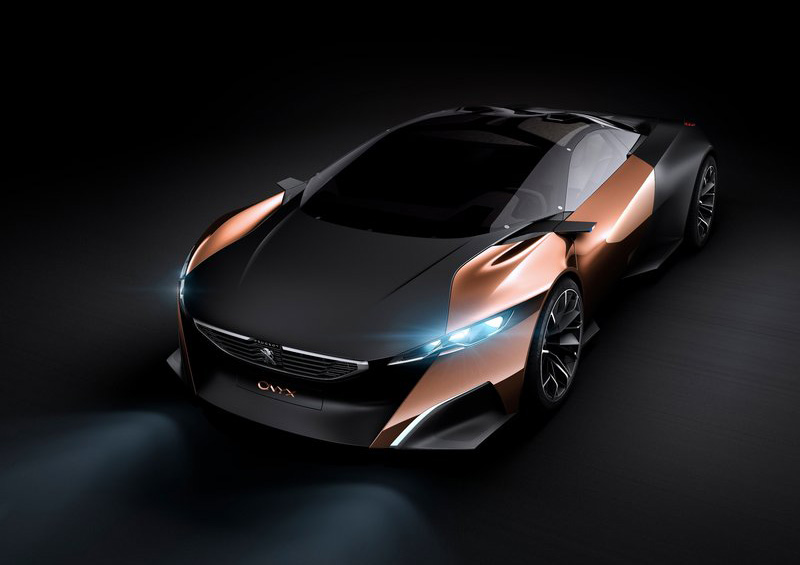
Peugeot Onyx Concept, 2012


  • Peugeot Onyx Concept, 2012

Quasar, Proxima, Oxia, 907... Peugeot's supercars have always made the eyes of both children and adults shine. In 2012, the Marque is again creating a dream with the supercar of the 21st century: the Peugeot Onyx Concept.

Sculpted using materials processed as little as possible, this supercar has been created by enthusiasts who have drawn their inspiration from the world of competition. With its V8 engine in a central rear position, the Peugeot Onyx Concept propels its admirers into a world of high performance, controlled in all circumstances thanks to intuitive instruments and controls. In addition to its stunning aesthetics, it explores new 'raw' materials, to take efficiency to another level.

A passion for innovation has never ceased to find its expression over the 202 year history of Peugeot, one of the oldest marques in the motor industry. Furthermore, it is the only one to offer a comprehensive range of personal means of transport: bicycles, scooters, cars and light utility vehicles. The Peugeot Onyx Concept Bike and Onyx Concept Scooter are also expressed with this vision of the future and will preview on

A radical silhouette... an intense emotion from the first glance

The sharp bodywork calls out with the striking contrast of its materials and colours. Fashioned by hand by a master craftsman, the wings and doors are pure copper sheet. A polished mirror, this metal does not need to resort to tricks to protect itself. So, its appearance will change over time, gaining a patina. The Onyx is alive! As for the other panels of the bodywork, these are carbon fibre, painted matt black.

Slicing through the air with finesse, the front face unites the vertical grille and full LED lamps, tapered, their surface area reduced to a minimum. The flow then separates; some penetrates into the heart of the vehicle, flowing inside the bodywork and the structure to supply the engine with air. The remainder of the flow spreads, skimming along the sides and the 'double-bubble' roof. Finishing off the Peugeot Onyx Concept with beauty, the rear lamps adopt a light signature with three claws now characteristic of Peugeot. They also support small spoilers which direct the upper and side flows. These reunite as far as possible from the bodywork to reduce drag. With a Cd of 0.30, the aerodynamic impact of the Onyx is inversely proportional to its visual impact.

A link between experience and the future, the Peugeot Onyx Concept incorporates the present by paying tribute to the RCZ through its 'double-bubble' roof and aluminium arches. With complete transparency, revealing the carbon fibre structure and the passenger compartment, the windows and roof are made of PMMA (PolyMethyl MethAcrylate). Enclosing the cocoon, they guarantee the occupants' optimum protection due to its ultra-resistant structure.

A powerful supercar
The chassis of the car is an innovative component, developed with the expertise of Peugeot Sport and the Group's Research and Development Department. In monolithic carbon, this central structure consists of only 12 parts. It incorporates the front and rear chassis legs, which makes it possible to eliminate the connected plates. The torsional stiffness and weight of the structure is optimised, at barely 100kg.

Bolted onto the carbon fibre shell, the 3.7-litre V8 hybrid HDi FAP engine and the suspension bear all the experience of Peugeot Sport, acquired and confirmed on tracks all over the world. Cooled by ducts which begin at the roof via NACA take-offs, the V8 transmits its 600bhp to the rear wheels via a six-speed sequential gearbox. This power ideally exploits compact proportions: 4.65m long, 2.20m wide, 1.13m high and of only 1100kg. Fitted with tyres specially developed by Michelin, 275/30 at the front and 345/30 at the rear, the 20" wheels see their hub retained on the structure by a double wishbone and an in-board controlled suspension, both at the front and at the rear.

Intelligent, the HYbrid4 technology recovers the kinetic energy which is usually lost during braking. Stored in lithium-ion batteries, this energy is then delivered automatically on acceleration, boosting the power by an additional 80bhp. The management of this function is transparent to the driver, as is that of the engine which has represented a real challenge. In fact, the engine designers had to make suitable for the road, an engine which, in competition, operates in an extreme range.

With less than 2kg per horsepower, the Onyx achieves high performance without altering the purity and elegance of its style. To obtain this result, the Peugeot Onyx Concept is fitted with a flat carbon fibre floor, which creates a powerful ground effect. So, the aerodynamic components could be limited to a strict minimum, by means of extensions of the carbon fibre structure and the moving spoiler which loads the rear suspension during braking. Braking is provided by four carbon discs, 380mm at the front and 355mm at the rear.

Innovative instruments and controls for a unique experience
The doors, the interface between the bodywork and the passenger compartment, offer easy access thanks to their two-movement kinematics. On opening, the outer copper skin separates from the door inner panel and moves laterally by a few centimetres before pivoting around its axis of rotation.

The passenger compartment is bathed with natural light, from floor to roof. Like the bodywork, it has the minimum amount of material retaining only that necessary to make the components and retain them. The result is an uncluttered passenger compartment, in close proximity to the occupants.

Sophie Gazeau, Peugeot Colour & Materials Stylist
Made of felt, compressed and stretched, the passenger compartment is formed as a one-piece pod, with no stitching or joins. It creates a real cocoon around the occupants and fitted into the carbon structure, visible in places, fulfils the functions carried out in the past by several components: soundproofing, floor, upper console, roof, bucket seats.

The occupants become one with a uniform part, which also reduces weight. Their sporting comfort has been incorporated with the insertion of foam, under the felt, in the areas of contact with the body.

Warm and soft, the felt originates from an ancestral tradition. Obtained from boiled wool, with intertwined fibres, this material is fully recyclable and provides excellent thermal insulation. In addition, it improves the quality of the surrounding air by dehumidifying it.

On board, the driver finds each control without having to take his eyes off the road. The small steering wheel with felt rim falls naturally into the driver's hands and gives an immediate feeling of agility. On its carbon hub the aluminium controls operate the functions of the Onyx, while paddles control the gearbox.

The dashboard is made of a new type of "wood", Newspaper Wood. It is produced from used newspapers, assembled and compressed to create new 'logs' from which the parts are made. The illusion is perfect, with grains which run across the surface. On closer inspection it reveals the secret with the appearance of printed characters.

The dashboard houses the instrument panel in a head up position. On the instrument panel surround, the engine speed and vehicle speed are indicated by metal parts, appearing or disappearing like the keys of a piano. As for the operation of the hybrid engine, this is indicated by digital screens.

A panel of aluminium toggle switches is installed in the roof, including the engine starting switch. Immediately behind this, a strip displays the images from the rear view cameras: two located in the mirrors, the third, panoramic, in the rear capping.

Also made from Newspaper Wood, the console features a unique fuel indicator, shaped from blown-glass by a master craftsman. This fuel chamber, displays the level of fuel visible against finely chiselled indication marks. Also, diffused in the passenger compartment by its vents, the fragrance reproduces the essence of the materials used. Finally, the console houses the dual-zone air conditioning controls, with an aluminium bar with a milled detail finish.

The Peugeot Onyx Concept, like its accomplished Peugeot Concept predecessors, exudes the skills of the talented engineers and designers, introducing new techniques and innovative materials to produce a stylish design with extreme performance that inspires excitement and desirability, while providing a glimpse of the theme of thinking with the future in mind.
Read More