


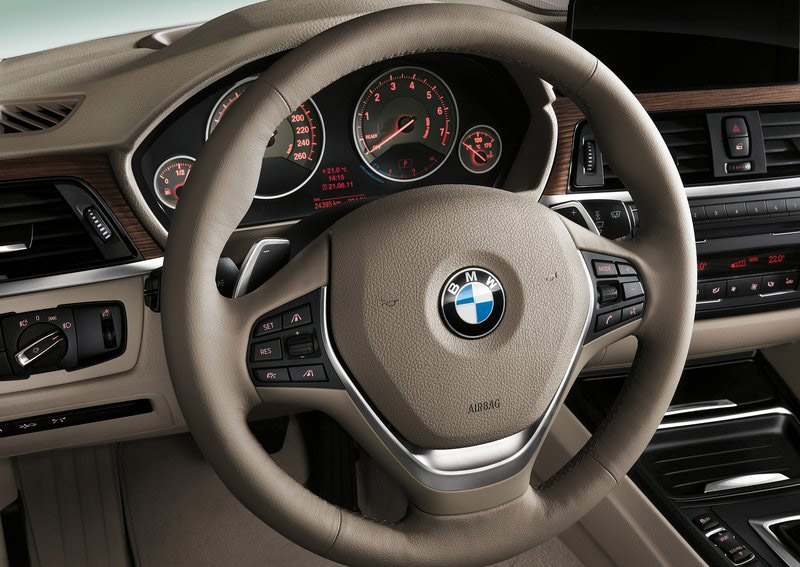


- BMW 3-Series, 2012
The BMW 3-Series Sedan is the original in the compact sports sedan segment and over the years has come to symbolise the aesthetic appeal, dynamics and sporting capability of BMW. With its dynamic and elegant lines, the sixth model generation of the world's best-selling premium vehicle highlights the sporting character of the brand's mid-size model. Although the new BMW 3-Series has grown in all dimensions compared to its predecessor, it retains a perfect balance of sportiness and elegance. As in previous generations, the sedan's dynamic proportions are shaped by the sweeping bonnet, short front overhang, long wheelbase and set-back greenhouse typical of BMW.
Striking front end with precise contours and multi-faceted surfaces
The wedge shape of the new 3-Series' silhouette and its wider track (+ 37/47 mm at the front/rear) underline the sporting appearance of the new BMW. By clearly accentuating the width of the car, the multi-faceted surfaces of the expressive front end give the BMW 3-Series a sportier face than ever. A wide, squat interpretation of the upright, slightly forward-slanting BMW kidney grille emphasises the stance of the new BMW 3-Series. LED accent lights positioned like eyebrows above the striking twin headlights with corona rings (if xenon headlights are specified) lend an extra intensity to the classic BMW focused look. The headlights now extend up to the frame of the kidney grille, merging the headlights and grille of the new BMW 3-Series Sedan into a single stylistic unit and adding further emphasis to the car's broad-set stance. The BMW 3-Series replaces the central air intake of its predecessor with two larger intakes, which are positioned underneath the headlights to the outer edges of the front end and add extra depth to the car's sporty styling. On the far left and right of the main ducts are small vertical intakes which help create the "Air Curtain". This new technology improves air flow around the front wheels, enhancing aerodynamic efficiency and reducing fuel consumption at higher speeds.
The closely spaced, squat openings of the kidney grille, with their eye-catching surrounds, form the most prominent element of the new BMW 3-Series Sedan's front end design. This is also where the precise lines of the heavily contoured bonnet finish. The result is a front end that appears lower-slung, giving the BMW 3-Series a clear sporting edge when viewed head-on.
Precise lines produce a stretched silhouette and enhance the car's dynamic impact
Powerfully taut surfaces with sweeping lines dominate the side view of the BMW 3-Series Sedan, stretching the car visually and lending extra verve to its dynamic stance. The flanks of the car are shaped by an eye-catching "double swage line" made up of two character lines running alongside each other. The higher swage line emerges out of the low-slung front end and flows over the front wheel with an understated sweep, in a nod to the sedan's fleetness of foot. The second swage line develops lower down behind the front wheel and follows a delicately arching path towards the rear. Together, they reinforce the dynamic wedge shape of the car's flanks and create vivid light and shade effects below the swage line, which draw further attention to the car's wide track.
The striking interpretation of the hallmark BMW Hofmeister kink at the base of the C-pillar injects the silhouette of the new 3-Series with even greater élan. Alongside it runs a fine contour line from the roof into the boot lid, giving the roof an even lower appearance from the side. The resultant sense of sporty yet elegant lightness spreads all the way down the sedan's sides, with the slightly rising shade line low down on the heavily contoured side skirt adding further emphasis. The large light surfaces above the side skirt serve to enhance the lightness of the car's flank lines.
Contrasting light surfaces imbue the rear with brio and energy
The strong horizontal lines of the rear - including rear lights in customary BMW L-shaped design positioned at the outer edges of the back end - accentuate the broad face of the wheels and wide track of the new BMW 3-Series Sedan. The low-set reflectors on the far edges guide the vertical lines flowing out of the greenhouse over the rear lights to the wheels, lending visual emphasis to the car's consummate road presence. A traditional BMW 3-Series design trait are the two lines below the rear spoiler and above the bumper, which frame the rear stylistically. Richly contrasting light surfaces give the rear end of the new BMW 3-Series Sedan a fresh dynamic flair, underlined by the interchanges between smoothly flowing surfaces, precise lines and defined edges.
The interplay of surfaces and lines fills the interior with life
The interior of the new BMW 3-Series Sedan is straight out of the BMW design handbook. The driver-focused cockpit wraps around the driver and puts all the important controls within easy reach. The cockpit is angled towards the driver by seven degrees. The surfaces and lines flow over the instrument panel towards the front passenger side of the cabin, where they form a smooth, protective border. In the driver's area all the lines converge on a single point behind the steering wheel and guide the eye towards the road.
The cockpit's four circular dials (fuel gauge, speedometer, rev counter and oil temperature gauge) come with a black panel display. Positioned on the horizontally-structured instrument panel, the freestanding standard-fitted iDrive monitor with high-resolution display recalls the latest flatscreen televisions normally found in living rooms rather than cars. The monitor has no folding mechanism or binnacle, allowing the entire dashboard to retain its flat, smooth lines and giving the interior a lighter, more dynamic feel.
On the driver's side of the deliberately asymmetric centre tunnel, a different trim surface and graining mark out the active driving elements of the interior, while the trim surface on the front passenger side exudes a pleasingly elegant air. Positioned centrally on the centre console within easy reach of both the driver and the front passenger is the standard iDrive Controller. Underneath the armrest - with optional fore/aft adjustment - between the front seats, meanwhile, is a compartment for mobile devices (e.g. mobile phones, MP3 players and smartphones), which also contains a USB/AUX-IN socket.
More space, wide variety of storage compartments, even greater practicality
The car's larger dimensions (length + 93 mm, wheelbase + 50 mm) mean that rear passengers can now enjoy extra legroom. Behind the fully contoured front seats, 15 millimetres of additional knee room and eight millimetres of extra headroom further enhance the passengers' comfort on the road. Backrest nets available as an option as part of the storage package offer additional accommodation for small items, reflective vests and road maps. Larger pockets in the front doors, whose lines and surfaces open up towards the instrument panel, now have space for drinks bottles up to one litre in size. Added to which, two large drinks holders are now integrated into the centre console ahead of the gearshift lever. If desired, the cupholders can be swapped for an oddments tray, which is stored in a designated area of the glove compartment when not in use. The new sedan offers 480 litres of boot capacity, 20 litres more than the outgoing model. And an innovative and practical solution allows extremely convenient access inside. If the optional Comfort Access is specified, the boot can be opened hands-free and without needing to use a key: all you need to do is move your foot around underneath the bumper to trigger the opening mechanism for the boot lid (see also BMW ConnectedDrive). He can then comfortably load as much as seven standard crates of bottled drinks, three golfbags or a pram over the boot sill, which is a mere 66 centimetres high (just under 26 in.). Standard-fitting securing lugs hold the items firmly in place, while a storage tray under the load compartment floor and a deep storage compartment on the left-hand side accommodate small oddments. For bulky items, the optional through-loading facility includes a folding rear seat bench to allow flexible transport solutions. The 40:20:40 split rear backrests offer unbeatable versatility when you need to carry passengers and long items, such as several pairs of skis or snowboards, at the same time. (A matching BMW ski/snowboard bag is available from the BMW Accessories range).
3 equipment lines shine the spotlight on the car's distinct character traits
High-quality material combinations and unbeatable build quality underline the premium ambience of the new BMW 3-Series Sedan. The materials and colour concept of the entry-level variant already clearly accentuates the sporting character of the car, but a large selection of colours and upholstery variants also offer scope for various other options. From the basic matt satin silver surface treatment to fine brushed aluminium and the homely feel of fine burr walnut wood, all trim surface options can be combined with either the cloth or one of two leather upholstery colours in the entry-level model. As well as the basic trim level, the new BMW 3-Series Sedan can now also be ordered with any of three equipment lines or an M Sports package. Customers can therefore adapt the appearance of their car to their own individual preferences - with eye-catching results. The Sport Line, Luxury Line and Modern Line equipment variants emphasise the different sides to the new BMW 3-Series Sedan's character in their own individual ways. The exclusive, carefully coordinated equipment features embrace both exterior design elements and the selection of materials and colours for each model. In terms of value, design coherence and expressiveness, the new BMW Lines go far beyond existing packages in the premium class.
Sport Line
With eye-catching exterior features in high-gloss black, this new line accentuates the dynamic appearance of the BMW 3-Series Sedan. Eight heavily contoured black kidney grille slats in a chrome-coloured surround give the front end of the car a particularly sporty and alert look. The black inserts in the front apron make the air intakes appear larger and lend extra emphasis to the muscular wheel arches. 17 or 18-inch light-alloy wheels - depending on the engine variant - in double-spoke design (18-inch items are bi-colour) provide the athletic looks to match. Meanwhile, optional high-gloss black painted exterior mirrors and the standard high-gloss black B-pillar and window guide add an extra sporting flavour to the flanks. A black trim strip on the lower crease underlines the width-enhancing effect of the rear styling, while the tailpipe embellisher is likewise black and rounds off the exterior's sporty appearance. The sporty and exclusive ambience of the interior is expressed by contrasting black and red accents. Red trim rings, red scales in the circular dials, red stitching on the sports steering wheel and a base trim strip in high-gloss black with coral red accent strips all underline the sporting ambience of the cockpit. The standard sports seats can be specified in a choice of three upholstery variants and four colours. The ignition key for Sport Line versions of the new BMW 3-Series Sedan is identified by its black finish and red detailing.
Luxury Line
The discreet high-gloss chrome elements of this line lend the exterior of the BMW 3-Series Sedan a particularly elegant and exclusive appeal. The BMW kidney grille with 11 fine chrome slats, two slightly offset chrome trim strips in the front apron air intakes, and a high-gloss chrome trim strip running horizontally above the air scoop give the front end a striking appearance. As with the Sport Line, the B-pillar and window guide come in high-gloss black, and the window frame and weather strip are in chrome. Special 17 or 18-inch light-alloy wheels in multi-spoke design accentuate the stylishness of the new BMW 3-Series Sedan when viewed side-on. From the rear, the new Luxury Line is easily identified by its exquisite, high-gloss chrome trim strip - which extends across the full width of the rear apron - and its chrome tailpipe embellisher. Chrome elements also catch the eye inside the Luxury Line variant. This is the only line which gives the radio and air conditioning units a chrome surround. High-gloss wood strips (with stylish inlays as an option) and seats with distinctive stitching and a choice of two upholstery materials in four classically elegant colours highlight an inviting, exclusive ambience. The ignition key (ID confirmation) for Luxury Line versions of the new BMW 3-Series Sedan can be identified by its black finish and chrome detailing.
Modern Line
In contrast to Luxury Line models, the high-class trim elements included in Modern Line versions of the new BMW 3-Series Sedan are all in satinated aluminium, underlining the contemporary character of this line. The BMW kidney grille, with 11 satinated aluminium slats, and double trim strips for the air intakes in the same colour give the front end of the new BMW 3-Series Sedan a particularly contemporary, classy touch. The car's high-gloss black B-pillar and window guide blend smoothly with the satinated aluminium trim elements at the font and rear. 17 or 18-inch turbine-style light-alloy wheels strengthen the impression of this equipment line. The harmonious lightness of the interior dispenses with strong contrasts. Instead, with a light upper side to the dashboard and a steering wheel in dark oyster, it generates an all-new ambience. Leather upholstery or cloth-leather combinations in oyster or black, and a choice of three trim surfaces with accent strips in pearl-effect chrome, further enhance the appealing interplay between materials. A trim element with three-dimensional wood surface structure lays on a whole new feast for the fingertips. Modern Line versions of the new BMW 3-Series Sedan are marked out by the oyster-coloured ignition key (ID confirmation) with matt silver detailing.
M Sport package
The M Sport package brings the ultimate in sporting makeovers to the new BMW 3-Series. An all-new aerodynamic package for the exterior clearly sets cars specified with this package apart from the base model and the three lines. Added to which, 18-inch light-alloy wheels (19-inch as an option) in hallmark M design, M Sport suspension and BMW Individual High-gloss Shadowline trim give the car that typical M look. The car's dynamic character is further emphasised by an optional exclusive M paint shade and optional M Sport brakes with contrasting blue paint finish. The theme continues inside the car with sports seats boasting distinctive cloth/Alcantara upholstery, trim elements with blue accent strips, an M Shortshifter (in models with manual gearbox), M door sill finishers, an M driver's footrest and the new M leather steering wheel.
New dimensions in driving pleasure and dynamic performance: Sporty power delivery, outstanding efficiency and enhanced ride comfort
The sixth-generation BMW 3-Series sports sedan models offer top-level agility and driving dynamics, and they combine all this with new levels of comfort. At the same time, there is no change to the proven basic concept comprising high-performance engines, a sporty chassis and a rigid, lightweight body. After all, over the past 35 or more years, drivers have come to expect dynamic, sporty driving enjoyment as a matter of course in a BMW 3-Series model, while powertrain and chassis technology rank as a core strength of the brand. A longitudinally mounted engine, rear-wheel drive and a balanced (50:50) front-to-rear axle load ratio are a formula that makes the BMW 3-Series the sportiest sedan in its segment.
At launch, the new BMW 3-Series Sedan will be offered with four high-torque, refined and fuel-efficient engines, all of which feature the latest BMW TwinPower Turbo technology. They comprise two optimised diesel engines and, on the petrol side, the familiar six-cylinder unit and a new-generation four-cylinder engine offering impressive driving dynamics coupled with substantially reduced fuel consumption and emissions. All the engines are well within the EU5 and US ULEV II limits. And the new Driving Experience Control switch, which is available for all engine versions, provides the opportunity to extend these savings even further when ECO PLUS mode is selected.
Power is delivered to the rear wheels either via a standard-fitted sporty six-speed manual transmission or, optionally, via an eight-speed automatic. The automatic, which can be combined with any engine, is so efficient that it is possible to achieve lower fuel consumption and emissions than with the manual unit. Both the manual and the automatic models are equipped with the Auto Start-Stop function for further savings.
Advanced suspension technology, featuring a large number of light-alloy components and new tuning, along with electromechanical steering which operates without torque steer, low vehicle weight and a balanced axle load ratio top off a dynamic package, making the new BMW 3-Series Sedan an exemplar of sporty handling combined with increased comfort.
BMW 328i: new four-cylinder petrol engine with TwinPower Turbo technology sets a new benchmark for driving dynamics and efficiency
With the launch of the new sports sedan, a brand-new four-cylinder engine will make its debut in the BMW 3-Series. In keeping with the dynamic overall theme of the new BMW sports sedan, this new-generation turbocharged engine offers plenty of power and performance, responsive acceleration, powerful torque, a high rpm ceiling and low weight. For this best-selling BMW model series, the new-generation 2.0-litre petrol engine will be available in two output ratings. The new four-cylinder units, which provide noticeably livelier power for maximum driving enjoyment, also come with lower fuel consumption and emissions than their predecessors.
The state-of-the-art, lively 2.0-litre powerplants mark a return to the popular sports sedan's roots - it was with lightweight, high-performance four-cylinder units in a similar vein that the BMW 3-Series made its debut back in 1975, with the first six-cylinder units for this series making their appearance at the 1977 Frankfurt Motor Show. A six-cylinder continues to top the engine line-up in the new BMW 3-Series.
The significant upgrade in power and efficiency is chiefly down to the use of BMW TwinPower Turbo technology, featuring innovative technologies such as High Precision Direct Petrol Injection, twin-scroll turbocharging, Double-Vanos variable camshaft timing and VALVETRONIC variable valve timing. On the new-generation four-cylinder engines, this world-exclusive technology package from BMW again provides a very efficient way to extract more power from the engine, rather than taking the route of a much larger displacement and, in the process, adding to the weight and therefore to fuel consumption. This explains why the more dynamic performance and driving enjoyment does not come at the expense of higher fuel consumption and emissions.
The new BMW TwinPower Turbo four-cylinder petrol engine's displacement of 1,997 cc delivers maximum power of 180 kW/245 hp at 5,000 rpm while, thanks to twin-scroll turbocharging, the maximum torque of 350 Nm is developed at just 1,250 rpm and remains constant up to 4,800 rpm. These statistics translate to sheer dynamic performance: the new BMW 328i accelerates from 0 to 100 km/h (62 mph) in just 5.9 seconds, on its way to an electronically governed top speed of 250 km/h (155 mph). The engine responds instantly when the driver demands more throttle, and the vigorous and almost linear power delivery from only slightly above idle, which continues all the way into the higher rpm range, is duly impressive.
The average fuel consumption of the BMW 328i in the EU test cycle is just 6.4 litres per 100 km (44.1 mpg imp), an 11 per cent (!) improvement on its 160 kW/218 hp predecessor. There is a similar improvement in CO2 emissions, which now stand at 149 grams per kilometre. The improvement is even more pronounced if the vehicle is equipped with the new eight-speed automatic, in which case fuel consumption is rated at just 6.3 litres per 100 km (44.8 mpg imp), with CO2 emissions at 147 grams per kilometre (-15%).
BMW TwinPower Turbo technology in the new four-cylinder engine
This new engine is the most powerful in a new generation of four-cylinder petrol units based on the same reduced-friction core engine, their different output ratings being achieved principally by modifications to the injection and turbocharging technology. In technical terms, this core engine is modelled on the current multi-award-winning six-in-line engine with BMW TwinPower Turbo technology, which is the benchmark in its class for dynamic power delivery and impressive efficiency. Key features of this world-exclusive technology include High Precision Direct Petrol Injection, twin-scroll turbocharging, Double-Vanos variable camshaft timing and VALVETRONIC variable valve timing.
These features give the new BMW 328i the sort of power which with a naturally aspirated engine would require more cylinders and larger displacement. At the same time, with its all-aluminium crankcase, this engine is lighter and more compact than a six-cylinder engine of equivalent power. This has obvious benefits for driving dynamics: the reduced load on the front axle gives this BMW sports sedan greater agility and further improved steering and cornering characteristics.
Twin-scroll turbocharging
The new four-cylinder engines also feature twin-scroll turbocharging. This means that the exhaust stream from cylinders 1 and 4, and the exhaust stream from cylinders 2 and 3, follow separate spiral-shaped paths to the turbine wheel. This reduces exhaust back-pressure at low engine rpm, allowing the energy of the exhaust gas pulses to be utilised as efficiently as possible. The result is instant throttle response and fast-revving performance which BMW drivers can instantly translate into driving pleasure.
VALVETRONIC, Double-Vanos and direct injection
The combination of a high power output and a simultaneous reduction in emissions is achieved by VALVETRONIC variable valve timing and Double-Vanos variable camshaft timing. The latest generation of the VALVETRONIC system features a faster-acting, optimised stepper motor with integrated sensor. Seamlessly variable control of intake valve lift dispenses with the need for a throttle valve. Instead, the air mass is controlled inside the engine, resulting in faster response. At the same time, pumping losses have been reduced to a minimum.
The excellent efficiency is also down to the High Precision Direct Petrol Injection system. Centrally positioned between the valves, solenoid injectors precisely control the supply of fuel. The fuel is injected very close to the spark plug, with a maximum injection pressure of 200 bar, resulting in clean and homogeneous combustion. The cooling effect of the directly injected fuel also results in a higher compression ratio than on port injection engines, bringing further efficiency improvements.
Exceptional performance assisted by innovative design features
The exceptional performance of the new engine is due last but not least to various innovative features of the core engine. For example, balancer shafts positioned at different heights result in optimised vibration absorption, while a centrifugal pendulum absorber integrated in the dual-mass flywheel brings a noticeable reduction in irregular running at low engine rpm. The driver can therefore make full use of the strong low-end torque without sacrificing smoothness. These factors all help to explain why the new 2.0-litre four-cylinder engine achieves refinement, noise and vibration of a kind that was previously confined to BMW six-cylinder engines.
BMW 335i: optimised six-cylinder petrol engine with beefy power delivery, strong torque and superb refinement
Fans of large six-cylinder engines have a treat in store too. The optimised six-in-line unit in the new BMW 335i will impress performance-minded drivers with its effortless power, exceptionally fast-revving temperament and outstanding refinement. The 3.0-litre core engine has been setting standards from the start, as the pioneer of a new generation of engines in which BMW TwinPower Turbo technology with High Precision Direct Petrol Injection and VALVETRONIC variable valve timing made its debut.
Thanks to intensive fine-tuning of the core engine, BMW's engineers have now further reduced the fuel consumption and emissions of the predecessor unit, while at the same time maintaining its high performance. With a maximum power rating of 225 kW/306 hp at 5,800 rpm, the 3.0-litre six-cylinder unit reflects the sporty personality of the BMW 3-Series and helps this sedan deliver ebullient performance. Peak torque of 400 Nm is on stream between 1,200 and 5,000 rpm.
As a result, the new BMW 335i can show off its prowess with a 0 to 100 km/h (62 mph) sprint time of just 5.5 seconds, which shaves 0.1 seconds off that of its equally powerful predecessor. The automatic version is even quicker, reaching 100 km/h (62 mph) a full 0.3 seconds faster than the outgoing model. Top speed remains the same, at an electronically governed 250 km/h (155 mph).
All this extra performance comes with exceptional fuel economy and low emission figures, so drivers can enjoy it with complete peace of mind. Fuel consumption in the EU test cycle is rated at 7.9 litres per 100 kilometres (35.8 mpg imp, and CO2 emissions at 186 grams per kilometre. Fitted with the new eight-speed automatic transmission, the BMW 335i is even more frugal, with combined fuel consumption of just 7.2 litres per 100 kilometres (39.2 mpg imp) and CO2 emissions of 169 grams per kilometre. The improvement in emissions for the manual and automatic versions works out at 6 and 16 per cent respectively.
BMW 320d: powerful torque, outstanding smoothness and further improved fuel efficiency
The new-generation BMW 3-Series Sedan features the BMW TwinPower Turbo four-cylinder diesel engine of its predecessor, which has been honed for even greater fuel economy and lower emissions with no reduction in power output. This state-of-the-art powerplant with composite aluminium crankcase sets many benchmarks, and with its latest-generation common rail direct injection system and VNT turbocharger it combines plenty of punchy power with a further reduction in fuel consumption and emissions. This all helps the new BMW 3-Series to further widen its competitive lead.
The thermodynamically improved turbocharger makes for lively power delivery right across the load range. An electric actuator adjusts the turbine blades with split-second speed in line with different engine loads, so that when the driver demands full throttle, the engine is as responsive in the low rpm range as it is at full load. Solenoid injectors supply the fuel to the cylinders at a pressure of up to 2,000 bar. High-precision fuel metering and high atomisation quality result in clean and homogeneous combustion.
With unchanged maximum power of 135 kW/184 hp at 4,000 rpm, and powerful torque of 380 Nm on stream between 1,750 and 2,750 rpm, the new BMW 320d is an extremely dynamic performer. This diesel model, too, delivers everything one would expect of a compact sports sedan. This is reflected in performance figures, which include a standstill to 100 km/h (62 mph) sprint time of just 7.5 seconds. When necessary, the agile diesel will accelerate up to a top speed of 235 km/h (146 mph).
The new BMW 320d's average fuel consumption in the EU test cycle of 4.5 litres per 100 kilometres (62.8 mpg imp) and CO2 emissions of 118 grams per kilometre mark a four per cent improvement on the predecessor model, with no reduction in power. For models fitted with the new eight-speed automatic transmission, the improvement is even more striking: fuel consumption (4.5 l/100 km / 64.2 mpg imp) and CO2 emissions (118 g/km) have fallen by 16 per cent. With all of this, the BMW 320d has reaffirmed its position as a high-performance, efficient sedan which boasts one of the world's cleanest and most economical diesel engines.
BMW 320d EfficientDynamics Edition: state-of-the-art diesel engine makes the new sports sedan the most efficient vehicle in its class
Drivers who don't want to miss out on either dynamic, sporty performance or first-class fuel economy will find the new BMW 320d EfficientDynamics Edition an extremely attractive proposition. As in the previous model, this ultra-fuel-efficient version of the BMW TwinPower Turbo four-cylinder diesel engine represents the most radical realisation to date, in the sporty BMW 3-Series range, of BMW's development strategy for reducing fuel consumption and emissions.
The 2.0-litre four-cylinder engine is from the same family as the regular BMW 320d engine and shares the same all-aluminium crankcase, VNT turbocharger and latest-generation common rail direct injection. Additional features like a slight reduction in maximum output rating, the rpm-reducing, friction-reduced powertrain design and an optimised aerodynamics package give this EfficientDynamics version of the new BMW 3-Series the lowest CO2 emissions in its class.
The new BMW 320d EfficientDynamics Edition develops maximum power of 120 kW/163 hp at 4,000 rpm and delivers its maximum torque of 380 Nm between 1,750 and 2,750 rpm. This sedan model accelerates from 0 to 100 km/h (62 mph) in just 8.0 seconds and hits a top speed of 230 km/h (143 mph). Fuel consumption of 4.1 litres per 100 kilometres (68.9 mpg imp), with corresponding CO2 emissions of 109 grams per kilometre, make this diesel model the most economical, eco-friendly and efficient vehicle in its segment.
The low-CO2 model also has something new for drivers who like to leave the shifting to an automatic transmission. The new BMW 320d EfficientDynamics Edition can now for the first time be combined with a cutting-edge eight-speed automatic transmission. What's more, this extra comfort doesn't come at the expense of higher fuel consumption. Thanks to efficient electronics and reduced-friction components, the engine can operate just as efficiently with the new unit as with the standard six-speed manual transmission.
Dual-mass flywheel with centrifugal pendulum absorber
In all road speed ranges that are relevant in everyday driving, the engineers have achieved reductions in engine speed which have noticeable benefits for fuel consumption. For example when cruising at 100 km/h (62 mph) in sixth gear, the engine is only turning over at 1,600 rpm. The "centrifugal pendulum absorber" fitted in the engine's dual-mass flywheel ensures smooth, vibration-free running even at low engine speeds. It efficiently counteracts irregular running and eliminates vibration when accelerating. The diesel engine revs smoothly from low engine speeds and the accompanying sound is equally refined.
This extra refinement, and improvements to the Optimum Shift Indicator, encourage the driver to change to a higher gear more often and to shift down less frequently. This means that, despite the changed engine load profile, which has the effect of reducing fuel consumption and emissions, the new BMW 320d EfficientDynamics Edition boasts the typical agility that everyone familiar with this sports sedan series has come to expect. The Edition-specific modifications include a longer final-drive ratio, an optimised aerodynamics package with a 10 mm (0.4 in.) drop in ride height and wheels with "turbine" styling. There is even a 15 per cent reduction in the rolling resistance of the tyres compared with the predecessor model.
On top of this, the economical sports diesel model also features all the fuel economy-enhancing measures used on other models in the new BMW 3-Series. These include Brake Energy Regeneration, the Auto Start-Stop function and on-demand control of ancillary units such as the oil and coolant pump. In the premium sector of the intensely competitive mid-range market, the new BMW 320d EfficientDynamics Edition is an attractive proposition for environmentally-minded drivers which to this day remains unrivalled even among its direct competitors.
BMW 320i, BMW 318d and BMW 316d
In spring 2012, BMW will launch three further engines for the new sports sedan series, all of them offering plentiful power and outstanding efficiency. Following the impressive BMW 328i, the top four-cylinder model already being presented today, the upcoming new BMW 320i will be the second model to be powered by a member of the new-generation 2.0-litre four-cylinder petrol engine family. In the new BMW 320i, this TwinPower Turbo engine will develop maximum power of 135 kW/184 hp at 5,000 rpm and peak torque of 270 Nm at just 1,250 rpm. The two upcoming turbodiesel models, which will be based on the same 2.0-litre core engine that is used in the new BMW 320d, will also develop impressive power and torque. In the BMW 318d, the diesel powerplant will develop maximum power of 105 kW/143 hp at 4,000 rpm and powerful peak torque of 320 Nm, which is available between 1,750 and 2,500 rpm. The extremely fuel-efficient BMW 316d, meanwhile, develops maximum power of 85 kW/116 hp at 4,000 rpm and maximum torque of 260 Nm, again at between 1,750 and 2,500 rpm. Further engine versions will follow, including a six-cylinder diesel unit and numerous xDrive models. Autumn 2012, finally, will see the launch of the BMW 3 ActiveHybrid.
Sporty six-speed manual transmission fitted as standard; state-of-the-art eight-speed automatic optionally available for all engine versions
The BMW 3-Series owes its characteristic driving experience not just to its high-torque, fast-revving engines, but also to its transmissions. For performance-minded drivers the transmission, as the interface where the power from the engine is relayed to the drive train, is pivotal to a dynamic driving experience. It is just as important for it to offer precise, short-throw shifting as to provide the right ratios. Smooth shifting, low noise and efficient design are further qualities demanded in the premium segment. The new BMW sports sedan comes with a six-speed manual transmission as standard. Those who prefer to leave the shifting to the transmission will find an ideal alternative in the ultra-innovative eight-speed automatic. Finally, customers can also opt for an eight-speed sports automatic version of this transmission, with steering wheel-mounted paddle shifts.
Six-speed manual transmission as standard
The sporty six-speed manual transmission in the new BMW 3-Series boasts an easy and precise shifting action and optimal ratio spacing. The lightweight, compact format and innovative, low-friction design help to further enhance driving enjoyment and efficiency. The transmissions used on the BMW 335i, BMW 320d and BMW 320d EfficientDynamics Edition models are equipped with dry sump lubrication for significantly improved efficiency and shifting quality, due to reduced drag losses. At the same time, noticeably more comfortable shifting is achieved by the use of innovative carbon friction linings in the synchromesh units. The transmission in the new BMW 328i features an optimised transmission precisely matched to the performance characteristics of the new turbo engine. The ratio spacing makes for powerful sprinting performance and fast mid-range acceleration, all combined with a reduction in fuel consumption.
Innovative eight-speed automatic transmission for petrol and diesel models: efficient power transmission and optimal ratios
Optionally, the new BMW 3-Series can be supplied with a high-performance eight-speed automatic transmission, which can be combined with any of the engines being presented. The additional ratios allow this transmission - which is an option not currently offered by any competitors in the compact sports sedan segment - to combine unprecedented standards of comfortable shifting, sporty performance and efficiency. With all this going for it, the automatic transmission is fully in keeping with the overall sporty temperament of the new BMW 3-Series Sedan.
In terms of size and weight, this eight-speed unit is comparable with the six-speed automatic transmission used in the past. A range of innovative technical features and exceptionally high internal efficiency allow this higher-performance unit, too, to combine powerful acceleration, nifty mid-range sprinting and further reduced fuel consumption. For performance-minded drivers this transmission also has lots to offer, particularly since the driver can choose to play a more active role by changing gear manually, thereby releasing even more of this sporty sedan's potential.
With its optimised control technology, the eight-speed transmission boasts extremely fast shift and reaction times and direct downshift capability. The electronic transmission controller can also alter the shift characteristics as required, to cater either for a more sporty or for a more relaxed, fuel-saving driving style. Despite a larger overall spread, eight ratios mean that the spacing between them is smaller, so that the optimal ratio is available in virtually all situations. The close ratios deliver refined and powerful acceleration as well as smooth and fuel-efficient low-rpm operation. Altogether, then, as well as providing dynamic acceleration and smooth shifting, the new eight-speed automatic also allows drivers to maintain a very economical driving style. The upshot is that, when fitted with the eight-speed automatic transmission, the new BMW 3-Series achieves virtually identical - or in the case of the BMW 335i, BMW 328i and BMW 320d even lower - fuel consumption and emissions than models equipped with the six-speed manual transmission.
A sports version of the new eight-speed automatic transmission is available as a further option for the new BMW 3-Series Sedan. This unit offers even sportier shift characteristics, and the option of changing gear manually using the paddle shifts on the steering wheel. Alternatively, on the petrol models it is also possible to use the electronic Quickshift selector lever on the centre console. To switch between Normal and Sport modes, the Driving Experience Control switch is used. This allows the sports automatic to deliver both dynamic driving enjoyment and top-level comfort.
Precision chassis engineering sets new standards: sporty handling, high agility and increased comfort
In the sixth model generation, too, dynamism and performance are among the stand-out features of the BMW sports sedan. These qualities are underpinned by a precision-engineered chassis that perfectly complements a winning formula: a longitudinally mounted engine, rear-wheel drive, a balanced axle load ratio and torsionally stiff body. In the new BMW 3-Series the engineers have further improved the already outstanding handling qualities of the predecessor series and its excellent agility and directional stability, while at the same time noticeably improving comfort. To achieve this, they have made extensive use of extra-lightweight chassis components, sophisticated and perfectly tailored axle kinematics and a high-precision steering system which - due to the rear-wheel-drive set-up - is not affected by torque steer. State-of-the-art electronic control systems on the new BMW 3-Series Sedan help manage the vehicle dynamics and ensure that the combination of outstanding sporty performance and increased comfort can be enjoyed to the full and with complete peace of mind.
With friction-reduced wheel bearings and ball joints, aerodynamic improvements at the rear axle, an electro-mechanical steering system and reduced rolling-resistance tyres, the whole chassis plays its part in reducing fuel consumption and thus emissions.
A wheelbase of 2,810 millimetres (+ 50 mm) and a front and rear track width of 1,543 (+ 37 mm) and 1,583 millimetres (+ 48 mm) respectively give the new BMW 3-Series Sedan a more road-hugging stance than its predecessor, while the weight-optimised powertrain and lightweight body design result in a perfectly balanced 50:50 axle load ratio. This means that maximum dynamism and agility is combined with maximum stability.
Double-joint front axle with spring struts and anti-roll bar
The front axle of the new BMW sports sedan is based on a proven design which provides an optimal fusion of driving dynamics and comfort. The wheel suspension combines maximum stiffness with minimum weight, while aluminium torque struts, wishbones and swivel bearings bring a substantial reduction in unsprung masses. At the same time, the absence of torque steer means the kinematics of the double-joint axle could be optimally geared to the agility and dynamism of the new BMW 3-Series. This factor also has benefits for the new BMW 3-Series' electromechanical steering system, which brings less weight to the scales, helps cut fuel consumption and, just like the suspension, damping and elastokinematics, is precisely matched to the requirements of this vehicle.
Advanced axle design further refined: five-link rear axle improves driving dynamics and comfort
Incorporating various significant improvements and refinements, the rear axle of the new BMW 3-Series makes an important contribution to the new model's improved driving dynamics and comfort. Its space-saving design is based on the tried-and-tested five-link design used on the predecessor model, with elastokinematics which have been specially tailored to the new sports sedan, featuring long spring travel and precise and confident wheel location in all situations.
Extra-wide mounts and supports on the wheel carriers for track and camber, extremely stiff control arms, the stiff axle subframe and thrust arms connecting the suspension and body provide an excellent basis for the agile and, at the same time, comfortable overall suspension qualities of the new BMW 3-Series Sedan. The large mounts and supports at the rear axle not only affect handling, they are also important for ensuring good acoustic insulation between the powertrain and suspension, particularly on vehicles with a powerful, high-torque engine. Thanks to the effective insulation of the powertrain from road excitations, the new rear axle therefore also provides first-class noise and vibration damping.
The classic BMW 3-Series rear-wheel-drive set-up and a balanced weight distribution also provide the ideal basis for resolving the conflict between ride and handling. As a result, the new BMW 3-Series impresses with extremely sporty handling combined with highest standards of stability and comfort. Last but not least, the reduced-friction wheel bearings, robust powertrain isolation and carefully targeted aerodynamics modifications at the rear axle also contribute to improved driving dynamics and efficiency.
Electromechanical steering increases agility and comfort
The driving enjoyment, agility and comfort are also down to an accurate steering system which always gives the driver precise feedback. The typical BMW rear-wheel-drive setup, which eliminates torque steer, provides the ideal basis for this. The new BMW 3-Series is fitted with the electromechanical power steering system EPS (Electronic Power Steering), which uses an electric motor to provide steering assistance, with no concessions on the sporty steering characteristics for which this sedan is noted. EPS only operates when steering assistance is actually required: no electrical power is consumed during straightline driving or steady-state cornering. That is what differentiates electromechanical steering from hydraulic systems, which use power and therefore fuel even when not providing steering assistance. Highlights of this system include not only high efficiency but also low weight, high steering precision with good feedback, and comfort-enhancing self-centering and anti-roll characteristics. The BMW 335i and 328i are both equipped as standard with the Servotronic function for speed-sensitive power assistance.
Optional Variable Sports Steering
Optionally a new variable-ratio steering system can be specified. Variable Sports Steering provides different steering gear ratios depending on the angle of the steering wheel, so that the new BMW 3-Series responds either more directly or more softly to the driver's inputs. This reduces the number of steering wheel rotations required for bigger turns by up to 25 per cent and makes for easier, more convenient parking and turning since less effort is required from the driver. Also, the handling is sharper in general, for example when very sudden evasive action is called for. At smaller steering angles between zero and 100 degrees, on the other hand, the Sedan provides high standards of track-holding and straightline stability, and offers very precise response to steering changes. The variable-ratio steering is a purely mechanical system based on a variable-ratio steering rack.
Wheels and tyres
The new BMW 3-Series Sedans are factory-fitted with attractively styled, high-quality alloy wheels. The BMW 335i and BMW 328i run on 17-inch Star-spoke wheels carrying 225/50 R17 tyres. The BMW 320d and BMW 320d EfficientDynamics Edition diesel models ride on 16-inch V-spoke or Streamline-style alloy wheels and 205/60 R16 tyres. The rolling resistance of the tyres in the basic sizes quoted above has been reduced yet again - this time by approximately 15 per cent, while still maintaining the customary high BMW standards of driving dynamics.
Model versions of the new BMW 3-Series fitted with 17-inch - or larger - wheels are supplied as standard with run-flat safety tyres and the Tyre Puncture Warning System (TPWS). This solution provides additional convenience and safety benefits. Should a puncture occur, there is no need for a roadside repair or tyre change. What's more, the warning system informs the driver of any loss of tyre pressure, so he can usually take precautions to avoid being stranded. Even if a tyre becomes fully deflated, the vehicle maintains directional stability and can continue to be driven on the run-flat tyre at an appropriate speed. A further advantage of this system is that a spare tyre and a jack can be dispensed with, thereby saving weight and creating more boot space. Vehicles which do not have run-flat safety tyres are equipped as standard with the BMW Mobility Set, including an air compressor, tyre sealant and other breakdown accessories.
High-performance lightweight brake system
The dynamic performance of the sports sedan calls for a larger brake system, and the new BMW 3-Series thus uses lightweight sliding-calliper brakes with large vented discs. The aluminium front callipers bring a further reduction in unsprung masses. This extremely high-performance system also features outstanding heat tolerance, excellent wet braking performance, easy operation and precise control. Together with the large wheels and high-grip wide tyres, it provides the sports sedan with highly effective deceleration. A brake pad wear indicator and brake drying function are standard on all models.
The brake system is further supported by various state-of-the-art electronic safety systems, which are integrated into the Dynamic Stability Control (DSC) system for improved driving dynamics and safety. The DSC system incorporates the following functions: Anti-lock Braking System (ABS), Automatic Stability Control (ASC), Dynamic Traction Control (DTC), Dynamic Brake Control (DBC) and Cornering Brake Control (CBC), along with start-off assist, brake drying and an electronic limited slip function for the rear differential, which can be activated using the "DSC Off" button.
Optional M Sport brake
For performance-minded customers, BMW can alternatively offer the M Sport brake, which combines high performance standards with sporty styling. Aluminium four-piston fixed callipers at the front and two-piston fixed callipers at the rear, and large brake discs, combine extremely low weight with very short stopping distances.
Driving Experience Control switch with ECO PRO mode: extra-sporty, more relaxed or more fuel-efficient driving modes - at the press of a button
Drivers are able to vary the overall character of the sedan depending on the driving situation or to suit their personal preferences. As well as sportier or more comfortable drive settings, they can also opt for extra fuel efficiency. The different modes are selected using the new Driving Experience Control function including ECO PRO mode, which is standard specification on all models.
Using the Driving Experience Control switch, the driver is able to customise accelerator response characteristics, engine response, the power steering characteristics and the Dynamic Stability Control (DSC) thresholds. If fitted, the Servotronic function, the automatic transmission and Dynamic Damper Control are integrated into the system too. Using the simple-to-operate rocker switch on the centre console, drivers can choose between ECO PRO, COMFORT, SPORT and SPORT+ modes. Each of these predefined set-ups activates different settings for the relevant powertrain and suspension components.
In SPORT mode, for example, throttle response is even faster and the steering becomes even more direct. On vehicles with automatic transmission, the shift points are altered to provide a significantly sportier drive. Depending on vehicle specification, it is also possible to choose at one and the same time a sporty setting for powertrain components and a comfortable setting for suspension components - and vice versa. If the Professional navigation system is fitted, two gauges in a dynamics display on the instrument panel inform the driver how much power and torque are being used in the current driving situation.
A further button allows the driver to change the DSC settings. Selecting TRACTION mode, for example, makes it much easier to start off on loose surfaces or in deep snow. In this mode as well as in SPORT+ mode, the Dynamic Stability Control thresholds are raised and Dynamic Traction Control (DTC) is activated. It is also possible to shut off DSC altogether. The electronic limited-slip function for the rear differential can then provide extra-sporty acceleration out of corners or hairpins.
The new ECO PRO mode, meanwhile, supports an extra-efficient and economy-conscious driving style. It does this by changing the accelerator mapping so that the same pedal travel delivers less power than in the standard mode. Also in this mode, the Optimum Shift Indicator for manual models, and the transmission control strategy for automatic models, are modified so as to bring forward upshifts and to delay downshifts, while intelligent energy and climate management reduces the mechanical power consumption and also the consumption of electrical systems such as heated mirrors and seats. But the biggest factor influencing fuel consumption figures are the driver's own personal driving habits. That is why, with reference to the specific driving situation, electronic systems provide tips and incentives on how to develop a more economy-conscious driving style. Special displays in the instrument cluster let the driver know by how much the driving range is being extended and indicate his fuel consumption history. ECO PRO mode allows average fuel consumption to be reduced by up to 20 per cent, with a corresponding increase in driving range.
Dynamic options: M Sport package, Adaptive M Sport suspension, sports automatic transmission and BMW 3-Series xDrive
Enthusiasts will welcome the further features that are available to enhance the dynamic driving qualities of the new BMW 3-Series and give them a distinctive visual dimension as well. The M Sport package is designed for this very purpose and has been developed specifically for this model series. It includes the lowered M Sport suspension, featuring a 10 millimetre (0.4 in.) drop in ride height, which works with firmer suspension and damping as well as harder anti-roll bars. Also featured are 18 or 19-inch M alloy wheels. The luxurious package is completed by an M aerodynamics package featuring special body parts, and by chrome tailpipes, exclusive exterior paintwork and interior trim to match. The M aerodynamics package and M Sport suspension can also be specified separately. Also optionally available for the new BMW 3-Series is an Adaptive M Sport suspension with electronically controlled damping. Based on incoming information about body and wheel acceleration, lateral and longitudinal acceleration, vehicle speed and steering wheel position, an electronic control unit adapts the damper mapping to the road surface and driving situation. At the same time the driver can use the Driving Experience Control switch to vary the basic suspension characteristics between more comfortable or sportier settings.
An eight-speed sports automatic suspension with faster shift times and sporty steering wheel-mounted paddle shifts is also available as an option.
The new BMW 3-Series will soon provide even more variety and become even more attractive with the introduction of BMW xDrive intelligent all-wheel drive. In addition to the typical benefits of all-wheel drive, the electronically controlled BMW xDrive system - which can vary the driver power split between the front and rear wheels with split-second speed - ensures top-class traction, safety and handling, and optimal power management whatever the weather and road conditions. The system has been recalibrated for greater agility and precision, with benefits also for cornering. In this new version it offers an ideal combination of dynamism and comfort, and is the ideal basis for maximum driving enjoyment. The BMW 335i xDrive, BMW 328i xDrive, BMW 320i xDrive and BMW 320d xDrive all-wheel-drive models will go on sale in summer 2012.
BMW EfficientDynamics: More power, less fuel consumption
With high-performance engines, superior suspension technology and an extremely torsion-resistant body, the new BMW 3-Series is building on its position as the sportiest sedan in its segment. It is also advancing even further on the comfort front. Agility and dynamism continue to be the sports sedan's stand-out features, and are key to its high standards of driving enjoyment.
State-of-the art petrol engines in the BMW 3-Series: BMW TwinPower Turbo technology for more dynamic performance and reduced fuel consumption
The petrol engines available at launch deliver best possible power, fast-revving performance and refinement, combined with unsurpassed efficiency. Both the new four-cylinder unit in the agile BMW 328i and the large-displacement six-cylinder unit in the new BMW 335i feature a perfect package of innovative technologies. The common feature of all these engines is BMW TwinPower Turbo technology, with twin-scroll turbocharging, High Precision Direct Petrol Injection, Double-Vanos variable camshaft timing and VALVETRONIC variable valve timing. The reduced-friction core engines also feature a lightweight all-aluminium crankcase, with benefits for both the efficiency and the agility of the new BMW 3-Series.
State-of-the-art diesel engines: high-torque, smooth-running and efficient
The sports sedan's BMW TwinPower Turbo diesel engines likewise incorporate the very latest in BMW engine technology. Latest-generation common rail direct injection, turbocharging and all-aluminium design provide these cutting-edge diesel engines with high torque, high levels of refinement and unsurpassed efficiency. A centrifugal pendulum absorber integrated in the dual-mass flywheel reduces irregular running for greater refinement at low engine speeds. In the sixth model generation, too, the BMW 320d EfficientDynamics Edition is the uncontested CO2 "champion" and again sets the benchmark in its segment, with average EU fuel consumption of 4.1 litres per 100 kilometres (68.9 mpg imp) and CO2 emissions of just 109 grams per kilometre. Also, from mid-2012, advanced BMW BluePerformance technology will be available for the new
BMW 320d and BMW 320d EfficientDynamics Edition. This system, which combines a diesel particulate filter and oxidation catalyst with a NOX adsorber catalyst, efficiently reduces nitrogen oxide emissions and achieves compliance with the EU6 standards.
Choice of optimised transmissions: six-speed manual or eight-speed automatic unit
All engine versions of the new sports sedan are specified as standard with a state-of-the-art six-speed manual transmission. Alternatively, an eight-speed automatic transmission is optionally available. Both transmissions boast optimised efficiency, compact design and reduced weight. In the BMW 335i and the two diesel versions, the six-speed manual transmission features dry sump lubrication and a modified gear train design. This new design reduces drag losses in the gear train, while oil supply management largely eliminates churning. All versions with manual transmission are also equipped with an Optimum Shift Indicator which shows the driver the ideal moment to change gear, taking into account the current driving situation. When the new ECO PRO mode is activated, the recommendations in this display are always geared to maximised fuel efficiency.
The eight-speed automatic transmission likewise features innovative gearing design. Although this new unit is neither larger nor heavier than the previous six-speed automatic, it offers two additional ratios and a larger overall ratio spread. Together with the minimised torque converter slip, high internal efficiency, low friction losses and intelligent transmission control, this creates substantial potential for fuel savings. The BMW 335i, BMW 328i and BMW 320d actually achieve better standard EU fuel consumption with this transmission than with the manual version, while compared with the previous six-speed automatic transmission, fuel consumption has been improved by between 9 and 13 per cent. Even the low-CO2 BMW 320d EfficientDynamics Edition achieves just as good fuel consumption and emissions with this transmission as with a manual unit. The new ECO PRO mode programmes the transmission to bring forward upshifts and to delay downshifts.
Auto Start-Stop, Brake Energy Regeneration, ECO PRO mode
The new BMW 3-Series Sedan is equipped as standard with an Auto Start-Stop function, which automatically switches off the engine during short stops at traffic lights or in stationary traffic, so as not to waste fuel. For the first time, and uniquely in this class, this system can be combined with the new eight-speed automatic transmission. The new BMW 3-Series also comes with standard-fitted Brake Energy Regeneration. As far as possible, therefore, power for the vehicle electrical system is generated only during braking and overrun. When the engine is under load, the alternator can often be disengaged. This not only means that electricity can be generated with little or no effect on fuel consumption, it also grants the sports sedan livelier acceleration. Finally, the new Driving Experience Control switch gives drivers the option of selecting ECO PRO mode which, by modifying the powertrain management and programming the heating and air conditioning, the heated seats and the exterior mirrors to operate at optimum efficiency, reduces fuel consumption by as much as 20 per cent.
On-demand control of ancillary units saves energy
Intelligent energy management in the new BMW 3-Series is further enhanced by the ancillary units, which consume significantly less energy compared with conventional systems. Examples include the on-demand coolant pump, the electronically controlled oil pump and the electromechanical steering system, which only consumes electric power when steering assistance is actually required. The special air conditioning compressor featured on many of the sports sedan models works on the same principle. As soon as the driver switches the air conditioning off, the belt drive to the compressor is disconnected by a magnetic clutch, to minimise power drain.
Intelligent lightweight design brings further reduction in fuel consumption and CO2 emissions
Use of lightweight materials has played a significant role in reducing vehicle weight and in delivering high passenger cell safety standards, combined with a significant increase in strength. At the same time, these measures also help to ensure superior driving dynamics. Intelligent lightweight design is integrated into all areas of BMW vehicle development work and into all components, from the body and engine to the suspension. Materials used include high and ultra-high tensile steels, a hot-stamped B-pillar, plastics and state-of the-art composites. Increased use of aluminium components in the engine and suspension systems has also further reduced the weight of the relevant assemblies.
Aerodynamic optimisation of underside panelling
As the excellent drag coefficient (cd = 0.26) would suggest, the aerodynamics of the new BMW 3-Series have been intensively honed in a state-of-the-art wind tunnel. The optimised aerodynamics also have benefits for noise reduction and roadholding. In particular, streamlined design of the underside plays a big part in minimising lift forces. The BMW 3-Series' aerodynamically optimised underside - with extended streamlined panels at the sides, under the engine compartment shield and at the front part of the exhaust tunnel - provides unprecedented standards of sealing. Additional aerodynamic covers, which create a diffusor effect at the rear axle, further reduce drag and lift forces, while at the same time improving stone chip protection. Also, the front aprons are designed to create an "air curtain" effect which reduces turbulence in the wheel arch area - again reducing drag. The aerodynamically designed wheel arches, and the air deflectors in front of them, likewise help to reduce fuel consumption.
Dynamic, efficient and innovative: the new BMW 3 ActiveHybrid
In autumn 2012 a further model will join the BMW 3-Series. In the new 3 ActiveHybrid - a full hybrid at the premium end of the sports sedan class - the innovative BMW ActiveHybrid powertrain technology and the sporty personality of the BMW 3-Series meet and merge with highly dynamic and efficient results. The combination of the six-cylinder petrol engine and electric drive produce unrivalled driving enjoyment, combined with even better fuel consumption and emissions figures, and further intensify the sporty yet fuel-efficient driving experience that lies at the heart of the new BMW 3-Series. The gains in both performance and efficiency are a textbook example of the BMW EfficientDynamics development strategy in action. The new BMW 3 ActiveHybrid is the fourth production model in which a model-specific intelligent combination of internal combustion engine and electric drive provides extra dynamism while at the same time significantly slashing fuel consumption and emissions. In the BMW 3 ActiveHybrid, ActiveHybrid technology has for the first time been integrated into the vehicle architecture right from the start. Amongst other things, this meant that a lot of space was saved.
The powertrain of the BMW 3 ActiveHybrid is closely tailored to the sporty personality of the new BMW 3-Series. It features a 225 kW/306 hp six-cylinder petrol engine with BMW TwinPower Turbo technology and a hybrid-specific eight-speed automatic transmission with integrated electric motor which for limited periods can increase power by up to 40 kW/54 hp. Maximum combined output is 250 kW/340 hp, with a maximum combined torque of 450 Newton metres. This high-powered, high-performance combination nevertheless returns low fuel figures. Average consumption in the EU test cycle is expected to be less than 6.4 litres per 100 kilometres (44.1 mpg imp). That means the ActiveHybrid technology in the BMW 3 ActiveHybrid offers fuel savings of around 12.5 per cent compared with equally powerful conventionally driven BMW sports sedans.
The electric motor supplies the six-cylinder petrol engine with supplementary driving power and can provide a boost function when extra-dynamic performance is required. This adds a further edge to the driving experience in the BMW 3 ActiveHybrid. BMW ActiveHybrid technology also allows the vehicle to run solely on electric power. In this zero-emission, virtually soundless driving mode, the vehicle can cover a distance of between three and four kilometres (around 2 to 2.5 miles). Top speeds in all-electric mode range from 60 km/h (37 mph) under load to 160 km/h (almost 100 mph) on overrun (coasting). When the driver applies more throttle, the internal combustion engine is engaged automatically, then disengaged on overrun. During overrun and braking, the electric motor acts as a generator, converting kinetic energy into electrical energy, which is used to charge the battery. This is the same principle as the Brake Energy Regeneration function on the regular models, although on the BMW 3 ActiveHybrid the amount of energy recuperated by the electric motor is many times greater.
Efficient and seamless integration between the internal combustion engine and electric motor is ensured by the central power electronics, which provide intelligent, proactive energy management to further improve overall system efficiency. In terms of utility and interior adaptability, the BMW 3 ActiveHybrid shows no significant differences from the other models in the series, since its high-voltage battery is integrated under the floor of the boot. With boot space of 390 litres and unrestricted through-loading functionality, there are no concessions on the car's high standards of comfort and convenience.
BMW ConnectedDrive: Intelligent integration provides greater assurance, comfort and safety
The BMW ConnectedDrive range of technology includes a portfolio of innovative functions which serve to ensure maximum comfort, infotainment and safety. BMW ConnectedDrive uses the intelligent link-up of the driver, car and outside world to provide useful information for the situation at hand. The technical pre-eminence and progressive character of the new BMW 3-Series is underpinned by an unmatched combination of driver assistance systems and mobility systems from BMW ConnectedDrive. Among the most prominent technologies developed under the banner of BMW ConnectedDrive are the comfort-enhancing systems BMW Parking Assistant, Surround View, Active Cruise Control with Stop&Go function, and Speed Limit Info with No Passing Info display. They are joined in the new BMW 3-Series Sedan by features which further increase levels of passenger comfort - such as Real-Time Traffic Information (RTTI), information and office services, and travel and leisure planners using the Google Maps and Panoramio services.
High-functionality interface technology providing a prime example of high-level infotainment capability enables the driver and passengers to make extensive use of external mobile phones and music players inside the new BMW 3-Series Sedan. With new Bluetooth office functions from BMW ConnectedDrive, internet-based services such as weather, news etc., as well as calendar entries and text-based messages (SMS and e-mail), can be viewed in the Control Display of the iDrive operating system and read out via the Text to Speech function. In addition, passengers can access their personal music library on their smartphone or music player inside the car. Their playlists, stored song titles and relevant album cover artwork are then displayed on the on-board monitor. The BMW Connected app allows full in-car use of web radio and calendar functions, as well as social networks such as Facebook and Twitter. The "My BMW Remote" app, meanwhile, allows you to open and close the car and to control the auxiliary heating from the outside, for example.
The constantly expanding number of driver assistance systems from BMW ConnectedDrive provide added safety and assurance on the road. In a new development in this premium class, the new BMW 3-Series Sedan will be available with the new-generation full-colour Head-Up Display. Key driving information is projected - in sharp resolution - onto the windscreen so it appears directly in the driver's field of view. Safety is given a further boost by the availability of the Lane Change Warning System and Lane Departure Warning System including Collision Warning. This technology warns the driver of a possible collision during a lane change manoeuvre or if the car strays unintentionally out of its lane. Meanwhile, the Active Protection safety package with extended protection measures and the Advanced eCall function help occupants to limit the consequences of an accident, should the worst come to the worst.
Head-Up Display with full-colour capability
The new-generation Head-Up Display delivers even greater display quality, functionality and flexibility. The symbols projected onto the windscreen are displayed in sharp resolution in the driver's direct field of vision. All of which allows drivers to view all of the information in this ergonomically excellent position without having to divert their gaze from the road ahead. A full range of colours are used to reproduce common road sign symbols as accurately as possible through the display graphics. Depending on vehicle specification, the car's speed, speed limits for a particular road and overtaking restrictions are flashed up, along with navigation instructions and alerts from the Collision Warning and Lane Departure Warning systems. Even direction indicators and Check/Control messages can now be displayed, as well as a wide range of information selected personally by the driver. The intensity of the projections adapts automatically to the light conditions, and therefore follows the illumination of the cockpit dials. Added to which, the precise positioning of the projections on the windscreen can be adjusted easily using the iDrive Controller. The variety of driver assistance systems available for the BMW 3-Series Sedan increases the amount of information that can be shown in the Head-Up Display to a whole new level.
Lane Change Warning System monitors vehicles following behind
Inattentiveness or misjudgement of the distance and speed of a vehicle approaching from behind can lead the driver into a critical situation when changing lanes. The optional Lane Change Warning System warns BMW 3-Series Sedan drivers of the potential danger of such an overtaking manoeuvre. The system uses a pair of rear-mounted radar sensors to monitor traffic in the adjacent lanes, from the blind spot to a distance of approximately 60 metres (200 ft.) behind the car. This information, indicated to the driver before he actually changes lanes, allows him to prepare for a lane change manoeuvre with confidence and to avoid critical situations from the outset. If other road users are approaching the car in an adjacent lane or moving through the driver's blind spot behind and to the side of the car, a yellow triangle symbol in the housing of the driver's side exterior mirror gives a discreet warning of possible danger. If the driver then still goes ahead and activates the direction indicator, announcing an intention to pull in or out, the LED symbol starts to flash. A further warning is provided in the form of a discreet but unmistakable vibration of the steering wheel rim.
Camera monitoring: Lane Departure Warning System and Collision Warning
The Lane Departure Warning System available for the new BMW 3-Series Sedan is activated at speeds above 70 km/h (43 mph) and warns the driver if he unintentionally strays out of his lane. The system comprises a windscreen-mounted camera in the rear-view mirror area, a data comparison unit and a signal generator which causes the steering wheel to vibrate. The Lane Departure Warning System is speed-sensitive. At high speeds, the system reacts at a suitably early stage if the car is getting close to the lane markings. The camera tracks the lane markings on at least one side of the car, and the control unit uses image processing to calculate the position of the car in relation to the markings. The camera focuses some 50 metres (164 ft.) ahead of the car and is also active through corners and on narrow roads. Indeed, the system even works in the dark as soon as the headlights have been switched on. The driver can therefore count on its services in a wide range of everyday driving scenarios. The system does not give a warning if the driver has signalled an intention to change lanes or turn off by switching on the direction indicator. BMW ConnectedDrive uses a high-tech multifunctional camera, mounted on the rear-view mirror, to initiate a number of different driver assistance systems. With the new BMW 3-Series Sedan, BMW will become the first premium manufacturer to use such a camera for monitoring traffic on the road ahead. The image processing system continuously scans the scene on the road and gives an audible warning if it identifies a potential collision risk. If the driver draws too close to the vehicle in front, the system produces an acute audible warning and a visual signal appears in the instrument cluster or the optional Head-Up Display, if specified. At speeds upwards of 50 km/h (30 mph), the brake system is primed and the activation threshold of the hydraulic Brake Assist system is lowered. These measures, which are activated simultaneously with the visual and audible warnings, are designed to help the driver react effectively in an emergency. There is no automatic braking intervention. The sensitivity of the automatic Collision Warning system can be individually configured by the driver through several stages.
Active Protection - preventative occupant protection
The Active Protection safety package is making its debut in the new BMW 3-Series Sedan under the banner of BMW ConnectedDrive. This assistance system is activated shortly after the driver pulls away - from 18 km/h (11 mph) - and tightens the driver and front passenger seat belts automatically to take up any slack. If the car enters a critical pre-crash scenario, the driver and front passenger belts are pulled tight, and the side windows and sunroof are closed. If the front-mounted camera or radar detects an emergency braking manoeuvre initiated by the driver or the onset of heavy understeer or oversteer, Active Protection deduces that a collision is likely. If a crash is unavoidable, the system automatically brakes the car without any intervention required from the driver. Following the initial impact, the car is then slowed to a standstill with maximum deceleration of 5 m/s² and its brakes locked for a further 1.5 seconds. This reduces the likelihood of - or even prevents - a second collision.
If the worst comes to the worst: BMW Assist Emergency Call with automatic vehicle location
In the event of an accident in the new BMW 3-Series, the Advanced eCall function from BMW ConnectedDrive allows the emergency services to receive detailed information on the type of collision and likely injuries before arriving at the scene of the accident. That allows them to prepare the appropriate medical care in advance for those involved in the accident. This is possible thanks to the information relayed to the BMW call centre by the Advanced eCall function with automatic vehicle location. The precise position of the car and vehicle type are specified, and all the data gathered by sensors in the car is forwarded.
The information provides indications as to the nature and severity of the collision, while the deployment of the car's restraint systems gives the emergency services an idea of the number of injured people and allows frontal, rear, side or multiple collisions to be identified and differentiated. As well as automatic activation, the system also allows the driver or front passenger to trigger the Emergency Call manually and to be connected with the BMW call centre without delay.
Intelligent use of advanced light technology
The optional High-Beam Assistant for the new BMW 3-Series Sedan provides enhanced safety at night. The system automatically switches high beam on and off, as conditions require, ensuring that the driver always has optimal visibility without having to switch manually between high and low beam. Images recorded by the camera integrated into the rear-view mirror allow the system to identify vehicles travelling up to around 400 metres (approx. ¼ mile) in front. Oncoming traffic is picked up when it is still around 1,000 metres (just under ¾ mile) away, and the system also switches to low beam if ambient lighting is bright enough.
If the optional bi-xenon headlights are specified, the new BMW 3-Series Sedan can also be ordered with the latest-generation Adaptive Headlights with cornering lights, variable headlight distribution and adaptive headlight range control for city and motorway driving. The Adaptive Headlights provide illumination that follows the course of the road, swivelling in line with the steering angle and the speed of the car. The cornering light function integrated into the foglamps is triggered when the driver switches on the indicator and turns the steering wheel (at up to 65 km/h / 40 mph). Every time the driver turns off, an additional beam of light provides significantly improved visibility in the area immediately around the car. Included in the equipment package for the first time is an anti-dazzle High-Beam Assistant, which allows high beam to remain engaged even when there is oncoming traffic. A cover applied across the headlights as and when required eliminates the danger of dazzling approaching vehicles.
Speed Limit Info with No Passing Info display and Speed Limit Device
In combination with the navigation system Professional or Business, Speed Limit Info helps alert drivers to the current speed limit on the road on which they are travelling. The camera integrated into the rear-view mirror continuously monitors road signs, including variable-message overhead signs on motorways and dual carriageways. This information is checked against the navigation system's database of speed limits. The camera ensures that additional signs or temporary restrictions - at roadworks, for example - are taken into account. As part of this function BMW ConnectedDrive introduces the No Passing Info display in the new BMW 3-Series Sedan for the first time. As with speed limits, if the system detects an overtaking restriction, a symbol of a road sign is displayed in the instrument cluster or optional Head-Up Display until this restriction changes or no longer applies. The system stores all the data temporarily, allowing the most recently recorded limits and restriction signs to be flagged up once again if the driver resumes a journey after a short break.
Striking front end with precise contours and multi-faceted surfaces
The wedge shape of the new 3-Series' silhouette and its wider track (+ 37/47 mm at the front/rear) underline the sporting appearance of the new BMW. By clearly accentuating the width of the car, the multi-faceted surfaces of the expressive front end give the BMW 3-Series a sportier face than ever. A wide, squat interpretation of the upright, slightly forward-slanting BMW kidney grille emphasises the stance of the new BMW 3-Series. LED accent lights positioned like eyebrows above the striking twin headlights with corona rings (if xenon headlights are specified) lend an extra intensity to the classic BMW focused look. The headlights now extend up to the frame of the kidney grille, merging the headlights and grille of the new BMW 3-Series Sedan into a single stylistic unit and adding further emphasis to the car's broad-set stance. The BMW 3-Series replaces the central air intake of its predecessor with two larger intakes, which are positioned underneath the headlights to the outer edges of the front end and add extra depth to the car's sporty styling. On the far left and right of the main ducts are small vertical intakes which help create the "Air Curtain". This new technology improves air flow around the front wheels, enhancing aerodynamic efficiency and reducing fuel consumption at higher speeds.
The closely spaced, squat openings of the kidney grille, with their eye-catching surrounds, form the most prominent element of the new BMW 3-Series Sedan's front end design. This is also where the precise lines of the heavily contoured bonnet finish. The result is a front end that appears lower-slung, giving the BMW 3-Series a clear sporting edge when viewed head-on.
Precise lines produce a stretched silhouette and enhance the car's dynamic impact
Powerfully taut surfaces with sweeping lines dominate the side view of the BMW 3-Series Sedan, stretching the car visually and lending extra verve to its dynamic stance. The flanks of the car are shaped by an eye-catching "double swage line" made up of two character lines running alongside each other. The higher swage line emerges out of the low-slung front end and flows over the front wheel with an understated sweep, in a nod to the sedan's fleetness of foot. The second swage line develops lower down behind the front wheel and follows a delicately arching path towards the rear. Together, they reinforce the dynamic wedge shape of the car's flanks and create vivid light and shade effects below the swage line, which draw further attention to the car's wide track.
The striking interpretation of the hallmark BMW Hofmeister kink at the base of the C-pillar injects the silhouette of the new 3-Series with even greater élan. Alongside it runs a fine contour line from the roof into the boot lid, giving the roof an even lower appearance from the side. The resultant sense of sporty yet elegant lightness spreads all the way down the sedan's sides, with the slightly rising shade line low down on the heavily contoured side skirt adding further emphasis. The large light surfaces above the side skirt serve to enhance the lightness of the car's flank lines.
Contrasting light surfaces imbue the rear with brio and energy
The strong horizontal lines of the rear - including rear lights in customary BMW L-shaped design positioned at the outer edges of the back end - accentuate the broad face of the wheels and wide track of the new BMW 3-Series Sedan. The low-set reflectors on the far edges guide the vertical lines flowing out of the greenhouse over the rear lights to the wheels, lending visual emphasis to the car's consummate road presence. A traditional BMW 3-Series design trait are the two lines below the rear spoiler and above the bumper, which frame the rear stylistically. Richly contrasting light surfaces give the rear end of the new BMW 3-Series Sedan a fresh dynamic flair, underlined by the interchanges between smoothly flowing surfaces, precise lines and defined edges.
The interplay of surfaces and lines fills the interior with life
The interior of the new BMW 3-Series Sedan is straight out of the BMW design handbook. The driver-focused cockpit wraps around the driver and puts all the important controls within easy reach. The cockpit is angled towards the driver by seven degrees. The surfaces and lines flow over the instrument panel towards the front passenger side of the cabin, where they form a smooth, protective border. In the driver's area all the lines converge on a single point behind the steering wheel and guide the eye towards the road.
The cockpit's four circular dials (fuel gauge, speedometer, rev counter and oil temperature gauge) come with a black panel display. Positioned on the horizontally-structured instrument panel, the freestanding standard-fitted iDrive monitor with high-resolution display recalls the latest flatscreen televisions normally found in living rooms rather than cars. The monitor has no folding mechanism or binnacle, allowing the entire dashboard to retain its flat, smooth lines and giving the interior a lighter, more dynamic feel.
On the driver's side of the deliberately asymmetric centre tunnel, a different trim surface and graining mark out the active driving elements of the interior, while the trim surface on the front passenger side exudes a pleasingly elegant air. Positioned centrally on the centre console within easy reach of both the driver and the front passenger is the standard iDrive Controller. Underneath the armrest - with optional fore/aft adjustment - between the front seats, meanwhile, is a compartment for mobile devices (e.g. mobile phones, MP3 players and smartphones), which also contains a USB/AUX-IN socket.
More space, wide variety of storage compartments, even greater practicality
The car's larger dimensions (length + 93 mm, wheelbase + 50 mm) mean that rear passengers can now enjoy extra legroom. Behind the fully contoured front seats, 15 millimetres of additional knee room and eight millimetres of extra headroom further enhance the passengers' comfort on the road. Backrest nets available as an option as part of the storage package offer additional accommodation for small items, reflective vests and road maps. Larger pockets in the front doors, whose lines and surfaces open up towards the instrument panel, now have space for drinks bottles up to one litre in size. Added to which, two large drinks holders are now integrated into the centre console ahead of the gearshift lever. If desired, the cupholders can be swapped for an oddments tray, which is stored in a designated area of the glove compartment when not in use. The new sedan offers 480 litres of boot capacity, 20 litres more than the outgoing model. And an innovative and practical solution allows extremely convenient access inside. If the optional Comfort Access is specified, the boot can be opened hands-free and without needing to use a key: all you need to do is move your foot around underneath the bumper to trigger the opening mechanism for the boot lid (see also BMW ConnectedDrive). He can then comfortably load as much as seven standard crates of bottled drinks, three golfbags or a pram over the boot sill, which is a mere 66 centimetres high (just under 26 in.). Standard-fitting securing lugs hold the items firmly in place, while a storage tray under the load compartment floor and a deep storage compartment on the left-hand side accommodate small oddments. For bulky items, the optional through-loading facility includes a folding rear seat bench to allow flexible transport solutions. The 40:20:40 split rear backrests offer unbeatable versatility when you need to carry passengers and long items, such as several pairs of skis or snowboards, at the same time. (A matching BMW ski/snowboard bag is available from the BMW Accessories range).
3 equipment lines shine the spotlight on the car's distinct character traits
High-quality material combinations and unbeatable build quality underline the premium ambience of the new BMW 3-Series Sedan. The materials and colour concept of the entry-level variant already clearly accentuates the sporting character of the car, but a large selection of colours and upholstery variants also offer scope for various other options. From the basic matt satin silver surface treatment to fine brushed aluminium and the homely feel of fine burr walnut wood, all trim surface options can be combined with either the cloth or one of two leather upholstery colours in the entry-level model. As well as the basic trim level, the new BMW 3-Series Sedan can now also be ordered with any of three equipment lines or an M Sports package. Customers can therefore adapt the appearance of their car to their own individual preferences - with eye-catching results. The Sport Line, Luxury Line and Modern Line equipment variants emphasise the different sides to the new BMW 3-Series Sedan's character in their own individual ways. The exclusive, carefully coordinated equipment features embrace both exterior design elements and the selection of materials and colours for each model. In terms of value, design coherence and expressiveness, the new BMW Lines go far beyond existing packages in the premium class.
Sport Line
With eye-catching exterior features in high-gloss black, this new line accentuates the dynamic appearance of the BMW 3-Series Sedan. Eight heavily contoured black kidney grille slats in a chrome-coloured surround give the front end of the car a particularly sporty and alert look. The black inserts in the front apron make the air intakes appear larger and lend extra emphasis to the muscular wheel arches. 17 or 18-inch light-alloy wheels - depending on the engine variant - in double-spoke design (18-inch items are bi-colour) provide the athletic looks to match. Meanwhile, optional high-gloss black painted exterior mirrors and the standard high-gloss black B-pillar and window guide add an extra sporting flavour to the flanks. A black trim strip on the lower crease underlines the width-enhancing effect of the rear styling, while the tailpipe embellisher is likewise black and rounds off the exterior's sporty appearance. The sporty and exclusive ambience of the interior is expressed by contrasting black and red accents. Red trim rings, red scales in the circular dials, red stitching on the sports steering wheel and a base trim strip in high-gloss black with coral red accent strips all underline the sporting ambience of the cockpit. The standard sports seats can be specified in a choice of three upholstery variants and four colours. The ignition key for Sport Line versions of the new BMW 3-Series Sedan is identified by its black finish and red detailing.
Luxury Line
The discreet high-gloss chrome elements of this line lend the exterior of the BMW 3-Series Sedan a particularly elegant and exclusive appeal. The BMW kidney grille with 11 fine chrome slats, two slightly offset chrome trim strips in the front apron air intakes, and a high-gloss chrome trim strip running horizontally above the air scoop give the front end a striking appearance. As with the Sport Line, the B-pillar and window guide come in high-gloss black, and the window frame and weather strip are in chrome. Special 17 or 18-inch light-alloy wheels in multi-spoke design accentuate the stylishness of the new BMW 3-Series Sedan when viewed side-on. From the rear, the new Luxury Line is easily identified by its exquisite, high-gloss chrome trim strip - which extends across the full width of the rear apron - and its chrome tailpipe embellisher. Chrome elements also catch the eye inside the Luxury Line variant. This is the only line which gives the radio and air conditioning units a chrome surround. High-gloss wood strips (with stylish inlays as an option) and seats with distinctive stitching and a choice of two upholstery materials in four classically elegant colours highlight an inviting, exclusive ambience. The ignition key (ID confirmation) for Luxury Line versions of the new BMW 3-Series Sedan can be identified by its black finish and chrome detailing.
Modern Line
In contrast to Luxury Line models, the high-class trim elements included in Modern Line versions of the new BMW 3-Series Sedan are all in satinated aluminium, underlining the contemporary character of this line. The BMW kidney grille, with 11 satinated aluminium slats, and double trim strips for the air intakes in the same colour give the front end of the new BMW 3-Series Sedan a particularly contemporary, classy touch. The car's high-gloss black B-pillar and window guide blend smoothly with the satinated aluminium trim elements at the font and rear. 17 or 18-inch turbine-style light-alloy wheels strengthen the impression of this equipment line. The harmonious lightness of the interior dispenses with strong contrasts. Instead, with a light upper side to the dashboard and a steering wheel in dark oyster, it generates an all-new ambience. Leather upholstery or cloth-leather combinations in oyster or black, and a choice of three trim surfaces with accent strips in pearl-effect chrome, further enhance the appealing interplay between materials. A trim element with three-dimensional wood surface structure lays on a whole new feast for the fingertips. Modern Line versions of the new BMW 3-Series Sedan are marked out by the oyster-coloured ignition key (ID confirmation) with matt silver detailing.
M Sport package
The M Sport package brings the ultimate in sporting makeovers to the new BMW 3-Series. An all-new aerodynamic package for the exterior clearly sets cars specified with this package apart from the base model and the three lines. Added to which, 18-inch light-alloy wheels (19-inch as an option) in hallmark M design, M Sport suspension and BMW Individual High-gloss Shadowline trim give the car that typical M look. The car's dynamic character is further emphasised by an optional exclusive M paint shade and optional M Sport brakes with contrasting blue paint finish. The theme continues inside the car with sports seats boasting distinctive cloth/Alcantara upholstery, trim elements with blue accent strips, an M Shortshifter (in models with manual gearbox), M door sill finishers, an M driver's footrest and the new M leather steering wheel.
New dimensions in driving pleasure and dynamic performance: Sporty power delivery, outstanding efficiency and enhanced ride comfort
The sixth-generation BMW 3-Series sports sedan models offer top-level agility and driving dynamics, and they combine all this with new levels of comfort. At the same time, there is no change to the proven basic concept comprising high-performance engines, a sporty chassis and a rigid, lightweight body. After all, over the past 35 or more years, drivers have come to expect dynamic, sporty driving enjoyment as a matter of course in a BMW 3-Series model, while powertrain and chassis technology rank as a core strength of the brand. A longitudinally mounted engine, rear-wheel drive and a balanced (50:50) front-to-rear axle load ratio are a formula that makes the BMW 3-Series the sportiest sedan in its segment.
At launch, the new BMW 3-Series Sedan will be offered with four high-torque, refined and fuel-efficient engines, all of which feature the latest BMW TwinPower Turbo technology. They comprise two optimised diesel engines and, on the petrol side, the familiar six-cylinder unit and a new-generation four-cylinder engine offering impressive driving dynamics coupled with substantially reduced fuel consumption and emissions. All the engines are well within the EU5 and US ULEV II limits. And the new Driving Experience Control switch, which is available for all engine versions, provides the opportunity to extend these savings even further when ECO PLUS mode is selected.
Power is delivered to the rear wheels either via a standard-fitted sporty six-speed manual transmission or, optionally, via an eight-speed automatic. The automatic, which can be combined with any engine, is so efficient that it is possible to achieve lower fuel consumption and emissions than with the manual unit. Both the manual and the automatic models are equipped with the Auto Start-Stop function for further savings.
Advanced suspension technology, featuring a large number of light-alloy components and new tuning, along with electromechanical steering which operates without torque steer, low vehicle weight and a balanced axle load ratio top off a dynamic package, making the new BMW 3-Series Sedan an exemplar of sporty handling combined with increased comfort.
BMW 328i: new four-cylinder petrol engine with TwinPower Turbo technology sets a new benchmark for driving dynamics and efficiency
With the launch of the new sports sedan, a brand-new four-cylinder engine will make its debut in the BMW 3-Series. In keeping with the dynamic overall theme of the new BMW sports sedan, this new-generation turbocharged engine offers plenty of power and performance, responsive acceleration, powerful torque, a high rpm ceiling and low weight. For this best-selling BMW model series, the new-generation 2.0-litre petrol engine will be available in two output ratings. The new four-cylinder units, which provide noticeably livelier power for maximum driving enjoyment, also come with lower fuel consumption and emissions than their predecessors.
The state-of-the-art, lively 2.0-litre powerplants mark a return to the popular sports sedan's roots - it was with lightweight, high-performance four-cylinder units in a similar vein that the BMW 3-Series made its debut back in 1975, with the first six-cylinder units for this series making their appearance at the 1977 Frankfurt Motor Show. A six-cylinder continues to top the engine line-up in the new BMW 3-Series.
The significant upgrade in power and efficiency is chiefly down to the use of BMW TwinPower Turbo technology, featuring innovative technologies such as High Precision Direct Petrol Injection, twin-scroll turbocharging, Double-Vanos variable camshaft timing and VALVETRONIC variable valve timing. On the new-generation four-cylinder engines, this world-exclusive technology package from BMW again provides a very efficient way to extract more power from the engine, rather than taking the route of a much larger displacement and, in the process, adding to the weight and therefore to fuel consumption. This explains why the more dynamic performance and driving enjoyment does not come at the expense of higher fuel consumption and emissions.
The new BMW TwinPower Turbo four-cylinder petrol engine's displacement of 1,997 cc delivers maximum power of 180 kW/245 hp at 5,000 rpm while, thanks to twin-scroll turbocharging, the maximum torque of 350 Nm is developed at just 1,250 rpm and remains constant up to 4,800 rpm. These statistics translate to sheer dynamic performance: the new BMW 328i accelerates from 0 to 100 km/h (62 mph) in just 5.9 seconds, on its way to an electronically governed top speed of 250 km/h (155 mph). The engine responds instantly when the driver demands more throttle, and the vigorous and almost linear power delivery from only slightly above idle, which continues all the way into the higher rpm range, is duly impressive.
The average fuel consumption of the BMW 328i in the EU test cycle is just 6.4 litres per 100 km (44.1 mpg imp), an 11 per cent (!) improvement on its 160 kW/218 hp predecessor. There is a similar improvement in CO2 emissions, which now stand at 149 grams per kilometre. The improvement is even more pronounced if the vehicle is equipped with the new eight-speed automatic, in which case fuel consumption is rated at just 6.3 litres per 100 km (44.8 mpg imp), with CO2 emissions at 147 grams per kilometre (-15%).
BMW TwinPower Turbo technology in the new four-cylinder engine
This new engine is the most powerful in a new generation of four-cylinder petrol units based on the same reduced-friction core engine, their different output ratings being achieved principally by modifications to the injection and turbocharging technology. In technical terms, this core engine is modelled on the current multi-award-winning six-in-line engine with BMW TwinPower Turbo technology, which is the benchmark in its class for dynamic power delivery and impressive efficiency. Key features of this world-exclusive technology include High Precision Direct Petrol Injection, twin-scroll turbocharging, Double-Vanos variable camshaft timing and VALVETRONIC variable valve timing.
These features give the new BMW 328i the sort of power which with a naturally aspirated engine would require more cylinders and larger displacement. At the same time, with its all-aluminium crankcase, this engine is lighter and more compact than a six-cylinder engine of equivalent power. This has obvious benefits for driving dynamics: the reduced load on the front axle gives this BMW sports sedan greater agility and further improved steering and cornering characteristics.
Twin-scroll turbocharging
The new four-cylinder engines also feature twin-scroll turbocharging. This means that the exhaust stream from cylinders 1 and 4, and the exhaust stream from cylinders 2 and 3, follow separate spiral-shaped paths to the turbine wheel. This reduces exhaust back-pressure at low engine rpm, allowing the energy of the exhaust gas pulses to be utilised as efficiently as possible. The result is instant throttle response and fast-revving performance which BMW drivers can instantly translate into driving pleasure.
VALVETRONIC, Double-Vanos and direct injection
The combination of a high power output and a simultaneous reduction in emissions is achieved by VALVETRONIC variable valve timing and Double-Vanos variable camshaft timing. The latest generation of the VALVETRONIC system features a faster-acting, optimised stepper motor with integrated sensor. Seamlessly variable control of intake valve lift dispenses with the need for a throttle valve. Instead, the air mass is controlled inside the engine, resulting in faster response. At the same time, pumping losses have been reduced to a minimum.
The excellent efficiency is also down to the High Precision Direct Petrol Injection system. Centrally positioned between the valves, solenoid injectors precisely control the supply of fuel. The fuel is injected very close to the spark plug, with a maximum injection pressure of 200 bar, resulting in clean and homogeneous combustion. The cooling effect of the directly injected fuel also results in a higher compression ratio than on port injection engines, bringing further efficiency improvements.
Exceptional performance assisted by innovative design features
The exceptional performance of the new engine is due last but not least to various innovative features of the core engine. For example, balancer shafts positioned at different heights result in optimised vibration absorption, while a centrifugal pendulum absorber integrated in the dual-mass flywheel brings a noticeable reduction in irregular running at low engine rpm. The driver can therefore make full use of the strong low-end torque without sacrificing smoothness. These factors all help to explain why the new 2.0-litre four-cylinder engine achieves refinement, noise and vibration of a kind that was previously confined to BMW six-cylinder engines.
BMW 335i: optimised six-cylinder petrol engine with beefy power delivery, strong torque and superb refinement
Fans of large six-cylinder engines have a treat in store too. The optimised six-in-line unit in the new BMW 335i will impress performance-minded drivers with its effortless power, exceptionally fast-revving temperament and outstanding refinement. The 3.0-litre core engine has been setting standards from the start, as the pioneer of a new generation of engines in which BMW TwinPower Turbo technology with High Precision Direct Petrol Injection and VALVETRONIC variable valve timing made its debut.
Thanks to intensive fine-tuning of the core engine, BMW's engineers have now further reduced the fuel consumption and emissions of the predecessor unit, while at the same time maintaining its high performance. With a maximum power rating of 225 kW/306 hp at 5,800 rpm, the 3.0-litre six-cylinder unit reflects the sporty personality of the BMW 3-Series and helps this sedan deliver ebullient performance. Peak torque of 400 Nm is on stream between 1,200 and 5,000 rpm.
As a result, the new BMW 335i can show off its prowess with a 0 to 100 km/h (62 mph) sprint time of just 5.5 seconds, which shaves 0.1 seconds off that of its equally powerful predecessor. The automatic version is even quicker, reaching 100 km/h (62 mph) a full 0.3 seconds faster than the outgoing model. Top speed remains the same, at an electronically governed 250 km/h (155 mph).
All this extra performance comes with exceptional fuel economy and low emission figures, so drivers can enjoy it with complete peace of mind. Fuel consumption in the EU test cycle is rated at 7.9 litres per 100 kilometres (35.8 mpg imp, and CO2 emissions at 186 grams per kilometre. Fitted with the new eight-speed automatic transmission, the BMW 335i is even more frugal, with combined fuel consumption of just 7.2 litres per 100 kilometres (39.2 mpg imp) and CO2 emissions of 169 grams per kilometre. The improvement in emissions for the manual and automatic versions works out at 6 and 16 per cent respectively.
BMW 320d: powerful torque, outstanding smoothness and further improved fuel efficiency
The new-generation BMW 3-Series Sedan features the BMW TwinPower Turbo four-cylinder diesel engine of its predecessor, which has been honed for even greater fuel economy and lower emissions with no reduction in power output. This state-of-the-art powerplant with composite aluminium crankcase sets many benchmarks, and with its latest-generation common rail direct injection system and VNT turbocharger it combines plenty of punchy power with a further reduction in fuel consumption and emissions. This all helps the new BMW 3-Series to further widen its competitive lead.
The thermodynamically improved turbocharger makes for lively power delivery right across the load range. An electric actuator adjusts the turbine blades with split-second speed in line with different engine loads, so that when the driver demands full throttle, the engine is as responsive in the low rpm range as it is at full load. Solenoid injectors supply the fuel to the cylinders at a pressure of up to 2,000 bar. High-precision fuel metering and high atomisation quality result in clean and homogeneous combustion.
With unchanged maximum power of 135 kW/184 hp at 4,000 rpm, and powerful torque of 380 Nm on stream between 1,750 and 2,750 rpm, the new BMW 320d is an extremely dynamic performer. This diesel model, too, delivers everything one would expect of a compact sports sedan. This is reflected in performance figures, which include a standstill to 100 km/h (62 mph) sprint time of just 7.5 seconds. When necessary, the agile diesel will accelerate up to a top speed of 235 km/h (146 mph).
The new BMW 320d's average fuel consumption in the EU test cycle of 4.5 litres per 100 kilometres (62.8 mpg imp) and CO2 emissions of 118 grams per kilometre mark a four per cent improvement on the predecessor model, with no reduction in power. For models fitted with the new eight-speed automatic transmission, the improvement is even more striking: fuel consumption (4.5 l/100 km / 64.2 mpg imp) and CO2 emissions (118 g/km) have fallen by 16 per cent. With all of this, the BMW 320d has reaffirmed its position as a high-performance, efficient sedan which boasts one of the world's cleanest and most economical diesel engines.
BMW 320d EfficientDynamics Edition: state-of-the-art diesel engine makes the new sports sedan the most efficient vehicle in its class
Drivers who don't want to miss out on either dynamic, sporty performance or first-class fuel economy will find the new BMW 320d EfficientDynamics Edition an extremely attractive proposition. As in the previous model, this ultra-fuel-efficient version of the BMW TwinPower Turbo four-cylinder diesel engine represents the most radical realisation to date, in the sporty BMW 3-Series range, of BMW's development strategy for reducing fuel consumption and emissions.
The 2.0-litre four-cylinder engine is from the same family as the regular BMW 320d engine and shares the same all-aluminium crankcase, VNT turbocharger and latest-generation common rail direct injection. Additional features like a slight reduction in maximum output rating, the rpm-reducing, friction-reduced powertrain design and an optimised aerodynamics package give this EfficientDynamics version of the new BMW 3-Series the lowest CO2 emissions in its class.
The new BMW 320d EfficientDynamics Edition develops maximum power of 120 kW/163 hp at 4,000 rpm and delivers its maximum torque of 380 Nm between 1,750 and 2,750 rpm. This sedan model accelerates from 0 to 100 km/h (62 mph) in just 8.0 seconds and hits a top speed of 230 km/h (143 mph). Fuel consumption of 4.1 litres per 100 kilometres (68.9 mpg imp), with corresponding CO2 emissions of 109 grams per kilometre, make this diesel model the most economical, eco-friendly and efficient vehicle in its segment.
The low-CO2 model also has something new for drivers who like to leave the shifting to an automatic transmission. The new BMW 320d EfficientDynamics Edition can now for the first time be combined with a cutting-edge eight-speed automatic transmission. What's more, this extra comfort doesn't come at the expense of higher fuel consumption. Thanks to efficient electronics and reduced-friction components, the engine can operate just as efficiently with the new unit as with the standard six-speed manual transmission.
Dual-mass flywheel with centrifugal pendulum absorber
In all road speed ranges that are relevant in everyday driving, the engineers have achieved reductions in engine speed which have noticeable benefits for fuel consumption. For example when cruising at 100 km/h (62 mph) in sixth gear, the engine is only turning over at 1,600 rpm. The "centrifugal pendulum absorber" fitted in the engine's dual-mass flywheel ensures smooth, vibration-free running even at low engine speeds. It efficiently counteracts irregular running and eliminates vibration when accelerating. The diesel engine revs smoothly from low engine speeds and the accompanying sound is equally refined.
This extra refinement, and improvements to the Optimum Shift Indicator, encourage the driver to change to a higher gear more often and to shift down less frequently. This means that, despite the changed engine load profile, which has the effect of reducing fuel consumption and emissions, the new BMW 320d EfficientDynamics Edition boasts the typical agility that everyone familiar with this sports sedan series has come to expect. The Edition-specific modifications include a longer final-drive ratio, an optimised aerodynamics package with a 10 mm (0.4 in.) drop in ride height and wheels with "turbine" styling. There is even a 15 per cent reduction in the rolling resistance of the tyres compared with the predecessor model.
On top of this, the economical sports diesel model also features all the fuel economy-enhancing measures used on other models in the new BMW 3-Series. These include Brake Energy Regeneration, the Auto Start-Stop function and on-demand control of ancillary units such as the oil and coolant pump. In the premium sector of the intensely competitive mid-range market, the new BMW 320d EfficientDynamics Edition is an attractive proposition for environmentally-minded drivers which to this day remains unrivalled even among its direct competitors.
BMW 320i, BMW 318d and BMW 316d
In spring 2012, BMW will launch three further engines for the new sports sedan series, all of them offering plentiful power and outstanding efficiency. Following the impressive BMW 328i, the top four-cylinder model already being presented today, the upcoming new BMW 320i will be the second model to be powered by a member of the new-generation 2.0-litre four-cylinder petrol engine family. In the new BMW 320i, this TwinPower Turbo engine will develop maximum power of 135 kW/184 hp at 5,000 rpm and peak torque of 270 Nm at just 1,250 rpm. The two upcoming turbodiesel models, which will be based on the same 2.0-litre core engine that is used in the new BMW 320d, will also develop impressive power and torque. In the BMW 318d, the diesel powerplant will develop maximum power of 105 kW/143 hp at 4,000 rpm and powerful peak torque of 320 Nm, which is available between 1,750 and 2,500 rpm. The extremely fuel-efficient BMW 316d, meanwhile, develops maximum power of 85 kW/116 hp at 4,000 rpm and maximum torque of 260 Nm, again at between 1,750 and 2,500 rpm. Further engine versions will follow, including a six-cylinder diesel unit and numerous xDrive models. Autumn 2012, finally, will see the launch of the BMW 3 ActiveHybrid.
Sporty six-speed manual transmission fitted as standard; state-of-the-art eight-speed automatic optionally available for all engine versions
The BMW 3-Series owes its characteristic driving experience not just to its high-torque, fast-revving engines, but also to its transmissions. For performance-minded drivers the transmission, as the interface where the power from the engine is relayed to the drive train, is pivotal to a dynamic driving experience. It is just as important for it to offer precise, short-throw shifting as to provide the right ratios. Smooth shifting, low noise and efficient design are further qualities demanded in the premium segment. The new BMW sports sedan comes with a six-speed manual transmission as standard. Those who prefer to leave the shifting to the transmission will find an ideal alternative in the ultra-innovative eight-speed automatic. Finally, customers can also opt for an eight-speed sports automatic version of this transmission, with steering wheel-mounted paddle shifts.
Six-speed manual transmission as standard
The sporty six-speed manual transmission in the new BMW 3-Series boasts an easy and precise shifting action and optimal ratio spacing. The lightweight, compact format and innovative, low-friction design help to further enhance driving enjoyment and efficiency. The transmissions used on the BMW 335i, BMW 320d and BMW 320d EfficientDynamics Edition models are equipped with dry sump lubrication for significantly improved efficiency and shifting quality, due to reduced drag losses. At the same time, noticeably more comfortable shifting is achieved by the use of innovative carbon friction linings in the synchromesh units. The transmission in the new BMW 328i features an optimised transmission precisely matched to the performance characteristics of the new turbo engine. The ratio spacing makes for powerful sprinting performance and fast mid-range acceleration, all combined with a reduction in fuel consumption.
Innovative eight-speed automatic transmission for petrol and diesel models: efficient power transmission and optimal ratios
Optionally, the new BMW 3-Series can be supplied with a high-performance eight-speed automatic transmission, which can be combined with any of the engines being presented. The additional ratios allow this transmission - which is an option not currently offered by any competitors in the compact sports sedan segment - to combine unprecedented standards of comfortable shifting, sporty performance and efficiency. With all this going for it, the automatic transmission is fully in keeping with the overall sporty temperament of the new BMW 3-Series Sedan.
In terms of size and weight, this eight-speed unit is comparable with the six-speed automatic transmission used in the past. A range of innovative technical features and exceptionally high internal efficiency allow this higher-performance unit, too, to combine powerful acceleration, nifty mid-range sprinting and further reduced fuel consumption. For performance-minded drivers this transmission also has lots to offer, particularly since the driver can choose to play a more active role by changing gear manually, thereby releasing even more of this sporty sedan's potential.
With its optimised control technology, the eight-speed transmission boasts extremely fast shift and reaction times and direct downshift capability. The electronic transmission controller can also alter the shift characteristics as required, to cater either for a more sporty or for a more relaxed, fuel-saving driving style. Despite a larger overall spread, eight ratios mean that the spacing between them is smaller, so that the optimal ratio is available in virtually all situations. The close ratios deliver refined and powerful acceleration as well as smooth and fuel-efficient low-rpm operation. Altogether, then, as well as providing dynamic acceleration and smooth shifting, the new eight-speed automatic also allows drivers to maintain a very economical driving style. The upshot is that, when fitted with the eight-speed automatic transmission, the new BMW 3-Series achieves virtually identical - or in the case of the BMW 335i, BMW 328i and BMW 320d even lower - fuel consumption and emissions than models equipped with the six-speed manual transmission.
A sports version of the new eight-speed automatic transmission is available as a further option for the new BMW 3-Series Sedan. This unit offers even sportier shift characteristics, and the option of changing gear manually using the paddle shifts on the steering wheel. Alternatively, on the petrol models it is also possible to use the electronic Quickshift selector lever on the centre console. To switch between Normal and Sport modes, the Driving Experience Control switch is used. This allows the sports automatic to deliver both dynamic driving enjoyment and top-level comfort.
Precision chassis engineering sets new standards: sporty handling, high agility and increased comfort
In the sixth model generation, too, dynamism and performance are among the stand-out features of the BMW sports sedan. These qualities are underpinned by a precision-engineered chassis that perfectly complements a winning formula: a longitudinally mounted engine, rear-wheel drive, a balanced axle load ratio and torsionally stiff body. In the new BMW 3-Series the engineers have further improved the already outstanding handling qualities of the predecessor series and its excellent agility and directional stability, while at the same time noticeably improving comfort. To achieve this, they have made extensive use of extra-lightweight chassis components, sophisticated and perfectly tailored axle kinematics and a high-precision steering system which - due to the rear-wheel-drive set-up - is not affected by torque steer. State-of-the-art electronic control systems on the new BMW 3-Series Sedan help manage the vehicle dynamics and ensure that the combination of outstanding sporty performance and increased comfort can be enjoyed to the full and with complete peace of mind.
With friction-reduced wheel bearings and ball joints, aerodynamic improvements at the rear axle, an electro-mechanical steering system and reduced rolling-resistance tyres, the whole chassis plays its part in reducing fuel consumption and thus emissions.
A wheelbase of 2,810 millimetres (+ 50 mm) and a front and rear track width of 1,543 (+ 37 mm) and 1,583 millimetres (+ 48 mm) respectively give the new BMW 3-Series Sedan a more road-hugging stance than its predecessor, while the weight-optimised powertrain and lightweight body design result in a perfectly balanced 50:50 axle load ratio. This means that maximum dynamism and agility is combined with maximum stability.
Double-joint front axle with spring struts and anti-roll bar
The front axle of the new BMW sports sedan is based on a proven design which provides an optimal fusion of driving dynamics and comfort. The wheel suspension combines maximum stiffness with minimum weight, while aluminium torque struts, wishbones and swivel bearings bring a substantial reduction in unsprung masses. At the same time, the absence of torque steer means the kinematics of the double-joint axle could be optimally geared to the agility and dynamism of the new BMW 3-Series. This factor also has benefits for the new BMW 3-Series' electromechanical steering system, which brings less weight to the scales, helps cut fuel consumption and, just like the suspension, damping and elastokinematics, is precisely matched to the requirements of this vehicle.
Advanced axle design further refined: five-link rear axle improves driving dynamics and comfort
Incorporating various significant improvements and refinements, the rear axle of the new BMW 3-Series makes an important contribution to the new model's improved driving dynamics and comfort. Its space-saving design is based on the tried-and-tested five-link design used on the predecessor model, with elastokinematics which have been specially tailored to the new sports sedan, featuring long spring travel and precise and confident wheel location in all situations.
Extra-wide mounts and supports on the wheel carriers for track and camber, extremely stiff control arms, the stiff axle subframe and thrust arms connecting the suspension and body provide an excellent basis for the agile and, at the same time, comfortable overall suspension qualities of the new BMW 3-Series Sedan. The large mounts and supports at the rear axle not only affect handling, they are also important for ensuring good acoustic insulation between the powertrain and suspension, particularly on vehicles with a powerful, high-torque engine. Thanks to the effective insulation of the powertrain from road excitations, the new rear axle therefore also provides first-class noise and vibration damping.
The classic BMW 3-Series rear-wheel-drive set-up and a balanced weight distribution also provide the ideal basis for resolving the conflict between ride and handling. As a result, the new BMW 3-Series impresses with extremely sporty handling combined with highest standards of stability and comfort. Last but not least, the reduced-friction wheel bearings, robust powertrain isolation and carefully targeted aerodynamics modifications at the rear axle also contribute to improved driving dynamics and efficiency.
Electromechanical steering increases agility and comfort
The driving enjoyment, agility and comfort are also down to an accurate steering system which always gives the driver precise feedback. The typical BMW rear-wheel-drive setup, which eliminates torque steer, provides the ideal basis for this. The new BMW 3-Series is fitted with the electromechanical power steering system EPS (Electronic Power Steering), which uses an electric motor to provide steering assistance, with no concessions on the sporty steering characteristics for which this sedan is noted. EPS only operates when steering assistance is actually required: no electrical power is consumed during straightline driving or steady-state cornering. That is what differentiates electromechanical steering from hydraulic systems, which use power and therefore fuel even when not providing steering assistance. Highlights of this system include not only high efficiency but also low weight, high steering precision with good feedback, and comfort-enhancing self-centering and anti-roll characteristics. The BMW 335i and 328i are both equipped as standard with the Servotronic function for speed-sensitive power assistance.
Optional Variable Sports Steering
Optionally a new variable-ratio steering system can be specified. Variable Sports Steering provides different steering gear ratios depending on the angle of the steering wheel, so that the new BMW 3-Series responds either more directly or more softly to the driver's inputs. This reduces the number of steering wheel rotations required for bigger turns by up to 25 per cent and makes for easier, more convenient parking and turning since less effort is required from the driver. Also, the handling is sharper in general, for example when very sudden evasive action is called for. At smaller steering angles between zero and 100 degrees, on the other hand, the Sedan provides high standards of track-holding and straightline stability, and offers very precise response to steering changes. The variable-ratio steering is a purely mechanical system based on a variable-ratio steering rack.
Wheels and tyres
The new BMW 3-Series Sedans are factory-fitted with attractively styled, high-quality alloy wheels. The BMW 335i and BMW 328i run on 17-inch Star-spoke wheels carrying 225/50 R17 tyres. The BMW 320d and BMW 320d EfficientDynamics Edition diesel models ride on 16-inch V-spoke or Streamline-style alloy wheels and 205/60 R16 tyres. The rolling resistance of the tyres in the basic sizes quoted above has been reduced yet again - this time by approximately 15 per cent, while still maintaining the customary high BMW standards of driving dynamics.
Model versions of the new BMW 3-Series fitted with 17-inch - or larger - wheels are supplied as standard with run-flat safety tyres and the Tyre Puncture Warning System (TPWS). This solution provides additional convenience and safety benefits. Should a puncture occur, there is no need for a roadside repair or tyre change. What's more, the warning system informs the driver of any loss of tyre pressure, so he can usually take precautions to avoid being stranded. Even if a tyre becomes fully deflated, the vehicle maintains directional stability and can continue to be driven on the run-flat tyre at an appropriate speed. A further advantage of this system is that a spare tyre and a jack can be dispensed with, thereby saving weight and creating more boot space. Vehicles which do not have run-flat safety tyres are equipped as standard with the BMW Mobility Set, including an air compressor, tyre sealant and other breakdown accessories.
High-performance lightweight brake system
The dynamic performance of the sports sedan calls for a larger brake system, and the new BMW 3-Series thus uses lightweight sliding-calliper brakes with large vented discs. The aluminium front callipers bring a further reduction in unsprung masses. This extremely high-performance system also features outstanding heat tolerance, excellent wet braking performance, easy operation and precise control. Together with the large wheels and high-grip wide tyres, it provides the sports sedan with highly effective deceleration. A brake pad wear indicator and brake drying function are standard on all models.
The brake system is further supported by various state-of-the-art electronic safety systems, which are integrated into the Dynamic Stability Control (DSC) system for improved driving dynamics and safety. The DSC system incorporates the following functions: Anti-lock Braking System (ABS), Automatic Stability Control (ASC), Dynamic Traction Control (DTC), Dynamic Brake Control (DBC) and Cornering Brake Control (CBC), along with start-off assist, brake drying and an electronic limited slip function for the rear differential, which can be activated using the "DSC Off" button.
Optional M Sport brake
For performance-minded customers, BMW can alternatively offer the M Sport brake, which combines high performance standards with sporty styling. Aluminium four-piston fixed callipers at the front and two-piston fixed callipers at the rear, and large brake discs, combine extremely low weight with very short stopping distances.
Driving Experience Control switch with ECO PRO mode: extra-sporty, more relaxed or more fuel-efficient driving modes - at the press of a button
Drivers are able to vary the overall character of the sedan depending on the driving situation or to suit their personal preferences. As well as sportier or more comfortable drive settings, they can also opt for extra fuel efficiency. The different modes are selected using the new Driving Experience Control function including ECO PRO mode, which is standard specification on all models.
Using the Driving Experience Control switch, the driver is able to customise accelerator response characteristics, engine response, the power steering characteristics and the Dynamic Stability Control (DSC) thresholds. If fitted, the Servotronic function, the automatic transmission and Dynamic Damper Control are integrated into the system too. Using the simple-to-operate rocker switch on the centre console, drivers can choose between ECO PRO, COMFORT, SPORT and SPORT+ modes. Each of these predefined set-ups activates different settings for the relevant powertrain and suspension components.
In SPORT mode, for example, throttle response is even faster and the steering becomes even more direct. On vehicles with automatic transmission, the shift points are altered to provide a significantly sportier drive. Depending on vehicle specification, it is also possible to choose at one and the same time a sporty setting for powertrain components and a comfortable setting for suspension components - and vice versa. If the Professional navigation system is fitted, two gauges in a dynamics display on the instrument panel inform the driver how much power and torque are being used in the current driving situation.
A further button allows the driver to change the DSC settings. Selecting TRACTION mode, for example, makes it much easier to start off on loose surfaces or in deep snow. In this mode as well as in SPORT+ mode, the Dynamic Stability Control thresholds are raised and Dynamic Traction Control (DTC) is activated. It is also possible to shut off DSC altogether. The electronic limited-slip function for the rear differential can then provide extra-sporty acceleration out of corners or hairpins.
The new ECO PRO mode, meanwhile, supports an extra-efficient and economy-conscious driving style. It does this by changing the accelerator mapping so that the same pedal travel delivers less power than in the standard mode. Also in this mode, the Optimum Shift Indicator for manual models, and the transmission control strategy for automatic models, are modified so as to bring forward upshifts and to delay downshifts, while intelligent energy and climate management reduces the mechanical power consumption and also the consumption of electrical systems such as heated mirrors and seats. But the biggest factor influencing fuel consumption figures are the driver's own personal driving habits. That is why, with reference to the specific driving situation, electronic systems provide tips and incentives on how to develop a more economy-conscious driving style. Special displays in the instrument cluster let the driver know by how much the driving range is being extended and indicate his fuel consumption history. ECO PRO mode allows average fuel consumption to be reduced by up to 20 per cent, with a corresponding increase in driving range.
Dynamic options: M Sport package, Adaptive M Sport suspension, sports automatic transmission and BMW 3-Series xDrive
Enthusiasts will welcome the further features that are available to enhance the dynamic driving qualities of the new BMW 3-Series and give them a distinctive visual dimension as well. The M Sport package is designed for this very purpose and has been developed specifically for this model series. It includes the lowered M Sport suspension, featuring a 10 millimetre (0.4 in.) drop in ride height, which works with firmer suspension and damping as well as harder anti-roll bars. Also featured are 18 or 19-inch M alloy wheels. The luxurious package is completed by an M aerodynamics package featuring special body parts, and by chrome tailpipes, exclusive exterior paintwork and interior trim to match. The M aerodynamics package and M Sport suspension can also be specified separately. Also optionally available for the new BMW 3-Series is an Adaptive M Sport suspension with electronically controlled damping. Based on incoming information about body and wheel acceleration, lateral and longitudinal acceleration, vehicle speed and steering wheel position, an electronic control unit adapts the damper mapping to the road surface and driving situation. At the same time the driver can use the Driving Experience Control switch to vary the basic suspension characteristics between more comfortable or sportier settings.
An eight-speed sports automatic suspension with faster shift times and sporty steering wheel-mounted paddle shifts is also available as an option.
The new BMW 3-Series will soon provide even more variety and become even more attractive with the introduction of BMW xDrive intelligent all-wheel drive. In addition to the typical benefits of all-wheel drive, the electronically controlled BMW xDrive system - which can vary the driver power split between the front and rear wheels with split-second speed - ensures top-class traction, safety and handling, and optimal power management whatever the weather and road conditions. The system has been recalibrated for greater agility and precision, with benefits also for cornering. In this new version it offers an ideal combination of dynamism and comfort, and is the ideal basis for maximum driving enjoyment. The BMW 335i xDrive, BMW 328i xDrive, BMW 320i xDrive and BMW 320d xDrive all-wheel-drive models will go on sale in summer 2012.
BMW EfficientDynamics: More power, less fuel consumption
With high-performance engines, superior suspension technology and an extremely torsion-resistant body, the new BMW 3-Series is building on its position as the sportiest sedan in its segment. It is also advancing even further on the comfort front. Agility and dynamism continue to be the sports sedan's stand-out features, and are key to its high standards of driving enjoyment.
State-of-the art petrol engines in the BMW 3-Series: BMW TwinPower Turbo technology for more dynamic performance and reduced fuel consumption
The petrol engines available at launch deliver best possible power, fast-revving performance and refinement, combined with unsurpassed efficiency. Both the new four-cylinder unit in the agile BMW 328i and the large-displacement six-cylinder unit in the new BMW 335i feature a perfect package of innovative technologies. The common feature of all these engines is BMW TwinPower Turbo technology, with twin-scroll turbocharging, High Precision Direct Petrol Injection, Double-Vanos variable camshaft timing and VALVETRONIC variable valve timing. The reduced-friction core engines also feature a lightweight all-aluminium crankcase, with benefits for both the efficiency and the agility of the new BMW 3-Series.
State-of-the-art diesel engines: high-torque, smooth-running and efficient
The sports sedan's BMW TwinPower Turbo diesel engines likewise incorporate the very latest in BMW engine technology. Latest-generation common rail direct injection, turbocharging and all-aluminium design provide these cutting-edge diesel engines with high torque, high levels of refinement and unsurpassed efficiency. A centrifugal pendulum absorber integrated in the dual-mass flywheel reduces irregular running for greater refinement at low engine speeds. In the sixth model generation, too, the BMW 320d EfficientDynamics Edition is the uncontested CO2 "champion" and again sets the benchmark in its segment, with average EU fuel consumption of 4.1 litres per 100 kilometres (68.9 mpg imp) and CO2 emissions of just 109 grams per kilometre. Also, from mid-2012, advanced BMW BluePerformance technology will be available for the new
BMW 320d and BMW 320d EfficientDynamics Edition. This system, which combines a diesel particulate filter and oxidation catalyst with a NOX adsorber catalyst, efficiently reduces nitrogen oxide emissions and achieves compliance with the EU6 standards.
Choice of optimised transmissions: six-speed manual or eight-speed automatic unit
All engine versions of the new sports sedan are specified as standard with a state-of-the-art six-speed manual transmission. Alternatively, an eight-speed automatic transmission is optionally available. Both transmissions boast optimised efficiency, compact design and reduced weight. In the BMW 335i and the two diesel versions, the six-speed manual transmission features dry sump lubrication and a modified gear train design. This new design reduces drag losses in the gear train, while oil supply management largely eliminates churning. All versions with manual transmission are also equipped with an Optimum Shift Indicator which shows the driver the ideal moment to change gear, taking into account the current driving situation. When the new ECO PRO mode is activated, the recommendations in this display are always geared to maximised fuel efficiency.
The eight-speed automatic transmission likewise features innovative gearing design. Although this new unit is neither larger nor heavier than the previous six-speed automatic, it offers two additional ratios and a larger overall ratio spread. Together with the minimised torque converter slip, high internal efficiency, low friction losses and intelligent transmission control, this creates substantial potential for fuel savings. The BMW 335i, BMW 328i and BMW 320d actually achieve better standard EU fuel consumption with this transmission than with the manual version, while compared with the previous six-speed automatic transmission, fuel consumption has been improved by between 9 and 13 per cent. Even the low-CO2 BMW 320d EfficientDynamics Edition achieves just as good fuel consumption and emissions with this transmission as with a manual unit. The new ECO PRO mode programmes the transmission to bring forward upshifts and to delay downshifts.
Auto Start-Stop, Brake Energy Regeneration, ECO PRO mode
The new BMW 3-Series Sedan is equipped as standard with an Auto Start-Stop function, which automatically switches off the engine during short stops at traffic lights or in stationary traffic, so as not to waste fuel. For the first time, and uniquely in this class, this system can be combined with the new eight-speed automatic transmission. The new BMW 3-Series also comes with standard-fitted Brake Energy Regeneration. As far as possible, therefore, power for the vehicle electrical system is generated only during braking and overrun. When the engine is under load, the alternator can often be disengaged. This not only means that electricity can be generated with little or no effect on fuel consumption, it also grants the sports sedan livelier acceleration. Finally, the new Driving Experience Control switch gives drivers the option of selecting ECO PRO mode which, by modifying the powertrain management and programming the heating and air conditioning, the heated seats and the exterior mirrors to operate at optimum efficiency, reduces fuel consumption by as much as 20 per cent.
On-demand control of ancillary units saves energy
Intelligent energy management in the new BMW 3-Series is further enhanced by the ancillary units, which consume significantly less energy compared with conventional systems. Examples include the on-demand coolant pump, the electronically controlled oil pump and the electromechanical steering system, which only consumes electric power when steering assistance is actually required. The special air conditioning compressor featured on many of the sports sedan models works on the same principle. As soon as the driver switches the air conditioning off, the belt drive to the compressor is disconnected by a magnetic clutch, to minimise power drain.
Intelligent lightweight design brings further reduction in fuel consumption and CO2 emissions
Use of lightweight materials has played a significant role in reducing vehicle weight and in delivering high passenger cell safety standards, combined with a significant increase in strength. At the same time, these measures also help to ensure superior driving dynamics. Intelligent lightweight design is integrated into all areas of BMW vehicle development work and into all components, from the body and engine to the suspension. Materials used include high and ultra-high tensile steels, a hot-stamped B-pillar, plastics and state-of the-art composites. Increased use of aluminium components in the engine and suspension systems has also further reduced the weight of the relevant assemblies.
Aerodynamic optimisation of underside panelling
As the excellent drag coefficient (cd = 0.26) would suggest, the aerodynamics of the new BMW 3-Series have been intensively honed in a state-of-the-art wind tunnel. The optimised aerodynamics also have benefits for noise reduction and roadholding. In particular, streamlined design of the underside plays a big part in minimising lift forces. The BMW 3-Series' aerodynamically optimised underside - with extended streamlined panels at the sides, under the engine compartment shield and at the front part of the exhaust tunnel - provides unprecedented standards of sealing. Additional aerodynamic covers, which create a diffusor effect at the rear axle, further reduce drag and lift forces, while at the same time improving stone chip protection. Also, the front aprons are designed to create an "air curtain" effect which reduces turbulence in the wheel arch area - again reducing drag. The aerodynamically designed wheel arches, and the air deflectors in front of them, likewise help to reduce fuel consumption.
Dynamic, efficient and innovative: the new BMW 3 ActiveHybrid
In autumn 2012 a further model will join the BMW 3-Series. In the new 3 ActiveHybrid - a full hybrid at the premium end of the sports sedan class - the innovative BMW ActiveHybrid powertrain technology and the sporty personality of the BMW 3-Series meet and merge with highly dynamic and efficient results. The combination of the six-cylinder petrol engine and electric drive produce unrivalled driving enjoyment, combined with even better fuel consumption and emissions figures, and further intensify the sporty yet fuel-efficient driving experience that lies at the heart of the new BMW 3-Series. The gains in both performance and efficiency are a textbook example of the BMW EfficientDynamics development strategy in action. The new BMW 3 ActiveHybrid is the fourth production model in which a model-specific intelligent combination of internal combustion engine and electric drive provides extra dynamism while at the same time significantly slashing fuel consumption and emissions. In the BMW 3 ActiveHybrid, ActiveHybrid technology has for the first time been integrated into the vehicle architecture right from the start. Amongst other things, this meant that a lot of space was saved.
The powertrain of the BMW 3 ActiveHybrid is closely tailored to the sporty personality of the new BMW 3-Series. It features a 225 kW/306 hp six-cylinder petrol engine with BMW TwinPower Turbo technology and a hybrid-specific eight-speed automatic transmission with integrated electric motor which for limited periods can increase power by up to 40 kW/54 hp. Maximum combined output is 250 kW/340 hp, with a maximum combined torque of 450 Newton metres. This high-powered, high-performance combination nevertheless returns low fuel figures. Average consumption in the EU test cycle is expected to be less than 6.4 litres per 100 kilometres (44.1 mpg imp). That means the ActiveHybrid technology in the BMW 3 ActiveHybrid offers fuel savings of around 12.5 per cent compared with equally powerful conventionally driven BMW sports sedans.
The electric motor supplies the six-cylinder petrol engine with supplementary driving power and can provide a boost function when extra-dynamic performance is required. This adds a further edge to the driving experience in the BMW 3 ActiveHybrid. BMW ActiveHybrid technology also allows the vehicle to run solely on electric power. In this zero-emission, virtually soundless driving mode, the vehicle can cover a distance of between three and four kilometres (around 2 to 2.5 miles). Top speeds in all-electric mode range from 60 km/h (37 mph) under load to 160 km/h (almost 100 mph) on overrun (coasting). When the driver applies more throttle, the internal combustion engine is engaged automatically, then disengaged on overrun. During overrun and braking, the electric motor acts as a generator, converting kinetic energy into electrical energy, which is used to charge the battery. This is the same principle as the Brake Energy Regeneration function on the regular models, although on the BMW 3 ActiveHybrid the amount of energy recuperated by the electric motor is many times greater.
Efficient and seamless integration between the internal combustion engine and electric motor is ensured by the central power electronics, which provide intelligent, proactive energy management to further improve overall system efficiency. In terms of utility and interior adaptability, the BMW 3 ActiveHybrid shows no significant differences from the other models in the series, since its high-voltage battery is integrated under the floor of the boot. With boot space of 390 litres and unrestricted through-loading functionality, there are no concessions on the car's high standards of comfort and convenience.
BMW ConnectedDrive: Intelligent integration provides greater assurance, comfort and safety
The BMW ConnectedDrive range of technology includes a portfolio of innovative functions which serve to ensure maximum comfort, infotainment and safety. BMW ConnectedDrive uses the intelligent link-up of the driver, car and outside world to provide useful information for the situation at hand. The technical pre-eminence and progressive character of the new BMW 3-Series is underpinned by an unmatched combination of driver assistance systems and mobility systems from BMW ConnectedDrive. Among the most prominent technologies developed under the banner of BMW ConnectedDrive are the comfort-enhancing systems BMW Parking Assistant, Surround View, Active Cruise Control with Stop&Go function, and Speed Limit Info with No Passing Info display. They are joined in the new BMW 3-Series Sedan by features which further increase levels of passenger comfort - such as Real-Time Traffic Information (RTTI), information and office services, and travel and leisure planners using the Google Maps and Panoramio services.
High-functionality interface technology providing a prime example of high-level infotainment capability enables the driver and passengers to make extensive use of external mobile phones and music players inside the new BMW 3-Series Sedan. With new Bluetooth office functions from BMW ConnectedDrive, internet-based services such as weather, news etc., as well as calendar entries and text-based messages (SMS and e-mail), can be viewed in the Control Display of the iDrive operating system and read out via the Text to Speech function. In addition, passengers can access their personal music library on their smartphone or music player inside the car. Their playlists, stored song titles and relevant album cover artwork are then displayed on the on-board monitor. The BMW Connected app allows full in-car use of web radio and calendar functions, as well as social networks such as Facebook and Twitter. The "My BMW Remote" app, meanwhile, allows you to open and close the car and to control the auxiliary heating from the outside, for example.
The constantly expanding number of driver assistance systems from BMW ConnectedDrive provide added safety and assurance on the road. In a new development in this premium class, the new BMW 3-Series Sedan will be available with the new-generation full-colour Head-Up Display. Key driving information is projected - in sharp resolution - onto the windscreen so it appears directly in the driver's field of view. Safety is given a further boost by the availability of the Lane Change Warning System and Lane Departure Warning System including Collision Warning. This technology warns the driver of a possible collision during a lane change manoeuvre or if the car strays unintentionally out of its lane. Meanwhile, the Active Protection safety package with extended protection measures and the Advanced eCall function help occupants to limit the consequences of an accident, should the worst come to the worst.
Head-Up Display with full-colour capability
The new-generation Head-Up Display delivers even greater display quality, functionality and flexibility. The symbols projected onto the windscreen are displayed in sharp resolution in the driver's direct field of vision. All of which allows drivers to view all of the information in this ergonomically excellent position without having to divert their gaze from the road ahead. A full range of colours are used to reproduce common road sign symbols as accurately as possible through the display graphics. Depending on vehicle specification, the car's speed, speed limits for a particular road and overtaking restrictions are flashed up, along with navigation instructions and alerts from the Collision Warning and Lane Departure Warning systems. Even direction indicators and Check/Control messages can now be displayed, as well as a wide range of information selected personally by the driver. The intensity of the projections adapts automatically to the light conditions, and therefore follows the illumination of the cockpit dials. Added to which, the precise positioning of the projections on the windscreen can be adjusted easily using the iDrive Controller. The variety of driver assistance systems available for the BMW 3-Series Sedan increases the amount of information that can be shown in the Head-Up Display to a whole new level.
Lane Change Warning System monitors vehicles following behind
Inattentiveness or misjudgement of the distance and speed of a vehicle approaching from behind can lead the driver into a critical situation when changing lanes. The optional Lane Change Warning System warns BMW 3-Series Sedan drivers of the potential danger of such an overtaking manoeuvre. The system uses a pair of rear-mounted radar sensors to monitor traffic in the adjacent lanes, from the blind spot to a distance of approximately 60 metres (200 ft.) behind the car. This information, indicated to the driver before he actually changes lanes, allows him to prepare for a lane change manoeuvre with confidence and to avoid critical situations from the outset. If other road users are approaching the car in an adjacent lane or moving through the driver's blind spot behind and to the side of the car, a yellow triangle symbol in the housing of the driver's side exterior mirror gives a discreet warning of possible danger. If the driver then still goes ahead and activates the direction indicator, announcing an intention to pull in or out, the LED symbol starts to flash. A further warning is provided in the form of a discreet but unmistakable vibration of the steering wheel rim.
Camera monitoring: Lane Departure Warning System and Collision Warning
The Lane Departure Warning System available for the new BMW 3-Series Sedan is activated at speeds above 70 km/h (43 mph) and warns the driver if he unintentionally strays out of his lane. The system comprises a windscreen-mounted camera in the rear-view mirror area, a data comparison unit and a signal generator which causes the steering wheel to vibrate. The Lane Departure Warning System is speed-sensitive. At high speeds, the system reacts at a suitably early stage if the car is getting close to the lane markings. The camera tracks the lane markings on at least one side of the car, and the control unit uses image processing to calculate the position of the car in relation to the markings. The camera focuses some 50 metres (164 ft.) ahead of the car and is also active through corners and on narrow roads. Indeed, the system even works in the dark as soon as the headlights have been switched on. The driver can therefore count on its services in a wide range of everyday driving scenarios. The system does not give a warning if the driver has signalled an intention to change lanes or turn off by switching on the direction indicator. BMW ConnectedDrive uses a high-tech multifunctional camera, mounted on the rear-view mirror, to initiate a number of different driver assistance systems. With the new BMW 3-Series Sedan, BMW will become the first premium manufacturer to use such a camera for monitoring traffic on the road ahead. The image processing system continuously scans the scene on the road and gives an audible warning if it identifies a potential collision risk. If the driver draws too close to the vehicle in front, the system produces an acute audible warning and a visual signal appears in the instrument cluster or the optional Head-Up Display, if specified. At speeds upwards of 50 km/h (30 mph), the brake system is primed and the activation threshold of the hydraulic Brake Assist system is lowered. These measures, which are activated simultaneously with the visual and audible warnings, are designed to help the driver react effectively in an emergency. There is no automatic braking intervention. The sensitivity of the automatic Collision Warning system can be individually configured by the driver through several stages.
Active Protection - preventative occupant protection
The Active Protection safety package is making its debut in the new BMW 3-Series Sedan under the banner of BMW ConnectedDrive. This assistance system is activated shortly after the driver pulls away - from 18 km/h (11 mph) - and tightens the driver and front passenger seat belts automatically to take up any slack. If the car enters a critical pre-crash scenario, the driver and front passenger belts are pulled tight, and the side windows and sunroof are closed. If the front-mounted camera or radar detects an emergency braking manoeuvre initiated by the driver or the onset of heavy understeer or oversteer, Active Protection deduces that a collision is likely. If a crash is unavoidable, the system automatically brakes the car without any intervention required from the driver. Following the initial impact, the car is then slowed to a standstill with maximum deceleration of 5 m/s² and its brakes locked for a further 1.5 seconds. This reduces the likelihood of - or even prevents - a second collision.
If the worst comes to the worst: BMW Assist Emergency Call with automatic vehicle location
In the event of an accident in the new BMW 3-Series, the Advanced eCall function from BMW ConnectedDrive allows the emergency services to receive detailed information on the type of collision and likely injuries before arriving at the scene of the accident. That allows them to prepare the appropriate medical care in advance for those involved in the accident. This is possible thanks to the information relayed to the BMW call centre by the Advanced eCall function with automatic vehicle location. The precise position of the car and vehicle type are specified, and all the data gathered by sensors in the car is forwarded.
The information provides indications as to the nature and severity of the collision, while the deployment of the car's restraint systems gives the emergency services an idea of the number of injured people and allows frontal, rear, side or multiple collisions to be identified and differentiated. As well as automatic activation, the system also allows the driver or front passenger to trigger the Emergency Call manually and to be connected with the BMW call centre without delay.
Intelligent use of advanced light technology
The optional High-Beam Assistant for the new BMW 3-Series Sedan provides enhanced safety at night. The system automatically switches high beam on and off, as conditions require, ensuring that the driver always has optimal visibility without having to switch manually between high and low beam. Images recorded by the camera integrated into the rear-view mirror allow the system to identify vehicles travelling up to around 400 metres (approx. ¼ mile) in front. Oncoming traffic is picked up when it is still around 1,000 metres (just under ¾ mile) away, and the system also switches to low beam if ambient lighting is bright enough.
If the optional bi-xenon headlights are specified, the new BMW 3-Series Sedan can also be ordered with the latest-generation Adaptive Headlights with cornering lights, variable headlight distribution and adaptive headlight range control for city and motorway driving. The Adaptive Headlights provide illumination that follows the course of the road, swivelling in line with the steering angle and the speed of the car. The cornering light function integrated into the foglamps is triggered when the driver switches on the indicator and turns the steering wheel (at up to 65 km/h / 40 mph). Every time the driver turns off, an additional beam of light provides significantly improved visibility in the area immediately around the car. Included in the equipment package for the first time is an anti-dazzle High-Beam Assistant, which allows high beam to remain engaged even when there is oncoming traffic. A cover applied across the headlights as and when required eliminates the danger of dazzling approaching vehicles.
Speed Limit Info with No Passing Info display and Speed Limit Device
In combination with the navigation system Professional or Business, Speed Limit Info helps alert drivers to the current speed limit on the road on which they are travelling. The camera integrated into the rear-view mirror continuously monitors road signs, including variable-message overhead signs on motorways and dual carriageways. This information is checked against the navigation system's database of speed limits. The camera ensures that additional signs or temporary restrictions - at roadworks, for example - are taken into account. As part of this function BMW ConnectedDrive introduces the No Passing Info display in the new BMW 3-Series Sedan for the first time. As with speed limits, if the system detects an overtaking restriction, a symbol of a road sign is displayed in the instrument cluster or optional Head-Up Display until this restriction changes or no longer applies. The system stores all the data temporarily, allowing the most recently recorded limits and restriction signs to be flagged up once again if the driver resumes a journey after a short break.


