Monday, October 8, 2012

Lexus GS 250, 2013


  •  Lexus GS 250, 2013

The fourth generation Lexus GS features an all-new exterior reflecting a further development of Lexus' unique, L-finesse design philosophy, making the car look bolder and more dynamic.

Though remaining the same length, the new GS has a 10mm shorter front overhang, a 10mm longer rear overhang and is 30mm higher than its predecessor. Improving high speed stability, the front track has been increased by 40mm and the rear track by 50mm. Overall vehicle width has increased by 20mm.

Key to the new design is a more aggressive frontal treatment which gives the new GS the powerful, commanding road presence appropriate to a Lexus sports sedan.

In a further evolution of a styling cue first developed on the CT 200h, the inverted trapezoid upper grille and slanted lower grille have been combined and integrated into a single element, bridging the bumper mid-section to create a prominent 'spindle' shape. The brake cooling ducts at either side of the spindle grille combine a distinctive style with engineering functionality.

This bold, elegant and highly individual grille treatment makes the GS instantly recognisable as a Lexus at first glance, and will be adopted throughout the brand to strengthen the Lexus family identity between model ranges.

The grille is flanked by headlamp clusters clearly positioned on a higher plane than the grille itself. This is a unique characteristic of Lexus models, focusing the eye at the very apex of the vehicle to give the design a resolute look and strengthen the impression of speed and agility.

The headlamps themselves are underscored by newly developed, integral LED Daytime Running Lights (DRL) which form the L-finesse arrowhead motif, further reinforcing the unique visual signature of the new GS.

Exclusive to the hybrid GS 450h, a unique three-lamp design aligns the turn signal and Lexus-first high and low beam LED lamps in a single horizontal row. The improved illumination and beam range provided by LED lamps offers significantly superior visibility even under low beam driving conditions.

Integrating sharply sculpted front foglamp housings, the deep front bumper forms a wide, trapezoid shape which anchors muscular front wings and flared wheel arches, reinforcing the new GS's wider front track, broad stance and powerful road presence.

In profile, the new GS shares its predecessor's long, elegant cabin proportions and slingshot window design highlighted by a stainless steel door frame moulding. But a new, 15mm higher roofline reflects the increase in rear passenger accommodation and boot space whilst providing optimum aerodynamic performance for a drag coefficient of Cd 0.26.

The door handle design has been changed, making it easier to grip, and the smart entry lock mechanism has been changed from a push switch to a touch sensor, improving both appearance and operability. The door mirror now incorporates both an LED side turn signal lamp and a puddle lamp. Both the door panel gaps and the gap between wheel arches and tyres have been reduced, further enhancing the appearance of the new GS model range.

To the rear, the new design narrows behind the flared wheel arches, exposing the lower portion of the rear tyre to emphasise the vehicle's wide rear track. LED lamp clusters feature aero-stabilising fins to enhance the aerodynamic efficiency and driving stability of the car. Uniquely, the rear bumper of the GS 450h covers the exhaust pipe apertures.

In addition to its new headlamp design, the new GS 450h may be further identified by hybrid-specific, front, rear and side blue badging.

F Sport Exclusive Features
The F Sport package is available across the entire GS model range. F Sport exterior design features include exclusive front grille and bumper, rear bumper and lip spoiler treatment, 19" alloys and grade-specific badging.

The F Sport front bumper design features a more three-dimensional form at the sides, incorporating enlarged side grilles. Combined with an exclusive, upper and lower grille mesh design, this reinforces the new GS's more aggressive appearance, wider track and sporting stance.

To the rear, F Sport petrol engine models feature a grey metallic paint finish to the bumper diffuser. The Lexus GS 450h F Sport diffuser combines grey metallic paint with a chrome plated moulding to the lower section of the bumper to further enhance the vehicle's road presence.

All F Sport models further benefit from a grade-specific rear spoiler and exclusive, dark premium metallic 19" alloy wheels.

Exterior Colours
The new GS is available in a choice of 11 colours, including three that are new to the Lexus colour palette: Crimson Red, Meteor Blue and Sonic Silver. Vehicles in Crimson Red benefit from glass flakes incorporated into the coating, adding a high level of brilliance to the paint.

Lexus engineers developed a new advanced coating process for the Sonic Silver finish. The new GS is the first Lexus to adopt this new coating technology. Vehicles with the Sonic Silver exterior appear more radiant as an additional metallic texture gives both strong shading and defined, sharp highlights. This metallic effect makes subtle and defined bodylines more noticeable and the surface appear finely polished.

INTERIOR DESIGN
An ergonomically designed, driver-focused cockpit enabling customers to remain alert and comfortable over long periods of time is an essential requirement of a sports sedan.

The new GS interior represents a continuation of the next generation Lexus interior design theme first seen in the CT 200h. With all functional driving components consolidated in the driver's seat surroundings, it combines outstanding ergonomics with advanced Human Machine Interface technologies.

Driver Focused Cockpit
A clean, elegant dashboard design forms a wide horizontal plane, emphasising the overall roominess of the interior, whilst the door and centre console trim support the driver and front passenger in a secure, cocooned environment.

The dashboard is divided into two distinct zones: an upper Display Zone, with the largest, ultra-wide, 12.3 inch, LCD multi-display screen yet installed in a production car, located at an ideal distance for at-a-glance viewing, and a lower Operation Zone, which allows access to system controls such as the second generation of Lexus' award winning, computer mouse-style Remote Touch Interface (RTI).

Every aspect of the driving position has been carefully considered to create the ideal placement of controls, maximise comfort and minimise driver distraction and fatigue

A new front seat features a lower hip point, placing the driver closer to the GS's centre of gravity, and combines optimum holding ability with superlative comfort. An extended seat sliding range caters for the widest possible cross-section of occupants. As well as a new mid seat back folding adjustment, multiple adjustment mechanisms include a butterfly headrest, shoulder support, side support, 4-way lumbar support, and a cushion length adjustable by 76mm .

The airflow volume of the seat ventilation system has been increased to almost twice that of the current model. And soft padded, tactile finishes to the centre console arm rest, knee pads and door arm rests further enhance the long-distance comfort of the driving position.

The steering wheel features an enlarged, 50mm telescopic reach to bring it closer to the driver, and has been set at a low angle to facilitate large steering inputs without the need for the driver to move their body unnecessarily through over-reaching. Even the cross-section has been painstakingly analysed; no longer uniform throughout the entire circumference of the wheel, its varying profile allows for a relaxing grip and smooth steering inputs.

Brake pedal operability has been optimised with a new pedal shape and surface angle, and the footrest size increased to 300mm for a better fit and greater comfort.

The driver's instrument binnacle incorporates large diameter Optitron dials. Minimising the driver's eye movement from the road ahead, a new Head-Up Display (HUD) relays essential driving information. Its visibility has now been significantly improved. By implementing a wedge-shaped glass for the windshield and the PVC film for displaying information, the clarity of projection has been increased as well as double image projection avoided. The HUD now displays a wider range of information including SPORT mode (tachometer) display and ECO bar display in addition to the speed and audio displays already implemented.

The driver's forward visibility has also been maximised - slim A pillars and a taller windscreen creating a wider field of view. And even the bonnet visibility range has been tailored to allow the driver to readily establish the vehicle extremities, making it easier to place when manoeuvring in confined spaces.

Comfort, Convenience and Contemporary Craftsmanship
Despite having an identical wheelbase length to that of its predecessor, the new GS offers increased space and comfort to all vehicle occupants. Both front and rear door openings have been designed for maximum ease of ingress and egress, with a particular focus on head clearance.

Front cabin occupants benefit from a new seat back design which is more comfortable for taller passengers. A greater seat sliding range and seat height adjustment give an increase in legroom and up to 30mm of extra headroom.

Rear seat passengers benefit from new seats with a revised seat back angle and redesigned cushion shape for greater comfort. A thin front seat design improves knee room by 20mm, and headroom has been increased by 25mm.

Allied to a new, more compact rear suspension layout, a wider opening, increased deck length and reduced deck height combine to make the new GS's luggage space more practical, and significantly increase its volume to up to 566 litres (a 31% increase over the current GS 350). The smart-packaging of the hybrid battery into a stacked format also increased the GS 450h's luggage capacity to up to 482 litres2 (a 61% increase over the current GS 450h).

Throughout the interior, high-quality materials and finishes convey a contemporary, premium look and feel, with a level of craftsmanship and attention to detail for which Lexus is globally renowned.

A new interior colour scheme replaces the traditional two-tone design with a more versatile palette. The dashboard, floor and steering wheel are uniformly black to create a sporting, luxurious feel. And the leather instrument panel features coloured stitching - available in grey and ivory depending on the interior tone- to enhance the premium quality of the cabin environment.

Matching seat and door upholstery will be available in a choice of six colours - Black, Ivory, Grey, Saddle Tan, Topaz Brown and Garnet. In addition to Ebony, Walnut and Bamboo wood finishes, newly developed Black Gloss and Aluminium bring a contemporary, artistic look and feel to the interior ornamentation.

A world first, the steering wheel of the GS 450h will be available in a real bamboo finish, symbolising the innovative spirit and environmental credentials of the vehicle's Lexus Hybrid Drive system.

The GS interior's air of sophistication and luxury is reinforced through Lexus' painstaking attention to detail throughout. It incorporates exquisitely crafted details such as satin metal trim, high quality stitching and the brushed aluminium knobs of the audio system. A new analogue clock with LED indicators, carved from an ingot, adds a unique touch.

This beautifully crafted interior is complimented by an all-white LED interior lighting system which creates an atmosphere appropriate to a premium performance sedan. Reinforcing the GS's highly refined on-board ambience, elements of the LED lighting illuminate to greet the occupants as they approach the car, even before it is unlocked, activating and fading thereafter in sequence with the vehicle starting procedure.

F Sport Exclusive Features
F Sport model interior design features include matching door and seat upholstery also available in Garnet -a grade-exclusive colour, combined with newly developed Aluminium ornamentation, 16-way electrically adjustable F Sport front seats, a black headliner and pillar finish, a dimple perforated leather steering wheel and gear knob, Aluminium pedals and dashboard trim, exclusive black logo scuff plates and F Sport badging to the steering wheel.

INNOVATIVE ON-BOARD TECHNOLOGIES
Several highly innovative technologies make a first appearance in the new GS model range, including a new, energy saving air-conditioning system with S-Flow and 'nanoe' technologies, a second generation Remote Touch Interface (RTI) linked to the world's largest on-board multi-information display screen, and a choice of audio systems offering unparalleled power and clarity.

Second Generation RTI with 12.3" Multimedia Display
The second generation Lexus Remote Touch Interface (RTI) multi-function control device has been enhanced for increased user-friendliness and ease of operation.

It now features the world's first slide haptic joystick mechanism -a planar slide-type controller that is much like a computer mouse, and the ENTER command is now accomplished by simply pushing the controller. Usability has also been improved through the addition of ambient lighting, and by minimising the difference in height between the RTI controller and the armrest.

RTI allows users to manipulate the cursor quickly and easily across the world's largest on-board multimedia display; a 12.3 inch, full colour, LED screen with an ultra-wide, 24:9 format. The screen's size allows for the permanent display of two types of information simultaneously, such as map/audio, night view/map and navigation input/incoming call.

Improved Navigation System
The new GS' navigation system has been enhanced by using also TPEG (Transport Protocol Expert Group) data including TFP (Traffic Flow and Protection) information, parking lot availability and fees which additionally allows to set a certain parking slot as destination.

S-Flow Air Conditioning with Nanoe Technology

Considerably more powerful than the previous system, the new air-conditioning features S-Flow technology to maintain optimum occupant comfort whilst significantly reducing power consumption. Using sensors it determines if the front passenger seat is occupied. If not, the system automatically closes all vents serving this seat. The same happens to the rear seats when the S-Flow button is switched on. This maximises system efficiency.

In addition the system measures the ambient air temperature, interior air temperature and insolation to determine the optimal level of air conditioning. The target airflow volume is customised for each seat through Temperature Airflow Output (TAO) control. When the thermal load is large (cooldown in summertime, warm-up in winter) air conditioning is implemented in the entire car to quickly obtain a comfortable interior temperature. Once the overall interior temperature is stabilized, the system concentrates only on occupied seats.

During the development of the centralised occupant sensing control system, intensive vehicle tests in wind tunnel facilities were performed. The system was also repeatedly tested on both test courses and actual roads to ensure it maintains comfortable driving in a range of environments.

In addition to the TAO control, upper and lower independent, multilayer air mix technology has been adopted to achieve an environment tailored for both driver, front and rear passengers. This allows for example to set the upper air mix for coolness to deal with effects of solar insolation, and at the same time the lower air mix for warmth.

The new system also introduces a 2-tier Interior / Exterior Air Control which prevents window fogging by inducing low humidity exterior air to the upper half of the cabin while maintaining excellent heating performance in the foot area by circulating interior air. This avoids ventilation losses which are characteristic to conventional control system where cold exterior air is induced into heated interior air.

The new GS is also equipped with a new deodorizing filter, which, in addition to the removal of pollen and dust, etc., also removes exhaust gas from the ambient air.

In addition, the air conditioning system incorporates a new 'nanoe' technology system. This air cleaning technology operates automatically when the air conditioning is turned on. It releases 20 to 50Nm diameter nanoe particles -negatively charged ions wrapped in water molecules- into the cabin via the driver's side dashboard air vent.

By attaching themselves to airborne particles and molecules, the nanoe ions have been said to have both an air purifying and odour eliminating effect. They also deodorise vehicle seats and ceiling to create a cleaner cabin environment.

In addition, because nanoe moisture content is approximately 1,000 times that of conventional ions, the emission of ions bonded to water molecules is said to have a moisturising effect on skin and hair, acting to enhance occupant well-being.
Read More

Kia Trackster Concept, 2012


  • Kia Trackster Concept, 2012

What happens when a dream becomes reality? In the case of the Kia Trackster Concept unveiled at the 2012 Chicago Auto Show, car enthusiasts begin to salivate. Amid the driving rhythm of heavy-metal music, smoke and blinding lights, Kia Motors America (KMA) took the wraps off a performance-oriented three-door Soul coupé concept that hints at what could possibly be the future of Kia's wildly successful Soul.

Mission accomplished
The bold attitude Kearns refers to starts with the eye-catching Whiteout and Inferno Orange paint scheme. While the white portrays complex layers and shades that contribute to dramatic depth, the orange is perfectly suited for racing. Kia's signature grille features an air intake slit and is trimmed in lightweight carbon fibre. Smoothly integrated head lights sweep back suggestively over the sculpted front-wheel arches. The deeply recessed lenses echo the trapezoid themes found throughout the Kia Trackster Concept and are accented with compelling LEDs.

Most striking up front is the Trackster's lower intake grille. Flanked by immense LED driving lights with billet aluminium surrounds, the Trackster is capable of devouring prodigious amounts of air to keep the engine running cool even under the most gruelling conditions. The lower valance, trimmed in carbon fibre and accented with Inferno Orange, rides just inches off the ground and lends to the car's menacing stance.

The Kia Trackster Concept is not just another pretty face; it has a body to match. Sculpted surfaces seem to flow into each other naturally. The flanks are smooth but accented with well-defined wheel enclosures. Tucked beneath the Trackster's hips are custom HRE-K1 monoblock billet performance wheels that were a joint effort of Kia's California design team and HRE. The wheels are wrapped in 245/40-19-inch front and massive 285/35-19-inch rear Michelin Pilot Sport PS2 high-performance tyres.

The wheelbase on the concept is stretched to 101.2-inches, almost an inch longer than the production Soul. As expected on a car with the Trackster's performance intentions, large 14-inch Brembo vented and cross-drilled disc brakes are embraced by six-piston callipers up front and 13.6-inch discs are paired with four-piston calipers at the rear.

Soul fans will instantly recognize the Trackster's angled roof, accented with Inferno Orange. Closer inspection reveals this concept, while Soul inspired, is missing the production car's rear doors. The front doors have been lengthened and adorned with smooth billet push-style handles which echo the racing-inspired billet fuel filler door. Carbon fibre lower side valances are also accented in Inferno Orange and incorporate functional rear-brake cooling ducts. The rear hatch incorporates a horizontal Inferno Orange "backpack" panel that accentuates the Kia Trackster Concept's 75.5-inch width, which is more than 5-inches wider than a production Soul.

Performance on road and track
With performance as the top priority, the Trackster rolls into Chicago with a concept drivetrain sure to kick start any driving enthusiast's heart. KMA's design team dreamed big, but also kept their vision firmly rooted in reality. A 2.0-litre turbocharged in-line-four engine puts 250 horsepower to the road, a 66 per cent increase over that of the production Soul. Power is routed to all four wheels via an electronically controlled four-wheel-drive system. The short-throw six-speed manual transmission is capped with a stubby spherical shift lever. The Trackster rides on a lowered sport suspension tuned for track performance.

Opening the driver's door reveals a light and airy interior highlighted with deeply bolstered Inferno Orange suede-covered racing seats. Granite Grey leather envelopes the interior landscape and imparts a feeling of strength and stability. Granite Grey suede wraps the sport steering wheel and door panels. Located deep within red-glowing nacelles, the primary instruments are large and easily readable. Auxiliary vehicle information such as oil temperature and battery voltage is found atop the dash panel while navigation, entertainment and ventilation controls are accessed through a large touch-screen panel located just above the engine Start/Stop push-button.
Read More

Sunday, October 7, 2012

Audi A6 L e-tron Concept, 2012


  • Audi A6 L e-tron Concept, 2012

Audi is presenting its first luxury-class e-tron concept car - a technology study known as the Audi A6 L e-tron concept at Auto China 2012 in Beijing. The plug-in hybrid has a powerful drive system that enables a driving range of 80 km (49.71 miles) on pure electric power, and it was specifically designed to fulfill Chinese needs.

The Audi A6 L e-tron concept is an important step towards future electric mobility in China for Audi. With its first e-tron technology study in the luxury class, the company is showing what a locally produced New Energy Vehicle from Audi might look like.

The basis for this study is the new A6 L, the most successful premium automobile and Audi's bestselling model in China. Audi produces this business sedan at the Changchun plant in a joint venture with FAW.

The Audi A6 L e-tron concept is precisely tailored to the requirements of Chinese customers. Plug-in hybrids that can travel long distances electrically - thereby enabling zero emissions driving in local areas - are ideal for use in rapidly growing megacities. Beyond its drive system, the Audi A6 L e-tron concept has all of the qualities that customers value in Audi cars: prestige, comfort and sporty performance.

Parallel hybrid system: intelligently combined TFSI and electric motor
The technology study is a parallel hybrid. It brings together a 2.0 TFSI that outputs 155 kW (211 hp) and an electric motor with 70 kW (95 hp) peak power. The liquid-cooled lithium-ion battery is located in a collision-protected space at the rear of the vehicle. In electric mode, the Audi A6 L e-tron concept can travel up to 80 km (49.71 miles) at a constant speed of 60 km/h (37.28 mph). At any given moment, the hybrid control module chooses the best suited operating mode with the focus on driving range.

The technology platform can be operated with only the internal combustion engine, only the electric drive, or in hybrid mode. In addition, it can recover energy during deceleration, or it can boost output power for strong acceleration by combining the two drives. The Audi A6 L e-tron concept delivers sporty performance.

Setting a course for the future: Audi's e-tron strategy
The rapid advance in urbanization and the associated need to reduce CO2 emissions are a key determining factor for new drive technologies. Audi views electric mobility as a key future technology and is working on highly efficient solutions that simultaneously offer the customer a typical Audi driving experience.

Audi has already launched electrified drive systems in volume production with full hybrid models that have highly advanced lithium-ion technology. The Q5 hybrid quattro, A6 hybrid and A8 hybrid can drive up to three kilometers (1.86 miles) on electric power. In combined mode, which uses the internal combustion engine and electric motor, customers experience sporty driving performance and significantly better fuel economy.

The next step is to implement drive systems in which electric driving is the primary focus. The term Audi e-tron refers to technologies ranging from PHEV (Plug-in Hybrid Electric Vehicle) to range extenders and finally vehicles powered purely by electric batteries or fuel cells.

In its first Audi e-tron concept car, Audi already showed how this future might look. And in the case of the R8 e-tron, this vision will be realized in a short production run later this year.

Audi is using A1 e-tron and A3 e-tron test vehicles to acquire important customer feedback, which can be incorporated in later production cars. The first product will be the A3 e-tron in 2014. It will be followed by other New Energy Vehicles. In this way, e-tron will become established as a further attractive drive technology option alongside TDI and TFSI.

Elegant: the styling
The Audi A6 L e-tron concept is notable for its elegant styling. The sedan, which has a 3.01 meter (9.88 feet) wheelbase, is 5.02 meters (16.47 feet) long and 1.87 meters (6.14 feet) wide, but only 1.46 meters (4.79 feet) tall. Its long engine hood, its low, extended roof line and the sharp lines on its sides create an athletic overall look. Characteristic Audi LED headlights emphasize the car's determined expression.

The car's exterior styling shows its differences from the production car. At the front, the single-frame grille with its slender cross-bars and the nearly covered air intakes attract the eye - both features are typical of all e-tron models. Powerful 21-inch wheels in e-tron design and the special rear diffuser highlight the car's progressive character. On the body, signatures identify the prototype's technology, while under the engine hood a styling capsule covers engine components. A ribbed contour at its center symbolizes the hybrid drive.

Lightweight and strong with Audi ultra: the body
The body of the Audi A6 L e-tron concept is identical to that of the Audi A6 L. It is lightweight, rigid and safe to a maximum degree, due to application of the ultra lightweight principle. Consisting of approximately ten percent aluminum, it weighs about 15 percent less than a comparable all-steel design. Aluminum components in the load-bearing structure and exterior skin, as well as the high-tech steels used in the occupant cell, make the body significantly lighter.

Each new future Audi model will be lighter in weight than the previous model. This makes the brand a frontrunner in reversing the upward weight spiral. In designing car bodies, developers will intelligently use new combinations of materials, including carbon fiber-reinforced polymer (CFRP). For Audi, ultra lightweight construction does not solely focus on one material, rather it seeks a flexible approach that utilizes a wide variety of materials - but with one goal: to attain the best performance with the least material usage at the best places.

Furthermore, advanced materials and construction methods achieve an extremely low sound level in the interior of the Audi A6 L e-tron concept. Excellent vibration comfort is attained by fine-tuning components and by hydraulically damping axle and drive mounts.

Comfortable and sporty: the chassis
Audi's ultra lightweight construction competence is also found in the chassis, which combines a high level of comfort with sporty handling. The links are made of aluminum. The power steering, like the brake booster and the air conditioning compressor, utilizes an electromechanical drive.

At the limits of performance in driving through curves, the electronic transverse differential lock - a function of electronic stabilization control (ESC) - stabilizes the Audi A6 L e-tron concept by making small interventions at the front wheel on the outside of the curve.

Luxurious: interior and features
As in the Audi A6 L before it, the interior of the technology platform continues the elegant styling of its exterior design. Its defining element is an arc under the windshield - the wrap-around - that surrounds the driver and front passenger. The front of the instrument panel is designed in the form of a flowing wave. All of the interior details illustrate the aesthetic standard with which Audi builds its vehicles. All materials have been carefully selected and meticulously worked into the design.

The controls are intuitive. The powermeter replaces the tachometer; its pointer indicates total drive system power on a scale of zero to 100 percent. Colored segments indicate the current operating state of the Audi A6 L e-tron concept; an auxiliary instrument visualizes the charge state of the lithium-ion battery.

Meanwhile, the energy flow indicator tells the driver the current operating mode and which hybrid drive components are currently active. It can be called up from the driver information system or MMI monitor. The large screen shows a bar diagram of average fuel economy and indicates the amount of recovered energy over five-minute intervals.

The Audi A6 L e-tron concept offers a lot of space at all seating positions. It integrates all of the model line's luxury-class features. The seats offer ventilation and massage functions, the Bose surround system delivers good sound, and the deluxe automatic air conditioning system with air ionizer ensures a pleasant climate in the car. Ambient lighting adds subtle highlights to the interior illumination.

The driver assistance and safety systems also satisfy the highest standards. Audi active lane assist supports the driver in lane-keeping, while Audi side assist helps to change lanes. When it is dark, the night vision assistant highlights detected pedestrians even at a distance; the parking assistant helps in parking. The Audi pre sense system can reduce the severity of accidents and their consequences in many cases.

The car's features also include MMI navigation plus. Many functions of the large hard-drive navigation system can be controlled by touchpad character input; the touch-sensitive pad, MMI touch, recognizes 29,000 Chinese characters. A team of engineers developed these functions at the Audi Infotainment Tech Center (ITC) in Beijing, where infotainment components from Germany are adapted to suit the wishes of Chinese customers.
Read More

Jaguar XFR Speed, 2013


  •   Jaguar XFR Speed, 2013

The Jaguar XFR Speed Pack features a speed limiter raised to 174mph (280km/h), the 510PS car is equipped with revised engine and gearbox calibration to match the increased top speed. A new front aero splitter and a new rear wing distinguish the Speed Pack car.

The 510PS XFR sports saloon benefits from the same combination of eight-speed automatic gearbox and Intelligent Stop/Start allowing it to offer an unrivalled blend of efficiency and excitement. The EU Combined cycle improves by 11% with its emissions reduced by more than 8%
Read More

Saturday, October 6, 2012

Maserati GranCabrio MC, 2013


  • Maserati GranCabrio MC, 2013

Inspired and encouraged by the considerable success of the GranTurismo MC Stradale, which was warmly received by customers thanks to a masterly translation and adaptation of racing characteristics for use on the road, the new Maserati GranCabrio MC completes the open-top range with a highly sporty and aggressive look, while maintaining the strengths and characteristics of a true grand tourer, ideal for long journeys.

Exterior
The new, sporty look can be seen in each stylistic element of the Maserati GranCabrio MC's bodywork. Inspired directly by the cars of the Maserati Trofeo MC World Series and the GT4 version, the new design perfectly blends sportiness, dynamism, the search for aerodynamic perfection, elegance and style. These stylistic elements already partly characterised the GranTurismo MC Stradale and the GranTurismo Sport, and seamlessly unite form and function.

The car, 48 millimetres longer than the GranCabrio and GranCabrio Sport, is characterised by a front end which is inspired directly by the MC Stradale, adopting a profile designed to optimise the aerodynamic lift and flow. These differ from those on other versions of the GranCabrio due to the increased car length and other aerodynamic elements at the rear end.

The bonnet incorporates two generous air outlets at the centre to optimise cooling of the powerful V8, and two more air outlets to cool down the brake discs have also been added to the two front wings.

Initially introduced on the GranTurismo Sport the new headlights, which adopt LEDs for the daytime running light (DRL) function, complete the new look of the Maserati GranCabrio MC. Though they maintain the external shape seen on the other three versions in the GranCabrio range, the new headlights adopt the most modern technology, perfectly enhanced with an extremely sporty look thanks to the matt black colour of the structure.

The bi-xenon unit inside the headlight also incorporates Adaptive Light Control, which follows the movement of the steering by up to 15 degrees.

The rear is characterised by the large spoiler, for greater negative lift at high speeds. Inside the spoiler, built into the luggage compartment, is the third brake light. The standard version comes in the same colour as the body and it is also available, within the various car customisation packages, with a carbon finish.

The bumper has been completely redesigned at the bottom to make the new model even sportier and at the same time ensure optimal aerodynamic efficiency. The circular exhausts have been moved to the centre of the bumper and the specific layout of the air ducts, built into the lower part of the bumper, ensure greater streamlining, stabilising the air flow from the underbody.

Finally, the dynamism of the Maserati GranCabrio MC is accentuated by the 20" MC Design rims, available in glossy Titanio or matt Grafite, and made using flow-forming technology. In addition to being lighter, they feature the traditional Trident, skilfully worked into the double-spokes.

The Interior
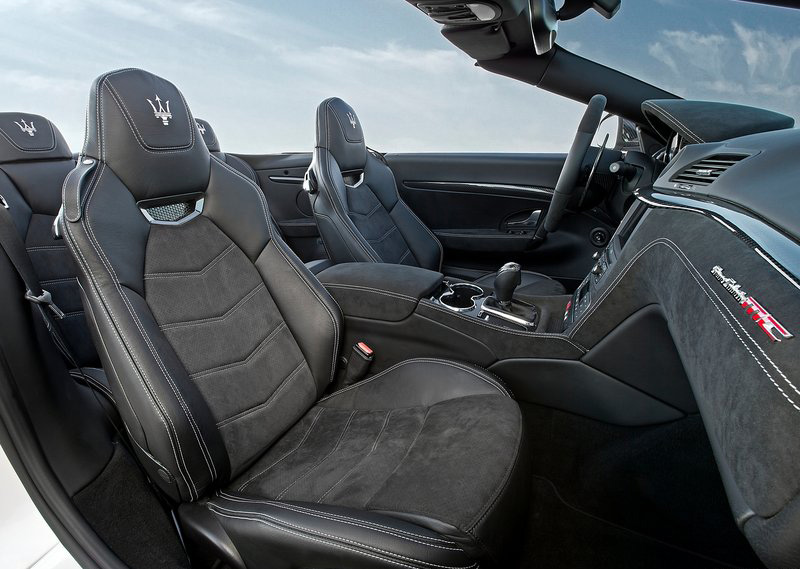
The interior of the Maserati GranCabrio MC has received a thorough overhaul with particular attention paid to ergonomics.

The new seats, completely redesigned from both an aesthetic and functional point of view and enhanced with high-quality materials, now ensure the optimum balance of comfort and performance, elegance and functionality. The new structure of both the front and rear seats now incorporates the headrest and is enhanced by an upper, central trim, with a design inspired by the car's front grille.

Particularly important, especially with convertible cars, is the attention paid to the rear passengers. For this reason, the frame for the front seats, which is also available in a completely carbon-fibre version, has been completely redesigned to ensure 20 mm more legroom for the rear passengers.

Particular attention has been paid to the ergonomic and comfort-related aspects of driving. The seats, with an increased profile to enhance their wrap-around structure and lateral containment, ensure sporty driving while guaranteeing superior comfort, even on very long journeys.

The steering wheel features a new design, with the rim flattened at the top and bottom for greater manoeuvrability, also for sports and high-speed use, without interfering with the driver's legs.

The rear seats have been redesigned according to the same logic: maximum comfort, maximum passenger restraint in sports driving and ample use of quality materials.

To complete the new, super-sporty look of the new Maserati GranCabrio MC, it incorporates the Trofeo-design steering wheel paddles as standard, with increased dimensions as seen on the GranTurismo Sport, and an aluminium pedal unit.

Engine and performance
As with the most sporty GranTurismo in the range (the GranTurismo Sport), the GranCabrio MC also adopts the new 4.7-litre V8 engine, which delivers 338 kW (460 HP) together with substantial torque of 520 Nm at 4,750 rpm.

The pistons, positioned at an angle of 90°, are made of reinforced, hardened aluminium, as is the engine block. The crankshaft, with five-point balancing, is made of high-strength steel.

The timing system, with a system of two chains per bank, features dual variable valve timing.

The new power unit, in combination with the MC Auto Shift transmission, is now able to propel the Maserati GranCabrio MC, in closed soft top configuration, to a top speed of 289 km/h (179 mph) with acceleration of 0 to 100 km/h in 4.9 seconds.

Automatic transmission (MC Auto Shift)
Like other sports models in the Maserati range, the Maserati GranCabrio MC also adopts an automatic six-speed ZF transmission able to transfer all the power of the 460 HP V8 engine to the ground. Calibrated specifically for application on the sportiest version in the GranCabrio range, the MC Auto Shift transmission features five operating modes. It can be used in Auto-Normal, Auto-Sport, Manual-Normal, Manual-Sport and Ice modes.

In Manual mode, gear changes are carried out directly by the driver through the steering wheel paddles, as with a truly manual gearbox. In Manual-Normal mode, the driver can change gear until the threshold value is reached, while in Manual-Sport mode the gear is maintained until the driver next changes gear, even if this may result in over-revving and the intervention of the limiter.

On the GranCabrio Sport, Sport mode includes super-fast mode, which derives directly from the GranTurismo Sport and the Quattroporte Sport GT S and permits gear changes that are 50% faster.

This mode includes automatic blipping (short burst of acceleration) when downshifting with the Launch Control system, called MC Start Strategy(which operates only with MSP deactivated).

Using the MC Start Strategy, the driver holds down the brake pedal, presses the accelerator pedal and then releases the brake pedal when the optimum engine speed is reached (2,300-2,500 rpm).

Chassis and suspension
Performance, safety and comfort were the guidelines that Maserati engineers followed when designing the chassis for the new GranCabrio MC. In light of the experience gained with the GranTurismo MC Stradale, it is fitted with single-rate dampers, to give maximum emphasis to the car's sporty character, which guarantee greater rigidity in order to ensure optimum road holding in all driving conditions, without detracting from maximum passenger comfort.

Braking, always powerful and safe, is guaranteed by Maserati's patented Dual Cast system, which includes brake discs with aluminium bell and steel braking surface, 360×32 mm at the front and 330×28 mm at the back.

The system guarantees the best pedal feeling and braking efficiency, which translates to an excellent stopping distance of 100 to 0 km/h over just 35 metres.

In addition to the conventional holes to optimise cooling of the discs, they also feature grooves which allow the film of water, which deposits on the discs when driving on wet surfaces, to be eliminated and ensure that the operation of the pad's friction material is restored in order to ensure maximum power and braking efficiency at all times.

The one-piece aluminium alloy brake callipers, produced by Brembo and available in various colours, are also six-piston at the front and four-piston at the rear. This configuration ensures greater uniformity in braking, a constant clamping force and the sensation of a stable and reliable pedal, reducing brake wear at the same time.

In deference to Maserati tradition, the monocoque chassis is made with different materials to ensure maximum weight reduction and maximum torsional rigidity. The use of high-strength steels for the structural part and the use of aluminium and composite materials for the moving parts, ensure maximum performance in complete conformity with the spirit in which the new Maserati GranCabrio MC was conceived.
Read More

Nissan Hi-Cross Concept, 2012


  •  Nissan Hi-Cross Concept, 2012

A dramatic new concept car from Nissan, to be given its World Premiere at the 2012 Geneva Motor Show, heralds a possible new design direction for the company.

Called the Nissan Hi-Cross Concept, the proposal looks at ways to extend Nissan's leadership of the crossover market with a possible expansion of the current Juke-Qashqai-Murano portfolio. Created in Japan, Hi-Cross Concept is compact yet surprisingly roomy, elegant yet purposeful and - being a Nissan - it's clever with it.

Its 'smartness' takes two forms. Despite its modest external proportions, Nissan Hi-Cross Concept has a highly space efficient interior with three rows of seats for seven passengers.

Equally as clever is its hybrid drive train, coupling an electric motor - powered by a Nissan-developed compact lithium-ion battery - with a 2.0-litre direct injection petrol engine to provide the performance potential of a 2.5-litre with the economy and emissions expected from a much smaller unit.

For the concept, the HEV drivetrain is based on new technology developed by Nissan for front-wheel drive models, but modified to provide four-wheel drive. The new system's innovative approach to affordability and packaging adopts 'one-motor, two clutch' technology linked to Nissan's new generation XTRONIC continuously variable transmission which by itself achieves a 10 per cent improvement in fuel economy over comparable previous generation CVTs. The low friction design has smaller shaft-diameter pulleys with a new belt to give the widest possible ratio coverage for enhanced efficiency.

The hybrid drivetrain makes extensive use of battery technology developed for the award-winning Nissan LEAF. The high output, fast-charging compact lithium-ion battery, linked to high-level motor control technology, provides acceleration assist when needed and permits downsizing of the petrol engine for optimum economy and emissions.

In city driving, the presence of the electric motor and lithium-ion battery allow the engine to be turned off frequently. It can also be disengaged completely with the clutch, and energy can be recovered effectively when braking.

Built on an extensively revised version of Nissan Hi-Cross Concept sits on a 2780mm wheelbase. It is 4660mm long, 1850mm wide and 1670mm tall, with 21-in. alloy wheels. The styling combines existing Nissan design cues with new elements, at the front it has a characteristic V-shaped grille set off by distinctive lighting signatures provided by stylish new headlamps.

Potential new design language is showcased, in particular, by a bold character line which extends from the bonnet down the flanks of the car to the D-pillar. At the rear it has distinctive lighting signatures provided by stylish rear combination lamps echoing with headlamp lighting signature. Inside, the seven-seat cockpit is dominated by a new T-wing shaped dashboard.

François Bancon, Deputy Division General Manager of Product Strategy and Product Planning Division , said: "Although this is purely a concept car, exploring potential ideas for the future, there is no ambiguity about its purpose. It is a high-riding crossover, hence its name: Nissan Hi-Cross Concept.
Read More