Sunday, October 7, 2012

Audi A6 L e-tron Concept, 2012


  • Audi A6 L e-tron Concept, 2012

Audi is presenting its first luxury-class e-tron concept car - a technology study known as the Audi A6 L e-tron concept at Auto China 2012 in Beijing. The plug-in hybrid has a powerful drive system that enables a driving range of 80 km (49.71 miles) on pure electric power, and it was specifically designed to fulfill Chinese needs.

The Audi A6 L e-tron concept is an important step towards future electric mobility in China for Audi. With its first e-tron technology study in the luxury class, the company is showing what a locally produced New Energy Vehicle from Audi might look like.

The basis for this study is the new A6 L, the most successful premium automobile and Audi's bestselling model in China. Audi produces this business sedan at the Changchun plant in a joint venture with FAW.

The Audi A6 L e-tron concept is precisely tailored to the requirements of Chinese customers. Plug-in hybrids that can travel long distances electrically - thereby enabling zero emissions driving in local areas - are ideal for use in rapidly growing megacities. Beyond its drive system, the Audi A6 L e-tron concept has all of the qualities that customers value in Audi cars: prestige, comfort and sporty performance.

Parallel hybrid system: intelligently combined TFSI and electric motor
The technology study is a parallel hybrid. It brings together a 2.0 TFSI that outputs 155 kW (211 hp) and an electric motor with 70 kW (95 hp) peak power. The liquid-cooled lithium-ion battery is located in a collision-protected space at the rear of the vehicle. In electric mode, the Audi A6 L e-tron concept can travel up to 80 km (49.71 miles) at a constant speed of 60 km/h (37.28 mph). At any given moment, the hybrid control module chooses the best suited operating mode with the focus on driving range.

The technology platform can be operated with only the internal combustion engine, only the electric drive, or in hybrid mode. In addition, it can recover energy during deceleration, or it can boost output power for strong acceleration by combining the two drives. The Audi A6 L e-tron concept delivers sporty performance.

Setting a course for the future: Audi's e-tron strategy
The rapid advance in urbanization and the associated need to reduce CO2 emissions are a key determining factor for new drive technologies. Audi views electric mobility as a key future technology and is working on highly efficient solutions that simultaneously offer the customer a typical Audi driving experience.

Audi has already launched electrified drive systems in volume production with full hybrid models that have highly advanced lithium-ion technology. The Q5 hybrid quattro, A6 hybrid and A8 hybrid can drive up to three kilometers (1.86 miles) on electric power. In combined mode, which uses the internal combustion engine and electric motor, customers experience sporty driving performance and significantly better fuel economy.

The next step is to implement drive systems in which electric driving is the primary focus. The term Audi e-tron refers to technologies ranging from PHEV (Plug-in Hybrid Electric Vehicle) to range extenders and finally vehicles powered purely by electric batteries or fuel cells.

In its first Audi e-tron concept car, Audi already showed how this future might look. And in the case of the R8 e-tron, this vision will be realized in a short production run later this year.

Audi is using A1 e-tron and A3 e-tron test vehicles to acquire important customer feedback, which can be incorporated in later production cars. The first product will be the A3 e-tron in 2014. It will be followed by other New Energy Vehicles. In this way, e-tron will become established as a further attractive drive technology option alongside TDI and TFSI.

Elegant: the styling
The Audi A6 L e-tron concept is notable for its elegant styling. The sedan, which has a 3.01 meter (9.88 feet) wheelbase, is 5.02 meters (16.47 feet) long and 1.87 meters (6.14 feet) wide, but only 1.46 meters (4.79 feet) tall. Its long engine hood, its low, extended roof line and the sharp lines on its sides create an athletic overall look. Characteristic Audi LED headlights emphasize the car's determined expression.

The car's exterior styling shows its differences from the production car. At the front, the single-frame grille with its slender cross-bars and the nearly covered air intakes attract the eye - both features are typical of all e-tron models. Powerful 21-inch wheels in e-tron design and the special rear diffuser highlight the car's progressive character. On the body, signatures identify the prototype's technology, while under the engine hood a styling capsule covers engine components. A ribbed contour at its center symbolizes the hybrid drive.

Lightweight and strong with Audi ultra: the body
The body of the Audi A6 L e-tron concept is identical to that of the Audi A6 L. It is lightweight, rigid and safe to a maximum degree, due to application of the ultra lightweight principle. Consisting of approximately ten percent aluminum, it weighs about 15 percent less than a comparable all-steel design. Aluminum components in the load-bearing structure and exterior skin, as well as the high-tech steels used in the occupant cell, make the body significantly lighter.

Each new future Audi model will be lighter in weight than the previous model. This makes the brand a frontrunner in reversing the upward weight spiral. In designing car bodies, developers will intelligently use new combinations of materials, including carbon fiber-reinforced polymer (CFRP). For Audi, ultra lightweight construction does not solely focus on one material, rather it seeks a flexible approach that utilizes a wide variety of materials - but with one goal: to attain the best performance with the least material usage at the best places.

Furthermore, advanced materials and construction methods achieve an extremely low sound level in the interior of the Audi A6 L e-tron concept. Excellent vibration comfort is attained by fine-tuning components and by hydraulically damping axle and drive mounts.

Comfortable and sporty: the chassis
Audi's ultra lightweight construction competence is also found in the chassis, which combines a high level of comfort with sporty handling. The links are made of aluminum. The power steering, like the brake booster and the air conditioning compressor, utilizes an electromechanical drive.

At the limits of performance in driving through curves, the electronic transverse differential lock - a function of electronic stabilization control (ESC) - stabilizes the Audi A6 L e-tron concept by making small interventions at the front wheel on the outside of the curve.

Luxurious: interior and features
As in the Audi A6 L before it, the interior of the technology platform continues the elegant styling of its exterior design. Its defining element is an arc under the windshield - the wrap-around - that surrounds the driver and front passenger. The front of the instrument panel is designed in the form of a flowing wave. All of the interior details illustrate the aesthetic standard with which Audi builds its vehicles. All materials have been carefully selected and meticulously worked into the design.

The controls are intuitive. The powermeter replaces the tachometer; its pointer indicates total drive system power on a scale of zero to 100 percent. Colored segments indicate the current operating state of the Audi A6 L e-tron concept; an auxiliary instrument visualizes the charge state of the lithium-ion battery.

Meanwhile, the energy flow indicator tells the driver the current operating mode and which hybrid drive components are currently active. It can be called up from the driver information system or MMI monitor. The large screen shows a bar diagram of average fuel economy and indicates the amount of recovered energy over five-minute intervals.

The Audi A6 L e-tron concept offers a lot of space at all seating positions. It integrates all of the model line's luxury-class features. The seats offer ventilation and massage functions, the Bose surround system delivers good sound, and the deluxe automatic air conditioning system with air ionizer ensures a pleasant climate in the car. Ambient lighting adds subtle highlights to the interior illumination.

The driver assistance and safety systems also satisfy the highest standards. Audi active lane assist supports the driver in lane-keeping, while Audi side assist helps to change lanes. When it is dark, the night vision assistant highlights detected pedestrians even at a distance; the parking assistant helps in parking. The Audi pre sense system can reduce the severity of accidents and their consequences in many cases.

The car's features also include MMI navigation plus. Many functions of the large hard-drive navigation system can be controlled by touchpad character input; the touch-sensitive pad, MMI touch, recognizes 29,000 Chinese characters. A team of engineers developed these functions at the Audi Infotainment Tech Center (ITC) in Beijing, where infotainment components from Germany are adapted to suit the wishes of Chinese customers.
Read More

Jaguar XFR Speed, 2013


  •   Jaguar XFR Speed, 2013

The Jaguar XFR Speed Pack features a speed limiter raised to 174mph (280km/h), the 510PS car is equipped with revised engine and gearbox calibration to match the increased top speed. A new front aero splitter and a new rear wing distinguish the Speed Pack car.

The 510PS XFR sports saloon benefits from the same combination of eight-speed automatic gearbox and Intelligent Stop/Start allowing it to offer an unrivalled blend of efficiency and excitement. The EU Combined cycle improves by 11% with its emissions reduced by more than 8%
Read More

Saturday, October 6, 2012

Maserati GranCabrio MC, 2013


  • Maserati GranCabrio MC, 2013

Inspired and encouraged by the considerable success of the GranTurismo MC Stradale, which was warmly received by customers thanks to a masterly translation and adaptation of racing characteristics for use on the road, the new Maserati GranCabrio MC completes the open-top range with a highly sporty and aggressive look, while maintaining the strengths and characteristics of a true grand tourer, ideal for long journeys.

Exterior
The new, sporty look can be seen in each stylistic element of the Maserati GranCabrio MC's bodywork. Inspired directly by the cars of the Maserati Trofeo MC World Series and the GT4 version, the new design perfectly blends sportiness, dynamism, the search for aerodynamic perfection, elegance and style. These stylistic elements already partly characterised the GranTurismo MC Stradale and the GranTurismo Sport, and seamlessly unite form and function.

The car, 48 millimetres longer than the GranCabrio and GranCabrio Sport, is characterised by a front end which is inspired directly by the MC Stradale, adopting a profile designed to optimise the aerodynamic lift and flow. These differ from those on other versions of the GranCabrio due to the increased car length and other aerodynamic elements at the rear end.

The bonnet incorporates two generous air outlets at the centre to optimise cooling of the powerful V8, and two more air outlets to cool down the brake discs have also been added to the two front wings.

Initially introduced on the GranTurismo Sport the new headlights, which adopt LEDs for the daytime running light (DRL) function, complete the new look of the Maserati GranCabrio MC. Though they maintain the external shape seen on the other three versions in the GranCabrio range, the new headlights adopt the most modern technology, perfectly enhanced with an extremely sporty look thanks to the matt black colour of the structure.

The bi-xenon unit inside the headlight also incorporates Adaptive Light Control, which follows the movement of the steering by up to 15 degrees.

The rear is characterised by the large spoiler, for greater negative lift at high speeds. Inside the spoiler, built into the luggage compartment, is the third brake light. The standard version comes in the same colour as the body and it is also available, within the various car customisation packages, with a carbon finish.

The bumper has been completely redesigned at the bottom to make the new model even sportier and at the same time ensure optimal aerodynamic efficiency. The circular exhausts have been moved to the centre of the bumper and the specific layout of the air ducts, built into the lower part of the bumper, ensure greater streamlining, stabilising the air flow from the underbody.

Finally, the dynamism of the Maserati GranCabrio MC is accentuated by the 20" MC Design rims, available in glossy Titanio or matt Grafite, and made using flow-forming technology. In addition to being lighter, they feature the traditional Trident, skilfully worked into the double-spokes.

The Interior
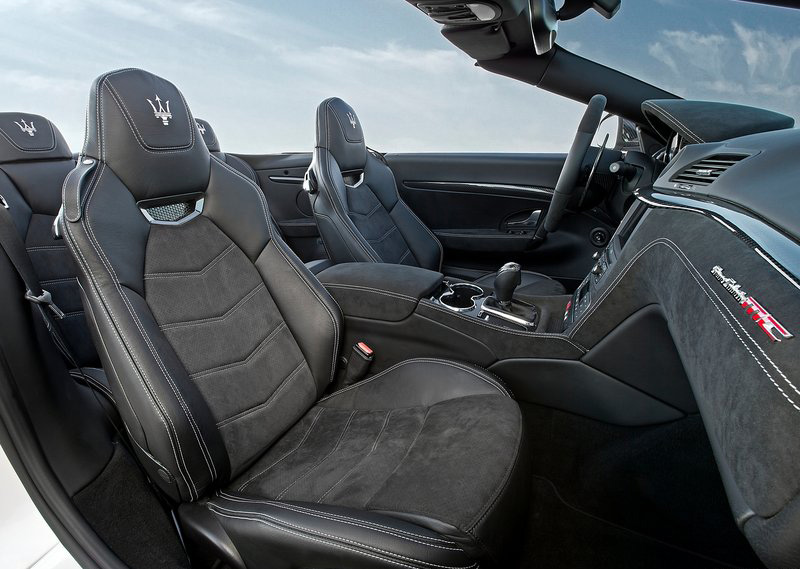
The interior of the Maserati GranCabrio MC has received a thorough overhaul with particular attention paid to ergonomics.

The new seats, completely redesigned from both an aesthetic and functional point of view and enhanced with high-quality materials, now ensure the optimum balance of comfort and performance, elegance and functionality. The new structure of both the front and rear seats now incorporates the headrest and is enhanced by an upper, central trim, with a design inspired by the car's front grille.

Particularly important, especially with convertible cars, is the attention paid to the rear passengers. For this reason, the frame for the front seats, which is also available in a completely carbon-fibre version, has been completely redesigned to ensure 20 mm more legroom for the rear passengers.

Particular attention has been paid to the ergonomic and comfort-related aspects of driving. The seats, with an increased profile to enhance their wrap-around structure and lateral containment, ensure sporty driving while guaranteeing superior comfort, even on very long journeys.

The steering wheel features a new design, with the rim flattened at the top and bottom for greater manoeuvrability, also for sports and high-speed use, without interfering with the driver's legs.

The rear seats have been redesigned according to the same logic: maximum comfort, maximum passenger restraint in sports driving and ample use of quality materials.

To complete the new, super-sporty look of the new Maserati GranCabrio MC, it incorporates the Trofeo-design steering wheel paddles as standard, with increased dimensions as seen on the GranTurismo Sport, and an aluminium pedal unit.

Engine and performance
As with the most sporty GranTurismo in the range (the GranTurismo Sport), the GranCabrio MC also adopts the new 4.7-litre V8 engine, which delivers 338 kW (460 HP) together with substantial torque of 520 Nm at 4,750 rpm.

The pistons, positioned at an angle of 90°, are made of reinforced, hardened aluminium, as is the engine block. The crankshaft, with five-point balancing, is made of high-strength steel.

The timing system, with a system of two chains per bank, features dual variable valve timing.

The new power unit, in combination with the MC Auto Shift transmission, is now able to propel the Maserati GranCabrio MC, in closed soft top configuration, to a top speed of 289 km/h (179 mph) with acceleration of 0 to 100 km/h in 4.9 seconds.

Automatic transmission (MC Auto Shift)
Like other sports models in the Maserati range, the Maserati GranCabrio MC also adopts an automatic six-speed ZF transmission able to transfer all the power of the 460 HP V8 engine to the ground. Calibrated specifically for application on the sportiest version in the GranCabrio range, the MC Auto Shift transmission features five operating modes. It can be used in Auto-Normal, Auto-Sport, Manual-Normal, Manual-Sport and Ice modes.

In Manual mode, gear changes are carried out directly by the driver through the steering wheel paddles, as with a truly manual gearbox. In Manual-Normal mode, the driver can change gear until the threshold value is reached, while in Manual-Sport mode the gear is maintained until the driver next changes gear, even if this may result in over-revving and the intervention of the limiter.

On the GranCabrio Sport, Sport mode includes super-fast mode, which derives directly from the GranTurismo Sport and the Quattroporte Sport GT S and permits gear changes that are 50% faster.

This mode includes automatic blipping (short burst of acceleration) when downshifting with the Launch Control system, called MC Start Strategy(which operates only with MSP deactivated).

Using the MC Start Strategy, the driver holds down the brake pedal, presses the accelerator pedal and then releases the brake pedal when the optimum engine speed is reached (2,300-2,500 rpm).

Chassis and suspension
Performance, safety and comfort were the guidelines that Maserati engineers followed when designing the chassis for the new GranCabrio MC. In light of the experience gained with the GranTurismo MC Stradale, it is fitted with single-rate dampers, to give maximum emphasis to the car's sporty character, which guarantee greater rigidity in order to ensure optimum road holding in all driving conditions, without detracting from maximum passenger comfort.

Braking, always powerful and safe, is guaranteed by Maserati's patented Dual Cast system, which includes brake discs with aluminium bell and steel braking surface, 360×32 mm at the front and 330×28 mm at the back.

The system guarantees the best pedal feeling and braking efficiency, which translates to an excellent stopping distance of 100 to 0 km/h over just 35 metres.

In addition to the conventional holes to optimise cooling of the discs, they also feature grooves which allow the film of water, which deposits on the discs when driving on wet surfaces, to be eliminated and ensure that the operation of the pad's friction material is restored in order to ensure maximum power and braking efficiency at all times.

The one-piece aluminium alloy brake callipers, produced by Brembo and available in various colours, are also six-piston at the front and four-piston at the rear. This configuration ensures greater uniformity in braking, a constant clamping force and the sensation of a stable and reliable pedal, reducing brake wear at the same time.

In deference to Maserati tradition, the monocoque chassis is made with different materials to ensure maximum weight reduction and maximum torsional rigidity. The use of high-strength steels for the structural part and the use of aluminium and composite materials for the moving parts, ensure maximum performance in complete conformity with the spirit in which the new Maserati GranCabrio MC was conceived.
Read More

Nissan Hi-Cross Concept, 2012


  •  Nissan Hi-Cross Concept, 2012

A dramatic new concept car from Nissan, to be given its World Premiere at the 2012 Geneva Motor Show, heralds a possible new design direction for the company.

Called the Nissan Hi-Cross Concept, the proposal looks at ways to extend Nissan's leadership of the crossover market with a possible expansion of the current Juke-Qashqai-Murano portfolio. Created in Japan, Hi-Cross Concept is compact yet surprisingly roomy, elegant yet purposeful and - being a Nissan - it's clever with it.

Its 'smartness' takes two forms. Despite its modest external proportions, Nissan Hi-Cross Concept has a highly space efficient interior with three rows of seats for seven passengers.

Equally as clever is its hybrid drive train, coupling an electric motor - powered by a Nissan-developed compact lithium-ion battery - with a 2.0-litre direct injection petrol engine to provide the performance potential of a 2.5-litre with the economy and emissions expected from a much smaller unit.

For the concept, the HEV drivetrain is based on new technology developed by Nissan for front-wheel drive models, but modified to provide four-wheel drive. The new system's innovative approach to affordability and packaging adopts 'one-motor, two clutch' technology linked to Nissan's new generation XTRONIC continuously variable transmission which by itself achieves a 10 per cent improvement in fuel economy over comparable previous generation CVTs. The low friction design has smaller shaft-diameter pulleys with a new belt to give the widest possible ratio coverage for enhanced efficiency.

The hybrid drivetrain makes extensive use of battery technology developed for the award-winning Nissan LEAF. The high output, fast-charging compact lithium-ion battery, linked to high-level motor control technology, provides acceleration assist when needed and permits downsizing of the petrol engine for optimum economy and emissions.

In city driving, the presence of the electric motor and lithium-ion battery allow the engine to be turned off frequently. It can also be disengaged completely with the clutch, and energy can be recovered effectively when braking.

Built on an extensively revised version of Nissan Hi-Cross Concept sits on a 2780mm wheelbase. It is 4660mm long, 1850mm wide and 1670mm tall, with 21-in. alloy wheels. The styling combines existing Nissan design cues with new elements, at the front it has a characteristic V-shaped grille set off by distinctive lighting signatures provided by stylish new headlamps.

Potential new design language is showcased, in particular, by a bold character line which extends from the bonnet down the flanks of the car to the D-pillar. At the rear it has distinctive lighting signatures provided by stylish rear combination lamps echoing with headlamp lighting signature. Inside, the seven-seat cockpit is dominated by a new T-wing shaped dashboard.

François Bancon, Deputy Division General Manager of Product Strategy and Product Planning Division , said: "Although this is purely a concept car, exploring potential ideas for the future, there is no ambiguity about its purpose. It is a high-riding crossover, hence its name: Nissan Hi-Cross Concept.
Read More

Friday, October 5, 2012

BMW 1-Series Urban Line, 2012


  •  BMW 1-Series Urban Line, 2012

The drive-train layout, with a longitudinally mounted in-line engine at the front and rear-wheel drive, is unique in the compact segment. This improves the handling of new BMW 1-Series, and is also reflected in its styling, with its distinctive BMW proportions: long bonnet, wide wheelbase and a set-back passenger cell. The new BMW 1-Series is the embodiment of responsiveness and innovative elegance in a compact car, with a youthful, lively design and high-quality features adding to the excitement.

Compared with its predecessor, the new BMW 1-Series is a car that has done some growing up, and that is reflected in its larger dimensions. It is now 8.5 centimetres longer and 1.7 centimetres wider. However, the height has remained unchanged, and the result is a more elegant, elongated profile. Seen from the front and rear views, the powerful stance of this compact model immediately catches the eye.

The front: striking looks with bold curves.
The front of the car is dominated by the large BMW kidney-shaped radiator grille, boldly shaped headlight units and three-section air intake. The grille is angled forwards, adding emphasis to the challenging stance of this most sporty of compact models, while the surrounding areas catch the light and create a strong sense of three-dimensionality, with four contour lines on the bonnet forming a V that points towards the grille.

The trademark BMW double-round headlights have accent trim across their tops. In combination with the optional bi-xenon headlights, this creates a strongly focused look, powerfully enhanced by the direction indicators set into the inner light rings of the headlights and an LED accent light. This is also the first BMW model to feature side indicator lights built into the exterior mirrors.

Side view: elegantly elongated lines, powerful concave surfaces.
From the side, the proportions of the new BMW 1-Series are even more strikingly apparent. The slightly sloping roof line, sporty, angled rear windscreen and flat side windows give the car a coupé-like feel, while the Hofmeister kink - the low forward bend at the back end of the side windows - extends well into the C-pillar, making the door aperture wider and facilitating entry to and exit from the rear seats.

The design quality of the new BMW 1-Series, which is unique in the compact segment, is particularly evident in the distinctive BMW lines and dramatically curved surfaces. The bold, characteristic BMW swage line gives powerful emphasis to the shoulder area. It starts at the front wing and rises continuously to the rear lights, with the door handle integrated neatly into it. An additional character line below the doors flows sharply upwards into the outline of the rear wheel arch. The sill line provides a similarly dynamic touch, running parallel to the ground before rising steeply at the rear wheel arch, and this is nicely echoed by the outlines of the side windows. The size of the rear wheel arches draws attention to its rear-wheel-drive layout, which underpins the car's excellent driving dynamics.

The rear: compact and sporty with a wide stance.
The wide-set wheel arches reinforce the powerful impression created by the back of the new BMW 1-Series. The rear windscreen extends right across the width of the car, emphasizing its sporty yet compact feel and inviting the viewer to admire the practicality of its flexible luggage compartment. The wide-opening, slightly concave tailgate is opened by pressing the top section of the BMW emblem that sits at its centre.

The rear lights are also set well apart, creating a strong horizontal emphasis that is heightened by their raised surrounds. Where the optional xenon headlights are specified, the rear lights consist of L-shaped banks of LEDs. An additional brake light is set into the roof spoiler. The outline of the rear apron echoes that of the front bumper, while the V-shaped emblem surround leads the eye towards the road surface, visually suggesting the excellent roadholding of the new BMW 1-Series.

The interior: premium finish, dynamic lines, driver-friendly cockpit.
Inside, a combination of typical BMW design features and innovative details gives the new BMW 1-Series a fresh, youthful and modern feel, with a focus on spaciousness and driving pleasure. Lines and surfaces are dynamic and forward-leaning, with high-quality, precision-finished materials reflecting the model's premium specifications. The characteristic BMW driver-focused layout is apparent in the angled displays and controls in the middle of the instrument panel, and the ergonomic contours of the centre console, which is likewise angled towards the driver. The interior surfaces are layered, another innovation which gives the new BMW 1-Series an organic look and feel.

In conjunction with an optional navigation system and the BMW Professional radio, the new BMW 1-Series uses the BMW iDrive control system. This comprises a controller on the centre console, favourites buttons and a freestanding flatscreen monitor. The 6.5 or 8.8-inch high-resolution Control Display, which is integrated into the instrument panel, is used for all information, entertainment, telecommunications and navigation functions.

The air vents underneath this monitor, and the controls for the air conditioning and audio system, are wider than usual, visually emphasizing the generous amount of horizontal space in the interior.

The ultimate in personalization: BMW Sport Line and BMW Urban Line make their debut.
The new BMW 1-Series is the first car to feature the new BMW Lines, opening up a whole new world of possibilities for personalization. An exclusive range of interior and exterior equipment options help to show off the dynamic design and technological sophistication of the car to best advantage. The BMW Lines represent an alternative to the standard specification. They can be combined with any of the exterior paint finishes, equipment packages and individual equipment options available for the new BMW 1-Series.

The BMW 1-Series Sport Line includes sports seats with exclusive coverings, a sports leather steering wheel with red contrast stitching, a red keyclasp, an adjustable armrest, high-gloss black interior trim strips and matt coral red accent strips. The instrument cluster features special Sport numbers and scales. The ambient lighting can be switched between orange and white, and includes additional light sources in the centre console and footwell. Other features of the BMW Sport Line include exclusive 16-inch star spoke light-alloy wheels, black trim for the exhaust tailpipe, and door sill finishers with "BMW Sport" lettering. The bars of the kidney grille, the trim bar in the central air intake, the side intake surrounds and the rear bumper trim are all high-gloss black. Additional options include high-gloss black mirror caps and 17-inch bi-colour light-alloy wheels.

The BMW 1-Series Urban Line includes special cloth/leather seats, a sports leather steering wheel, an adjustable armrest, and contemporary interior trim finishers in acrylic glass. This has a strong sense of depth and is available in white or black with matt oxide silver accent strips. A striking effect is also provided by the ambient and courtesy lights, which can be switched between orange and LED royal blue and white and royal blue respectively. An additional light source on the B-pillar enhances the effect of the illumination.

The distinctive exterior includes special 16-inch V-spoke alloy wheels or optional 17-inch high-gloss white wheels with an angled surface, and white rear bumper trim. Additional design accents on the front include white kidney bars with chrome-plated fronts and a white trim bar for the centre air intake. The side intake surrounds are painted in the same colour as the car, and the BMW Urban Line also includes door sill finishers with "BMW Urban" lettering and a white keyclasp. White mirror caps are available as an option.

The components of the BMW Lines are matched down to the last detail, and create a striking visual impact. Other individually customizable features include a choice of seat coverings, interior trim finishers, accent strips and light-alloy wheels. The range of Original BMW Accessories for the new BMW 1-Series also includes products specifically designed for each of the two BMW Lines, including bags, floor mats and key holders.

The new BMW 1-Series is also offered with numerous design and material options apart from those included in the new BMW Lines. The standard specification includes interior trim finishers in satin silver and Move cloth seats, while options include additional interior trim finishers and accent strips, and Dakota leather seats in a choice of two colours. All upholsteries are also available for the optional sports seats. There are currently three non-metallic and eight metallic exterior paint colours to choose between.

The driving experience: Uniquely dynamic with enhanced comfort.
At launch, the new BMW 1-Series will be available with a choice of five four-cylinder engines, all of them incorporating BMW TwinPower Turbo technology. In the new-generation petrol engines of the BMW 116i and BMW 118i, this combines instantaneous power delivery with exemplary fuel consumption and emissions figures. And a comprehensive array of updates to the 2.0-litre turbodiesel engines in the new BMW 116d, BMW 118d and BMW 120d enable these models too to extend their fuel-efficiency advantage over competitor compact models.

The new BMW 1-Series is the first and only car in its class to offer the option of an eight-speed automatic transmission. A driving experience switch is fitted as standard, enabling vehicle set-up to be changed to suit individual preferences - the precise drive-train and suspension parameters affected vary depending on the specification of the car. The defining characteristic of the driving experience in the new BMW 1-Series is its responsiveness, and this is primarily due to its rear-wheel drive layout and almost perfect 50:50 weight distribution. Sophisticated suspension technology enables it to deliver a ride that is noticeably more comfortable than that of its predecessor. For even sportier handling - without sacrificing any of this ride comfort - there is also the option of Adaptive Suspension with electronic damper regulation.

The new generation of petrol engines: dynamic power delivery and outstanding fuel efficiency thanks to BMW TwinPower Turbo technology.

The 1.6-litre petrol engines making their debut in the BMW 116i and BMW 118i models use BMW TwinPower Turbo technology, consisting of a twin-scroll turbocharger, High Precision Injection, VALVETRONIC variable valve control and Double-VANOS variable camshaft control. This design is based on that of the multi-award-winning 225 kW/306 hp in-line six-cylinder engine with BMW TwinPower Turbo found in models such as the BMW 135i and BMW 135i Convertible. Like that engine, the new four-cylinder units too are part of BMW's EfficientDynamics design strategy, which aims to continually increase driving pleasure while reducing fuel consumption and emissions.

The forced-induction system of the new BMW 1-Series uses the twin-scroll principle, with separate ducts both in the exhaust manifold and the turbocharger itself, each serving one pair of two cylinders. This enables more efficient use to be made of the exhaust pressure waves to drive the turbocharger, so in typical BMW fashion the engine responds instantly to any movement of the throttle. Output is also boosted by VALVETRONIC variable valve control, which is fully integrated into the cylinder head, and Double-VANOS variable camshaft control on the intake and exhaust sides. The patented BMW VALVETRONIC technology steplessly adjusts intake valve timing, rendering the throttle valve of earlier engines obsolete. The amount of air required for combustion is regulated within the engine itself, minimizing throttling losses during gas exchange and improving engine efficiency. The new engines are unusually fuel-efficient, thanks mainly to High Precision Injection. The fuel supply is precisely regulated by magnetic-valve injectors with a maximum injection pressure of 120 bar, positioned centrally between the valves directly next to the spark plug.

The four-cylinder engine of the new BMW 118i, which has an all-aluminium crankcase, has a maximum output of 125 kW/170 hp at 4,800 rpm, and a maximum torque of 250 Nm at between 1,500 and 4,500 rpm. It is exceptionally responsive, accelerating the car from 0 to 100 km/h in 7.4 seconds and on to a maximum speed of 225 km/h. Improved efficiency is reflected in combined-cycle fuel consumption of 5.8 to 5.9 litres per 100 kilometres and CO2 emissions of 134 to 137 grams per kilometre (EU test figures, variations due to differences in the tyres fitted).

The four-cylinder engine of the new BMW 116i too provides significantly improved driving dynamics compared to the predecessor model. It has an output of 100 kW/136 hp at 4,400 rpm and a maximum torque of 220 Nm between 1,350 and 4,300 rpm. What is more, the overboost function temporarily increases this torque figure to 240 Nm between 1,500 and 3,500 rpm, for an extra surge of acceleration. The car takes 8.5 seconds to reach 100 km/h from a standing start, and has a maximum speed of 210 km/h. Fuel consumption over the combined cycle is 5.5 to 5.7 litres per 100 kilometres, and CO2 emissions are 129 to 132 grams per kilometre (EU test figures, variations due to differences in the tyres fitted).

An evolutionary step forward: four-cylinder turbodiesel with BMW TwinPower Turbo technology and even greater fuel efficiency.

Wide-ranging design modifications have enabled the four-cylinder 2.0-litre turbodiesel engines in the new BMW 1-Series to build on their competitive advantage in the areas of output and fuel efficiency. These include aluminium crankcases, reduced engine friction, thermodynamically optimized turbochargers with variable turbine geometry, and next-generation common-rail direct injection with magnetic-valve injectors.

The new BMW 120d represents a significant advance on its predecessor, with a 5 kW increase in maximum output to 135 kW/184 hp at 4,000 rpm, and maximum torque boosted by 30 Nm to 380 Nm between 1,750 and 2,750 rpm. It reaches 100 km/h from a standing start in 7.2 seconds, and has a maximum speed of 228 km/h. Combined-cycle fuel consumption has been reduced to between 4.5 and 4.6 litres per 100 kilometres, with CO2 emissions of 119 to 122 grams per kilometre (EU test figures, variations due to differences in the tyres fitted).

The four-cylinder diesel engine of the new BMW 118d has a maximum output of 105 kW/143 hp at 4,000 rpm, and maximum torque of 320 Nm between 1,750 and 2,500 rpm. The car accelerates from 0 to 100 km/h in 8.9 seconds, and has a maximum speed of 212 km/h. Its combined-cycle fuel consumption is 4.4 to 4.5 litres per 100 kilometres, with CO2 emissions of 115 to 118 grams per kilometre (EU test figures, variations due to differences in the tyres fitted).

The new entry-level BMW 116d, meanwhile, has a maximum output of 85 kW/116 hp at 4,000 rpm, and maximum torque of 260 Nm between 1,750 and 2,500 rpm. It accelerates from 0 to 100 km/h in 10.3 seconds, and has a maximum speed of 200 km/h. Its combined-cycle fuel consumption is an outstanding 4.3 to 4.5 litres per 100 kilometres, with CO2 emissions an equally impressive 114 to 117 grams per kilometre (EU test figures, variations due to differences in the tyres fitted).

Eight-speed automatic transmission: sporty, fuel-efficient, and unique in a compact car.

The standard six-speed manual petrol and diesel versions of the new BMW 1-Series offer efficient power transmission and precise gear changes. In addition, the BMW 1-Series is the only compact car also available with the option of an eight-speed automatic transmission, offering fast, smooth gear changes and excellent fuel efficiency. The innovative architecture of its wheel set allows more gears and a better spread of ratios, with barely any increase in weight over the existing six-speed automatic gearbox for the BMW 1-Series. In fact, the unusually high efficiency of the eight-speed automatic transmission means that fitting it to the most powerful new BMW 1-Series models actually results in lower fuel consumption and CO2 figures than with a manual transmission.

The Steptronic function used in the automatic transmission allows gear changes to be initiated manually using the electronic selector lever. A further option for the BMW 120d is the eight-speed sports automatic transmission, which enables even more dynamic gear changes, and includes shift paddles on the steering wheel.

Perfect handling and increased comfort: high-quality suspension technology, even weight distribution and improved stability.
Read More