Tuesday, September 25, 2012

Fiat 695 Abarth Maserati Edition, 2012


  •  Fiat 695 Abarth Maserati Edition, 2012

The Abarth 695 Maserati Edition, the new Limited Edition (499 vehicles) will make its society debut on the occasion of the thirtieth anniversary of the Mille Miglia, which Enzo Ferrari called "the most beautiful race in the world". Displayed at Piazza della Loggia in Brescia in the midst of the collectors' automotive jewels and "luxury cars" of today, this glamorous car represents the bond between Abarth and Maserati, based on a host of shared values, including attention to detail, elegance and a passion for performance and sport.

Following the collaborative project three years ago with Ferrari and the creation of the Abarth 695 Tributo Ferrari, this is one more project that confirms the authoritative presence of Abarth in the luxury sports segment, this time flanked by a brand whose history of sporting achievements and elegant road cars is recognised worldwide. Karl Abarth and Alfieri Maserati: two legends, united by passion for mechanics and engines, who lent their names to two of the most prestigious companies to manufacture cars marked out by style and unmistakable performance.

Just as the Abarth 695 Tributo Ferrari is the utmost expression of Abarth's sporty character and "racing spirit", this new Limited Edition epitomises sheer elegance united to the comfort of a "GranTurismo", but with the handling of a car fit to take to the road every day.

The new Abarth 695 Maserati Edition is an exclusive convertible which blends the aggression and sportiness of a high-performance car with the refined, elegant aesthetics of a convertible. In keeping with Maserati's standards, this new Limited Edition is distinguished by excellent handling and outstanding sportiness, together with a great level of comfort and attention to materials and detail.

The new Abarth 695 Maserati Edition features exclusive style details and special technical features developed by Abarth engineers for Maserati. To start with, the 1.4 Turbo T-Jet 16v engine boosted to 180 HP and teamed with the electrically operated manual Abarth Competizione gearbox with steering wheel controls, which enhances the performance of the engine with reduced gearshift times as well as guaranteeing an experience of superior comfort at the wheel.

Again to improve performance, especially acceleration, the car is fitted with performance tyres on 17" alloy wheels featuring a special Maserati-inspired "Neptune" design. The ride and braking system have also been strengthened to cope with the extra power: Brembo 305 mm brake discs that can be dismantled with grey fixed four-piston caliper, and special Koni shock absorbers that guarantee performance in complete safety.

Nor would it be complete without the variable back-pressure "dual mode" exhaust, designed to improve engine performance and deliver an inspiring sound above 3,000 rpm, with tailpipes which have been modified to assume the hexagonal shape which has always marked out Maserati cars.

The car's exterior features a body in Pontevecchio Bordeaux. This colour from Maserati is achieved with special three-layer paintwork which reflects light and accentuates the shine of the colour. The same paintwork is also to be found on the door mirrors. The electrically controlled soft top is made of grey fabric.

The new Abarth adopts Xenon headlights with dipped and driving light functions for improved light emission and excellent performance in all weather conditions. These devices deliver three times the light intensity and duration of standard halogen-lamp headlights.

The customisation is just as complete on the inside. The interiors demonstrate both the attention to detail and the sportiness that characterise the two brands, starting with seats upholstered entirely in sand beige leather, with containment strips featuring single-layer padding, sporty but elegant and comfortable at the same time, and stylish details such as the number "695" heat-printed on the headrest. The dashboard and gearbox trim are distinguished by a special matt-finish carbon lining, further enhanced with the 695 logo, while the door panels and rear panels undergo a special UV-LUX treatment, which lends the trims an elegant grey "flocking" effect. The black leather steering wheel is characterised by beige leather inserts and tricolour hub and houses the "steering wheel gearbox" controls, while the instrument panel has been specifically produced by the Jaeger brand. Other details enrich the interior, such as the aluminium pedal unit and sill plate, the carbon fibre kick plate with customised "Abarth 695 Maserati Edition" graphics and the plate with the car's series number from 1 to 499. Lastly, as proof of its touring vocation and to enhance the on-board experience, the Abarth 695 Maserati Edition comes as standard with a boosted JBL hi-fi audio system with 9 speakers and an 8-channel amplifier supplying 400 W of total power.

In accordance with the tradition of Abarth Limited Editions, the already extensive equipment of the Abarth 695 Maserati Edition is expanded through accessories and merchandising designed to enhance the experience of the brand both on board and outside the car, as dictated by the DNA of Abarth and Maserati - more than just a car, a genuine philosophy of life. To take just one example, the Tramontano Tribute to Abarth Travel Pack, comprising two stylish anthracite leather travel bags.

TECHNICAL SPECIFICATIONS
    ENGINE
        4 cylindres in line, 4 valves per cylindre, 1368 cm3
        Power: 180 HP (132 kW) at 5500 rpm
        Maximum torque: 250 Nm at 3000 rpm (in sport mode)
        Supercharged with Garrett 1446 turbo
    TRANSMISSION
        Abarth Competizione gearbox with 5 speeds, C510 gearbox family with gear paddles on the steering wheel
    SUSPENSION
        Front: Abarth Koni shock absorbers with FSD valve
        Rear: Abarth Koni shock absorbers with FSD valve
        Lowered ride
    STEERING
        Electric power steering with "sport mode"
    BRAKES
        Floating, perforated and self-ventilating front brakes ø 305 mm × 28 mm
        Perforated rear brakes ø 264 mm × 22 mm
        TTC - Torque Transfer Control
    WHEELS
        Neptune Design 7×17" alloy wheels
        Tyres: 205/40 R17"
    EMISSIONS
        Euro 5 EEC-F5 Standard
        CO2: 151 g/km
    FUEL CONSUMPTION
        Urban consumption: 8.4 l/100 km
        Combined consumption: 6.5 l/100 km
        Extra-urban consumption: 5.4 l/100 km
    PERFORMANCE
        Top speed: >225 km/h (140 mph)
        0-100 km/h (0-62 mph): <7 br="br" secs="secs">
Read More

Honda CR-Z, 2012


  •  Honda CR-Z, 2012

The 2012 Honda CR-Z debuts with one available feature change - a new black seat fabric becomes an option on cars with the Crystal Black Pearl exterior color, replacing the standard silver mesh sport seats. The 2012 CR-Z starts at $19,545, plus a destination and handling charge of $770.

The Honda CR-Z is available in two models - the well-equipped CR-Z and the feature-rich CR-Z EX. A six-speed manual transmission is standard equipment and a Continuously Variable Transmission (CVT) is available. Standard features on the CR-Z include Vehicle Stability Assist, an AM/FM/CD/USB audio system with six speakers, automatic climate control, power windows and door locks, remote entry, cruise control, and more.

The Honda CR-Z EX adds High-Intensity Discharge (HID) Headlights with Auto-On/Off, fog lights, a 360-Watt AM/FM/CD Premium Audio System with seven speakers including subwoofer, Bluetooth® HandsFreeLink®, perforated leather-wrapped steering wheel, and more. The CR-Z EX is available with the Honda Satellite-Linked Navigation System with voice recognition.

Technological Sophistication Inside and Out
The exterior's "one-motion" wedge form begins at its low-slung hood to form a broad forward stance. A side profile with a deeply inset beltline adds a dynamic element, while the short wheelbase and large, wide front grille accent the vehicle's athletic look. Exterior colors include Crystal Black Pearl, Milano Red Pearl, North Shore Blue Metallic (exclusive to CR-Z), Premium White Pearl and Storm Silver Metallic.

A high-tech appearance and intuitive controls define the interior. Instrument panel meters illuminate with a three-dimensional blue color theme resulting in a multi-layered appearance. Set against textured black materials and aluminum-style trim accents, the upper portion of the dashboard extends toward the driver to provide a wraparound cockpit environment. Premium sport-oriented seats are designed to provide firm lateral support along with everyday driving comfort. A mid-ship console behind the front seats optimizes cargo space, and a hard-shell separator can be closed to create additional hidden storage.

The Honda CR-Z features a six-speaker, 160-watt AM/FM/CD audio system with an auxiliary input jack for connection to a portable audio player, and all models include a USB audio interface for connecting an iPod or other compatible audio device. Other audio features include speed-sensitive volume control and CD/MP3 text readout. The radio data system shows supplemental programming information from participating radio stations while also offering search-by-genre capability (not available on the CR-Z EX with navigation).

The Honda Satellite-Linked Navigation System is available on the CR-Z EX model and features a 6.5-inch display. The navigation system database includes more than 7-million points of interest and integrates the audio system. The voice recognition feature is capable of inputting numbers, street names and cities, in addition to more than 600 commands. Data storage is via a single DVD that contains information for the entire United States.

Performance and Efficiency
The Honda CR-Z hybrid powertrain is a unique variation of Honda's original IMA technology , which originally debuted on the 2000 Honda Insight, the first hybrid vehicle available for sale in North America. The system utilizes a four-cylinder, 16-valve, single-overhead cam engine with "intelligent" Variable Valve Timing and Lift Electronic Control (i-VTEC) that receives additional power from the Integrated Motor Assist (IMA) system's DC brushless electric motor. The system delivers a combined peak output of 122 horsepower at 6000 RPM and 128 lb-ft. of torque at 1000 to 1750 RPM (123 lb-ft. at 1000 to 2000 on CVT-equipped models).

The 10-kilowatt electric motor assists in acceleration and also acts as a generator during braking or coasting to capture kinetic energy that recharges the 100-volt IMA nickel-metal hydride battery pack. The gasoline engine can automatically turn off during vehicle stops to improve efficiency. When starting on steep inclines from a stop with the manual transmission, hill start assist temporarily prevents the vehicle from rolling backwards during the moment between releasing the brake, depressing the throttle and releasing the clutch.

EPA-estimated fuel economy is 35/39/37 city/highway/combined mpg on CVT-equipped models and 31/37/34 city/highway/combined mpg on manual models. The CR-Z is rated as an Advanced Technology Partial Zero Emissions Vehicle (AT-PZEV) in states that adhere to California Air Resource Board (CARB) ZEV standards (EPA Tier 2, Bin 2 in all states).

Three-Mode Drive System
Activated via three backlit buttons to the left of the steering wheel, the three-mode drive system allows the driver to select between individual modes of performance for Sport, Normal and Economy driving styles:
    Sport mode enhances engine throttle responsiveness, electric power steering effort and the electric motor power assist.
    Normal mode standardizes steering, engine response, motor assist and air conditioning settings.
    Econ mode can increase the potential for enhanced fuel efficiency by optimizing throttle angle for smooth acceleration, lower engine rpm and limiting power and torque by approximately 4 percent (except at wide-open throttle). It can also reduce the air conditioning's overall load on the engine and modify the cruise control to operate more efficiently.

Safety by Design
The Honda CR-Z demonstrates a commitment to safety in its design and construction. The Advanced Compatibility Engineering (ACE) body structure helps protect vehicle occupants in a frontal collision. Additional safety technologies include: standard dual-stage, multiple-threshold front airbags; standard front-side airbags with passenger-side Occupant Position Detection System (OPDS); side-curtain airbags, active head restraints; an anti-lock braking system (ABS); a tire pressure monitoring system; and a pedestrian injury mitigation design in the front of the vehicle.

Sport-Tuned Chassis
The front MacPherson strut and rear H-shaped torsion beam suspension are tuned to provide a sporty driving experience. All models are equipped with 16x6-inch aluminum wheels with 195/55R16 86V tires, while accessory 17x7 alloy wheels with 205/45R17 84V tires are available. The standard anti-lock braking system (ABS) with electronic brake distribution (EBD) uses ventilated front discs and solid rear discs. The low vehicle height and placement of the battery and other hybrid components beneath the rear cargo area further contribute to a low center of gravity and responsive, sporty handling. Electric power-assisted rack-and-pinion steering enhances steering performance and improves efficiency.
Read More

Monday, September 24, 2012

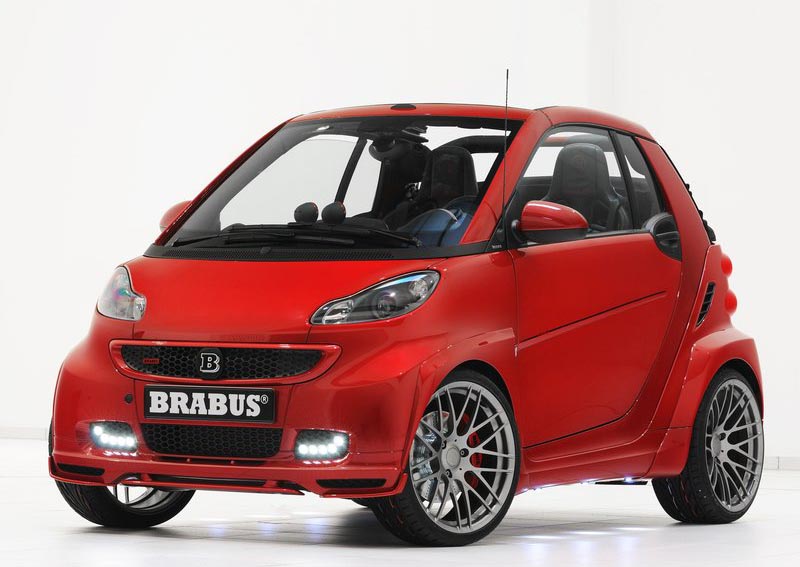
Brabus Ultimate 120, 2012


  •  Brabus Ultimate 120, 2012
Highly exclusive and equally dynamic limited-edition city sports cars have a long, successful history at Brabus. Reason enough for Brabus to celebrate yet another world debut at the 2012 Geneva Motor Show: based on the latest evolution of the smart fortwo cabrio there is now a successor to the sold-out limited-edition models Ultimate 101, Ultimate 112, Ultimate R and Ultimate style - the Brabus Ultimate 120. As the name indicates, this drop-top two-seater car is a supercar with 120 hp (118 bhp) / 88.3 kW and a top speed of 170 km/h (112 mph), which will be built in a small-series production run limited to just 120 consecutively numbered cars. The exclusive appointments range from a special paint finish as per customer specification to the WIDESTAR wide-body version with forged Brabus Monoblock F 18-inch wheels and an all-leather interior. MSRP for a Brabus Ultimate 120 starts at EUR 45,900.

In addition to the special paint finish, which on the car at the 2012 Geneva Motor Show is an intense metallic red, the Ultimate 120 immediately catches the eye with its muscular Brabus WIDESTAR body kit with front spoiler, side sills and Brabus WIDESTAR fender flares front and back.

The large wheel wells offers space for a tire/wheel combination that is highly unusual in this vehicle class and design: the new Brabus Monoblock F "Platinum Edition" forged wheels are mounted on the front axle in size 7Jx18 with size 205/35 R 18 high-performance tires. Size 8.5Jx18 wheels with size 235/30 R 18 tires in the rear provide plenty of grip for transferring the power of 120 horses to the asphalt with no slip.

The height-adjustable Brabus coilover suspension is custom-calibrated to the ultra-low-profile tires and the wider track. It combines direct and safe handling with excellent ride comfort. A Brabus high-performance brake system with cross-drilled discs and four-piston fixed calipers painted in body color on the front axle provides enormous stopping power and maximum durability.

This makes the Ultimate 120 perfectly suited for the installation of the powerful Brabus three-cylinder turbocharged engine. In keeping with its name, the Ultimate city sports car keeps a maximum power output of 120 hp (118 bhp) / 88.3 kW at 6,000 rpm on tap for its driver. However, even more important in day-to-day operation is the peak torque of 160 Nm (118 lb-ft), available between 2,250 and 3,750 rpm, and unparalleled in this vehicle class.

Gears in the Brabus Ultimate 120 are shifted either automatically or similar to Formula 1 racing manually with shift paddles on the ergonomically shaped Brabus steering wheel that has a diameter of just 34 centimeters (13.4 inches).

With a sprint time of 8.9 seconds for 0 - 100 km/h (62 mph) and an electronically limited top speed of 170 km/h (106 mph) the convertible also sets new class standards in these disciplines.

The performance is accompanied acoustically by the Brabus stainless-steel sport exhaust system with two chrome-plated tailpipes.

The Ultimate 120 also features a number of exquisite interior highlights: the entire interior is clad in especially soft and breathable black Brabus Mastik leather with red contrasting seams that match the outer skin. For perfect lateral support during fast cornering the city sports car is equipped with Recaro Sportster seats. These also are wrapped in the finest Brabus leather and their seat shells are painted in the same color as the car's exterior.

Numerous other details such as the speedometer, tach and clock including the instrument bezels, dashboard molding, turn signal stalks and door handles were also painted in body color. Brabus stainless-steel pedals as well as an aluminum shifter and emergency-brake lever create pure motor sports ambiance.

Air conditioning system, radio and navigation system are of course also part of the two-seat drop-top's standard equipment.
Read More

Aston Martin AM 310 Vanquish, 2013

 
  •  Aston Martin AM 310 Vanquish, 2013

The Aston Martin has unveiled a stunning new luxury sports car - the Aston Martin AM 310 Vanquish.
Sitting proudly at the pinnacle of the luxury British car maker's sports car line-up, this breath-taking new super grand tourer represents the zenith of current Aston Martin design and engineering. Vanquish points to an exciting and confident future for the historic brand.

Aston Martin AM 310 Vanquish is a new Aston Martin featuring the next generation of the renowned VH architecture as well as a significantly upgraded 6.0-litre V12 engine that is considerably more potent than before.

The design represents the latest take on Aston Martin's iconic visual language. Vanquish unquestionably sees the brand continue its enviable tradition of producing some of the most beautiful sports cars in the world. Styling cues such as the elegant new waist, elongated side strakes and LED rear light blades are derived from the One-77 supercar.

Unmistakably an Aston Martin, the design shows a clear and coherent lineage from its heritage while providing an equally clear pointer to the luxury car brand's vibrant future. Closer inspection reveals details such as the stunning new Aero Duct on the rear boot lid. This elegantly devised passive engineering feature, which counteracts lift at the car's rear when travelling at speed, is a triumph of both design and technical ability.

Performance, presence, style and great British craftsmanship - the new Vanquish has all these traits in abundance.

Aston Martin Chief Executive Officer, Dr Ulrich Bez said: "AM 310 Vanquish is the ultimate expression of Aston Martin design ethos, engineering innovation and technical ability. It offers luxurious, continent-crossing capability and pure driving excitement without compromise.

As happy on the streets of a bustling city as it is carving through the countryside or long distance motorway touring, the Vanquish offers a thoroughbred British luxury sports car that's also suited to everyday use.

Powered by a significantly revised naturally aspirated 6.0-litre V12 petrol engine mated to the proven Touchtronic 2 six-speed automatic gearbox, the new car offers suitably impressive performance figures. The V12's power peak of 565 bhp (573 PS) makes it Aston Martin's most potent production model yet, outmuscled only by the strictly limited edition £1.2m One-77 supercar.

The raw statistics speak for themselves: 573 PS at 6,750 rpm, 620 Nm of torque at 5,500 rpm, 0-62 mph in 4.1 seconds and a top speed of 183 mph place the Aston Martin Vanquish firmly into supercar territory. Yet the brand's team of engineers have been working towards economy and emissions improvements, too.

The latest engineering methods, innovative technologies and typically understated classic British design come together to make the muscular new Vanquish a true super GT. For instance, each body panel on the car is constructed from carbon fibre because of its high strength-to-weight ratio and flexibility of form. Meanwhile torsional rigidity is improved by more than 25%.

Practical improvements such as a newly designed and significantly more spacious cabin and a boot that, at 368 litres, is more than 60% larger than that of the DBS, ensure the new Vanquish can carry sufficient luggage for even the most ambitious grand tourist.

Designed and hand-built at Aston Martin's global headquarters at Gaydon in Warwickshire the new Vanquish, available as a 2+2 or 2+0, sits atop a broad line-up of world-class sports cars including the exquisite DB9, sporty V8 Vantage and luxurious four-door Rapide.

Priced from £189,995 RRP first deliveries of the new sports car are expected to begin in the UK and Continental Europe late in 2012.

Aston Martin AM 310 Vanquish: Design
Aston Martin is renowned in the motor industry for the supreme beauty of its cars. The visual language of a modern Aston Martin is highly distinctive, yet timelessly attractive.

The design team at the company's global HQ in Gaydon, Warwickshire, is led by Design Director Marek Reichman and, together, they have developed an unmistakable visual interpretation of the brand's ethos.

When the commission for new Aston Martin AM 310 Vanquish arrived Marek and his team set about working to hone the flowing exterior lines of a classic Aston Martin GT and to create a modern day interpretation of the Vanquish.

Drawing inspiration not least from the iconic One-77 supercar, the team worked to evolve that design language and create a 21st Century successor worthy of sporting the Vanquish moniker.

They worked to stay faithful to the AM V12 Vanquish inspiration - so beloved of Aston Martin fans worldwide - while introducing new aspects that debuted in the One-77.

The result is a new Aston Martin Vanquish that very clearly retains the presence of its forebear, yet offers it in a much more refined and functional package. Sporting the assertive body language for which the AM V12 Vanquish is renowned, today's GT is more lean and elegant - highlighting its improved agility and dynamics.

With the exception of the now sold-out One-77 supercar, and limited edition V12 Zagato, the AM 310 Vanquish sits atop Aston Martin's model range. Understandably, therefore, it boasts design language derived from the One-77 such as the elegant and flowing waistline, elongated side strakes, curvaceous, taut, form and LED light blade rear clusters, as well as entirely new design ideas such as the remarkable rear Aero Duct. Blending the aggressive lines of the One-77 with the elegant shape of the DB9 and Rapide, the new Vanquish sets the visual standard for today's luxury GT cars.
It has amplified gestures - in the form of bonnet vents, side strakes and a sculpted roof - that accentuate the car's extra performance and edgier character. The car has a more assertive stance, yet is not overtly aggressive.

A near-continuous ring of exposed carbon fibre features at the base of the car in the form of a carbon fibre splitter, light-catching carbon fibre side skirts and imposing carbon fibre rear diffuser. This accentuates the car's sporting dynamics, as well as making it appear more planted.

Each body panel on the new Vanquish is also constructed from carbon fibre, because of its high strength-to-weight ratio and flexibility of form. This not only reduces mass but means that fewer individual body panels are required. For instance, the panel gap on the C-pillar joint is no longer necessary.

The designers have worked hard to pay attention to the finer details of all the materials used, with the carbon fibre weave direction a good example of this. It has been designed, and is constructed, to flow precisely with the car's elegant shape.

Just as with the exterior, the design team were tasked with redesigning the Vanquish's interior to give it a more complete and high quality finish. The result is an all-new interior that is more roomy, comfortable and luxurious than ever.

Again drawing inspiration from the One-77, the design team have emulated the flowing lines, quality and craftsmanship while introducing significant refinements over DBS to improve ergonomics and usability.

Showcasing the vast selection of materials and finishes that are now available on the Vanquish, the interior trim is available in a wide range of materials including fine Bridge of Weir Luxmil Leather, Semi-Aniline Leather and Alcantara, all expertly hand-stitched by some of the world's most experienced craftspeople.

Elsewhere inside, the new instrument panel is a refinement of the One-77's, with new detailing and improved ergonomics.

The new design is sleeker with a more elegant finish to complement the rest of the interior. It features new elements that convey a powerful and assertive attitude, and a new Driver Information Module (DIM) that the Vanquish shares with the One-77. The new DIM retains the classic Aston Martin style, but with a more futuristic typeface. The digital displays have been revised following feedback from existing owners, now permanently showing a digital speedo and a trip computer, which details the remaining range and the odometer.

Perhaps one of the most striking new interior design elements, though, is the new centre stack with refinements providing a more elegant form that is also more intuitive and accessible for both driver and front seat passenger.

A direct descendent of the One-77 centre stack, the Aston Martin AM 310 Vanquish set-up retains familiar elements such as the ECU engine start button and gear selection buttons, while introducing a new infotainment system and a significantly more user-friendly design.

The facia trim now stretches down the whole centre stack and is manufactured from a single piece of material, giving a uniform finish with, obviously, no panel gaps.

The user interface has been completely redesigned, with a more user-friendly and ergonomic layout as well as technological updates that make it one of the most advanced in-car systems available.

Aston Martin's trademark glass starter module and gear mode selection buttons have been retained while all-new capacitive glass buttons with illumination and haptic feedback have been introduced for the rest of the centre stack's switchgear.

Haptic feedback is more commonly found in touch-screen mobile phones and Aston Martin becomes among the first significant luxury car manufacturers in the world to use the technology in a series production model.

Importantly, of course, the new car has more space both for occupants, and their belongings in the cabin. In fact the interior of the Vanquish has 140% more storage space than the DBS. The cubby box has been redesigned with a stylish armrest lid and now offers more than three litres of storage space and an integrated USB and AC point for portable devices.

There is further storage space at the base of the centre stack, with more than two litres of storage, generously sized cupholders and a mobile phone holder, as well as additional USB and AC points. Other storage spaces are dotted handily around the car, too, with more than three litres in the door bins and seat pouches alone.

Occupant space grows in all axes versus DBS with, in essence, the interior 'pushed' outward. Legroom is up 37 mm, shoulder room grows 25 mm, elbow room extends by 87 mm while knee room is boosted by 50 mm. All this, as the dash surface is moved forward 20 mm, too.

The Aston Martin Vanquish is available with either 2+0 or 2+2 seating configurations.

Aston Martin AM 310 Vanquish: Performance
As with all Aston Martin sports cars, the need for perfect balance, high-performance stability, nimble handling ability and minimised kerb weight define the new Vanquish. The comprehensive use of carbon fibre body panels for the first time in an Aston Martin underline the new Vanquish's credentials as a truly innovative model.

Strenuous efforts have been made to limit the new car's weight, contributing to its impressive performance, handling and significantly improved power to weight ratio. The combination of controlled weight, near-perfect 50:50 weight distribution, a powerful new V12 engine and a performance-honed six-speed transmission combine to make the Vanquish as rewarding and engaging on the move as it is elegant standing still.

At the heart of the new car is the latest iteration of Aston Martin's a 6.0-litre V12 engine. Significant re-engineering of this iconic V12 includes a revised block and new head including the debut of dual variable valve timing, uprated fuel pump, enlarged throttle bodies, a revised 'big wing' intake manifold and fully machined combustion chambers help the engine to a peak power output of 573 PS (565 bhp) at 6,750 rpm.

Crucially, too, the unit has been tuned specifically to deliver greater torque low down the rev range to make the car feel even more willing and muscular from very low revs. The result, predictably perhaps, is an improved 0-100 km/h time of 4.1 seconds. The top speed, where legal, is 295 km/h (183 mph).

As is the modern custom with all Aston Martin sports cars the engine is hand-assembled at the dedicated Aston Martin engine plant in Cologne, Germany.

The Vanquish uses the latest generation of Aston Martin's class-leading VH (Vertical Horizontal) architecture, a lightweight bonded aluminium structure that provides outstanding strength and rigidity. In this iteration, the Vanquish tub now includes the addition of significant carbon fibre components, as well as the use of bonding derived directly from the latest aerospace technologies.

The architecture has been re-engineered to control weight and improve packaging. With 75% new parts, the depth of re-engineering to achieve major packaging improvements cannot be overestimated.

Engineers have employed the extensive use of advanced materials and processes - some derived direct from the aerospace industry - to control weight and optimise the new car's driving experience.

For the first time in an Aston Martin, carbon fibre is used to make every external panel. The race car-inspired technology gives benefits for weight and body stiffness but, more importantly, has been essential in realising the design of Vanquish. Two notable components are the door skin and boot lid - neither of these unbroken surfaces would have been possible without the use of carbon fibre.

"There are no restrictions on form or shape when using carbon fibre," says Marek Reichman, Aston Martin's Design Director, "and the material allowed us to wrap bodywork around the 20-inch wheels and maintain the precise relationship between the wheel and the bodywork."

Each panel has been carefully sculpted to direct the airflow around the car, into the engine and to help cool the braking system. The carbon fibre elements are produced using advanced manufacturing techniques developed from the aerospace and motorsport industries.

The panel-making procedure also delivers an exceptional surface finish. The application of a 200 micron layer of epoxy and glass to the panel delivers a class-A surface that is in line with Aston Martin's tradition of high-quality finishes. Inside the car, the weave patterns on the exposed carbon fibre elements have been carefully selected to present the most harmonious surfaces.

Aston Martin AM 310 Vanquish: Control
As well as being light, strong and flexible in its application, the latest generation VH architecture is also extremely stiff. The new Aston Martin AM 310 Vanquish is, in fact, 25% torsionally stiffer than the outgoing DBS making it highly resistant to flex and allowing for responsive and predictable handling.

This rigid and stiff structure also provides an ideal foundation from which the suspension can control the vehicle effectively, further highlighting the importance of the body structure and the effect it has on the dynamic performance of the car.

Aston Martin's engineering teams have worked particularly hard to minimise the weight outside the wheelbase of the new car to reduce yaw inertia. As a result, carbon fibre has been used extensively in the rear structure and the weight of the aluminium front structure has been reduced significantly.

The front chassis structure is a full 13% lighter than that of the DBS - a direct result of using hollow cast aluminium rather than solid cast aluminium. It has also been redesigned to allow for a lowering of the engine. Now 19 mm lower within the body, the repositioned engine improves both the Vanquish's agility and its handling.

The car's front-mid mounted engine and rear-mid mounted transaxle ensuring a near perfect weight distribution: 85% of the car's weight is positioned within its wheelbase.

To take full advantage of its precise and rigid new architecture, the Aston Martin AM 310 Vanquish employs a battery of sophisticated technologies including, for the first time on an Aston Martin, a motorsport-derived Launch Control system. This works to deliver the optimum take-off from a standing start - balancing throttle, gearbox and various traction aids to deliver a perfect 'launch'.

Once on the move, the Vanquish boasts a plethora of dynamic aids including Dynamic Stability Control and Positive Torque Control to help harness its fearsome potential and deliver a rewarding, controlled, refined Grand Tourer experience.

The latest iteration of Aston Martin's Adaptive Damping System (ADS) allows the driver to switch between three distinct damping modes: Normal, Sport and Track, delivering instant adjustment of the car's ride and handling characteristics.

The ADS automatically alters the suspension settings to ensure the driver has high levels of control at all times, with the ability to respond quickly to different driving conditions. The different damping modes available help significantly broaden the Vanquish's character, adapting its set-up to suit the driver's mood and requirements. Thus it can be a cruising GT car in Normal mode with the capacity to morph into an assertive sports car in Sport and Track modes.

The damper settings are determined by an electronic control unit which takes sensor readings from the car's systems, including throttle position, brake position, steering wheel rotation and vehicle speed. This data establishes the prevailing driving conditions and the demands the driver is making on the car.

The Vanquish is fitted with new generation Pirelli P-Zero tyres that have been developed especially for the car, along with new 20-inch lightweight alloy wheels.

The car's braking system features third generation Brembo Carbon Ceramic Matrix (CCM) brakes to deliver shorter stopping distances with resistance to fade in even the most demanding driving conditions. CCM brakes are also lighter than a conventional system, reducing the weight of the car overall and, in particular, the unsprung weight and rotational masses, further enhancing the performance of the suspension.

The front brakes use 398 mm x 36 mm CCM brake discs with larger front brake pads and six-piston brake callipers from the One-77, while the rear brakes use 360 mm x 32 mm CCM brake discs with a four-piston calliper.

Aston Martin AM 310 Vanquish: Quality
Craftsmanship, attention to detail and ingenious design and engineering techniques combine in the Vanquish to deliver a GT of exceptional quality.

It takes, for instance, more than 70 hours of expert handcraftsmanship to build and trim one interior. Seven leather hides are used in each Vanquish to create the sports car's luxurious ambience.

The new car also benefits directly from the experience of creating the One-77 supercar and features new design highlights such as quilted material as a result. The quilting uses detailing not seen on any other car and is delivered via a state-of-the-art machine developed specially for Aston Martin. It produces a finish of rare quality and complexity, with around one million separate stitches used in each new Vanquish quilted leather interior.

Designers at Aston Martin are renowned for paying attention to every minute detail on the brand's sports cars, with numerous examples of this on the Vanquish. One such case is the removal of the towing eye from in the bumper to improve aesthetics. Now positioned hidden away in the front grille, this results in a bumper with less clutter that gives the Vanquish a much cleaner face. And on US-spec cars, the side markers have also been incorporated into the head and tail lamps, again removing clutter from the bumper.

Quality and craftsmanship come together in the Vanquish's new Aero Duct on the deck (boot) lid. This elegantly devised passive engineering feature is included to counteract lift at the car's rear when travelling at speed.

The challenge from CEO Dr Ulrich Bez was to create a part that was "impossible to make". This naturally generated some huge headaches for the design, engineering and manufacturing teams, but the result is a look of unrivalled beauty, form and function. It takes one person two days to construct this one-piece carbon fibre moulding, while the Aston Martin paint team created unique paint guns and polishing tools to be able to finish the decklid to the same glass-like finish as the rest of the car.

The fact that this part has no joint lines is a true testament to the ingenuity, dedication and meticulous attention to detail of the car's designers, engineers and craftsmen.

Testing is, of course, fundamental to the quality and longevity of an Aston Martin and the Vanquish has undergone an exhaustive series of examinations. Digital modelling analysis, bench tests and, of course, thousands of hours of real-world testing around the globe have produced the most comprehensively engineered GT ever to leave Gaydon.

For instance the engineering team carried out more than 5,000 km of durability and high speed testing at the Nardo Ring in northern Italy alone. The circuit is one giant loop that stretches for 12.5 km (7.8 miles), so is perfect for high speed testing, allowing the driver to examine the car at high speed without having to brake for corners. This test puts high levels of stress on all systems and helps to prove out high speed durability.

Following this, a Vanquish prototype was sent to the Aston Martin test centre at the Nürburgring for yet more intense limit handling work. The notorious German track is an ideal place to test and refine the Aston Martin AM 310 Vanquish as it is regarded as the most demanding race circuit in the world. There the new car underwent more than 10,000 km of testing to prove-out the car's durability, brakes, DSC system, tyres and chassis set-up.
Read More

Sunday, September 23, 2012

Mercedes-Benz C63 AMG Coupe Black Series DTM Safety Car, 2012


 Mercedes-Benz C63 AMG Coupe Black Series DTM Safety Car, 2012

A further highlight of the 2012 DTM season in addition to the spectacular new Mercedes-AMG C-Coupé will be the DTM Safety Car: right from the off, C63 AMG Coupé Black Series will be providing the necessary safety for the world's most popular touring car series. With a maximum output of 380 kW (517 hp), this two-seater is the most powerful C-Class of all time. The German Touring Car Masters (DTM) gets underway at the Hockenheimring on 29 April 2012.

The Safety Car is deployed under the direction of the German Motorsport Association (DMSB), which is responsible for implementing safety measures, ensuring compliance with safety standards and discharging the attendant official sporting functions in accordance with the DTM rules. The Mercedes-Benz C63 AMG Coupé Black Series Safety Car driven by racing driver Jürgen Kastenholz (44) is intended to ensure maximum safety for racing drivers, spectators and track marshals in case of dangerous situations, such as extreme weather conditions, accidents or other incidents. In response to a radio message from the race organisers, the Safety Car enters the track and leads the DTM field around the circuit until normal racing can be resumed.

The most powerful C-Class of all time stands for spectacular design, technology transfer from the field of motorsport and driving dynamics of the very highest calibre. As such, the Mercedes-Benz C63 AMG Coupé Black Series only required modification to a few points of detail for deployment as the DTM Safety Car. The most striking feature distinguishing it from the series production version is the aerodynamically optimised light bar on the roof. Energy-efficient, fast-response LEDs in green and orange keep the DTM racing drivers informed of the current situation.

Green: the two central green lights on the front and rear are always active when the Mercedes-Benz C63 AMG Coupé Black Series enters the field at the beginning of a Safety Car phase. Continuous green is the signal for all DTM drivers to overtake the Safety Car.

Orange: as soon as the Safety Car is in position in front of all DTM vehicles, the green LEDs are switched off and the orange LEDs are activated. The flashing orange lights at the outer ends of the light bar indicate that overtaking is absolutely prohibited.

The stroboscope-like flashing LED lights on the front and rear remain active throughout the Safety Car phase. The license plate with Safety Car lettering which is illuminated by LEDs on the boot lid provides for better visibility in poor weather.

The engine, power transmission, chassis, suspension and brake system corresponding to series production variant
The AMG 6.3-litre V8 engine corresponds to the series-production engine: with a maximum output of 380 kW (517 hp) and maximum torque of 620 Newton metres it even tops the roughly 377 kW (500 hp) V8 engine in the Mercedes-AMG C-Coupé which is being used in the DTM. The high-speed naturally aspirated engine enables acceleration to 100 km/h from a standing start in 4.2 seconds and a top speed of 300 km/h (electronically limited). With the spectators at the race track and the TV audience in mind, the Mercedes-Benz C63 AMG Coupé Black Series Safety Car is fitted with a modified AMG sports exhaust system. The special rear silencer guarantees a distinctive AMG V8 sound.

Engine cooling, power transmission, chassis and suspension, brake system - these areas have been honed to perfection and did not require any modification. The AMG SPEEDSHIFT MCT 7-speed sports transmission with four drive programmes, double-declutching function and RACE START guarantees direct and fast gear-shifting. As is customary in motorsport and typical for a Black Series model, the AMG sports suspension is designed as a coil-over suspension. It covers a broad range of adjustment options for an individual race track set-up. The standard-fit AMG rear-axle differential lock with locking effect in acceleration and deceleration mode combines with the 3-stage ESP® for reliable traction. The AMG high-performance braking system featuring motorsport-tested compound brake disks at the front offers extremely short stopping distances and fade-resistant deceleration performance.

Optional equipment from the AMG Performance Studio
The Mercedes-Benz C63 AMG Coupé Black Series DTM Safety Car is equipped with the AMG Track package, the AMG Aerodynamics package, the AMG Exterior Carbon-Fibre package and forged AMG light-alloy wheels. The AMG Track package comprises active rear axle gear cooling and sports tyres. The radiator is positioned in front of the diffuser insert in the rear apron, where it effectively takes in the air stream. The specially developed Dunlop Sport Maxx Race sports tyres in size 255/35 R 19 at the front and 285/30 R 19 at the rear are fitted on forged AMG wheels which are painted matt black with a high-sheen rim flange.

The AMG Aerodynamics package includes so-called flics and a functionally designed genuine carbon-fibre front splitter on the front apron, plus a fixed carbon-fibre rear aerofoil with adjustable blade. All three components provide the vehicle with a sharper profile while optimising its aerodynamic balance. The AMG Exterior Carbon-Fibre package covers exterior mirror housings, the inserts in the side sill panels and a diffuser insert in genuine carbon fibre. All optional equipment items come from the AMG Performance Studio and are available ex-factory for every Mercedes-Benz C63 AMG Coupé Black Series.

Functional race-track atmosphere in the interior
The interior also corresponds to the series production model, with a few exceptions. The two AMG sports bucket seats ensure optimum lateral support for driver and co-driver. In view of the intended deployment on the race track, four-point seat belts are used. Optimum control of the vehicle is guaranteed by the AMG Performance steering wheel in nappa leather/DINAMICA with flattened top and bottom rim sections and aluminium gearshift paddles.

AMG carbon-fibre trim featuring the "AMG Black Series" logo underscores the functional race-track atmosphere. For communication with the race organisers, the Safety Car is equipped with a two-way radio system and TV monitor. The camera located next to the rear license plate provides the co-driver with a view of the DTM cars following the Safety Car. Under the monitor there are four buttons in blue, green, orange and silver for operating the light bar, the stroboscope-type flashing LED lights and the horn.

DTM Safety Car provided by Mercedes-AMG since 2000
Mercedes-AMG has been providing the Safety Car ever since the beginning of the "new" DTM in 2000, alternating with Audi from race to race - and since 2012 with BMW also. In the Formula 1 World Championship, an SLS AMG is deployed as an Official F1 Safety-Car and a C63 AMG Estate serves as an Official F1 Medical Car.
Read More

Saturday, September 22, 2012

Leblanc Mirabeau, 2005


  • Leblanc Mirabeau, 2005

Mirabeau, the newest car from wysstec. A real piece of art with the spirit of race.
The car is designed and prepared to fulfill all the FIA/Le Mans standards to drive the car in LeMans.
With this kind of potential, the Leblanc Mirabeau really belongs on the racing track.
That this car can be driven on public roads, is sensational.
To reach the maximum of lightweight building and race feeling the car interior is optimized for maximum of speed and acceleration.
If there are some special wishes of leather interior and optional extras feel free to contact our engineers team.

Real spirit of race: Leblanc!

Technical Datasheet

Powertrain Layout: Mid Engine / RW
Weight: 812 kg
Length: 4550 mm
Width: 2000 mm
Height: 980 mm
Wheelbase: 2800 mm
Front / Rear Track: 1733 mm / 1682 mm

Engine (by koenigsegg)
Type: V8 Supercharged
Displacement: 4.7 l
Power: >700 bhp
Torque: >850 Nm
Max Engine Speed: 7600 rpm

Wheels
Le Mans:
- 18" x 10.5" Front
- 18" x 12.5" Rear
Street
- 19" x 10.5" Front
- 19" x 12.5" Rear

Drivetrain
Transmission: 6-speed sequential
Top Speed:(approx. 370 km/h

Base Price (excl. VAT): 478 000 Euro

Options
Semiautomatic Gear Shifting: 52 000 Euro
Further options on request
Read More