Thursday, August 9, 2012

Jeep Wrangler Unlimited Altitude, 2012


Jeep Wrangler Unlimited Altitude, 2012

On the heels of the popular Jeep Wrangler Call of Duty: MW3 and Arctic models - and in response to Wrangler enthusiasts' continued desire for limited-edition vehicles - Jeep is introducing its new, 2012 Wrangler Unlimited Altitude edition. The Jeep Wrangler Unlimited Altitude is the latest Altitude model in the Jeep lineup, following the introduction of the Grand Cherokee, Compass and Patriot Altitude models.

Based on the 2012 Jeep Wrangler Unlimited Sahara model, the Altitude edition offers Jeep enthusiasts a Wrangler with a unique appearance that includes a body-color hardtop combined with a variety of black-gloss exterior appointments, and a distinctive black-and-red interior theme.

Jeep Wrangler sales were up 43 percent in March 2012 versus March 2011, and are up 30 percent for the year (through March). The new 2012 Jeep Wrangler Unlimited Altitude edition arrives in Jeep showrooms in May 2012.

The new Jeep Wrangler Unlimited Altitude edition includes a body-color hardtop with matching painted center sections on the front and rear bumpers. Unique eighteen-inch, five-spoke alloy wheels with black-painted spokes and polished wheel rings combine to give the Altitude model a one-of-a-kind appearance.

Jeep Wrangler Unlimited Altitude's exterior appointments are completed with the inclusion of a Mopar black fuel fill door, a matte black "Jeep" grille badge and a black tone-on-tone hood graphic.

A black-and-red theme is found inside the new Jeep Wrangler Unlimited Altitude. Specifically, red accent stitching adorns black leather seats, door panels, center arm rest, floor mats and steering wheel. Vent rings, steering-wheel spokes, door pulls and passenger-side dashboard grab handle and berber floor mats all appear in black, to provide the contrasting and one-of-a-kind interior.

Jeep Wrangler Unlimited Altitude models are available in Deep Cherry Red, Black, Bright White and Bright Silver Metallic, and will be available at a Manufacturer's Suggested Retail Price (MSRP) of $33,740.
Read More

Dacia Duster Concept, 2009


  •  Dacia Duster Concept, 2009

The Dacia Duster Concept - Dacia's first concept crossover - is proud to be different. Seen from the driver's side, it is visibly a sporting coupé, yet passengers entering from the other side will see it as an MPV (Multi Purpose Vehicle) with a traditionally opening front door and rear-hinged rear door which suggest plush travelling refinement.
The Dacia Duster Concept's height of 1.49 metres, short front and rear overhangs (65cm and 80cm respectively), generous wheelbase (2.80m) and compact volumes (4.25m long, 1.64m wide) exude an overriding sense of robustness and sports appeal.

The front end features a broad bumper with two horizontal air-intake slits that suggest power. The grille features evident Dacia styling cues and is flanked by headlamps which wrap over the front wings to form a tapering line of light that stretches rearward towards the doors.
Viewed from the side, the clear-cut lines of the wheel arches and tall doors reinforce the impression that Dacia Duster Concept sits squarely on the road. The Anthracite Grey bodywork and extensive one-piece glazed sweep - made possible by the absence of a central pillar - highlights the styling of the sides which are unmistakably reminiscent of Dacia Duster Concept's graphic identity.

At the rear, the engraved Dacia logo further emphasizes the concept car's robust, dependable credentials.
Like Logan, Dacia Duster Concept is just 4.25 metres long, and its inherent agility ensures that it is perfectly at home in the urban jungle. Meanwhile, its 21-inch, five-spoke aluminium alloy wheels, exterior mirrors positioned on the window surround and trapezoidal aluminium exhaust tailpipes are telltale signs of its sporting pedigree.

Special care has gone into Dacia Duster Concept's aerodynamic efficiency (Cd: 0.30) and the fluid lines of the body sides enable air to flow freely along the vehicle's flanks before being jettisoned through the rear lights. The aerodynamic, wing-like forms of the roof-mounted direction indicators also channel airflow towards the rear. The sum of all this work has naturally been beneficial to fuel consumption, and Dacia Duster Concept stands out as a particularly environmentally-respectful crossover. Despite its performance potential, the particulate filterequipped 1.5 dCi 105hp engine (77kW) emits just 139g of CO2/km, equivalent to fuel consumption of 5.3 litres/100km.

A CROSSOVER WITH DACIA HALLMARKS
This futuristic crossover showcases the brand's core values - namely simplicity, robustness and authenticity - in a surprising form, yet Dacia's hallmark ingenuity and generosity are immediately apparent in the way designers have approached Dacia Duster Concept's cabin.
The concept car's two-tone chocolate and blue interior exudes a sense of well-being and conviviality. The fully glazed roof floods the cabin with light, while the enveloping forms of the staggered slim-line front seats provide first class comfort and support. The driver's seat is incorporated in a structure which extends all the way from the sill to the centre console, forming a sculptural, one-piece ensemble that echoes the exterior's sporty appeal.

The user-friendly dashboard features fluid, expressive lines while employing simple materials. The driver's side front airbag is housed in the lower part of the steeringwheel which has made it possible to position the screen centrally and free up appreciable stowage space on the dashboard. The latter's receding lines also provide record kneeroom of 280mm for the front passenger who benefits from an exceptionally comfortable seating position. The bellows-like form of the original two-tone dashboard incorporates a 20-litre glovebox, while the door inserts each include eight-litre stowage bins. Another bin has been cleverly concealed in the back of the rear right-hand seat. A simple push causes a box to slide forward from the boot which itself is in total keeping with the Dacia spirit, with the upright tailgate providing a carrying capacity of 470dm3 (VDA), a remarkable achievement for a vehicle of Dacia Duster Concept's compact overall dimensions.

Dacia Duster Concept is an adaptable, modular concept car. The four-seat 'daily driver' layout can be swiftly converted into a leisure configuration in a matter of seconds. The passenger seat slides underneath the driver's seat on rails concealed in the floor to leave just one front seat and consequently free up a total carrying volume of two cubic metres. Thanks to a recess in the floor and a strap located under the dashboard, this space can be used to carry a trials mountain bike.

Dimensions
    * Length: 4,250 mm
    * Width: 1,640 mm
    * Height: 1,495 mm
    * Overall width, doors open: 4,285 mm
    * Wheelbase: 2,804 mm
    * Front track: 1,637 mm
    * Rear track: 1,640 mm
    * Unladen weight: 1,300 kg
    * Boot volume: 470 dm3 (VDA)

Technical data
    * Engine type: dCi 105
    * Maximum power: 105 hp (77 kW)
    * Maximum torque: 240 Nm at 2,000rpm
    * 0-100 km/h: 9.6 s
    * CO2 emissions: 139g/km
    * Combined cycle fuel consumption: equivalent to 5.3 litres/100km
    * Transmission: Manual six-speed gearbox
    * Tyres: 245/35 ZR21
    * Wheels: 21-inch diameter wheels
Read More

Wednesday, August 8, 2012

Maserati GranTurismo MC Stradale, 2012


  •  Maserati GranTurismo MC Stradale, 2012
The new Maserati GranTurismo MC Stradale will be the fastest, lightest and most powerful car in the Maserati range when it goes on sale in the first quarter of 2011. Inspired by the Trofeo GranTurismo MC and the race-winning GT4 motorsport models, the Maserati GranTurismo MC Stradale will have more power, less weight, razor-sharp handling and a top speed of over 300 km/h.

The Maserati GranTurismo MC Stradale responds to demands for a GranTurismo which can balance on-road driving needs with race-driving desires and it incorporates the handling and aerodynamic lessons from Maserati's three racing programs. It produces more aerodynamic down force without producing more aerodynamic drag, it produces more power without using more fuel and it is more agile without sacrificing the GranTurismo S's highly praised ride quality.

With 330kW (450 horsepower), the Maserati GranTurismo MC Stradale generates more power (7 kW, 10hp) from the 4.7-litre V8 engine than the GranTurismo S, while its 510Nm of torque is a further 20Nm improvement. Its race-bred heritage is highlighted by a 110kg weight reduction from the GranTurismo S, down to 1770kg. It mirrors Maserati's racing advantages by retaining an optimal 48 : 52 weight distribution, ensuring balanced handling and even tyre wear.

The Maserati GranTurismo MC Stradale uses advanced electronics to cut gear-shift times from the upgraded MC Race Shift electro-actuated transaxle gearbox to just 60 milliseconds. This all helps to slash the 0-100km/h sprint time, which the Maserati GranTurismo MC Stradale covers in just 4.6 seconds.
The Maserati GranTurismo MC Stradale is also the first Maserati in history to have a dedicated Race mode alongside the upgraded Auto and Sport modes in its simplified dashboard layout.

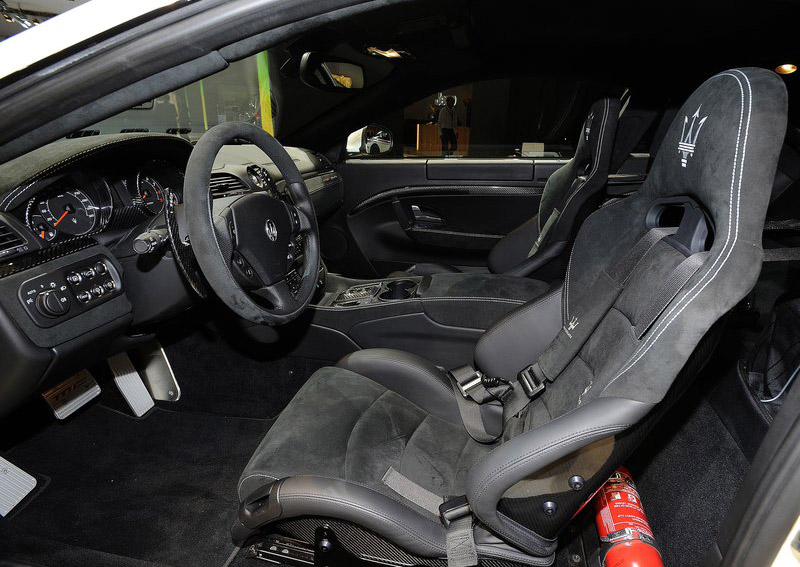
With the removal of the rear seats, the Maserati GranTurismo MC Stradale becomes the first two-seat Maserati since the MC12. The GranTurismo MC Stradale has also benefited from new Brembo carbon-ceramic brakes, custom-developed Pirelli tyres, a unique suspension layout and rigid, light-weight, carbon-fibre race seats.

The push for the Maserati GranTurismo MC Stradale came from existing Maserati customers who wanted a road-legal super sports car that looked and felt like the GT4 and Trofeo race cars. The Maserati GranTurismo MC Stradale also provides the latest step in the well-trodden path between Maserati's racing programs and its production road cars and, often, back again. In the 1990s, the Ghibli Open Cup race car gave birth to the Ghibli Cup and a decade later the Trofeo GranSport gave birth to the GranSport MC Victory. At the pinnacle of recent Maserati's road-to race story, the FIA GT-winning MC12 was developed directly from the MC12 Stradale.

With a unique body design that is based around the requirements of the track, the Maserati GranTurismo MC Stradale has borrowed heavily from its racing car stablemates, the Maserati GranTurismo MC, both in the Trofeo and GT4 configurations. It has a new front splitter, bumper, bonnet, front guard panels, sills, exhausts and even a new rear bumper. To emphasize the harder-edged nature of the Maserati GranTurismo MC Stradale, Maserati even offers the car with an optional roll cage and a four-point racing harness.

Yet it was also designed to be easy to drive, so it retains all the inherent ride, handling and stability benefits of the GranTurismo S's long wheelbase. It has the speed to be a road-legal racing car, yet it has the progressive handling to be considered an extremely usable super-sports car.

In this configuration, the Maserati GranTurismo MC Stradale will be on sale in February 2011 in all major markets, with the exceptions of the USA, Canada and Korea.
Read More

Tuesday, August 7, 2012

Volkswagen Golf GTI Cabriolet Concept, 2011


  • Volkswagen Golf GTI Cabriolet Concept, 2011
The Volkswagen has presented the VW Golf GTI Cabriolet Concept in a world debut at the 2011 Wörthersee - it is the first officially built open-top version of the icon. There are plenty of good reasons for introducing this extremely dynamic concept in 2011: this year, the Golf GTI celebrates its 35th anniversary, and the legendary GTI Meet at Wörthersee is taking place for the 30th time. 2011 is also the year of the new Golf Cabriolet. While the production Golf cabriolet can already be ordered, the Volkswagen Golf GTI Cabriolet Concept is still a concept. And what a concept!

Visually, the fire red "Firespark Metallic" open-top GTI shows independent ways: especially noteworthy here are the add-on parts designed in shiny black piano paint. The concept's styling focuses on extreme precision with lines that appear as if cut by a razor. The add-on parts themselves are on the one hand delicate and light, but at the same time sturdy and integrally designed. A look at the front and rear spoilers or the side sills designed in the style of splitters used in motorsport shows this impressively.

Visual highlights: the front fog lights of the GTI gave way to air guides for ventilating the high-performance brake system that is used in the cabriolet. In side profile, the open-top GTI's look is characterised by black-silver 19-inch "Glendale" alloy wheels with 235 tyres. They fill out the wheel housings completely, since the Golf's ride height was lowered with a coilover suspension. Another feature that stands out in side profile are the brake callipers painted "Tornado Red" with black GTI logos.

The concept car's interior was upgraded with "Black Stripe" pattern accents and Nappa leather seats with red GTI logos in the head restraints. The seams between the individual leather surfaces provide a sporty contrast; they are styled in "Flash Red" and "Crystal Grey". Two-tone door inserts were coordinated with the seat pattern. As on the interior door panels, fine red decorative seams also customise the leather-trimmed steering wheel and the trim of the gear shift and parking brake levers. This colour is repeated in the red borders of the black safety belts and the black-red piping of the floor mats. Classic effects are achieved by aluminium door sill plates with worked-in GTI logo. By the way, the cabriolet's driving performance - with its 155 kW / 210 PS GTI engine - fully matches that of the closed-top GTI - i.e. right around 240 km/h and seven seconds for the sprint to 100 km/h. A genuine GTI!
Read More

Jaguar XKR, 2011

 
  •  Jaguar XKR, 2011

The Jaguar debuts the latest dramatic evolution of its supercharged Jaguar XKR coupe at the 2010 Geneva Motor Show. The stunning new Jaguar XKR Special Edition delivers a significantly raised maximum speed - 174mph (280km/h) - and bold exterior styling changes that create the ultimate supercharged Jaguar.

The Jaguar XKR Special Edition combines a number of new features and option packs that are introduced to the XK range at 2011 Model Year. Jaguar customers have the option to personalise their vehicle by building on the existing Jaguar XKR package to deliver a car that offers even greater performance without sacrificing the refinement and luxury for which every Jaguar is renowned.

Introduced in 2009, the Jaguar XKR boasts a state-of-the-art 5.0-litre supercharged AJ-V8 Gen III R engine that delivers 510PS (510bhp SAE), 625Nm of torque and propels the coupe to 60mph in just 4.6 seconds. Now, in Special Edition guise, the Jaguar XKR's top speed climbs significantly from an electronically limited 155mph (250km/h) to 174mph (280km/h) thanks to the addition of the Speed Pack. Allied to that remarkable engine is an advanced six-speed automatic transmission with steering-wheel mounted paddles, lightweight aluminium body structure and a range of computer-controlled systems including Active Differential Control and Adaptive Dynamics that ensure the supercharged car accelerates even faster, handles even more precisely and sets new standards of ride and comfort.

The benefits of the Jaguar XKR's lightweight but stiff and strong advanced all aluminium body are already acknowledged. Not only does this architecture bring dynamic benefits thanks to its torsional rigidity, it also offers excellent safety and crash repair features and provides the ideal base to improve performance across the board - including optimised fuel economy and CO2 emissions. Thanks to the combination of excellent powertrain efficiency and the Jaguar XKR's advanced lightweight body architecture, its fuel economy is comparable to the previous generation of Jaguar XKR - despite the significant increases in power and performance.

The Jaguar XKR Special Edition pairs the optional Speed and Black Packs to create the bold new model unveiled in Geneva, which also sports optional Piano Black veneers on the dashboard and red brake callipers. Both option packs are also available separately for customers who seek to personalise their cars in terms of either styling or additional performance. Whatever combination is chosen, every Jaguar XKR delivers that classic Jaguar blend of seductive, powerful and elegant looks, beautifully finished interiors and even more comprehensive specification.

The driver is the centre of attention in the Jaguar XKR Special Edition, with exciting new features including the acclaimed JaguarDrive Selector™, and high levels of specification such as the 7-inch Touch-Screen, 16-way heated and cooled memory seats, Jet Suedecloth premium headlining and Flint Grey premium carpet. In addition, a bespoke new Jaguar XK suitcase (which will be available as an option for all XK models) has been fashioned for the Jaguar XKR Special Edition. From 2010, the Jaguar XK range (UK and certain European markets only) will be fitted with the tyre repair Instant Mobility System. By adopting IMS on all models, the XK frees up its 30-litre wheel well, which is now carpeted and can hold the specially designed and tailored XK accessory suitcase, substantially increasing the versatility of the car.

The new 2011 Jaguar XKR Special Edition consists of two new styling and performance packs - the Speed and Black Pack. Both are available to Jaguar XKR coupe customers separately and provide new levels of styling and performance for owners looking to further personalise their Jaguar.

The Jaguar XKR Speed Pack

The Jaguar XKR with new optional Speed Pack allows customers to further strengthen their XKR's already impressive breadth of capability, by extending the car's top speed from 155mph (250km/h) to an electronically limited 174mph (280km/h), thanks to a unique engine and transmission recalibration.

To ensure the Jaguar XKR with Speed Pack remains stable at high speeds, the coupe uses a revised front aerodynamic splitter and larger rear spoiler to provide increased balance and a reduction in lift. The Jaguar XKR's computerised Active Differential Control also adjusts to reduce steering sensitivity at very high speeds, further improving stability and driver control.

Customers who order the Jaguar XKR coupe with the Speed Pack will be offered a paint palette that is part of the Jaguar Designers' Choice programme - a range of colours that have been specifically chosen to compliment the performance potential of the car. Seven colours are available on Speed Pack models - Ultimate Black, Polaris White, Salsa Red, Liquid Silver, Lunar Grey, Kyanite Blue and Spectrum Blue.

Every Jaguar XKR with the Speed Pack will come with body-coloured side sills and rear diffuser, and a chrome finish to the window surrounds, upper and lower mesh grilles, side Power Vents and boot lid finisher. Red brake callipers with a Jaguar 'R' logo sit inside 20-inch Kasuga alloy wheels.

By raising the Jaguar XKR's maximum speed the new car has extended its sporting credentials, taking it even further into supercar performance territory. Russ Varney, Chief Programme Engineer, XK Series, explains the philosophy behind the uprated Jaguar XKR: "With 510PS and 625Nm of torque, the Jaguar XKR has immense reserves of power and acceleration which impress everyone who experience it. The car has always had the potential to reach speeds far beyond its original electronically limited maximum and many of our customers have expressed an interest in a car that can safely be driven faster where conditions permit. The new Speed Pack allows them to release some of that potential and give them control of the fastest Jaguar XK we've made to date."

The performance potential of the supercharged AJ-V8 Gen III R engine comes courtesy of its highly advanced design. The all-aluminium four-cam power unit has a number of features that deliver power with very high efficiency, including spray-guided direct injection (SGDI), which improves performance and economy, and dual independent variable cam timing (DIVCT), which benefits performance and economy, while also reducing emissions.

The AJ-V8 engine is built around a stiff, aluminium block with cast-in iron liners and cross-bolted main bearing caps to reduce noise, vibration and harshness. The block is high pressure die-cast, providing a superior finish and greater dimensional accuracy. The engine uses aluminium heads, with four valves per cylinder and spheroidal-graphite cast-iron crankshafts and forged steel connecting rods. The cylinder heads for the first time are specified with a secondary (recycled) aluminium alloy thus reducing the environmental impact of manufacturing the new engine.

A sixth-generation, twin vortex system supercharger is fitted to the Jaguar XKR's 510PS engine. It is a compact Roots-type unit, feeding air through twin intercoolers, which in turn are water-cooled by their own discreet cooling circuit. The high helix rotor design improves the supercharger thermodynamic efficiency by more than 20 percent over its predecessor. It also improves noise quality to the point where the unit is virtually inaudible (making supercharger whine a thing of the past). The intercoolers reduce the temperature of the pressurised intake-air and so optimise power and efficiency. Mechanically, the new supercharger and its intercoolers are efficiently packaged in the 'V' of the engine to deliver a lower overall engine height in support of pedestrian safety requirements.

An industry-first, centrally-mounted, six-hole, spray-guided fuel injection system delivers fuel at a pressure of up to 150bar directly to the cylinder. This substantially contributes to improved low-speed, dynamic response. The positioning of the injectors ensures fuel is precisely delivered to the centre of the combustion chamber, maximising air-fuel mixing and improving combustion control. Fuel is delivered through twin, high-pressure fuel pumps that are driven via an auxiliary shaft in the all-new engine block.

The charge cooling effects of the direct-injection fuel system have allowed the compression ratio of the supercharged engine to increase from 9.1:1 to 9.5:1, further optimising fuel economy. During the engine warm-up phase, the combustion system employs multiple injection mode strategies to deliver 50 percent more heat for fast catalyst warm-up and emissions reduction.

A new type of variable camshaft timing (VCT) system introduces another new technology. The four VCT units are activated by the positive and negative torques generated by opening and closing the intake and exhaust valves, instead of by oil pressure. This has allowed the engine oil pump to be reduced in size, saving energy and improving fuel consumption.

VCT units work independently on all four camshafts with 62 degrees of authority on the inlet cams and 50 degrees of authority on the exhaust cams. Timing is optimised by the engine control unit for torque, power and economy at every point in the engine's speed range. The new VCT units are capable of a response rate up to three times faster than in previous Jaguar engines, with actuation rates in excess of 150 degrees per second. This delivers a more immediate engine response to the driver's demand for power.

Minimising internal friction is key to improving fuel consumption and CO2 emissions, and as such was a key aim when it came to the design of the engines. As a result, the new Jaguar AJ-V8 Gen III engines achieve another best in class, setting a new industry benchmark for cranktrain efficiency.

All engine bearings were engineered for reduced friction without compromising reliability. Diamond-Like Carbon Coating (DLC) has been used to reduce friction on the fuel pump tappets and a solid film lubricant has been used to coat the piston skirts. New engine oil has a lower viscosity, contributing to an extension in service intervals from 10,000 miles to 15,000 miles (or 12 months). The V8 engine is fitted with an electronic oil-level indicator for added peace of mind.

Sound quality is a key characteristic of all Jaguars and is one particular aspect that customers relish. With that in mind, Jaguar engineers have accentuated the acoustic feedback into the cabin in order to further enhance the driving pleasure.

In addition to the fully active exhaust system in which valves open to provide a more rewarding note, the new Jaguar XKR has been engineered to provide an intake feedback system to enhance the V8 sound character commonly absent on supercharged engines. Intake manifold pressure pulsations are fed into an acoustic filter at the rear of the engine that is tuned to provide an edgy sports car 'crescendo' at high revs. The filter is controlled by the engine management system, which only allows the sound to enter the cabin under the appropriate driving conditions.

The new intake feedback system combined with the fully active exhaust system provides the most exhilarating aural experience yet delivered on a Jaguar.

The Jaguar XKR Black Pack

For customers looking to create a real statement with their Jaguar XKR, the new optional Black Pack allows them to own a bold and purposeful Jaguar with undeniable visual impact thanks to menacing gloss black wheels and exterior detailing.

Like the Speed Pack, XKRs fitted with the Black Pack have a paint palette that is restricted to colours that Jaguar's Design team believe to be ideal for creating a coupe with immediate exclusivity. The Black Pack models will be available in Ultimate Black, Polaris White or Salsa Red and boast eye-catching 20-inch gloss black Kalimnos alloy wheels. Further gloss black finishing is applied to the window surrounds, front grilles and side Power Vents. Optional red painted brake callipers contrast strongly with the black alloy wheels, while body coloured front and rear spoilers and boot lid finisher round out the package. Customers also have the option to apply a sweeping 'XKR' side body graphic that runs along the door sills.

Jaguar's Design Director, Ian Callum, says the new Black Pack is a fitting addition to the Jaguar XKR: "While Jaguars are about beauty, they are also about speed and power. With the optional Black Pack you can now add a sense of drama and severity to that performance."

In addition to the Black Pack's exterior changes, the Jaguar Designers' Choice programme has also selected a range of interior trims that support the visual impact of the car. All XKRs with the Black Pack will be trimmed with Charcoal leather hides that can be personalised with a range of colour stitching and grain. Three interior finishes and veneers for the fascia and door trims are also available - Dark Oak, Dark Mesh Aluminium and Piano Black.

Whatever interior trim is selected, the Jaguar XKR's cabin is evidence of contemporary, sporting luxury, exceptional quality of craftsmanship, and Jaguar's renowned attention to detail. The interior is clean, elegant and spacious, and remains entirely in harmony with the sporting character of the revised exterior.

The latest feature enhancements are showcased by the JaguarDrive Selector™, which is neatly and elegantly packaged in the centre console. First seen on the Jaguar XF saloon, the JaguarDrive Selector™ features a rotary shift control which rises into the driver's hand as the car is started, to give intuitive, ergonomically efficient transmission control from a neat, space-efficient interface.

The selector is, in fact, much more than just an unobtrusive yet completely practical solution to selecting an automatic gear mode. It also imbues the car with a strong driver 'handshake' - get into an Jaguar XKR and the start button in front of the JaguarDrive Selector™ pulses red, like a heartbeat; press this button to start the engine and the cast alloy JaguarDrive Selector™ rises into the palm of your hand.

From there, automatic transmission functions are selected simply by turning the control with the fingertips. As an example, Drive to Drive Sport selection is accomplished with a simple push and turn action. Returning from S to D, the rotary control operates with spring-assistance, which eliminates the need to pull the Selector. It couldn't be simpler. And when the engine is stopped, the JaguarDrive Selector™ returns automatically to its Park position.

The welcome to the car is also enhanced by bright treadplate inserts. Many of the other changes emphasise high levels of Jaguar craftsmanship with jewel-like touches. The three-spoke steering wheel contains a leather-wrapped lower spoke, and Jaguar's striking 'growler' badge. The Jaguar XKR's instruments further emphasise the car's performance character with red pointers and white illumination.

The door casings are even more luxuriously crafted than before, with saddle-stitched lines and a new interlayer to give a softer touch to the top shoulder of the casing. The leather door pulls also introduce twin-needle stitching and a soft-feel interlayer. In each door, the modified seat switch pack includes single-piece chrome 'highlight' switches.

In true, contemporary Jaguar fashion, a great deal of relevant and intuitive technology is controlled by the clear and elegant seven-inch Touch-screen in the centre console. The Touch-screen provides access and control for the Climate Control and Audio systems, for the Satellite Navigation System, for Bluetooth mobile connectivity, and for Jaguar's Portable Audio Interface - which are all standard equipment. The satellite navigation system offers DVD mapping, postcode entry, and a traffic message channel. The Portable Audio Interface offers iPod connectivity, and the connection of other storage devices through a USB port, to the in-car sound system, with full Touch-screen control.

The audio system for the new Jaguar XKR is the ultimate Bowers & Wilkins 525-watt system with Dolby® ProLogic®II Surround Sound, three-channel stereo with unique amplifier, Kevlar mid-range speakers with high output and low distortion, and specially designed aluminium tweeters.

Depending on market, a number of Digital Radio options are available: HD radio is available for North American market cars, SDARS satellite radio for North America and Canada, and Digital Audio Broadcasting (DAB) is offered in selected European markets.
Read More

Monday, August 6, 2012

Bentley Continental GTC V8, 2013


  •  Bentley Continental GTC V8, 2013

The red winged 'B' and black gloss grille provide a strong indicator that a different Bentley powerplant nestles in the engine bay of the Bentley Continental GT V8 and its convertible stablemate.

Settle into the supportive cobra-style seats, press the start button, and all is revealed. The new 4.0 litre Bentley engine comes to life with an unmistakable V8 burble: deep, sporty and ready for action.

To achieve the 40 per cent efficiency improvement targeted by Bentley's Board of Directors back in 2008, Bentley's engineering team left no detail unexamined. The reduction in displacement from 6.0 litre W12 to 4.0 litre V8 was the first starting point - but a smaller capacity engine in itself would not have delivered anything close to the ambitious power and emissions targets.

Variable displacement - deactivating cylinders when at a gentle cruising speed or light throttle - was already an area of Bentley expertise. The Bentley Mulsanne's 6.75 litre V8, though similar in format to the original Bentley V8 of 1959, features variable displacement as part of its technologically-advanced specification.

Similar technology now features on the Bentley 4.0 V8: when the engine's control microprocessor detects a light throttle opening as the driver maintains a steady cruising speed or gentle acceleration or deceleration it closes the valves in four of the eight cylinders so that they simply act as air springs.

This has two immediate benefits; the remaining four cylinders operate at a higher level of efficiency, and the engine's frictional and gas transfer losses are reduced. As soon as the driver presses the throttle harder the engine instantly switches back to full eight-cylinder operation.

Switchable hydraulic engine mounts compensate for the different resonances of V8 and V4 mode, as the mount switches to a 'soft' state during idle for improved isolation from vibration.

Seamlessly managing the transition between modes and maintaining optimum efficiency throughout the V8's operating range is a highly advanced engine management system (EMS). A 32-bit TriCore™ microprocessor performs up to 180 million instructions per second, providing an unparalleled level of precision in its control of the combustion process.

The EMS also controls the thermal management system that ensures a faster warm up for the engine and transmission, as well as the switchable oil control system, each of which has a contribution to make to the new model's overall 40 per cent efficiency gain.

Another key component of the innovative V8 powertrain is the new close-ratio 8 speed automatic transmission. Not only does it deliver faster, smoother gearshifts, it also accounts for 6 per cent of the total 40 per cent efficiency gain achieved by the new V8. Having a greater number of ratios ensures that the engine is always working at its most efficient gearing, while drag torque losses have been minimised within the transmission.

New thermal management features ensure that the V8 reaches its most efficient working temperature as swiftly as possible, minimising losses via the unwanted extra drag of cold lubricants and bearings.

A rapid warm-up valve keeps coolant inside the engine until a preset temperature has been reached. It then diverts the warm coolant to the transmission, heating it rapidly thereby reducing energy losses. Only when both major drivetrain components have reached their most efficient operating temperatures does the coolant enter the full cooling system.

In the quest for efficiency, Bentley engineers considered the design of every component to minimise energy losses without compromising power or durability. This process of 'engine optimisation' encompassed everything from oil viscosity, variable oil pressure and indirect intercooling to the use of low friction bearings. Unusually, as well as being technically demanding to achieve, the turbochargers are mounted within the 'V' of the V8, contributing to efficiency and weight reduction, a process that Bentley's engineering describe as 'hot side inside'.

Bentley's engineers have also designed the electrical system to work in a more efficient way, reducing the amount of power sapped by the alternator. Using the principle of recuperation, the alternator's output is 'topped up' by the battery at low engine speeds, then the process is reversed via energy recovery during those times when the car is decelerating.

Over a typical drive cycle this can reduce fuel consumption by 4 per cent, while the 'on demand' variable power assistance for the steering adds a further 3 per cent efficiency gain. Even the specification of the tyres had an additional 1 per cent efficiency gain to contribute, naturally without compromising the Bentley's limpet-like grip and responsive handling characteristics.

As a result of these incremental gains through the use of advanced engineering technology, the new Bentley Continental GT V8 does indeed offer a 40% improvement, compared to the W12-engined Continental GT of 2008, the date when the commitment was made.

But the greatest achievement of all is that the thunderous Bentley performance characteristics are maintained. Full throttle acceleration will catapult the Bentley Continental GT V8 or GTC V8 past sixty miles an hour in less than five seconds; performance figures only surpassed by the 6.0 litre W12 powered models.

Better still, it will do so with an intensity of aural and sensory feedback - a deep growl rising to a full throttle racer's pitch - that delivers a new form of Bentley driving exhilaration. Bentley's engineers accepted no compromises in their pursuit of efficiency - and as a result, the owners of the new Bentley Continental V8 models need make no compromises in their enjoyment of its performance.

Contemporary, sporting design character
The new Bentley Continental V8 models have all the sculpted, muscular elegance of their W12 stablemates, with their distinctive wide rear track, super formed aluminium wings, powerful haunches and low, poised stance. But a number of key differences distinguish these branches of the Continental family.

One of the most significant differences is also one of the smallest. When it appears on the Mulsanne and the 6.0 W12 Continental models the winged 'B' emblem above the radiator grille has a black enamel background.

On the Continental V8, the enamel is red. It's a distinction that dates right back to the 1920s, where the 'red label' badge appeared upon the company's smaller cars, such as the short-chassis 3 Litre, while black badges were usually reserved for larger-engined models.

Other external distinguishing features are more striking. The radiator grille of the V8 models features gloss black mesh, bordered by a fine chrome surround, in place of the W12 Continental GT's brightwork.

Underneath the grille the lower bumper also features black mesh and is divided by strakes into three distinct segments. The effect, both literally and figuratively, is a Bentley with a darker side to its character; potent, muscular and challenging.

At the rear two eye-catching 'figure eight' exhaust pipes, one each side of a dark lower rear valance, tell those in the know that this Bentley is powered by the advanced, exhilarating and efficient new 4.0 litre V8.

Both the coupe and convertible will be launched with 20-inch wheels as standard and customers will also be able to select from two 21-inch wheel designs especially created for the Continental V8 models. Both these options feature a six-spoke alloy with a strong, sporting theme and are finished in either Diamond Black (exclusive to the Continental V8) or Diamond Silver. Each Bentley 'B' emblem featured on the wheel centre caps is also finished in red.

The cockpit of the two Continental V8 models has a correspondingly sporty ambience, featuring a new veneer, Dark Fiddleback Eucalyptus, for the fascia and trim. Both the coupe and convertible feature a technical finish Eliade cloth headlining, rather than the leather that is standard in their W12-engined counterparts.

Unlike the full through-console of the W12, the centre console simply separates driver and front passenger seats, underscoring the sporting, lean and weight-conscious ethos of the V8 models.

Both the coupe and convertible will be offered with a choice of four single-tone interior hide colours, seven exterior finishes and (in the case of the GTC) three hood colours.

However, owners wishing to access the full palette of 17 exterior finishes, 17 hide colours, up to seven interior duotone colour 'splits' and eight hood colours available on the Continental W12, can take this option. This also brings access to the full Bentley range of veneers and a new sporty duotone seat design.

The other optional packages include the Driving Specification, Mulliner Styling Specification, Touring Specification and Convenience Specification. Many, however, will prefer the sporting, focused simplicity of the single-colour interior with its contemporary, clean Fiddleback Eucalyptus trim and Eliade cloth headlining.
Read More