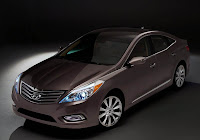



The Hyundai Motor America introduced the all-new Hyundai Azera in a North American debut at the 2011 Los Angeles Auto Show. Azera is the fifth vehicle to adopt the company's signature Fluidic Sculpture design language. Tucson, Accent, Elantra, Sonata and Azera now all have a modern, sleek, sophisticated style, creating the illusion of constant motion. This flagship Fluidic Sculpture sedan also features a more powerful Lambda II 3.3-liter GDI engine, six-speed transmission, best-in-class combined fuel economy of 23 miles per gallon and a wide range of advanced safety equipment.
AZERA MEETS THE MECHANICS OF FLIGHT
Hyundai Azera's Fluidic Sculpture design takes inspiration from the mechanics of flight. The exterior of the all-new Azera is long, light and low. The unique, undulating beltline allows for a long, sleek roofline accented by the third window and wraparound LED taillights. A monoform side profile includes flowing lines. The face is masculine with a large powerful chrome grille and HID headlamps that integrate precise details. The stance is completed by available 19-inch multi-spoke wheels.
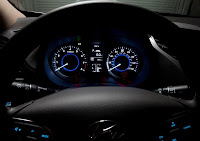
The elegant look continues inside where Hyundai has created an upscale ambiance, thanks to a flow-through center fascia and instrument panel. These flowing surfaces complement the exterior design and wrap around the driver and passengers.
ACCOMMODATING INTERIOR WITH STANDARD LEATHER
The 2012 Azera offers luxurious appointments that rival the finest premium competitor brands. It offers a roomy cabin with more than 45 inches of legroom and 40 inches of headroom for front-seat passengers.
Special attention has been paid to other interior details, such as an optional panoramic sunroof, which allows more natural light into the cabin and 3D Carbon interior accents. Ambient lighting compliments the vehicle's modern appearance. Other unexpected luxury appointments include an electrochromic auto-dimming mirror with HomeLink® and power rear sunshade and manual rear side window shades. The side shades can be inconspicuously tucked away when not in use and no other car in the segment offers them.
Seats are extremely important in this segment. The 2012 Hyundai Azera offers first class seating assignments for all passengers. Leather seating surfaces are standard. A ten-way power driver and eight-way front passenger's seats are standard equipment. The driver's seat has an optional cushion extension and an integrated memory system for the seat, steering wheel and side mirrors. Hyundai Azera's climate and seat temperature controls keep occupants in total comfort.
- Ventilated front seats (optional) - fans in the front seat back and bottom cushions circulate air through the perforated leather seats
- Heated front and rear seats standard
- Dual automatic climate control standard
- Second row air vents standard
- Cooled glove box standard
BEST-IN-CLASS SPECIFIC OUTPUT
There's an old saying "there is no replacement for displacement." Well, gasoline direct injection technology has changed the game. The Lambda II 3.3-liter GDI engine is the heart of the 2012 Hyundai Azera. It produces a best-in-class specific output of 88.8 horsepower per liter, while having the smallest displacement V6 in the segment. This engine has a high-pressure direct injection system (over 2,200 psi), which dramatically increases power and torque, while reducing fuel consumption and emissions. This system eliminates the need for a large displacement V6 engine and increases the compression ratio from 10.4 to 11.5 for greater thermal efficiency and output. It also features all-aluminum construction, four valves per cylinder, piston cooling jets, roller timing chain, CrN Physical Vapor Deposition (PVD) coating on the top ring chamfer and Dual Continuously Variable Valve Timing (D-CVVT) for a broad power spread. A three-stage Variable Intake System (VIS) further broadens its power curve to improve the vehicle's off-the-line acceleration and passing performance. EPA fuel economy estimates for the Hyundai Azera are 20 mpg city / 29 mpg highway / 23 mpg combined.
The engine is mated to Hyundai's six-speed automatic transmission with SHIFTRONIC® manual control. This transmission offers smooth shifts and a wide ratio spread that ideally suits the engine's characteristics.
Hyundai Azera's powertrain also has an Active Eco mode, which modifies engine and transmission control for improved fuel economy that translates into more than a five percent improvement in real-world fuel economy.
OVERALL DIMENSIONS
The Hyundai Azera rides on a 112-inch wheelbase, with an overall length of 193.3 inches and width of 73.2 inches. These exterior dimensions optimally size Azera between the Sonata and Genesis models.
BEST-IN-CLASS FRONT HEAD AND LEG ROOM
Hyundai Azera has best-in-class front head and leg room.
WORLD-CLASS WEIGHT EFFICIENCY
World-class weight efficiency is a program target for all Hyundai models. This strategy delivers outstanding fuel economy and performance simultaneously. At just 3,605 pounds, Hyundai Azera is more than 200 pounds lighter than the Buick LaCrosse (3,835 pounds) and more than 400 pounds lighter than the Ford Taurus (4,015 pounds). This priority on weight efficiency allows the Hyundai Azera to deliver a great combination of agility, performance and fuel efficiency.
BALANCED STEERING AND SUSPENSION SOLUTIONS
The Hyundai Azera is fitted with a MacPherson strut front suspension, coil springs and a 24 mm diameter front stabilizer bar. The sophisticated multi-link independent rear suspension enables precise geometry for a premium ride and engaging handling prowess. The capabilities of the advanced front and rear-suspension are maximized through Sachs Amplitude Selective Dampers (ASD), allowing tuning flexibility at smaller damper displacements. The ASD suspension provides:
Improved ride comfort with more body/wheel control
Increased driving comfort without compromised handling
Optimized road surface contact
Standard are 245/45R18 tires on 18-inch Hyper silver alloy wheels. There is an optional 19-inch Hyper silver alloy wheel fitted with 245/40R19 tire.
ADVANCED STANDARD SAFETY TECHNOLOGIES: PART OF HYUNDAi'S ASSURANCE COMMITMENT AND IT STARTS WITH THE SEATS
Hyundai Azera has an exceptional level of standard safety features for the large car segment right down to the part people spend the most time in - the seats. Hyundai engineers have developed an impact-reducing seat system for the Hyundai Azera. This seat system eliminates the need for active front head restraints and is expected to reduce head and neck injuries by 17 percent over the front seats in the previous generation Hyundai Azera, which had active front head restraints. This result is achieved through optimization of seat back structure to further absorb impacts.
Hyundai Azera has a Vehicle Stability Management (VSM) system, which optimally manages ESC (Electronic Stability Control) and the Motor-Driven electric Power Steering (MDPS).
VSM works to control two effects. The first is when a driver accelerates or brakes on a split-mu surface (slippery on one side, dry pavement on the other) and the vehicle wants to pull in one direction. VSM detects this condition and sends a signal to the MDPS to apply steering assist. VSM counters the pull and automatically provides eightNewtonmeters of counter- steering. VSM reacts the same way during sudden lane changes or fast cornering.
Hyundai Azera features nine airbags including dual front, front and rear seat-mounted side-impact, front and rear side curtain airbags and a driver's knee airbag.
The Hyundai Azera also features a state-of-the-art braking package. The package includes four-wheel disc brakes (12.6 inch front and 11.2 inch rear) and an Anti-Lock Braking System (ABS) including Brake Assist, which provides maximum braking force when a panic stop is detected, and Electronic Brake-force Distribution (EBD), to automatically adjust the braking force to front and rear axles based on vehicle loading conditions.
Additionally, Hyundai Azera offers impressive passive safety features including a Lower Anchors and Tethers for Children (LATCH) system for children's seats and three-point seatbelts for all positions.
ADVANCED CONNECTIVITY AND STANDARD NAVIGATION
Touch-screen navigation with backup camera is standard on all Azeras. No other car in the segment offers navigation with a backup camera as standard equipment. This easy-to-use unit can be controlled via seven-inch WVGA touchscreen or voice-activation by a headliner-mounted microphone. The system features 8GB of flash memory and comes matched with a sound system that plays compact discs, accesses digital music files via Bluetooth streaming audio or allows driver and passengers to access their personal listening devices through the iPod/USB/auxiliary inputs. Bluetooth audio wirelessly streams music from select mobile phones to the head unit. Also, with a Bluetooth-enabled phone one can look up a local restaurant and call for reservations before plotting the route.
Hyundai Azera is available with two audio systems. Standard is a Dimension AM/FM/Satellite Radio/CD/MP3 audio system with seven-speakers and iPod®/USB/auxiliary input jacks. An Infinity 550-watt, Logic 7 audio system with 12 speakers, including an eight-inch subwoofer and external amplifier is available. An XM Satellite Radio interface is also integrated into the head unit and features channel logos and XM Data services, such as XM NavWeather®, XM Stock Ticker and XM Sports Ticker. Azera also offers standard HD Radio™ technology.
A Bluetooth hands-free phone system with voice recognition, address book download and audio streaming is standard.
HYUNDAI BLUE LINK
Hyundai Blue Link telematics is standard on the Hyundai Azera with a 90-day complimentary trial period. Blue Link can be accessed from the buttons on the rearview mirror inside the Azera, the web and via a smart phone. Blue Link is offered in three packages: Assurance, Essentials and Guidance.
"Blue Link combines safety, service and infotainment into a complete package that works to both help simplify Hyundai owners' lives and reduce distracted driving," said Barry Ratzlaff, director of customer satisfaction and service business development, Hyundai Motor America. "We've carefully studied how drivers rely on smart phones and navigation systems as an innovative link to the outside world. Blue Link brings that seamless connectivity directly into the car with technology like voice text messaging, POI web search download, turn-by-turn navigation, and monthly vehicle reporting. Our agent-assisted advanced voice recognition system offers a 21st century solution to performing POI searches in the vehicle. This unique and innovative approach enables Hyundai to deliver fast, accurate searches and downloads of POIs to vehicles without the unnecessary costs of traditional operator-only type systems of our competitors."
COLOR PALETTE
Hyundai Azera's elegance is further brought to life through a bold color palette including Black Onyx Pearl, Porcelain White Pearl, Silver Frost Metallic, Smoke Gray Metallic, Hyper Silver Metallic, Venetian Red Pearl, Bronze Mist Metallic and Midnight Blue Pearl. Interior color choices are Camel, Graphite Black and Chestnut Brown.


