Sunday, March 18, 2012

Lotus Elise, 2011


 Lotus Elise, 2011

The Lotus Elise revolutionised the sportscar market 14 years ago when the small lightweight agile 2-seat mid engine sportscar was introduced. By ensuring that the Lotus Elise stuck rigidly to Lotus' core values of performance through light weight, the Lotus Elise was able to produce supercar performance with city car economy.

Making its debut at the 80th International Geneva Motorshow, the 2011 model year Lotus Elise introduces a number of changes and improvements to maintain its class leading position.

The body - an evolution
The body of the new 2011 Lotus Elise is an evolution of the iconic Elise design, retaining the character and style, while offering a more planted, purposeful stance and a pure, contemporary look that links it to the Evora. As with all Lotus product the design is an exciting blend of dramatic style and functional efficiency

The new Lotus Elise body has a fresh sculptured front, including a new bumper, front clam and access panel that combine to give the Lotus Elise a wider look with more road presence.
At the rear of the car the new engine has been encased by a distinctive "twin-spine" engine cover whilst lower down a more aggressive diffuser is tightly wrapped by an elegant new bumper design that now includes the rear licence plate.

New headlamp units with distinctively sculptured LED lighting guides (incorporating daytime running lamps and direction indicators) give a contemporary twist to this classic design. Elsewhere, the signature, Lotus "mouth" and familiar sculptured forms have been sensitively refined to give a crisper, more dynamic look. The repositioning of lamp functions has enabled the creation of broad clean surface between the fenders which combines with sleek corner intakes and prominent splitter detail to give a broader more planted stance.

The theme of purity is carried through to the cooling apertures that are efficiently finished with a new lightweight aluminium mesh that gives the car a classically sporting character.
The rear boot is now opened from the cockpit rather than via a separate key operation. The high quality feel of the Lotus Elise is continued throughout the car with the Lotus Elise graphic incorporated into the new side LED direction indicators, like those on the Evora.

The driving position, from the perfectly positioned pedals and steering wheel, to the comfortable and supportive seats with ProBax technology means that, like all Lotus cars, the driver becomes part of the car rather than being just a passenger.

With the sleek new body the aerodynamics have improved giving a reduction in the coefficient of drag of 4%.
Finally, a choice of two beautiful, light weight wheel designs are available; an incredibly light forged wheel and a new cast wheel completes the picture for this sensitive update of a Lotus Icon.

Additional changes 
The new 2011 Lotus Elise has a number of additional changes and improvements, with the installation of a new advanced 1.6 litre Valvematic engine meeting EURO 5 regulations. This new engine is 200cc smaller than the outgoing Lotus Elise S model and produces similar power (136 PS, 100 kW, 134 hp at 6800 rpm) with maximum torque of 160 Nm, 118 lbft at 4400 rpm, but offers a significant improvement to fuel economy of over 23%, to 6.14 litres / 100km (46 mpg) and a reduction in CO2 emission by more than 13%. This provides the new Lotus Elise with the lowest CO2 per performance for any gasoline high performance sportscar in the world. This high technology engine is mated to a new 6-speed manual gearbox, providing closer and more performance orientated ratios than the outgoing 5 speed box.

The 1.6 litre engine is controlled via the bespoke Lotus T6 engine management system. Cruise control is available on the Lotus Elise for the first time with the controls present on a stalk located to the left of the steering column.

New cast wheels have been designed specifically for the Lotus Elise and the new optional forged wheels weigh just 29.26 kg per set, 2.14 kg lighter than a set of lightweight cast versions. Both are available in silver or black colour.

The Engine
The Lotus Elise introduces the new 1598 cm3, 1ZR-FAE engine, provided by Toyota. The key to this engine's performance and efficiency is the Valvematic system (a variable valve lift mechanism), which is combined with the dual VVT-i (Variable Valve Timing-intelligent). The engine continuously controls intake valve opening/closing timing and the intake valve lift to vary the volume of the intake airflow, giving significant improvements in efficiency and fuel economy. This ensures optimal performance based on the engines operational condition, thus helping the Lotus Elise achieve both high fuel efficiency and high performance.

First of all, the maximum power output is achieved at near maximum revs (engine speed) of 6800 rpm and maximum torque (a respectable 160 Nm, 118 lb.ft) is reached at 4400 rpm. This gives a good combination of mid range pull but also encourages the driver to rev the engine to the maximum permitted engine speed of 7000 rpm (transient rev limit). Like all Lotus Elise sportscars, there are three shift up lights, on the binnacle cumulatively lighting when the driver is getting closer to the rev limiter and when all three are illuminated, they flash to indicate that the driver is almost on the rev limiter so time to change up a gear!

The height of the engine cover has been raised by 34mm to accommodate the taller 1ZR engine compared to the previous 1ZZ engine from the outgoing model due, in part, to the additional Valvematic technology included on the new engine. This has given Lotus engineers an opportunity to subtly redesign the rear engine cover to match the design theme from the front and rear of the car.

The Chassis
The Lotus Elise is built around the revolutionary and award winning extruded and bonded aluminium chassis, with a lightweight steel rear subframe. The chassis weighs 68 kg (150 lbs) and has a stiffness of 9,800 Nm per degree, giving a high level of control of the suspension. At the rear, and also acting as a rear energy absorbing crash structure, a lightweight steel subframe carries the engine and gearbox. At the front, the radiator and key ancillaries are mounted into a high tech composite energy absorbing crash structure that is both lightweight, compact and over three times more energy absorbing than the equivalent steel structure.

Ride and handling
The legendary Lotus ride and handling gives a superb high performance, sporty drive, combined with a compliant ride and progressive on limit handling, it makes the Lotus Elise a car that demands to be driven.

The entry level Lotus Elise weighs 876 kg, making it one of the lightest fully homologated sportscars in the world. This low weight translates into efficient performance with minimal environmental impact in terms of emissions and fuel consumption. The efficiency of the Lotus Elise structure means that the 136 PS (100 kW, 134 hp) delivers phenomenal performance.

Few cars can match the delicacy and accuracy of the steering, throttle and brakes of the Lotus Elise and all of these factors contribute to the excellent driving experience of the Lotus Elise.

Safety
The Lotus Elise has high performance AP Racing callipers at the front and Brembo callipers at the rear linked to 282 mm vented and cross-drilled cast iron discs to give excellent stopping power.
The Lotus Elise comes as standard with a track tuned ABS system that is designed to be unobtrusive under normal driving conditions. This system is designed to be used on track and has a high threshold, only intervening in emergencies.

The ABS system is linked to a lightweight pedal box with steel pedal arms and extruded aluminium pads. This unit also has an electronic (drive-by-wire) throttle for quick, smooth and more linear engine response.

The impressive braking coupled with excellent handling gives good primary safety and the composite front crash structure and rear crash protection offers efficient secondary safety. Driver and passenger airbags and pre-tensioning seatbelt are standard on all Lotus Elise models.
Read More

Lotus Evora 414E Hybrid Concept, 2010

 
 Lotus Evora 414E Hybrid Concept, 2010

The Lotus Evora 414E Hybrid Concept, so-named because this latest environmentally-focused technology demonstrator from Lotus Engineering produces 414 PS (306 kW) of power, promises breathtaking performance from a highly efficient propulsion system. The concept showcases new developments in plug-in, range-extended electric propulsion, new electronic technologies to enhance driver involvement, the adaptability of the Lotus Versatile Vehicle Architecture (VVA) that underpins the Lotus Evora 414E Hybrid and a dramatic new roof system and interior concept from Lotus Design. Through all of these aspects it ultimately demonstrates the exceptional ability of Lotus Engineering to integrate and develop advanced technologies for exciting, efficient, high performance niche vehicles.

The range extended electric drive of the Lotus Evora 414E Hybrid consists of two electric motors driving each of the rear wheels independently via single speed geartrain, integrated into a common transmission housing, thus enabling torque vectoring for stability control of the vehicle. Electrical power is stored in a lithium polymer battery pack optimised for energy density, efficiency and high power demand, mounted in the centre of the vehicle for stability and safety. Additional range is provided by the Lotus Range Extender engine, an optimised 1.2 litre, three-cylinder engine, designed specifically for series hybrid vehicles. The drivetrain is designed to combine astonishing performance with efficient, low emissions driving.

Driver involvement is enhanced by the incorporation of HALOsonic Internal and External Electronic Sound Synthesis technologies from Lotus and Harman International, which provide sound contouring within the cabin and improve pedestrian safety outside the vehicle. Integrated with the HALOsonic technology, the Lotus Evora 414E Hybrid also showcases a brand new technology from Lotus Engineering, a sports mode that simulates a 7 speed, paddle shift transmission that combines exceptional driver involvement for a hybrid sports car and optimised energy recuperation.

The Lotus Evora 414E Hybrid has been designed to highlight Lotus' innovative electric and hybrid vehicle technology without distracting from the pure sportscar character of the Evora. The solution is innovative, instantly recognizable, beautiful and sporty. It demonstrates Lotus DNA.

The Drivetrain
For the Lotus Evora 414E Hybrid Concept, Lotus Engineering has developed a highly efficient, high performance drivetrain system consisting of twin motors each limited to providing 152 kW (207 PS/204 hp) of power and 400 Nm (295 lbft) of torque to each wheel via independent, single speed, reduction transmissions integrated into a single housing, enabling torque vectoring dynamic control of the vehicle.

The vehicle energy storage system is made up of the latest Lithium Polymer battery chemistry providing 17 kWH energy storage capacity. The battery pack is optimised for energy density, efficiency and high power demand, with over 100 kW discharge capability.

The Lotus Range Extender engine provides 35 kW (48 PS/47 hp) of power at 3,500 rpm via the integrated electrical generator and features an innovative architecture comprising an aluminium monoblock construction, integrating the cylinder block, cylinder head and exhaust manifold in one casting. This results in reduced engine mass, assembly costs, package size and improved emissions and engine durability. The engine uses an optimised two-valve, port-fuel injection combustion system to reduce cost and mass and can be operated on alcohol-based fuels and/or gasoline. The generator converts mechanical energy to electrical energy to replenish the battery pack charge and provides additional vehicle range in a small light weight package. The generator is also used as a motor to start the range extender engine. The low mass of the range extender unit (85 kg) and compact package makes it ideal for the series hybrid drivetrain in the Lotus Evora 414E Hybird.

All the operation and management of the range extender engine, the power management of the batteries and motor control are controlled by Lotus' electronic control units and software systems. Full energy management of all the operating systems is the key to maximising performance and operation while minimising energy consumption and CO2 emissions.

For everyday commuting journeys, up to 35 miles can be travelled using battery power. The battery can be charged overnight using a conventional domestic mains supply through a socket concealed by the rear number plate. This permits the vehicle to operate with zero tailpipe emissions. For longer journeys, exceeding the battery capacity, the highly efficient range extender engine is used as a generator to supply the motor with electrical power and top up the battery.

Lotus has used its own vehicle simulation tools to determine the size, capacity, power and performance of all the components in the drivetrain system to optimise the system operation. Overall this is far more energy efficient, weight efficient and cost effective than fitting the vehicle with a larger and more expensive battery, which for the majority of short journeys is a redundant weight, which increases energy requirements. With regard to the total lifetime CO2 emissions of the vehicle, including the energy required to manufacture and run it, the range extender solution has a lower overall CO2 footprint than a fully electric car of comparable performance and operating range running with a larger battery.

The Package
The Lotus Evora 414E Hybrid Concept structure is the same award-winning, versatile vehicle architecture used on the Lotus Evora. The low volume architecture was designed with the upmost flexibility in mind. The Lotus Evora 414E Hybrid is a perfect example of how to integrate a compact packaged drivetrain, with excellent performance and range, while using this underpinning. The complete chassis has remained unchanged from the Evora which maintains the structural integrity and strength performance of the original car.

The structure progresses the Lotus 'bonded and riveted' technology with new and unique extrusions and folded panels, whilst providing production build modularity and lower cost repairs. The chassis has been designed for scalability so that it can be extended in width, length and height. The strength and stiffness of the low volume VVA chassis can be modified cost effectively by varying the wall thickness of the extrusions, without altering the exterior dimensions. The ability to lengthen or shorten extrusions with the option to tailor the chassis stiffness vastly increases the number of vehicles that can be developed from this vehicle architecture.

The Driving Dynamics
The Lotus Evora 414E Hybrid offers exhilarating, all-round dynamic performance and takes advantage of Lotus developed torque vectoring dynamics. Torque vectoring, which is the capacity to generate different torques at each of the driving wheels, is particularly suited to electric vehicles and significantly reduces the conflict between stability and response.

A key benefit of separate motors to drive each rear wheel individually is that this facilitates a much higher level of vehicle dynamics control. Driving the wheels with different levels of torque can not only generate all the capabilities of a conventional ESP system using energy regeneration as opposed to brake application, but it can also actively drive each wheel forward at different rates, producing a turning moment at the rear of the vehicle in addition to the steering input.

It can be used to enhance low speed manoeuvrability and ease of parking but can also be used to produce a much greater level of straight line high speed stability. Incorporating lateral sensors the system also provides stability control capabilities and levels of steering response normally only associated with heavy and expensive rear steer systems. This can provide automatic correction of both understeer and oversteer characteristics. In addition, the standard method to provide high speed stability of designing the rear wheels to toe-in is not required as the torque vectoring system automatically provides this stability control, with toe-in increasing rolling resistance, lowering fuel economy and increasing tyre wear. Lotus' long history of active suspension control provides the core capability to develop this technology and provides extraordinary driving pleasure on the Lotus Evora 414E Hybrid.

Driver Interaction
The Lotus Evora 414E Hybrid Concept provides less of a psychological step change for people familiar with high performance cars compared to other electric and hybrid sports cars. The car has a simulated paddle shift gear change offering ultra quick gear changes reminiscent of a dual clutch transmission, while actually single speed. This enhances the driver interaction with the vehicle and provides a driving experience similar to current internal combustion engine high performance sports cars. The Lotus Evora 414E Hybrid uses a column mounted paddle shift to simulate the gear change and a synthesised engine sound changes frequency with virtual gear selection. The drive torque is also modulated to simulate a physical feeling of a gearshift jolt.

The virtual gearshift simulation, like a conventional gearbox, is used to change the driving characteristics and response of the vehicle. The most significant aspect that this offers the driver is the ability to control the vehicle deceleration by simulating engine braking through a virtual downshift in gears. Unlike true engine braking, the Lotus system does not dissipate the energy of the moving vehicle through internal engine friction but uses the electric motors to regenerate the energy back into the battery. While many electric and hybrid vehicles provide engine braking, this is generally at a fixed rate or preselected rate. In some driving situations this can either be too aggressive, slowing the vehicle unnecessarily, or too light, requiring additional braking application. The Lotus system effectively allows the driver to select the appropriate level of regeneration by simulating stepping down by one, two or even three gears. The simulation of engine braking through both the gear noise change and the retardation of the vehicle is fully intuitive to a driver familiar with a conventional gearbox. The simulated gearchange capability can be selected for greater driving involvement or switched off for more relaxed driving.

The Lotus Evora 414E Hybrid Concept uses the Lotus Engineering and Harman International developed HALOsonic suite of noise solutions. The first of which is Electronic Sound Synthesis. This generates engine sounds inside the vehicle through the audio system where it provides an exciting sports sound in line with the brand and nature of the vehicle together with a high level of driver feedback in an intuitive manner. In addition, it also generates sound on the outside of the vehicle through speakers mounted at the front and rear to provide a warning to increase pedestrian safety, which is especially important for electric and hybrid vehicles which can be difficult to hear at slower speeds.

There are four driver selectable engine sounds currently on the vehicle, two of which have been designed to have characteristics of a multi-cylinder conventional V6 and V12 engine. There is also a futuristic sound and a combination of a conventional engine and a futuristic sound, enhancing the brand identity of the vehicle as a step forward in electric vehicle design.

The addition of this Lotus patented simulated gearshift concept not only provides for an exciting and involving driving experience that customers would expect from a Lotus, but also enhances the driver's control of the vehicle while providing the capability for more efficient operation through a greater use of energy regeneration.

The Design
The distinctive colour scheme and 'floating' roof have been carefully designed to accent the cars electric vehicle technology whilst complementing the iconic lines of the Evora.

Copper, a colour often associated with electrical systems, has been chosen for the car's exterior and interior. A contemporary satin finish paint is complemented by electrical circuit inspired graphics that highlight the car's key feature lines and the unique glazed roof panel. The newly extended glazed zone integrates seamlessly with the existing forms of the Evora whilst showcasing the key components behind the hybrid and electric vehicle technology.

The signature copper theme is consistently carried throughout the car from the dramatic seat stripes and instrument panel inserts to the copper callipers that nestle behind the carbon grey forged wheels. Inside the cabin a sense of quality and richness has been created by carefully juxtaposing the different tactile qualities intrinsic to leather, Alcantara and metal.
Read More

Saturday, March 17, 2012

Ferrari 599 GTB Fiorano HGTE, 2010


Ferrari 599 GTB Fiorano HGTE, 2010

When it first debuted, the Ferrari 599 GTB Fiorano set a new standard in terms of performance that remains a benchmark for new sports car development to this day. Now Ferrari is introducing the new Ferrari 599 GTB Fiorano HGTE (Handling Gran Turismo Evoluzione) package for the model to further underscore its sportiness and handling.

The package includes a modified set-up with stiffer springs and rear anti-roll bar as well as new calibration settings for the magnetorheological shock absorbers when the manettino is at its sportier settings. The ride height has also been lowered which in turn lowers the car's centre of gravity. This combined with the new set-up helps improve body control. The package also includes specifically optimised tyres featuring a compound that offers even better grip.

The car's electronics have also evolved to ensure even more prompt response to driver commands. The F1 gearbox's shifts are now even faster in high-performance settings, while a new engine software strategy has improved accelerator response.

The exhaust silencer has also been modified with the result producing an even more marked and thrilling sound under hard usage whilst still delivering just the right comfort levels at cruising speed.

The 20" split-rim wheels are new with a special diamond-cut and matte silver finish. The rear diffuser is finished in matte black to underscore the car's new set-up and highlight the chromed tail pipes. The cabin is sportier too thanks to a sophisticated mix of full-grain leather, black Alcantara® and carbon-fibre trim.

The new seats are trimmed in a new two-tone combination of leather with black Alcantara inserts, and the seat backs are trimmed entirely in carbon-fibre. Embroidered in contrasting stitching on the headrest are a Prancing Horse and the world.
Read More

Ferrari Scuderia Spider 16M, 2009


Ferrari Scuderia Spider 16M, 2009

Ferrari has chosen to unveil the new Ferrari Scuderia Spider 16M at the World Finals in Mugello in celebration of its recent victory in the Formula 1 Constructor's World Championship 2008. This new high performance sports car features the very best of Ferrari's latest mid-rear-engined 8-cylinder technology. In fact, the Ferrari Scuderia Spider 16M is faster round the Fiorano circuit than any other Prancing Horse open-top road car yet built. This truly evocative special series model, of which just 499 unique examples will be produced, is aimed at the most passionate clients, drivers who demand both exclusivity and superb driving pleasure.

The Ferrari Scuderia Spider 16M is available in a choice of two new signature colour schemes: the standard version is black with grey trim, while a tricolour livery is also available as part of the Carrozzeria Scaglietti Personalisation Programme. The new car also sports a special plaque on its rear grille commemorating Ferrari's 16th Constructor's World title. The exclusivity of the interior is underscored by the silver "limited series" plaque just above the air vents at the centre of the dashboard. Other exclusive features include a roll-bar with carbon-fibre outer shell and a specific new generation audio system that can be combined with the removable customised Ferrari iPod Touch 16 GB with central dock just in front of the dashboard.

From a technical point of view, this car has a dry weight of 1340 Kg (80 kg lighter than the Ferrari F430 Spider). This, combined with the 510 hp provided by its V8 engine and a power-to-weight ratio of 2.6 kg/hp, means that it delivers blistering 0-100 kph acceleration in just 3.7 seconds and a superb top speed of 315 kph.
Ferrari Scuderia Spider 16M

Technical Specifications
    = Engine
          o Naturally aspirated mid-rear 90° V8, 4308 cc
          o Maximum power: 375.4 kW (510 hp) @ 8500 rpm
          o Maximum torque: 470 Nm (47.7 Kgm) @ 5250 rpm
          o Max engine speed: 8640 rpm (at limiter)
          o Compression ratio: 11.9:1
          o Bore and Stroke: 92 mm X 81 mm
          o Specific power output: 118.4 hp/litre
    = Transmission
          o Six-speed plus Reverse F1 gearbox
          o Dry dual clutch
          o Electronic differential E-diff + F1-Trac
          o Oil gearbox lubrication with oil/water heat exchanger
    = Performance
          o 0-100 km/h: 3.7 s
          o Top speed: 315 kph
          o Drive weight/power: 2.6 kg/hp
    = Fuel consumption
          o Combined: 15.7 l/100 km (ECE)
    = Emissions
          o CO2 emissions: 360 g/km (combined ECE)
    = Chassis and bodywork
          o Dimensions
                + Length: 4512 mm
                + Width: 1923 mm
                + Height: 1216 mm
                + Wheelbase: 2600 mm
                + Front track: 1669 mm
                + Rear track: 1616 mm
          o Dry weight: 1340 kg
          o Kerb weight: 1440 kg
          o Weight distribution: 43% front, 57% rear
          o Fuel tank capacity: 95 litres
          o Independent front and rear forged aluminium double wishbone suspensions, titanium helical springs, hollow anti-roll bars and lighter electronic shocks
          o Brakes
                + Front: 398 mm x 36 mm carbon-ceramic material disc brakes with aluminium 6-pot callipers
                + Back: 350 mm x 34 mm carbon-ceramic material disc brakes with aluminium 6-pot callipers
          o 19" five-spoke split rims front and rear
          o Tyres: 235/35 front and 285/35 rear; Fabbrica Pirelli PZero Corsa only
    = Electronic control systems
          o CST Stability and Traction Control System
          o Steering wheel-mounted manettino with five settings to integrate the F1 gearbox, CST and F1-Trac (Stability and Traction Control System), suspension control.
Read More

Saleen S7 Twin Turbo, 2005


Saleen S7 Twin Turbo, 2005

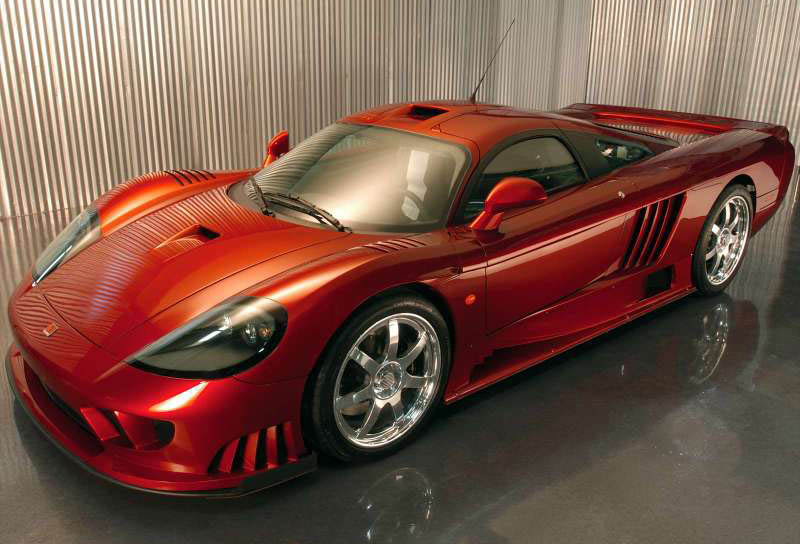
Saleen knows all about power. As in S281 Mustangs, N2O Focuses and the S7, America's first (and still the only) mid-engine exotic supercar. When it went on sale in 2002, the S7 was the only street-legal car in the U.S. with more than 500 horsepower and 500 lb-ft of torque. The media and S7 owners have raved about the car since it first smoked the rear tires in anger. And it has been recognized by numerous automotive magazines as the fastest production car in the world.
But during the past three years the automobile marketplace has witnessed an explosion of performance with models from manufacturers including Ferrari, Lamborghini, Mercedes-Benz, Porsche and Chevrolet touting power numbers above the once magic 500 level.

Saleen is not an organization content to rest on yesterday's 0-60 mph times or quarter-mile speeds. So for 2005 it's "goodbye S7" and "all hail the S7 Twin Turbo!"
This is the first major change to the S7 since its introduction, and it is a BIG change as in 750 horsepower and 700 lb-ft of torque, numbers the competition will be chasing for a long while we predict.

What's New for 2005
It's pretty obvious to Saleen product planners during the late 1990s that horsepower and torque numbers were trending upwards, especially among the purveyors of supercars. And power figures that looked spectacular at that time might seem quite ordinary a few years down the road. So Saleen engineers have been planning for this day since they drew the first line on a computer screen for the original S7's 7-liter engine.
While there are a number of different roads Saleen's engine designers could have traveled down to achieve those high-altitude horsepower and torque figures, for this second edition of the S7 they decided to think beyond atmospheric. And because this is Saleen, they added a double twist to a tried and true racing technique for boosting power and torque: twin turbos.

The aerodynamics has also come under scrutiny for 2005. Unless you place the new S7 Twin Turbo next to one of the original 2002 models, you probably won't notice that the 2005 version has a different diffuser/rear spoilerpackage and reshaped front fenders to enhance the S7s already sleek, swoopy and aerodynamic contours.
To complement the Twin Turbo's enhanced straight-line performance envelope The S7 chassis has also undergone a fair amount of tweaking. Virtually every suspension pickup point has been changed, and the suspension geometry has been modified for less squat and dive during acceleration and braking.

The Engine & Drivetrain
Designed by Saleen engineers, the S7's engine and drivetrain incorporate the latest in modern racing technology. The new all-aluminum V8 engine casting was engineered and tooled by Saleen to displace seven liters. Redline is 6500 rpm. Space age materials and engineering are used throughout, including stainless steel valves, titanium retainers, beryllium exhaust valve seats, an aluminum throttle body, Saleendesigned aluminum CNC-machined cylinder heads and stainless steel exhaust system.
An exclusive Saleen-designed Front Engine Accessory Drive (FEAD) system results in an extremely compact engine, allowing for better packaging and overall weight distribution. The V8 incorporates a unique Saleen-designed side-mounted water pump, a belt-driven camshaft drive and a Saleen-engineered dry sump oil delivery system.

The engine's mid-chassis placement optimizes weight distribution and center of gravity, making room for an unusually tall engine that allows for a very efficient induction system. Air enters a roof intake, passes through a 90-mm mass air meter and feeds into a carbon fiber plenum. From the plenum the air is routed to the twin ball bearing turbos, is pressurized to 5.5 psi max and then passes through an oval-bore throttle body into an aluminum intake manifold with eight individual runners.
To feed juice to this setup, the injection system includes dual electric fuel pumps and high-capacity, return-less, 52 lb/hr fuel injectors.
Neatly engineered and integrated into the S7's stainless steel, dual, high-flow exhaust system are two, twin-ball-bearing, water-cooled Saleen-Garrett turbos, featuring 44-mm wastegates.

The four exhaust pipes from each bank of cylinders merge into a race-car-like high-efficiency collector. In addition, the exhaust incorporates dual catalysts per cylinder bank, EGR and those aforementioned twin wastegates. And because Saleen believes in power and clean air, the emission control system features dual, heated oxygen sensors per cylinder bank and a high-volume evaporative emission system along with those four catalysts. Oh, and for good measure and clean air, the system is OBD-II compliant.

When Saleen's engineers originally laid out the architecture of the S7's 7-liter V8, they purposely over designed all the major components because they knew the car would be raced, and they were also planning ahead for future increased street performance. So one of the few internal changes to the twin-turbo engine is a swap from hydraulic to solid lifters. This change allows the engine to rev higher and "harder." Solid lifers don't "pump up" and "float" like hydraulic lifters can at high rpm, and they also allow more aggressive cam profiles, which results in more horsepower at the top end. As with the previous hydraulic tappets, the valves are actuated by low-friction roller rockers.

As is typical with turbocharged engines, the compression ratio has been lowered. It drops from a very high 12.0:1 in the previous naturally aspirated V8 to a still high 11.0:1. And for increased durability, Saleen engineers also added oil squirters to cool the undersides of the pistons.

A Saleen PowerFlashTM performance computer, recalibrated for 2005, handles engine management. The ignition system is integrated coil-on-plug.
A new-generation six-speed transaxle, with a unique Saleen bell housing, transfers power to the wheels. The clutch is an organic/metallic 8.0-inch, twin-plate unit with hydraulic actuation.
And if you need any more proof of how Saleen engineers sweat the details, the stroke of the already short-stroke shifter has been furthered shortened for improved shifting feel. Say that five times fast, once for each gear change!

Chassis, Suspension & Brakes
The S7 chassis and suspension incorporate decades of Saleen's experience in racing, racecar construction and high-performance road car manufacturing. The Saleen S7 architecture begins with a space frame chassis to which honeycomb composite reinforcing is grafted. The body is structural, aerospace-quality, autoclave carbon fiber.
Suspension is via fully independent unequal-length double wishbones with coilover springs, lightweight aluminum dampers (shock absorbers) and stabilizer (anti-roll) bars front and rear. The uprights at each corner are CNC machined billet aluminum, flow-through designs that use air to help cool the bearings.

A major improvement in ride is achieved for 2005 with the use of coil springs that are a dual-stage design. The first spring has a lower rate than the single springs fitted to the current S7, resulting in softer ride during normal street driving. But if you remember your history, you know that the S7 is a flat-bottom, downforce car. The faster you go, the more downforce the S7 develops. In the case of the S7's new dual-stage springs, the second stiffer spring starts coming into play at around 100 mph when the car begins to develop serious downforce.
Chassis tuning also includes revised shock valving front and rear. Saleen-engineered Brembo-supplied lightweight aluminum six-piston mono-block calipers are fitted front and rear.

The brakes are among the largest of any production car with 15-inch vented discs up front and 14-inch vented discs at the rear.
The Saleen-designed forged alloy wheels feature center locking wheel nuts with automatic safety locks. Sizes are 19 x 9.5 inches up front and 20 x 12 inches at the rear.
Geometry changes, along with new tires, result in about a 30 percent increase in mechanical grip... which is substantial. In a seeming contradiction to current performance tire practice, the 2005 S7 Twin Turbo is fitted with "taller" tires, 275/35R19s up front and 335/30R20s at the rear, replacing the 275/30R19s and 345/25R20s fitted to the normally aspirated S7. While the Michelin Pilot Sport PS2 tires have higher aspect ratios, they also lay tire patches that are nearly an inch wider up front and almost 1.5 inches wider at the rear.

Body Design
The S7's beautiful shape was "designed" by the wind. Optimal aerodynamics and top speed performance objectives were achieved with extensive wind tunnel work. Targets included a low coefficient of drag, optimum drag-to-lift ratio, and extreme down force. The S7 has "full tray" body sculpting underneath.
Longtime Saleen design consultant, Phil Frank, and Steve Saleen then personalized and refined the aesthetics of the S7 to reflect modern supercar thinking. The gill-like ducting is, of course, fully functional. The autoclaved carbon fiber body panels incorporate advanced aerodynamics and include integrated split-channel airflow throughout the car, full underside air management, and advanced front tray and side skirt designs and an integrated full-body rear spoiler, replacing the wing used previously.

For the 2005 S7 Twin Turbo, the redesigned front and rear diffusers, along with the new rear spoiler, result in a 40 percent reduction in aero drag and a 60 percent increase in down force. Those of you who know anything about aero forces recognize the significance of that last statement. Typically, you would have to trade down force to reduce aero drag.
The mid-engine Saleen S7 has front and rear trunks and comes with Mulholland Brothers(R) custom-made, 3-piece, fitted luggage. In true supercar style, the doors open up and away from the body.

The interior
As much care has been given to the creature comforts of the Saleen S7 as to its performance. Great attention was given to seating position. The car features asymmetrical seating, with the driver position moved slightly more to the center than the passenger. This improves the driver's ergonomics and the side-to-side weight distribution. Because the S7 features a custom fitted driver seating position with 6 adjustable pedals and a tilt and telescoping steering wheel, it comfortably accommodates tall drivers. While Shaquille O'Neal would have a tough time fitting behind the wheel of an S7, drivers as tall as 6 feet 6 inches can enjoy the S7 driving experience.

To further improve driving comfort and ergonomics, the S7 Twin Turbo incorporates a revised pedal box. The clutch and throttle lever ratios pedals have been changed for lighter pedal efforts. In addition, the three pedals have been spaced farther apart without impinging upon the dead pedal.
Seats and other interior surfaces are covered in elegant leather and suede. Air conditioning, power windows, power door locks with remote keyless opening for the doors and both trunks, an electric-headed front windshield, variable intermittent windshield wipers, a leather-wrapped steering wheel and an AM/FM/CD/DVD/TV system are all standard. The Saleen S7 also has one unique interior feature: a video "rearview mirror" - there is a small video camera inconspicuously mounted in the rear of the car.
A navigation system and polished wheels are among the few available features.

The Background
The Saleen S7, America's first true supercar, has captured the imagination of the automotive world since its introduction in August 2000 at the prestigious Monterey Historic vintage car races. Designed to compete with the fastest, quickest, best handling and most exotic sports cars, the S7 provides a distinctly American driving experience for the fortunate few who will own one. It also reflects Saleen's more than two decades of performance and engineering excellence in manufacturing fully certified high-performance automobiles.
The exotic S7 is designed, engineered, manufactured and marketed by Saleen, Inc., a high-performance vehicle manufacturer headquartered in Irvine, Calif. Working with some of the world's most respected and technologically advanced automotive suppliers, the Saleen S7 went from prototype to first customer deliveries in less than two years.

Dual Personality
The Saleen S7 Twin Turbo was conceived to combine the performance of a track-only racecar with the driving pleasure of a road car. As a result, while the S7 would be at home on any racetrack, it is also a car that can be driven with pleasure on highways, Autobahnen and back roads.

Racing Successes
Unlike most exotic supercars, the racing version, the S7R, has already proven itself on the international motorsports stage. During the past three years, the racing version has won more than 50 poles, set fastest race lap over 50 times and has been victorious well over 40 times, winning seven GT Championships. This incredible record includes winning the prestigious 12 Hours of Sebring and setting a new track record at the famed 24 Hours of Le Mans.

The S7R has won a number of FIA GT races so that victory stands as one among many. What was more significant is that the race took place at Imola, Italy, home track of Ferrari and Maserati, and the big story that weekend was supposed to have been the heralded debut of the Maserati MC 12s. Instead, Saleen S7Rs dominated qualifying, placing 5 cars in the top 10 and added insult to injury when the Vitaphone S7R finished the race with a 43-second advantage over the second-place Maserati. It was not a happy day for Ferrari-Maserati management or any of the Ferrari, Maserati and Lamborghini racing teams.

Best-in-Practice Design
While the S7 is an American supercar, the vehicle itself reflects a "best-inpractice" philosophy, where Saleen has incorporated superior components from around the globe in order to manufacture the best vehicle possible. For example, the Saleen S7 uses Saleen-engineered/ Brembo-supplied brakes from Italy as well as numerous high technology pieces from companies located in the Midlands area of the United Kingdom, a region that is to motorsports what the Silicon Valley is to computers. Initial wind tunnel testing was conducted at the University of Glasgow in Scotland.
Read More

Friday, March 16, 2012

Alfa Romeo Giulietta, 2011

 
 Alfa Romeo Giulietta, 2011

The new Alfa Romeo Giulietta presented to the world at the 2010 Geneva Car Show. Sales of the new model start in spring and be gradually extended to all the major markets. The Alfa Romeo Giulietta is expected to give new impetus to the brand in one of Europe's most important segments.

In the Centenary year, the name is a tribute to an automobile myth and Alfa Romeo. The Giulietta is a car that, in the fifties, caught the imagination of generations of car enthusiasts, making the dream of owning an Alfa Romeo and enjoying the high level of comfort and technical excellence accessible for the first time.

The Alfa Romeo Style Centre has produced a new Alfa Romeo Giulietta, a sports car capable of expressing both great agility on the most demanding routes and providing comfort on everyday roads.

A new architecture for enhancing road hold and agility in total comfort and safety
Meet the new Alfa Romeo, a compact created to appeal to customers who seek top dynamic performance and those who are looking for a distinctive style and a high level of comfort.

The Alfa Romeo Giulietta has brand-new architecture, designed to meet the expectations of the most demanding customers in terms of road holding, agility and safety. Its excellent dynamic performance and great comfort are the result of refined technical solutions implemented in the suspensions, a next-generation steering system, a rigid yet light structure made of aluminium and high-strength steel, and state-of-the-art manufacturing technologies.

Alfa DNA, a device which customises behaviour of the car according to different driving styles and road conditions, can adapt the new Alfa Romeo to the needs of each individual driver to enhance driving pleasure and comfort. The new architecture of the Alfa Romeo Giulietta was designed to integrate and enhance all onboard systems. Three set-ups (Dynamic, Normal and All Weather) are available and can be selected using the Alfa DNA. This device - standard across the entire range of the new model - modifies the operating parameters of the engine, of the steering system, and of the Q2 electronic differential, in addition to fine-tuning the stability control system (VDC) behavioural logics.

The Italian style sportiness and comfort
Combining sportiness and elegance, the Alfa Giulietta is the result of Alfa Romeo's new direction in style and technology - an approach that started with the Alfa Romeo 8C Competizione supercar and which recalls the brand's glorious past while projecting its traditional values of technology and emotion into the future.

The front end is developed around a "trilobe shape" and features a brand-new interpretation of the classic Alfa grille, set into the front bumper and suspended between the two air intakes. The entire car develops from here to combine a lively personality with an elegant form. The front headlamps implement LED technology and a Daytime Running Lights (DRL) function for maximum active safety.

The profile of the Alfa Romeo Giulietta is rich in personality and confers the appearance of an agile, solid model. This is above all the result of the coupé shaped side windows, which highlight dynamic and streamlined shape, and of the concealed rear handles. The side ribbing adds to the car's slender look, while the taut lines closing in on the rear end accentuate the "wedge" shape of the body.

The style of the rear end, like that of the front and the side, is strong and consolidates the impression of a muscular car, firmly gripped to the road. Like the headlamps, the rear light clusters implement LED technology, to the advantage of preventive safety, in addition to good looks.

The interior design is taut and light: a horizontally developed dashboard with aluminium element accents and rocker controls which explicitly recall the 8C Competizione. Painstaking attention to detail and the high quality of the materials used are the most advanced expression of Italian style.

Finally, the dimensions of the new car give a compact, dynamic shape combined with excellent roominess and a capacious boot (350 litres): the car is 4.35 metres long, 1.46 metre high and 1.80 metres wide with a wheelbase of 2.63 metres.

Innovative engines for exciting, environmentally friendly driving
The Alfa Romeo Giulietta guarantees top level performance and next-generation technology in terms of technical solutions, performance and environmental friendliness. Four Turbo engines available at launch, all Euro 5 compliant and fitted with a standard "Start&Stop" system for reducing consumption and emissions: two petrol engines (1.4TB - 120 HP and 1.4TB MultiAir - 170 HP) and two diesel engines (1.6 JTDM - 105 HP and 2.0 JTDM - 170 HP, both belonging to the second generation of JTDM engines). Finally, the range is completed with the lively 1750 TBi - 235 HP with an exclusive Quadrifoglio Verde configuration.

Safety and dynamic behaviour at the top of the segment
The Alfa Romeo Giulietta was designed to obtain the maximum Euro NCAP rating in order to offer total protection to driver and passengers. Furthermore, suspension, steering and braking system are designed to be perfectly balanced even during extreme manoeuvres.

The Alfa Romeo Giulietta is fitted with the most sophisticated electronic devices for dynamic control as standard: VDC (Vehicle Dynamic Control), DST (Dynamic Steering Torque), Q2 electronic differential and Alfa DNA selector. All these systems guarantee driving safety, dynamism and performance in the best Alfa Romeo tradition.
Read More

Mitsubishi Lancer Evolution MR, 2011


Mitsubishi Lancer Evolution MR, 2011

With its rally racing-inspired design, electronic driver aids and potent turbocharged power, the Mitsubishi Lancer Evolution is one of the most capable high-performance sports sedans in the marketplace. But the lusty appeal of this instantly recognizable 4-door is not limited just to the North American market; the "Evo" has a rabid fan following throughout the world.

2 versions of the Mitsubishi Lancer Evolution  offered in the U.S. market for the 2011 model year: the GSR model that features a short-throw 5-speed manual transmission along with a long list of standard features as well as numerous advanced electronic driver aids including the advanced Super All-Wheel Control (S-AWC) full-time all-wheel drive system and an even better equipped MR edition that includes Mitsubishi's remarkable 6-speed Twin Clutch Sportronic-Shift Transmission (TC-SST).

Mitsubishi's FUSE Hands-free Link System
The innovative technology gives users the ability to access their Bluetooth-enabled cell phone, iPod or USB drive with the sound of their voice. By using simple voice commands, users can make hands-free phone calls and play their favorite songs by artist, genre, album or playlist. What's more, the Gracenote® software that recognizes the names of musical artists and their songs can be updated for free so that as consumers add more and more new music, the FUSE system will recognize these new voice commands.

Real-Time Traffic (RTT)
A very convenient and informative real-time traffic (RTT) function has been added to the available 40GB HDD navigation system.

Retuned Exhaust
The Mitsubishi Lancer Evolution's exhaust system has been tuned for an even more sporty-sounding exhaust note.

Sporty-looking Rear Spoilers
All Mitsubishi Lancer Evolution GSR models now include a large rear spoiler at no additional cost to the consumer, with the MR version receiving a stylish low-key rear lip spoiler.

USB auxiliary input
Every Mitsubishi Lancer Evolution features a convenient USB port that is easily accessed inside the storage bin between the two front seats.

Aggressive Racing Car-Inspired Styling
Automotive enthusiasts - especially fans of motorsports - have long appreciated the distinctive and aggressive body lines that have been a trademark characteristic throughout the years for the Mitsubishi Lancer Evolution sports sedan. The current 10th-generation car continues to carry this trend but does so with a design aesthetic that is arguably the most refined interpretation of this legendary high-performance sports sedan's long and storied sporting history.

Inspired by the air intakes on jet fighters, the tall and wide openings of the car's front fascia not only lend the Mitsubishi Lancer Evolution an imposing face but also flow vast volumes of air into the engine compartment to provide beneficial cooling to the radiator and intercooler, helping to maximize power production. Vents located atop the lightweight aluminum hood and on the sheetmetal aft of the front wheels are as functional as they are stylish as they help to evacuate hot air from within the engine compartment.

Protruding fenders at all four corners, a relatively tall beltline that slopes slightly downward towards the front of the vehicle and the car's short rear deck lid all combine to give the Mitsubishi Lancer Evolution a stance that is both muscular and attractive-looking.

A tall trunk lid-mounted rear spoiler (GSR model) or a low-profile rear lip spoiler (MR model) round out the 2011 Mitsubishi Lancer Evolution's exciting race car-inspired exterior styling.

Exhilarating Turbocharged/Intercooled 2.0-Liter Engine
The well-engineered 4B11 T/C engine is at the heart of every Mitsubishi Lancer Evolution's fast-paced athleticism - it can get the pulse racing of even the most jaded automotive enthusiast with its ultra-quick acceleration and loads of instantaneous power on tap at seemingly any point of the tachometer's rev range.

Though only 2.0-liters (1,997 cc) in displacement, this hearty DOHC 16-valve inline-4 powerplant consists of an all-aluminum engine block and cylinder head (for high-strength and light weight) and a bore and stroke that both measure exactly 86.0 mm (3.4 in.), making it a "square" design as its bore-stroke ratio is 1.0. Power ratings for this engine are 291 horsepower at 6,500 rpm with a full 300 lb.-ft. of torque produced at a much lower 4,000 rpm. Mitsubishi Innovative Valve timing Electronic Control system (MIVEC) works on both the intake and exhaust camshafts for optimized power production and cleaner exhaust emissions. This turbocharged/intercooled engine's compression ratio is 9.0:1.

Short-Throw 5-speed Manual or Rapid-Fire 6-speed Twin Clutch Sportronic-Shift Transmission
As standard equipment on the 2011 Mitsubishi Lancer Evolution GSR, the 5-speed manual gearbox is a driver's delight.

 The driver will find that the lightweight clutch pedal operates in a similar manner. The functionality of both the shifter and the clutch pedal reward the operator with a high degree of mechanical feel - precisely what one wants from a high-performance sports car.

Mitsubishi's revolutionary Twin Clutch Sportronic Shift Transmission (TC-SST) is nothing short of an engineering marvel.

Supercar Performance from Super All-Wheel Control (S-AWC)
Mitsubishi's Lancer Evolution has always been known for its exceptional handling prowess. But the advanced electronic driver aids on the current generation vehicle - especially the company's superb Super All-Wheel Control (S-AWC) system - have taken the Evolution's road hugging maneuverability to an astonishingly high level.

Super All-Wheel Control (S-AWC) is not one specific device but a network of technologically-advanced dynamic systems that constantly communicate with each other to provide optimized tractability. These include Active Stability Control (ASC), an Active Center Differential (ACD), an Active Yaw Control (AYC) rear differential, and Sport ABS brakes. Working in concert, Super All-Wheel Control (S-AWC) modulates torque delivery to each wheel in real-time for maximum control.

The Active Stability Control (ASC) includes the vehicle's traction control and stability control systems and helps to regulate brake force and engine power distribution at each individual wheel.

The Active Center Differential (ACD) uses an electronically-controlled hydraulic multi-plate clutch to split engine torque (up to 50:50) between the front and rear wheels. This routing of engine power between the front and rear of the vehicle is determined by data collected from a variety of sensors including individual wheel speeds, throttle opening, steering wheel angle, and the vehicle's lateral and longitudinal positioning.

Acting in a similar fashion to a conventional limited-slip differential, the Active Yaw Control (AYC) rear differential utilizes a planetary gear differential, yaw rate sensor and brake force control via the Active Stability Control (ASC) system to control rear wheel torque for improved traction and stability in slippery road conditions and high-speed cornering.

The Advanced Sport-Tuned Chassis and Suspension
A highly rigid structure, strong but lightweight components and a superbly-tuned independent suspension system make up the foundation of every Lancer Evolution.

The Evo's platform features ample use of ultra-strong yet lightweight high-tensile steel along with a hood, greenhouse and front fenders composed entirely of lightweight aluminum. Mitsubishi engineers cleverly placed the car's battery and windshield washer fluid reservoir in the trunk to help improve overall vehicle weight distribution.

The suspension consists of a McPherson type strut (inverted strut) design at the front of the vehicle with a multi-link suspension employed at the rear. To improve unsprung weight, the control arms for both the front and rear suspensions are constructed of forged aluminum. Another Mitsubishi Lancer Evolution strong suit is its incredible braking ability, thanks to a Brembo braking system that uses 4-channel Sport ABS with Electronic Brake-force Distribution (EBD) and large ventilated rotors at all four corners (13.8-in. diameter with 4-piston calipers up front and 13.0-in. diameter with 2-piston calipers in back). The Mitsubishi Lancer Evolution MR model's brakes are even more advanced as they employ a two-piece rotor design for reduced weight. Super-sticky 245/40R18 Yokohama ADVAN asymmetrical performance tires wrapped around 18 x 8.5-in. wheels (Enkei cast-alloy on the GSR and BBS forged-alloy on the MR) round out the ultra-high-performance componentry and design that make this sensational performance car every bit as capable on the racetrack as it is comfortable for driving in the real world.

World-Class Daily Driver
Having made its mark on the world in motorsports competition including multiple championships in the grueling World Rally Championship (WRC) where combatants battle it out on courses that include sand, gravel and paved roads, the current Lancer Evolution is a delightful vehicle to live with on a daily basis thanks to its excellent ergonomics and thoughtful amenities.

Supportive yet comfortable RECARO front bucket sports seats work well for either quick trips or long daily commutes, while a sumptuous-sounding 6-speaker 140-watt AM/FM/CD/MP3 audio system with digital signal processor, cruise control, automatic climate control, remote keyless entry and power windows, side mirrors and door locks help make extended time behind the wheel very pleasurable.
A Touring package is also available for the MR that consists of a power glass sunroof; leather seating surfaces for the RECARO seats; improved sound insulation; rain-sensing wipers; automatic on/off headlamps and heated front seats and door mirrors.

Advanced Safety Technologies
The 2011 Mitsubishi Lancer Evolution features numerous innovative safety technologies to help protect all of the vehicle's occupants.

Every Evolution is endowed with Mitsubishi's next-generation Reinforced Impact Safety Evolution (RISE) unibody platform that, in the event of side or rear collisions, helps to dissipate energy away from the vehicle's occupants to improve protection from injury; the RISE system also helps to protect the fuel system from rear impacts.

Seven air bags: Advanced dual front air bag supplemental restraint system (SRS) with occupant sensors, front seat-mounted side-impact air bags, side curtain air bags and a driver's side knee air bag. A Tire Pressure Monitoring System (TPMS) and anti-lock braking system (advanced Sport ABS included on the Lancer Evolution) with Electronic Brake-force Distribution (EBD) are also included.
Read More

Thursday, March 15, 2012

Land Rover Range Rover Evoque Convertible Concept, 2012

 
Land Rover Range Rover Evoque Convertible Concept, 2012

The Evoque Convertible Concept vehicle will explore the potential for the world's first premium convertible SUV.

The bold concept builds on the global success of the Evoque and continues Land Rover's tradition for creating and leading new market segments. The concept is being shown to gauge reaction and to assess the potential for what could be another white space product from the world's leading SUV brand.

The soft-top convertible concept is based on the Range Rover Evoque Coupe. It features a fully retractable premium roof system with a Roll Over Protection System [ROPS]. The concept cleverly combines capability and versatility with a drop down tailgate and a comfortable four seat package. The vehicle has been developed with Land Rover DNA at its heart, retaining key characteristics including a command driving position and all-terrain capability.

The Evoque's dramatic rising waist line and distinctive shape has been retained and the new convertible body style has been achieved with minimal changes to weight and torsional rigidity. The hood is housed in a neat tapered finisher with the roof mechanism stowed discretely below the belt-line.

Inside, the concept is packed with Evoque's award winning technology including Terrain Response, surround cameras, Park Assist and class leading infotainment featuring an 8-inch dual view touch screen and a sound system from British audio experts, Meridian. The Evoque Convertible Concept features unique 21-inch Titan silver wheels and is finished in a new metallic Causeway Grey paint. The interior is in Lunar and Ivory with leather seats featuring sporty perforated panels and Ivory contrast stitching.

The Range Rover Evoque has been on sale for six months and is widely recognised as an international success with strong sales performances in 170 global markets, and achieving excellent customer satisfaction and class-leading residual values. The Evoque has been launched to worldwide media acclaim and to date has been honoured with over 90 international awards.

The Evoque Convertible Concept will be revealed at Geneva as a design and engineering study. There are no production plans confirmed.
Read More

Wiesmann Roadster MF5, 2010


Wiesmann Roadster MF5, 2010

Delivering a top speed of 310 km/h, an exceptionally low power-to-weight ratio of only 2.7 kg/hp and completing the sprint from standstill to 100 km/h in 3.9 seconds, the Wiesmann Roadster MF5 takes even experienced sports car enthusiasts into a brand new dimension of driving enjoyment. 

The exclusive open-air experience will only be available to a select few because the spirited power package is only being produced in a limited edition of 55. Equipped with a V10 engine, 507 HP and 520 Nm torque, it's a car that appeals to all the senses. The extendable rear wing of the roadster version plus perfectly balanced suspension set-up guarantees the necessary stability, even at top speeds.

The Wiesmann Roadster MF5 basic price is EUR 189,500.
Read More